
ACT English Scores Only 40 of 50 Questions: What Your Raw Score Means
On this page
- What the ACT English Section Actually Tests
- How the ACT English Score Feeds Your Composite
- How to Raise Your ACT English Score: Where Points Are Won and Lost
- Is the ACT English Section Hard? Honest Benchmarks for Every Score Band
- FAQ: ACT English Section and Scoring
- What is the ACT English exam?
- Is ACT English section hard?
- How to prepare for ACT English?
- Is ACT English easier than SAT English?
- Your Next Step on ACT English
The ACT English section is a 50-question, 35-minute test, but only 40 questions count toward your score. The other 10 are unscored field-test items, scattered invisibly through the section. Your raw score from those 40 converts to a 1-to-36 scaled score.
Those counts come from ACT, Inc.'s official sections-and-structure page. The practical catch is that you cannot tell which 10 are the pilot questions, so you have to treat every item on your screen as if it scores.
What the ACT English Section Actually Tests
The ACT English section tests two question categories: Conventions of Standard English and Production of Writing. It runs 50 passage-based multiple-choice questions in 35 minutes, and ACT, Inc. scores 40 of them. The rest are embedded field-test items. English is the first section of the enhanced ACT and the most grammar-intensive section on the test.
Passage-based, not isolated. Each question sits inside a short essay. Some underline a portion of the text and ask you to fix or keep it; others ask about the passage as a whole. ACT, Inc.'s English test description confirms both the two-category split and this passage format.
Here is the part that trips up students who prepped early. The enhanced ACT cut English from 75 questions down to 50, per ACT, Inc.'s counselor blog. Any workbook built on the old 75-question, 45-minute section now gives you the wrong pacing and the wrong question count.
English is one of three required sections in the enhanced ACT. For the full section-by-section breakdown including Math and Reading counts and timings, check how the enhanced ACT splits its sections and timings. If you're still choosing between the tests, the ACT English section's grammar-heavy format is one of the clearest differentiators from the SAT's Reading and Writing structure.
| Feature | Enhanced ACT (current) | Legacy ACT (pre-2025) |
| Questions | 50 total, 40 scored | 75, all scored |
| Time | 35 minutes | 45 minutes |
| Seconds per question (IvyStrides) | about 42 | about 36 |
| Format | passage-based | passage-based |
| Scored scale | 1 to 36 | 1 to 36 |
| Categories | Conventions, Production of Writing | same two categories |
How the ACT English Score Feeds Your Composite
Your 40 scored English questions produce a raw score, which converts to a scaled score of 1 to 36. That English scaled score then averages with your Math and Reading scores to form the ACT Composite. Because English drives one-third of the Composite, the raw-to-scaled conversion matters more than most students expect.
The Composite calculation uses three sections only, and English is one of them. Per ACT, Inc.'s scores page, the Composite averages English, Math and Reading, rounded to the nearest whole number. Science earns a separate Science score; Writing reports on a 2-to-12 scale. Neither touches your Composite.
So a strong English score pulls your Composite up directly. Once you have a Composite in hand, what a 28 composite signals to admissions readers walks through where that full-test number lands. The ACT score ranges for top colleges shows how it compares to your target school list.
| English Section Score | What It Means for Your Composite |
| 24 | lifts a mid-20s Composite |
| 27 | strong anchor section |
| 30 | top-tier pull |
| 33 | near-ceiling contribution |
| 36 | maximum |
How to Raise Your ACT English Score: Where Points Are Won and Lost
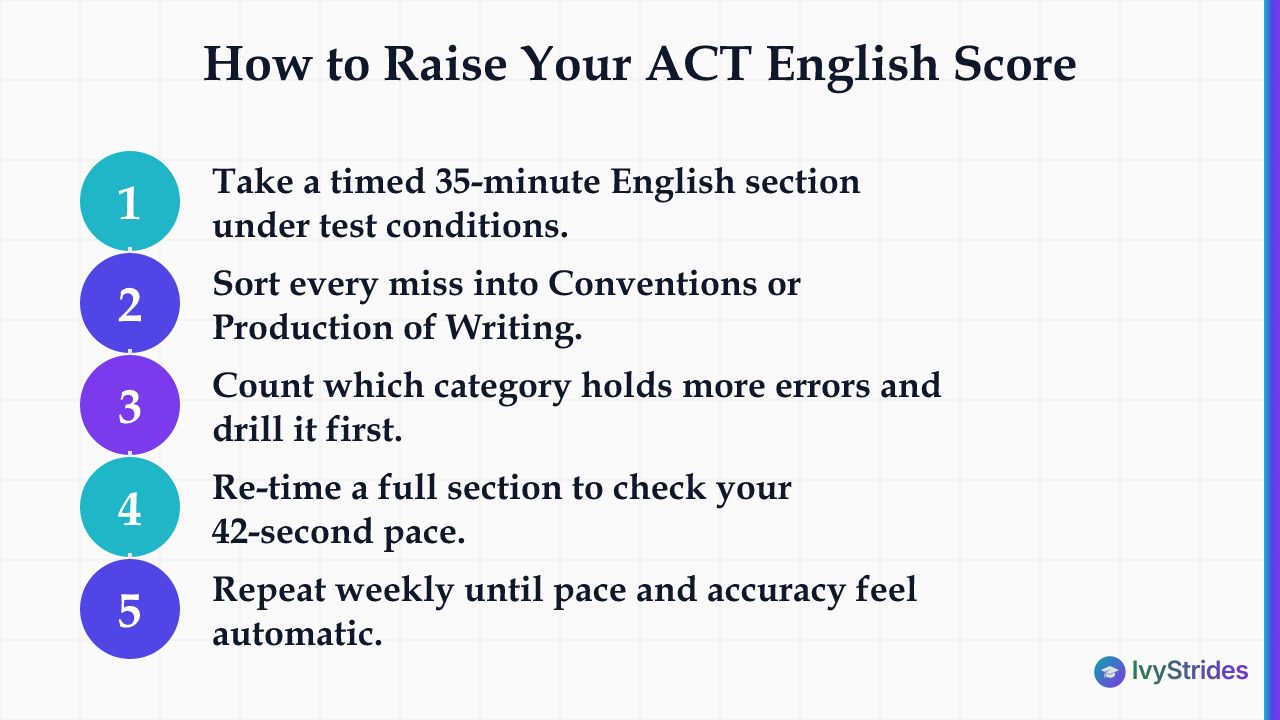
You raise an ACT English score by fixing one question category first, not by reviewing grammar at random. Errors cluster in either Conventions of Standard English or Production of Writing, and the two respond to different practice. Once you know which category is costing you the most points, you can target that one rather than re-covering material you already know.
Conventions is rule-based. These questions test comma rules, subject-verb agreement, pronoun reference and modifier placement. Those respond well to drilling: learn the rule, spot the pattern, apply it fast.
Production of Writing is context-based. These cover topic sentences, transitions, the relevance of an added sentence and passage-level organization. It requires reading the full passage, not just the underlined portion. You cannot judge whether a sentence belongs if you only read the line it sits on.
Then there's pacing. ACT, Inc. publishes 35 minutes and 50 questions; IvyStrides calculates about 42 seconds per question (35 x 60 / 50). That's tight. Students who prepped on legacy 75-question materials often arrive at their first enhanced ACT surprised by the faster pace and the different passage structure. The fix is timed full-section practice, not untimed drills.
A section-specialist English coach starts from a diagnostic and builds the plan around your specific error pattern. You can take that diagnostic with a coach who works only on ACT English and Reading. For material that reflects the current format, use practice tests built on the enhanced 50-question section rather than older sets.
-
Take a timed 35-minute English section under test conditions.
-
Sort every miss into Conventions or Production of Writing.
-
Count which category holds more errors.
-
Drill the heavier category's rules or passage strategy first.
-
Re-time a full section to check your 42-second pace.
-
Review every skipped or guessed question, not just the wrong ones.
-
Repeat the timed section weekly until the pace feels automatic.
Is the ACT English Section Hard? Honest Benchmarks for Every Score Band

Photo by https://kaboompics.com/ on Pexels
ACT English is hard mostly because of pacing, not content. The grammar rules are finite and learnable; the 42-second-per-question clock is the real pressure. Meaningful movement off the middle is realistic with targeted work.
That same pacing pressure separates ACT English from the SAT. The section gives you 50 questions in 35 minutes; the SAT's Reading and Writing section gives 54 questions in 64 minutes. Students who know grammar rules cold often find the ACT format more predictable. If you're weighing the two, whether the SAT is harder than the ACT comes down to this trade between speed and inference.
One caveat before you set a target. Test-optional policies vary by school and year, and some schools still require scores. College Board's list names 21 private colleges and 42 public colleges that currently or soon will require the SAT or ACT, and the list changes frequently. Confirm each college's current policy before you decide how much English prep to do.
| English Score | Typical Composite Implication | Prep Priority |
| 24 | mid-20s range | fix heavier category |
| 27 | competitive anchor | tighten pacing |
| 30 | high selectivity | trim careless errors |
| 33 | near-elite | eliminate rare rule gaps |
Once you know your band, moving up is a matter of sequencing drills against your weaker category and your pace. For the wider plan, how to move your Composite across all three required sections builds on the same diagnostic step.
FAQ: ACT English Section and Scoring
What is the ACT English exam?
The ACT English section is the first section of the ACT. It holds 50 passage-based multiple-choice questions in 35 minutes, with 40 scored and 10 unscored field-test items. It tests two categories: Conventions of Standard English, meaning grammar, punctuation and sentence structure, and Production of Writing, meaning rhetorical strategy and organization. Scores report on a 1-to-36 scale.
Is ACT English section hard?
Difficulty depends on your grammar background and your reading speed. The pacing is demanding at roughly 42 seconds per question. Conventions questions reward students who know specific rules cold; Production of Writing questions require reading the full passage for context. Gains are achievable with focused practice.
How to prepare for ACT English?
Start with a timed diagnostic to see whether your errors cluster in Conventions of Standard English or Production of Writing. Conventions errors like comma rules, subject-verb agreement and pronoun reference respond well to rule-based drilling. Production of Writing errors need practice reading passages whole. Timed full-section work under the 35-minute limit is essential before test day.
Is ACT English easier than SAT English?
They test different skills. ACT English is more grammar-rule-heavy: 50 questions in 35 minutes with a strong focus on punctuation and sentence structure. The SAT's Reading and Writing section runs 54 questions in 64 minutes with more emphasis on passage-level inference. Students who know grammar rules cold often find the ACT format more predictable; wide readers often prefer the SAT.
Your Next Step on ACT English
You now know the section's shape: 50 questions, 40 scored, 35 minutes, two categories, a 1-to-36 scale that feeds one-third of your Composite. The useful next move is narrow, not sweeping.
- Take one timed 35-minute English section this week.
- Sort every miss into Conventions or Production of Writing.
- Drill the heavier category first, then re-time to check your pace.
- Confirm your target colleges' current testing policy before setting a score goal.

Award-winning author (South Asian Book Award) and graduate of BITS Pilani and UCLA Luskin School of Public Affairs. Brings a published writer's eye to Common App essays and grammatical precision to SAT and ACT R&W instruction.