
How Does the Adaptive PSAT Work: The Complete 2026 Playbook for a Top Score
On this page
- How Does the Adaptive PSAT Work From Module 1 to 2?
- Is the PSAT Adaptive in 2026 for Every Grade Level?
- Scoring for the Adaptive PSAT: How Does It Work Across Modules?
- Is the PSAT Practice Test Adaptive in Bluebook?
- FAQ: How the Adaptive PSAT Works
- Is the adaptive SAT harder, and is the adaptive PSAT harder too?
- Is the PSAT 8/9 adaptive?
- When did the SAT become adaptive?
- What are the timings for the PSAT?
- Your Next Step on the Adaptive PSAT
The PSAT/NMSQT is a multistage adaptive test that adapts by module, not by question. Each section, Reading and Writing then Math, has two equal modules. Every student's Module 1 holds a broad mix of easy, medium and hard questions, and performance there routes you to a harder or easier Module 2.
That description comes from College Board's explanation of digital adaptive testing. The distinction that matters: routing happens once per section, so Module 1 deserves more of your preparation than its share of the clock suggests.

How Does the Adaptive PSAT Work From Module 1 to 2?
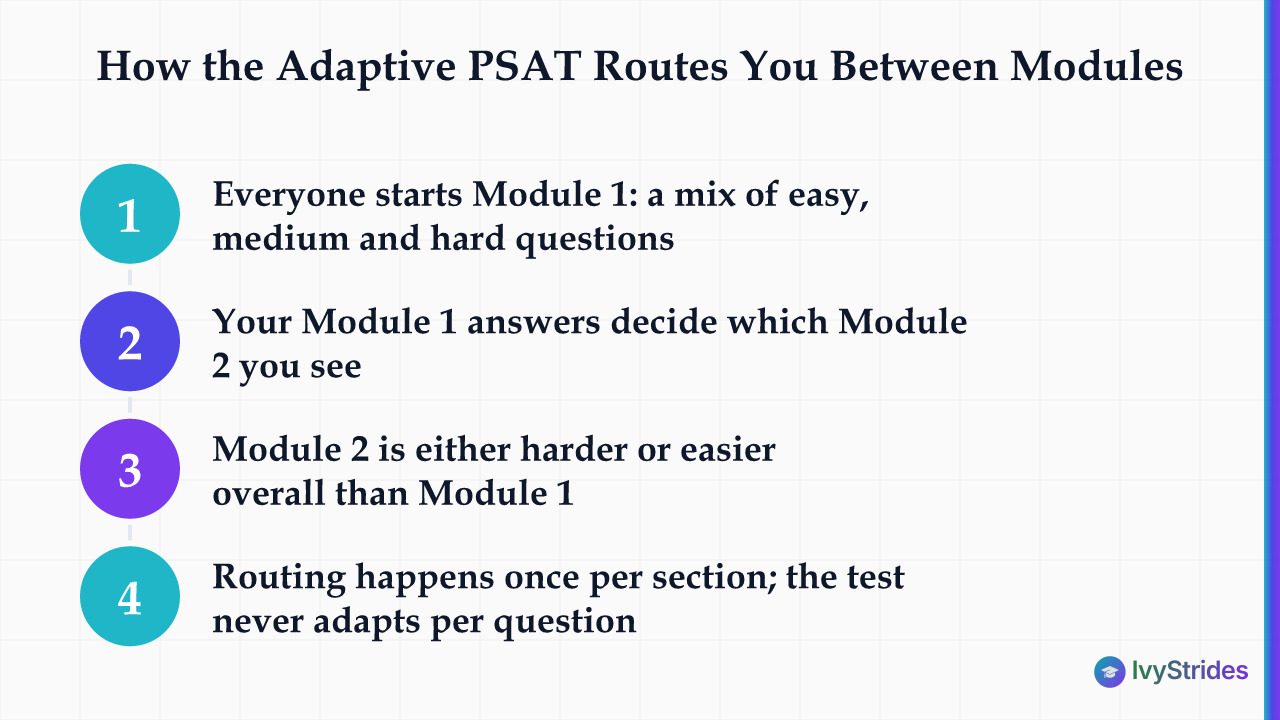
The adaptive PSAT works in two stages per section. Module 1 holds half the section's questions, mixing easy, medium and hard ones; your answers there decide which Module 2 you see. College Board describes the second module's overall mix as "either of higher difficulty or of lower difficulty" than the first.
So how does the PSAT adaptive test work underneath? Multistage adaptive testing refers to a design where, within each section, the second set of questions depends on how you did on the first. The test doesn't adapt after each question, and College Board doesn't publish how many correct answers send a student to either route.
Fixed timing inside each module. College Board's Reading and Writing page gives 32 minutes per module. Math modules run 35 minutes each. Every module also carries two pretest questions; your answers to them don't affect your score.
| Section and module | Questions (incl. 2 pretest) | Minutes | Approx. seconds per question | Who sees it |
| Reading and Writing, Module 1 | 27 | 32 | about 71 | Everyone |
| Reading and Writing, Module 2 | 27 | 32 | about 71 | Harder or easier |
| Math, Module 1 | 22 | 35 | about 95 | Everyone |
| Math, Module 2 | 22 | 35 | about 95 | Harder or easier |
The PSAT/NMSQT structure page lists 98 questions and 2 hours and 14 minutes of testing in all. Those modules sit inside a fixed two-section layout, so it helps to know how the PSAT sections and their timing fit together before you think about routing.
Moving around inside a module. Bluebook lets you mark questions for review and jump to any question within the module you're in. Its timer counts down per module and alerts you when 5 minutes remain. The Math section includes a built-in Desmos calculator throughout, though you may bring an approved handheld one.
Why rushing Module 1 costs more than it seems. Math questions in each module run from easiest to hardest, and Reading and Writing questions do the same within each group of similar skills, so the easier questions that open each run are points to bank. Rush them and you lose those points and weaken the performance that decides your Module 2. That is how one careless slip early in Module 1 does double work against you.
Is the PSAT Adaptive in 2026 for Every Grade Level?
Yes, the standard PSAT is adaptive at every grade level in 2026. College Board's PSAT/NMSQT Student Guide says the PSAT/NMSQT "and all tests in the SAT Suite" use multistage adaptive testing, so a careless slip in Module 1 does the same double work at every grade level. Students approved for a human reader, raised line drawings or paper test forms take a nonadaptive version.
The PSAT and the SAT use the same multistage adaptive design, so the routing habits a student builds for the PSAT carry straight into the SAT. Two differences that matter here are the score range and National Merit eligibility, per College Board's score ranges and NMSC.
| Test | Adaptive design | Total score range | Section score range | Counts for National Merit entry |
| PSAT 8/9 | Yes, two modules | 240 to 1440 | 120 to 720 | No |
| PSAT 10 | Yes, two modules | 320 to 1520 | 160 to 760 | No |
| PSAT/NMSQT | Yes, two modules | 320 to 1520 | 160 to 760 | Yes |
| SAT | Yes, two modules | 400 to 1600 | 200 to 800 | Not the qualifying test |
One scale, different ranges. The SAT Suite uses a common score scale, and each test's range reflects grade-level appropriateness within it. The differences between the PSAT 8/9, PSAT 10 and PSAT/NMSQT in grade, score range and eligibility decide which sitting matters most for you.
The digital timeline. College Board's assessment framework records that the digital SAT was first given at international test centers in spring 2023. All PSAT-related testing, in the US and abroad, went digital in fall 2023, and US students moved to the digital SAT in spring 2024. International families take the same adaptive PSAT.
The stake for juniors. NMSC's entry rules name the PSAT/NMSQT as the qualifying test; the PSAT 10 and PSAT 8/9 aren't considered. A Module 1 habit left unfixed in tenth grade follows you into the one PSAT that carries scholarship consequences.
Scoring for the Adaptive PSAT: How Does It Work Across Modules?
Scoring for the adaptive PSAT uses Item Response Theory, so which questions you get right matters, not only how many. Since the junior-year PSAT carries scholarship consequences through National Merit, it pays to know how routing becomes a number. College Board's scoring page states that two students with the same number correct may earn different section scores.
Routing isn't a verdict. College Board says students aren't disadvantaged just for seeing the easier Module 2, and that "a range of section scores are possible no matter which second module a student sees." Its own example, written for the SAT, still warns that missing a couple of first-module questions puts the top section score out of reach.
Scored versus pretest questions. With two pretest questions per module, 4 of the 54 Reading and Writing questions and 4 of the 44 Math questions don't count, leaving 50 and 40 scored. You can't tell which are pretest, so treat every question as live, and guess rather than leave one blank.
| Score element | How it is produced | What it means for Module 1 | Source |
| Section score, 160 to 760 | Item Response Theory across both modules | Accuracy shapes the route | College Board |
| Total score, 320 to 1520 | Sum of two section scores | Both Module 1s count | College Board |
| Selection Index, 48 to 228 | (2 x Reading and Writing + Math) / 10 | Reading and Writing weighs most | NMSC |
| Score report | Eight content domains, four per section | Shows where points went | College Board |
Why Reading and Writing weighs double. Because the Selection Index doubles the Reading and Writing score, how a student performs in Reading and Writing Module 1 carries extra weight for National Merit. IvyStrides' analysis of the NMSC formula shows Reading and Writing carrying two thirds of the formula's weight: 10 more Reading and Writing points add 2 index points, while 10 more Math points add 1. NMSC uses Selection Index scores to identify 50,000 high scorers, and its Semifinalists are the highest-scoring entrants in each state.
Get your Daily IV Dose on Instagram: quick study tips and test-day advice for high school students. Follow @ivy.strides.
What the report shows. College Board's guide to the score report lists the total and section scores, percentiles, the Selection Index and eight content-domain bands; module-by-module results aren't among them. So use the PSAT score report and its eight domain bands to find which skill areas cost points.
For a sophomore aiming at National Merit, IvyStrides runs live online PSAT prep with adaptive mock tests for grades 8 to 11, as a National Merit-aware small cohort or National Merit-targeted 1-on-1 coaching. Both tracks include a diagnostic, and the practice uses Bluebook-style adaptive routing.
Is the PSAT Practice Test Adaptive in Bluebook?
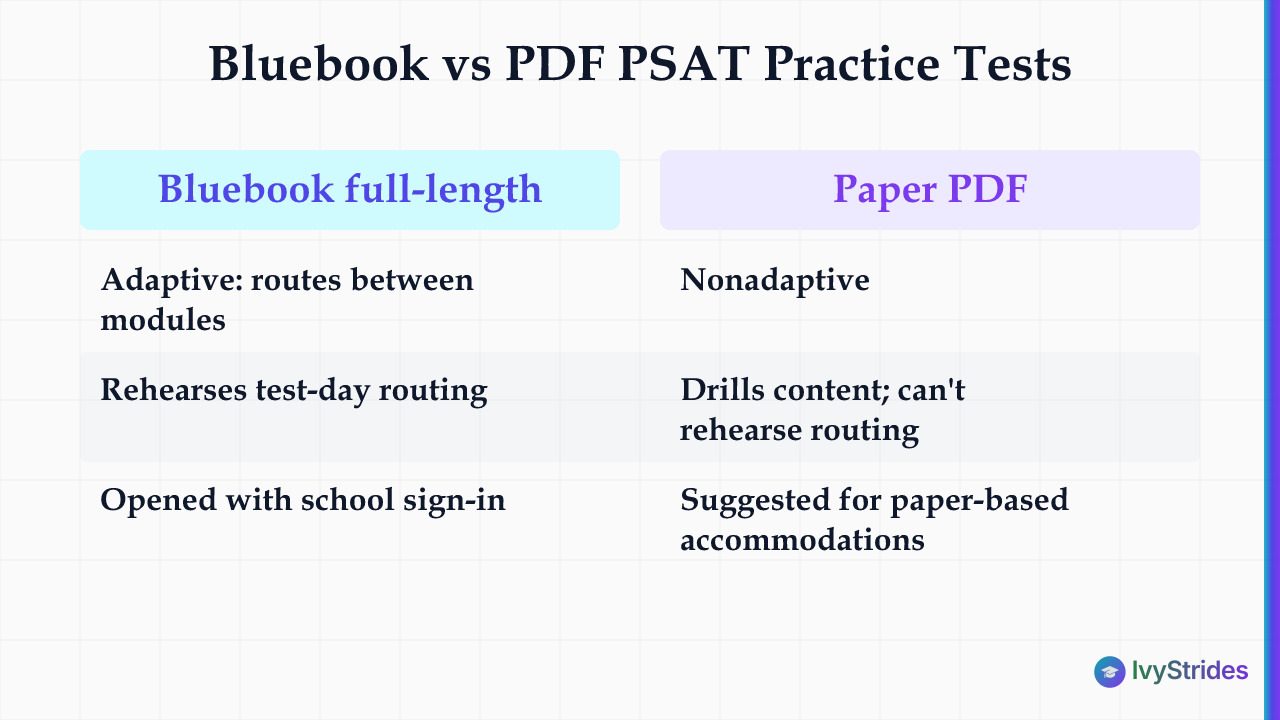
The standard full-length PSAT practice tests in Bluebook are adaptive; the paper PDFs aren't. Whether you prepare with a coach or alone, National Merit preparation needs practice that routes like test day. College Board's student guide describes full-length adaptive PSAT/NMSQT practice tests in Bluebook, opened with your school's sign-in credentials, that return a score.
Is the PSAT practice test adaptive in every format? No. Among College Board's official formats, only the full-length adaptive practice tests in Bluebook route a student between modules the way test day does. The College Board practice page labels paper practice tests nonadaptive and recommends them for students testing with paper-based accommodations. A PDF can drill content; it can't rehearse routing.
One test is never a verdict. Each practice test draws different questions, and your route can change from one to the next, which helps explain why Bluebook practice scores swing between adaptive tests even when your skills haven't.
For each adaptive practice test:
-
Sit it timed. Take the full test in Bluebook in one sitting, keeping the 32- and 35-minute module clocks.
-
Note your route. After each section, write down whether Module 2 felt harder or easier than Module 1.
-
Review Module 1 first. Sort every first-module miss by content domain before you look at Module 2.
-
Split careless from content. Mark each easy or medium Module 1 miss as a slip or a gap; slips are the cheapest routing points to recover.
-
Fix Reading and Writing first. It counts double in the Selection Index.
-
Retest only after the review. Never take adaptive tests back to back.
Rehearsing routing takes more than one full-length test, spaced so each review can change the next attempt. Beyond College Board's official tests, IvyStrides offers full-length PSAT practice tests to rehearse module routing for the digital PSAT 8/9 and PSAT/NMSQT. They use Bluebook-style adaptive multistage testing, with instant scoring, a per-section breakdown and step-by-step explanations.
Skip the review and the next test can repeat the same Module 1 slips under a new score. That's the real cost of back-to-back practice before your junior-year PSAT/NMSQT.
FAQ: How the Adaptive PSAT Works
Is the adaptive SAT harder, and is the adaptive PSAT harder too?
Not in a way that works against you. The second module's overall mix is harder or easier depending on the first, and College Board says students aren't "disadvantaged just for seeing a lower difficulty set of questions."
Is the PSAT 8/9 adaptive?
Yes. The PSAT 8/9 follows the same two-module design as the rest of the SAT Suite. It reports a total from 240 to 1440 and doesn't count for National Merit entry.
When did the SAT become adaptive?
International test centers got the digital, adaptive SAT first, in spring 2023. US students switched in spring 2024, after every PSAT-related test went digital in fall 2023.
What are the timings for the PSAT?
The PSAT/NMSQT runs 2 hours and 14 minutes of testing. Reading and Writing takes 64 minutes in two 32-minute modules; Math takes 70 minutes in two 35-minute modules.
Your Next Step on the Adaptive PSAT
How the adaptive PSAT works comes down to one fact: Module 1 sets the route, and the score reflects both modules.
- Take one timed, full-length adaptive PSAT practice test in Bluebook.
- Sort Module 1 misses by content domain, Reading and Writing first.
- Retest only after that review.
Watch the method, then try it: IvyStrides explains SAT and ACT question types on YouTube.

Hemant is a seasoned entrepreneur, investor, and growth strategist with deep ground in education and technology-driven learning. His core training is in Mathematics and Physics — he authored Physics for IB Diploma: Ultimate Revision Guide, recognized as a top student resource.