
How to Prep for National Merit: The Complete 2026 Playbook for a Top Score
On this page
- What the National Merit Scholarship Program Actually Is (and Why the PSAT Is the Only Entry Point)
- How the Selection Index Works: The Formula That Determines Your Fate
- State Cutoff Scores for 2026: What Score You Actually Need
- Does a 1400 or 1470 PSAT Score Qualify for National Merit?
- When to Start Prepping for National Merit: A Grade-by-Grade Timeline
- 9th and 10th Grade: Familiarity, Not Cramming
- Summer Before Junior Year: Diagnostic Baseline
- August Through October of Junior Year: The 10-12 Week Push
- Section-by-Section Tactics: How to Move Your Selection Index Most Efficiently
- PSAT Reading and Writing: Where Selection Index Gains Live
- PSAT Math: Where the Ceiling Is Real But Achievable
- What Happens After the Score: From Semifinalist to Finalist to Scholar
- Is National Merit Worth the Effort? What It Actually Signals to Colleges
- FAQ
- Is 1490 enough for National Merit?
- How hard is it to qualify for the National Merit Scholarship?
- How much money do you get as a National Merit Scholar?
- Can a homeschooled student qualify for National Merit?
- Do all National Merit Finalists receive a scholarship?
- When do students find out if they are National Merit Semifinalists?
- Your Next Concrete Step
To prep for National Merit, you need to score in the top roughly 1% of PSAT/NMSQT takers in your state on the October junior-year exam. The qualifying metric is the Selection Index, calculated as your Reading and Writing scaled score divided by 10, multiplied by 2, plus your Math scaled score divided by 10. State cutoffs for the Class of 2026 ranged from roughly 207 to 222. Because Reading and Writing is weighted double, targeted R&W prep moves your Selection Index faster than equal effort on Math. Start with a full-length diagnostic PSAT at least about 10-12 weeks before the October test date.
Format and scoring details throughout this article come from the College Board PSAT/NMSQT page; state cutoff data comes from the National Merit Scholarship Corporation (NMSC) and independent trackers cited where used. The next sections walk through the exact Selection Index math, your state's benchmark, and how to move your score before October.

What the National Merit Scholarship Program Actually Is (and Why the PSAT Is the Only Entry Point)
The National Merit Scholarship Program is a single competition run by the National Merit Scholarship Corporation (NMSC), a nonprofit organization separate from College Board. Each year, roughly 1.5 million high school juniors enter by taking the PSAT/NMSQT in October. There is no other entry vehicle. Miss that October test as a junior and you can't compete in that cycle, though NMSC does allow alternate entry for students with documented reasons for missing the standard administration.
Out of those 1.5 million entrants, about 50,000 students earn recognition. The top roughly 34,000 become Commended Scholars based on a single national Selection Index cutoff. The next roughly 16,000, distributed by state, become Semifinalists. About 15,000 of those Semifinalists advance to Finalist status after completing an application. Scholarship winners represent less than 1% of the initial entrant pool.
Three award types exist. NMSC awards $2,500 one-time scholarships to a selected group of Finalists. Corporate-sponsored Merit Scholarships come from employer sponsors and vary by amount and eligibility. College-sponsored Merit Scholarships are the most financially significant tier; some universities offer full-tuition or full cost-of-attendance packages to enrolled Finalists who name that school as their first choice with NMSC. For a broader breakdown of the competition timeline and Commended Scholar thresholds, see our companion article on the National Merit Scholarship program.
One test. One October. One narrow entry point. Everything downstream depends on the PSAT/NMSQT score.
How the Selection Index Works: The Formula That Determines Your Fate
The Selection Index is not your PSAT composite score. It's a separate calculation NMSC applies to determine Semifinalist status, and understanding the formula changes how you prep.
Here's the formula:
Selection Index = (Reading and Writing score ÷ 10) × 2 + (Math score ÷ 10)
Each PSAT section is scored on a 160-760 scale, so the composite runs 320-1520. The Selection Index maxes out at 228, which corresponds to a perfect R&W 760 and Math 760: (76 × 2) + 76 = 228.
Two worked examples make the weighting visible.
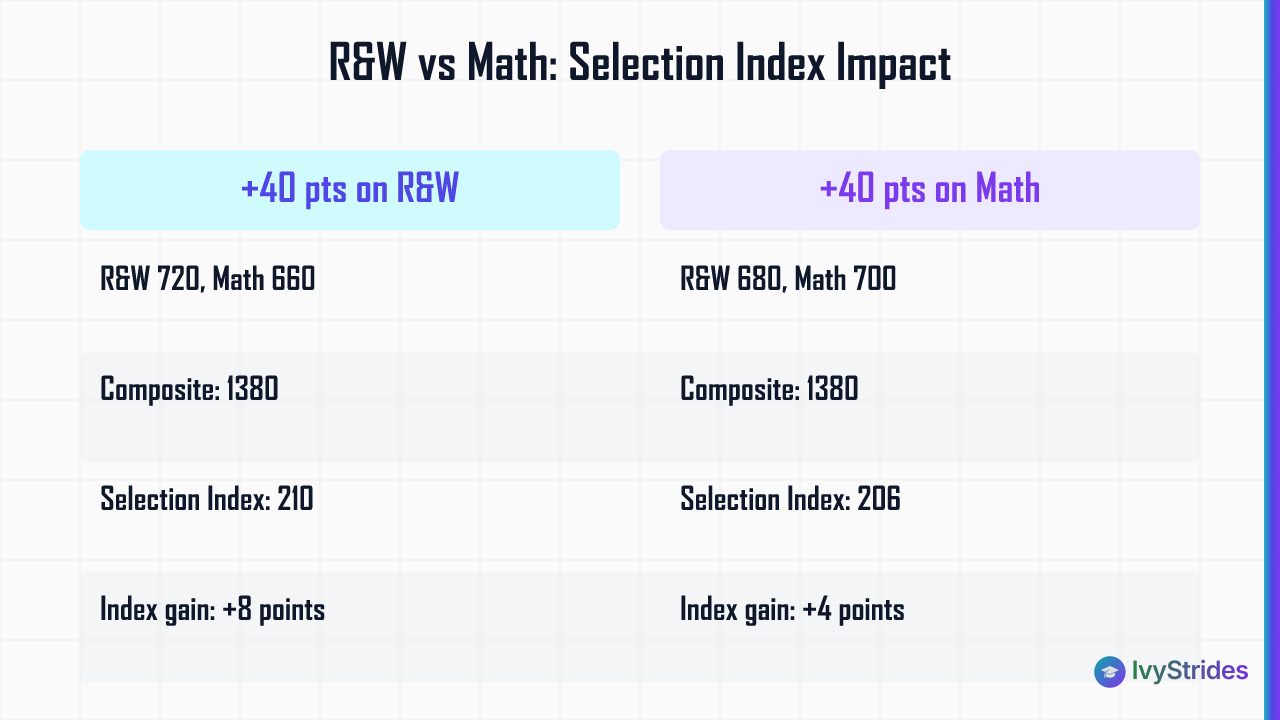
Student A scores R&W 680 and Math 660. Composite: 1340. Selection Index: (68 × 2) + 66 = 202.
Student B scores R&W 720 and Math 660. Composite: 1380. Selection Index: (72 × 2) + 66 = 210.
Student B gained 40 points on R&W alone and moved the Selection Index by 8 points. If that same student had instead gained 40 points on Math (R&W 680, Math 700), the composite would still be 1380, but the Selection Index would be (68 × 2) + 70 = 206, a gain of only 4 points.
Same composite. Different Selection Index. That's the structural insight of National Merit prep: for the same section-point gain, R&W moves your Selection Index twice as fast as Math. In our coaching, students who underweight R&W often hit a Math ceiling and plateau below their state cutoff even with strong Math scores. Section scoring specifications come from the College Board PSAT/NMSQT scoring guide.
If your student is in 9th or 10th grade, building PSAT familiarity early pays compounding dividends; see our PSAT strategy by grade guide for a phased approach before junior year.
State Cutoff Scores for 2026: What Score You Actually Need
The single most useful number for your prep plan is your state's Semifinalist cutoff. Cutoffs are set so that Semifinalists represent roughly the top 1% of PSAT takers in each state, which means high-competition states run substantially higher than low-competition ones.
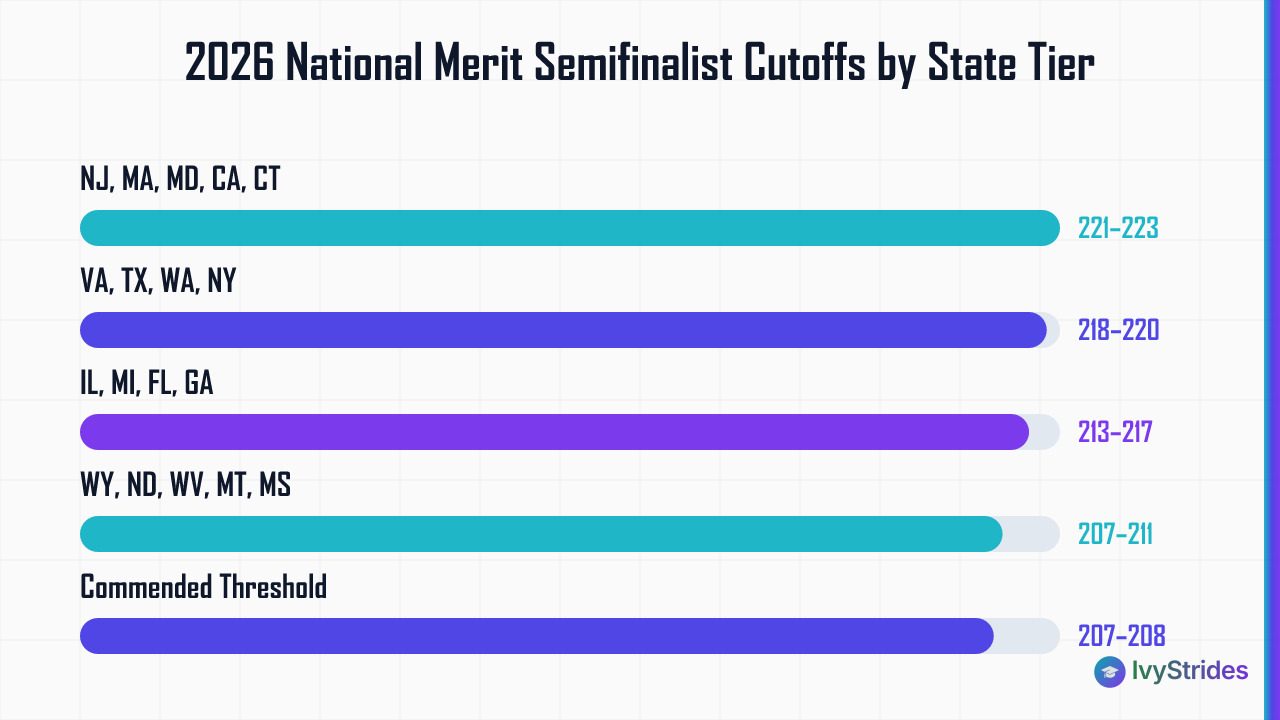
For the Class of 2026 competition (students who took the PSAT in October 2024), Semifinalist cutoffs ranged from roughly 207 to 222 across states. Illustrative examples:
- New Jersey, Massachusetts, Maryland, California, Connecticut: roughly 221-223 (highest cutoffs)
- Virginia, Texas, Washington, New York: roughly 218-220
- Illinois, Michigan, Florida, Georgia: roughly 213-217
- Wyoming, North Dakota, West Virginia, Montana, Mississippi: roughly 207-211 (lowest cutoffs)
The Commended Scholar threshold is a single national number that sits at or just below the lowest state Semifinalist cutoff; for the Class of 2026 it was approximately 207-208. Any student scoring at or above the national Commended threshold earns Commended Scholar recognition even if they miss their state's Semifinalist number.
One caveat matters: state cutoffs shift year to year based on the score distribution in each state. Class of 2027 cutoffs (students taking the PSAT in October 2025) are not yet published as of this article's writing, and figures typically drift by 1-3 points in either direction. Use the current cutoff as your working target, then add a roughly 3-point safety buffer to your prep goal. For state-by-state historical data, cross-reference the NMSC's annual announcement with independent trackers.
To calibrate where a specific composite score sits on the full 320-1520 scale, see what is a good PSAT score by percentile and grade. For structured, full-length practice under real timing, our PSAT practice tests library is built for Selection Index calibration.
Does a 1400 or 1470 PSAT Score Qualify for National Merit?
Short answer: it depends on your state and, importantly, on your section split.
PSAT 1400 with an equal split (R&W 700, Math 700): Selection Index = (70 × 2) + 70 = 210. Qualifies as a Semifinalist in the lowest-cutoff states (Wyoming, North Dakota, West Virginia range). Falls short in every mid- and high-cutoff state. A 1400 with R&W 720 and Math 680, however, produces (72 × 2) + 68 = 212, gaining 2 Selection Index points from the same composite.
PSAT 1470 with an equal split (R&W 735, Math 735): Selection Index = (73.5 × 2) + 73.5 ≈ 220.5. Qualifies in the majority of states and sits at the borderline for the highest-cutoff states (New Jersey, Massachusetts, Maryland, California, Connecticut). A 1470 with R&W 760 and Math 710 yields (76 × 2) + 71 = 223, clearing every state cutoff. The same 1470 with R&W 710 and Math 760 yields (71 × 2) + 76 = 218, which fails in the highest-cutoff states.
Same composite. Roughly 5 Selection Index points of spread. That's why coaches who take National Merit seriously push R&W harder in the final six weeks of prep, especially for students already inside the 1400-1500 composite band.
A note on rounding: PSAT section scores are reported in 10-point increments, so a "735" score doesn't exist on an actual score report. The worked examples above are illustrative to show the math; your real Selection Index will land on a whole number based on your rounded section scores. For the October test schedule and registration mechanics, see PSAT test dates 2026.
When to Start Prepping for National Merit: A Grade-by-Grade Timeline
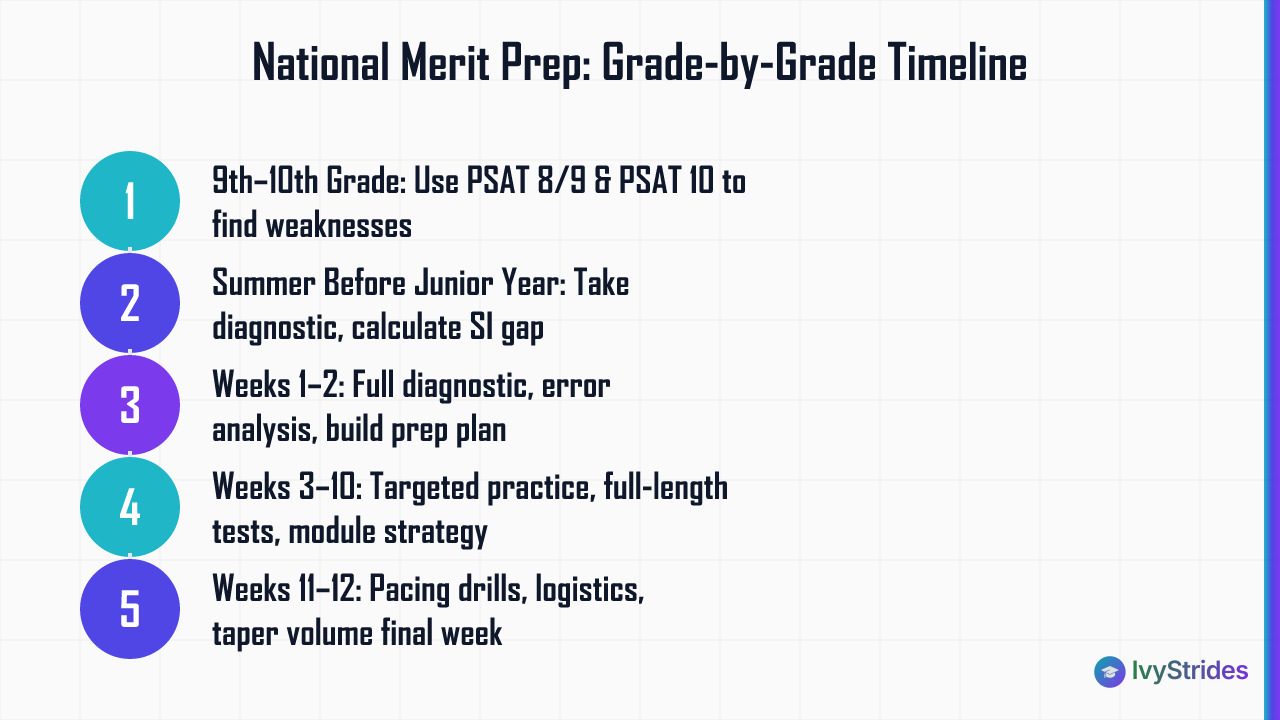
The most common planning mistake is starting too late and expecting a 20-point Selection Index gain in six weeks. Here's a realistic timeline.
9th and 10th Grade: Familiarity, Not Cramming
The PSAT 8/9 (9th grade) and PSAT 10 (spring of 10th grade) are administered by many high schools and use the same digital adaptive format as the PSAT/NMSQT. Neither counts for National Merit. Both are diagnostic gold. A 10th-grader who scores a Selection Index equivalent of 195 has a very different runway than one who scores 215.
Use these earlier tests to identify structural weaknesses, particularly in R&W, since those weaknesses take longer to fix than Math gaps.
Summer Before Junior Year: Diagnostic Baseline
By June or July before junior year, take a full-length, timed PSAT/NMSQT practice test under real conditions. Calculate your current Selection Index. Compare it to your state's most recent Semifinalist cutoff. That gap, in points, defines your prep goal.
- Gap of 0-5 points: focus on pacing, error-rate reduction, and adaptive-module strategy. Roughly 6-8 weeks of light prep.
- Gap of 5-15 points: structured 10-12 week plan, heavy R&W emphasis, weekly section drills plus biweekly full-length tests.
- Gap of 15+ points: candid conversation about whether National Merit is the right investment versus redirecting the same hours toward SAT/ACT prep and admissions essays. National Merit isn't the only path.
August Through October of Junior Year: The 10-12 Week Push
In our coaching with students starting at a Selection Index of 195-205, a 10-15 point gain over about 10-12 weeks of targeted work is typical for students completing the program. That translates to roughly 8-10 hours of structured prep per week. A consistent 8-10 hours per week across about 10-12 weeks adds up to about 80-120 total prep hours. Here's how those hours phase out:
- Weeks 1-2: Full-length diagnostic, section-by-section error analysis, weakness map, prep plan build.
- Weeks 3-7: Section-specific targeted practice on identified weak question types. Roughly 60% R&W, 40% Math for most students.
- Weeks 8-10: Two full-length timed practice tests with error review sessions. Adaptive module strategy work.
- Weeks 11-12: Pacing drills, test-day logistics, light review. Taper volume in the final week.
For students who need a compressed, high-intensity template that carries over to SAT prep afterward, our 30-Day SAT Study Plan shows the same diagnostic-driven structure applied to a shorter runway.
Section-by-Section Tactics: How to Move Your Selection Index Most Efficiently
Not all question types are equal. Some appear frequently and respond quickly to pattern drilling; others are rare and expensive to master. Here's where to spend your hours.
PSAT Reading and Writing: Where Selection Index Gains Live
The PSAT R&W section is delivered in two adaptive modules, each 32 minutes with 27 questions, per the College Board PSAT/NMSQT format specifications. Module 1 has a fixed difficulty; Module 2 difficulty is determined by Module 1 performance. To reach the highest R&W score band, you have to earn the harder Module 2.
R&W tests four content domains:
-
Information and Ideas (command of evidence, central ideas, inferences)
-
Craft and Structure (words in context, text structure and purpose, cross-text connections)
-
Expression of Ideas (rhetorical synthesis, transitions)
-
Standard English Conventions (punctuation, sentence structure, agreement, modifiers)
The highest-value question types for a student in the 650-720 R&W range are transitions, rhetorical synthesis, and standard English conventions. Transitions and conventions are pattern-recognition heavy. Rhetorical synthesis (the "which choice best accomplishes the goal" question) rewards a specific reading protocol that can be taught explicitly.
Here's the part most students miss. Because R&W is weighted double, a 20-40 point R&W section gain flows into roughly 4-8 Selection Index points. In our coaching, students who plateau on R&W in weeks 4-6 are usually repeating the same 2-3 error types across every practice test; a targeted error-log review typically breaks the plateau within two weeks.
For deeper R&W tactics that transfer directly from PSAT to Digital SAT, see how to improve SAT reading score.
PSAT Math: Where the Ceiling Is Real But Achievable
The Math section runs two adaptive modules, each 35 minutes with 22 questions. It covers four domains:
-
Algebra (linear equations, systems, inequalities)
-
Advanced Math (quadratics, exponential functions, polynomial manipulation)
-
Problem-Solving and Data Analysis (ratios, percentages, data interpretation, probability)
-
Geometry and Trigonometry (area, volume, right triangles, basic trig)
Algebra and Advanced Math combined account for roughly 65-70% of PSAT Math questions. Linear equations and systems of equations appear in nearly every PSAT Math section. In our coaching, mastering these two categories alone typically recovers 20-30 points for students in the 650-700 Math range. Geometry and trig questions are lower frequency but often trip up students who haven't touched right-triangle trig since 10th grade. A short review of unit circle values, SOHCAHTOA, and 30-60-90 / 45-45-90 triangles usually recovers 1-2 questions per test.
For a full breakdown of PSAT and Digital SAT math content, see SAT math topics.
Students pairing PSAT prep with rigorous AP coursework should also see our AP courses online for per-subject specialist support. A strong AP transcript compounds with National Merit recognition on the eventual admissions application.
What Happens After the Score: From Semifinalist to Finalist to Scholar
Suppose the October PSAT went well and you cleared your state's cutoff by a comfortable margin. What comes next?
September of senior year: NMSC notifies high school principals of Semifinalist designations. Schools then inform students. About 16,000 Semifinalists are named nationally.
September-October of senior year: Semifinalists submit the Finalist application through the NMSC Online Scholarship Application (OSA) portal. Requirements include:
- Confirmed high school GPA (submitted by the school)
- A recommendation from a school official (usually the counselor or principal)
- A brief personal essay written by the student and submitted through the OSA
- A confirming SAT score that reasonably matches the PSAT performance level; the score doesn't need to equal the PSAT but must confirm academic ability per NMSC guidelines. Students typically take the SAT during junior spring or early senior fall to satisfy this requirement.
- A list of activities, honors, and leadership roles
February of senior year: NMSC names approximately 15,000 Finalists from the 16,000 Semifinalist pool. The 6-7% who don't advance typically fall out for missing confirming SAT scores, incomplete applications, or documentation issues, not academic quality.
March through June of senior year: Scholarship awards are announced in three waves. Approximately 7,500 of the 15,000 Finalists receive some form of Merit Scholarship award. The other half of Finalists still hold the Finalist designation on their applications and remain eligible for college-sponsored awards if they enroll at a participating institution and name that school as their first-choice college with NMSC by the required deadline.
The Finalist application includes a personal essay submitted through the OSA. Habits built during Common App essay coaching transfer directly to that writing task; students already working with a common app essay tutor usually handle the NMSC essay in a single revision cycle.
The Finalist application also asks about GPA rigor and coursework. Students pursuing rigorous AP subjects strengthen the Finalist package alongside their Common App application. Our AP classes online roster covers the subjects most relevant to National Merit-competitive applicants.
A caveat on college-sponsored awards: the list of participating universities and the award amounts change annually. Some schools offer full tuition, some offer full cost of attendance, and some have discontinued their college-sponsored programs in recent years. Verify current award terms with each university's financial aid office before assuming a specific dollar amount.
Is National Merit Worth the Effort? What It Actually Signals to Colleges
Honest answer: it depends on where the student currently sits and what schools they're targeting.
If your diagnostic Selection Index is within 10-15 points of your state cutoff, the marginal prep investment (roughly 80-120 focused hours across about 10-12 weeks) has a genuinely high expected return. Semifinalist and Finalist designations appear in the Honors section of the Common App and are recognized by admissions officers at every selective college. At schools with college-sponsored awards, the financial return can reach five or six figures across four years.
If your diagnostic Selection Index is more than 20 points below your state cutoff, the honest recommendation is usually to redirect those hours. The same 100 hours applied to Digital SAT prep can typically move a composite by 150-200 points for students in the 1200-1400 band, which affects admissions and merit aid at a wider set of schools than National Merit alone.
Even at test-optional schools, a National Merit Semifinalist or Finalist designation is a named academic honor that appears on the Common App Honors section regardless of whether a student submits SAT scores. Test-optional policies vary by school and year; the FairTest tracker publishes the current list. But the National Merit honor isn't a test score; it's a recognition that lives on the application independently.
Two caveats stay important. First, admissions outcomes depend on the entire application: rigor of coursework, essays, recommendations, activities, and demonstrated interest matter alongside test recognition. National Merit is a strong signal, not a decision. Second, National Merit recognition is far from the only path to substantial merit aid; many universities offer generous non-Merit scholarships based on GPA and test scores alone.
For context on how testing weighs into modern admissions decisions, see does the ACT matter for college admission and, for high-Ivy targets, is 1500 a good SAT score for Ivy League.
FAQ
Is 1490 enough for National Merit?
A PSAT 1490 with an equal R&W/Math split (approximately R&W 745, Math 745) yields a Selection Index of roughly 223, which qualifies in most states for the Class of 2026 competition. In the highest-cutoff states such as New Jersey, Massachusetts, and California, where cutoffs reached 221-223, a 1490 sits at the borderline. Section split matters: a 1490 with R&W 760 and Math 730 produces a higher Selection Index than 1490 with R&W 730 and Math 760, because R&W is weighted double. Verify your state's specific cutoff before assuming qualification.
How hard is it to qualify for the National Merit Scholarship?
Qualifying as a Semifinalist means scoring in the top approximately 1% of PSAT/NMSQT takers in your state, so roughly 16,000 students out of 1.5 million entrants earn the designation each year. Difficulty varies significantly by state; in high-competition states, a Selection Index of 221 or higher is required, while in lower-competition states the threshold falls to 207-210. For a student currently scoring 10-15 Selection Index points below their state's cutoff, a structured 10-12 week prep plan with targeted section work is a realistic path, though outcomes depend on starting score, effort, and time invested.
How much money do you get as a National Merit Scholar?
NMSC awards $2,500 one-time scholarships to a select group of Finalists. Corporate-sponsored Merit Scholarships vary by employer sponsor and range from a few thousand dollars to renewable annual awards. College-sponsored Merit Scholarships are the most financially significant tier; some universities offer full-tuition or full cost-of-attendance awards to enrolled National Merit Finalists who name that school as their first choice with NMSC. Total value depends entirely on which university a student enrolls in. Verify current award amounts directly with each university's financial aid office, as policies shift year to year.
Can a homeschooled student qualify for National Merit?
Yes. Homeschooled students are eligible to enter the National Merit Scholarship Program provided they take the PSAT/NMSQT at a participating high school in the designated year and meet the other eligibility requirements set by NMSC. Homeschooled students should contact local high schools in advance, ideally by August of junior year, to arrange a test seat, since not all schools automatically accommodate outside students. Eligibility details are outlined in the NMSC Student Guide available at nationalmerit.org.
Do all National Merit Finalists receive a scholarship?
No. Finalist status is a prerequisite for scholarship consideration, but not all Finalists receive an NMSC $2,500 award. Approximately 7,500 of the roughly 15,000 Finalists receive some form of Merit Scholarship award (NMSC, corporate, or college-sponsored). All Finalists remain eligible for college-sponsored awards at participating universities if they name that school as their first choice with NMSC, and Finalist status itself carries admissions and scholarship weight at many schools even without a formal NMSC award.
When do students find out if they are National Merit Semifinalists?
NMSC notifies high school principals of Semifinalist designations in early September of the student's senior year, roughly 11 months after the October junior-year PSAT. Schools then inform students directly. For the Class of 2026 competition (students who took the PSAT in October 2024), Semifinalist notifications were released in September 2025. Confirm the exact notification date with your school counselor each year, since NMSC communicates through schools rather than directly to students.
Your Next Concrete Step
National Merit prep rewards precision. Know your state's cutoff. Know your current Selection Index from a real diagnostic. Know which sections carry the highest use per prep hour. Then work the plan for about 10-12 weeks with weekly accountability. The students who earn Semifinalist status are almost never the ones who studied the longest; they're the ones who studied the right questions in the right order.
That's what our PSAT section specialists do. Learn more about our approach on the IvyStrides About page. You can also meet the tutors who work with National Merit-track students worldwide.

Award-winning author (South Asian Book Award) and graduate of BITS Pilani and UCLA Luskin School of Public Affairs. Brings a published writer's eye to Common App essays and grammatical precision to SAT and ACT R&W instruction.