
Are Bluebook Practice Tests Adaptive? Why Your Scores Swing

On this page
- How the Bluebook Adaptive Algorithm Routes Your SAT Modules
- Why Your Bluebook SAT Scores Swing Between Tests
- Are Bluebook SAT Practice Tests Accurate Compared to the Real Exam
- How to Use Bluebook Practice Tests to Build a Smarter SAT Study Plan
- FAQ: Bluebook Adaptive Tests and Score Swings
- Do the Bluebook practice tests get harder?
- Are Bluebook practice tests accurate?
- Are SAT practice tests easier than the real thing?
- Which Bluebook practice test is the most realistic?
- Your Next Step With Bluebook Scores
Yes, Bluebook practice tests are fully adaptive. Bluebook is College Board's official app that delivers full-length digital SAT simulations, and both the Reading and Writing section and the Math section use a two-module design. Module 1 holds a broad mix of easy, medium, and hard questions, and your Module 1 performance decides whether Module 2 runs harder or easier.
That mechanism comes straight from College Board's Bluebook practice documentation, which confirms the practice tests run the same multistage adaptive model as the real exam. Here's the part most students miss: a harder Module 2 is not a punishment. It means your first module went well.
How the Bluebook Adaptive Algorithm Routes Your SAT Modules
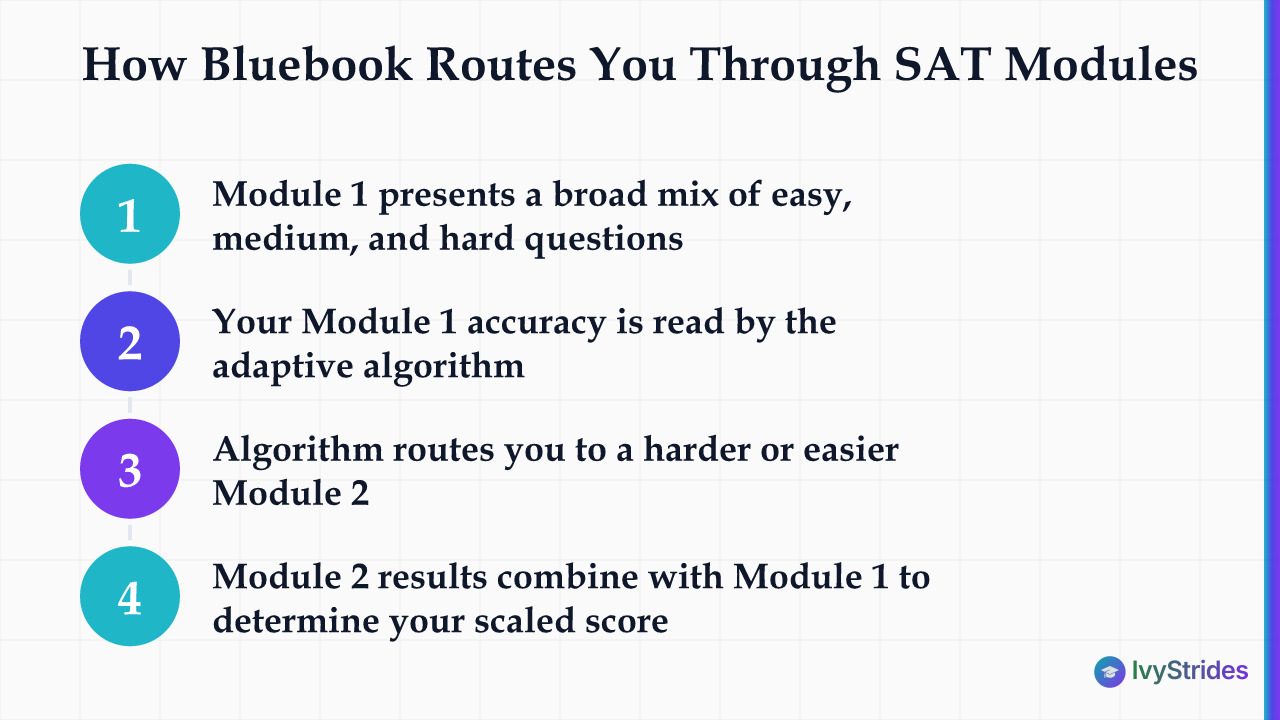
Bluebook practice tests route you through two modules per section, and Module 1 contains a broad mix of easy, medium, and hard questions. Your accuracy on that first module tells the adaptive algorithm whether to send you to a harder or an easier Module 2.
This is multistage adaptive testing, and it works the same way on the real digital SAT.
The section math. The Reading and Writing section holds 54 questions in 64 minutes, delivered as two 32-minute modules. The Math section holds 44 questions in 70 minutes, delivered as two 35-minute modules (College Board). That's 98 questions across 134 minutes of testing, with a single 10-minute break between the two sections. IvyStrides works out the average time per question across the full SAT at approximately 82 seconds (134 minutes over 98 questions); Math gives you more time per question than Reading and Writing.
| Section | Total Questions | Total Time | Module Length | Module 2 Routing |
| Reading and Writing | 54 | 64 min | Two 32-min modules | Harder or easier by Module 1 |
| Math | 44 | 70 min | Two 35-min modules | Harder or easier by Module 1 |
Not every question you answer counts. Each module carries 2 pretest questions that never touch your score, sitting alongside 20 to 25 operational questions (College Board). They look identical to scored questions, so you can't spot them and shouldn't try. Answer everything as if it counts, because you cannot tell which ones do.
Module routing is only half the picture, and how the digital SAT turns module results into a scaled score explains the other half. For this article, the routing is what you need: a strong Module 1 leads to a harder Module 2, and a weaker Module 1 leads to an easier one.
Why Your Bluebook SAT Scores Swing Between Tests
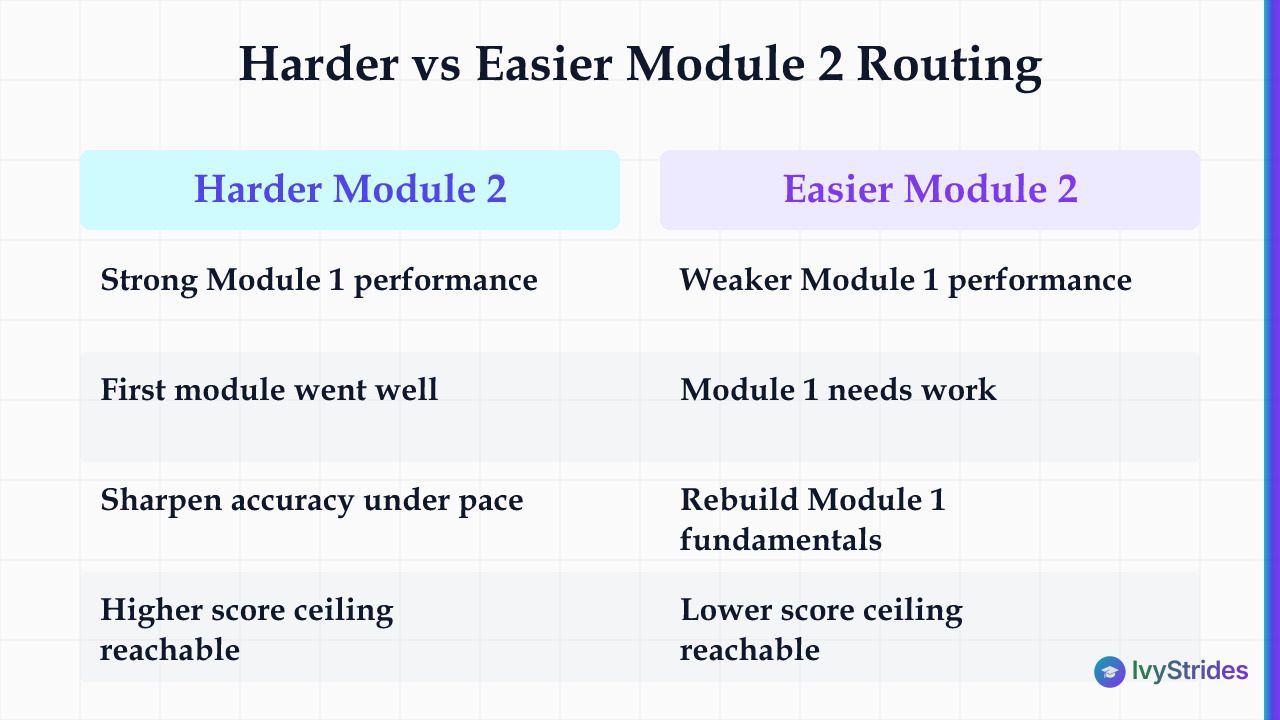
Bluebook SAT score swings between tests often trace to module routing, not to a change in your ability. The digital SAT reports on a 400 to 1600 scale, and where you land inside that scale depends heavily on which Module 2 the adaptive algorithm assigns you.
A test where you route into the harder Module 2 can score higher than one where you slip into the easier one, even with similar raw effort.
College Board states that the second module's questions are slightly more or slightly less difficult depending on your performance in the first (College Board). Because the scoring accounts for which questions you answered, the module you route into shapes the score you can reach on that test. That is why two sittings with similar effort can land in different places.
| Module 1 Performance | Module 2 Assigned | What It Signals | What to Do Next |
| Strong | Harder | Your first module went well | Sharpen accuracy under pace |
| Weaker | Easier | Module 1 needs work | Rebuild Module 1 fundamentals |
Where the swing really comes from. In our coaching, students who receive a harder Module 2 often assume they bombed, when the harder routing reflects a stronger first module. A score swing across two Bluebook tests often traces to which Module 2 you unlocked plus small pacing differences, not to inconsistent ability. So a review starts at the module level before anyone touches the study plan.
So which test should you trust? Once you've worked through every Bluebook test, which third-party SAT practice most closely matches the real exam becomes the next question. The mechanism behind the routing, how Module 1 sets your reachable range, gets a full walkthrough in how Module 1 shapes your reachable score.
Are Bluebook SAT Practice Tests Accurate Compared to the Real Exam
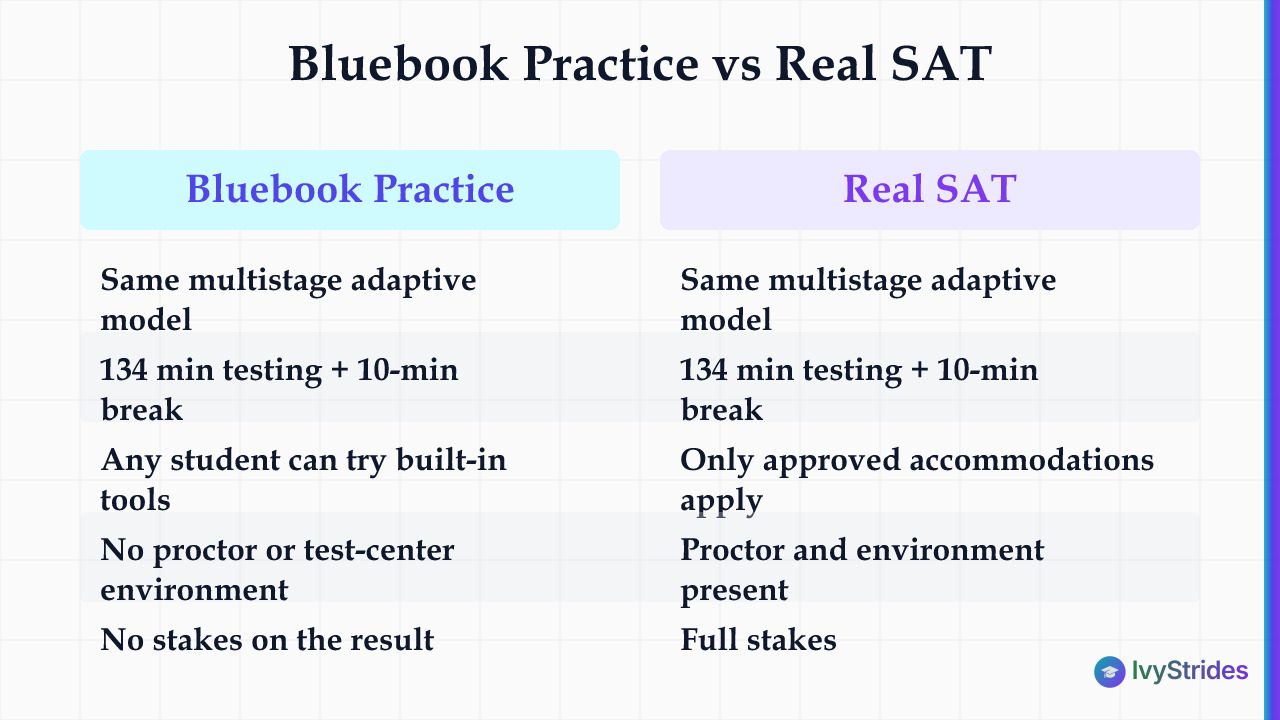
Bluebook SAT practice tests are the closest simulation of the digital SAT, because College Board delivers them in the same Bluebook app students use on test day. The practice tests use the same multistage adaptive model (College Board), the same 134 minutes of testing time, and the same 10-minute break structure.
What they cannot replicate is the room. A Bluebook practice test at your kitchen table has no proctor, no unfamiliar test center, no morning of nerves, and no stakes riding on the result. The algorithm and question difficulty match the real thing; the psychological environment does not. That gap is why some students score lower on test day than their best Bluebook run.
| Factor | Bluebook Practice | Real SAT |
| Adaptive algorithm | Same multistage model | Same multistage model |
| Testing time and break | 134 min of testing + 10-min break | 134 min of testing + 10-min break |
| Question types | Identical | Identical |
| Accommodations | Any student can try built-in tools | Only approved accommodations apply |
| Test-center stakes | None | Full stakes |
| Proctor and environment | None | Present |
College Board lets every student experiment with built-in accommodations in practice, but that does not mean approval for test day. Note that 134 minutes is testing time only. Total appointment time is longer, so block extra time on your calendar for check-in and the break.
Make a practice run count like the real one:
-
Take it in Bluebook, fully timed, in one sitting.
-
Keep the break to 10 minutes, as on test day.
-
Use only the accommodations you are approved for.
-
Review both sections by module the same day.
How to read your practice score. Treat a Bluebook total as a reliable read on your current skill under the algorithm, not as a locked prediction of your test-day number. It won't promise you an exact result in October, and it shouldn't.
The honest use is diagnostic: a Bluebook total tells you where your Reading and Writing and Math sit today. Once you trust that read, the productive next move is reviewing every mistake by type rather than chasing the number alone. If you want more full-length reps beyond the official set, our SAT practice test library extends the Bluebook-style pool.
How to Use Bluebook Practice Tests to Build a Smarter SAT Study Plan
Use Bluebook practice tests as diagnostic checkpoints, not as busywork. College Board provides several full-length practice tests in the Bluebook app, and the smart sequence spaces them across your prep so each one measures whether the work between tests actually landed. In our coaching, every plan starts with a timed diagnostic before any targeted practice begins.
A common trap: taking test after test back to back, then wondering why the scores barely move. Practice tests measure progress. They don't create it. The gains happen in the review and the focused work between them, which is why the spacing matters more than the count.
-
Take your first Bluebook practice test cold, fully timed, to set your baseline across both sections.
-
Log every miss by content domain the same day, while the reasoning is fresh.
-
Spend roughly two to three weeks on the weakest domain before the next full test.
-
Take the next Bluebook test and compare module routing, not just totals.
-
Repeat the cycle, retiring domains as your accuracy on them holds.
Read the routing as a signal. If Math keeps routing you into the easier Module 2 while Reading and Writing routes harder, your prep time belongs in Math, full stop. That module-level pattern is more useful than the composite, because it names which section is holding your score back. Knowing how many full tests are enough for your score band keeps you from over-testing and under-reviewing. A structured error log by question type turns each test into a to-do list.
This is where a plan gets personal. A student stuck at an easier-Module-2 routing in one section needs section-specific coaching, not a generic review of everything. That's the case for one-on-one work with a coach who reads your module-level breakdown and builds the sequence around your weakest domain.
FAQ: Bluebook Adaptive Tests and Score Swings
Do the Bluebook practice tests get harder?
The tests themselves don't get harder as you take more of them. Every Bluebook full-length uses the same structure. What changes is your Module 2 routing: a strong Module 1 sends you to a harder Module 2, so a later test can feel tougher even though the design is identical across all of them.
Are Bluebook practice tests accurate?
College Board states that Bluebook practice tests use the same multistage adaptive model as the real SAT, with matching timing and question types. The main difference is the absence of test-day stakes, a proctor, and an unfamiliar test-center environment.
Are SAT practice tests easier than the real thing?
The algorithm and question difficulty are the same, so Bluebook is not easier by design. Some students still find the real test feels harder because of center pressure, unfamiliar surroundings, and higher stakes. The scoring is faithful; the environment around it is what shifts.
Which Bluebook practice test is the most realistic?
All full-length Bluebook practice tests use the same multistage adaptive model, and College Board does not rank them by difficulty. Forum posts claiming one test is the hardest aren't reliable, since your Module 2 routing, not the test number, drives how hard your run feels.
Your Next Step With Bluebook Scores
A swing between Bluebook tests is a routing story, not a verdict on your ability. Read your scores at the module level, work the weakest domain between tests, and let the algorithm's routing tell you where your ceiling is being set.
- Take your next Bluebook test fully timed and note which Module 2 each section routed you into.
- Log misses by content domain the same day and spend two to three weeks on the weakest one.
- Compare module routing across tests, not just totals, before you change your plan.

Two decades teaching quantitative and verbal aptitude on standardized tests. Rare dual expertise across Math and Verbal — particularly effective for students with gaps on both sides. Senior AP Mentor for our Calculus and English tracks.