
When Should My Child Start ACT Prep? The Complete 2026 Guide for Parents

On this page
- The Short Answer: When Most Students Should Start ACT Prep
- Grade-by-Grade ACT Prep Timeline: From 9th Grade to Senior Year
- Is Your Child Already Behind? The Fear Parents Get Wrong
- Not Sure Where Your Child Stands? Get a Diagnostic Snapshot in 15 Minutes.
- Step One Before Any Timeline: Take a Diagnostic Test
- How Many Hours Does ACT Prep Actually Take? A Score-Band Breakdown
- Are ACT Prep Classes Worth It? What the Research and Our Coaching Data Show
- The 2025-2026 ACT Format Changes: What Parents Need to Know Before Setting a Timeline
- Choosing the Right ACT Test Date: Summer, Fall, or Winter?
- FAQ
- Can my child take the ACT in 10th grade?
- What is a good ACT score for college admissions?
- Is the ACT the same as the SAT?
- Can a senior still improve their ACT score enough to matter?
- How is the ACT scored, and what does the composite mean?
- How early is too early to start ACT prep?
- Ready to Build Your Child's ACT Prep Plan? Start with a Free Call.
Most students should start ACT prep in June, right after sophomore year ends. That summer window gives your child time for a full diagnostic test, roughly six to ten weeks of targeted study, and a first official ACT attempt in the fall of junior year. Students targeting a composite of 30 or above benefit from starting earlier, in sophomore spring. The exact start date hinges on two things: your child's current score from a practice diagnostic and the composite their target colleges expect.
A diagnostic test, not a calendar date, is always the real first step. The ACT is scored on a 1 to 36 composite scale, and where your child sits on that scale determines almost everything about the timeline. This guide gives you a grade-by-grade roadmap, honest hour estimates by score band, and the one caveat about the 2025-2026 ACT format changes that most families miss. Format, scoring, and test-date claims below are drawn from ACT, Inc.'s official site.
The Short Answer: When Most Students Should Start ACT Prep
June after sophomore year is the standard start date. Here's why that window works: your child has finished most of the Algebra II and grammar content the ACT tests, junior-year coursework hasn't buried them yet, and there's room for a first official sitting in September or October of junior year. Per ACT, Inc., fall of junior year is the most common first test date, and it leaves time for a retake before applications open.
The standard timeline isn't right for every student, though. A child aiming for a 32+ at selective schools needs more runway, so sophomore spring is a smarter start. A child who needs a modest two-point bump can start later and still be fine. The variable is the gap between the baseline score and the target composite, and you don't know either number until your child takes a diagnostic.
One thing before you build any plan: confirm the ACT is even the right test. Some students score meaningfully higher on the SAT because of pacing or the Science section. If you haven't compared the two, read our breakdown of ACT vs SAT difficulty and format differences first. Committing to an ACT timeline before confirming test fit is how families waste a summer.
Grade-by-Grade ACT Prep Timeline: From 9th Grade to Senior Year
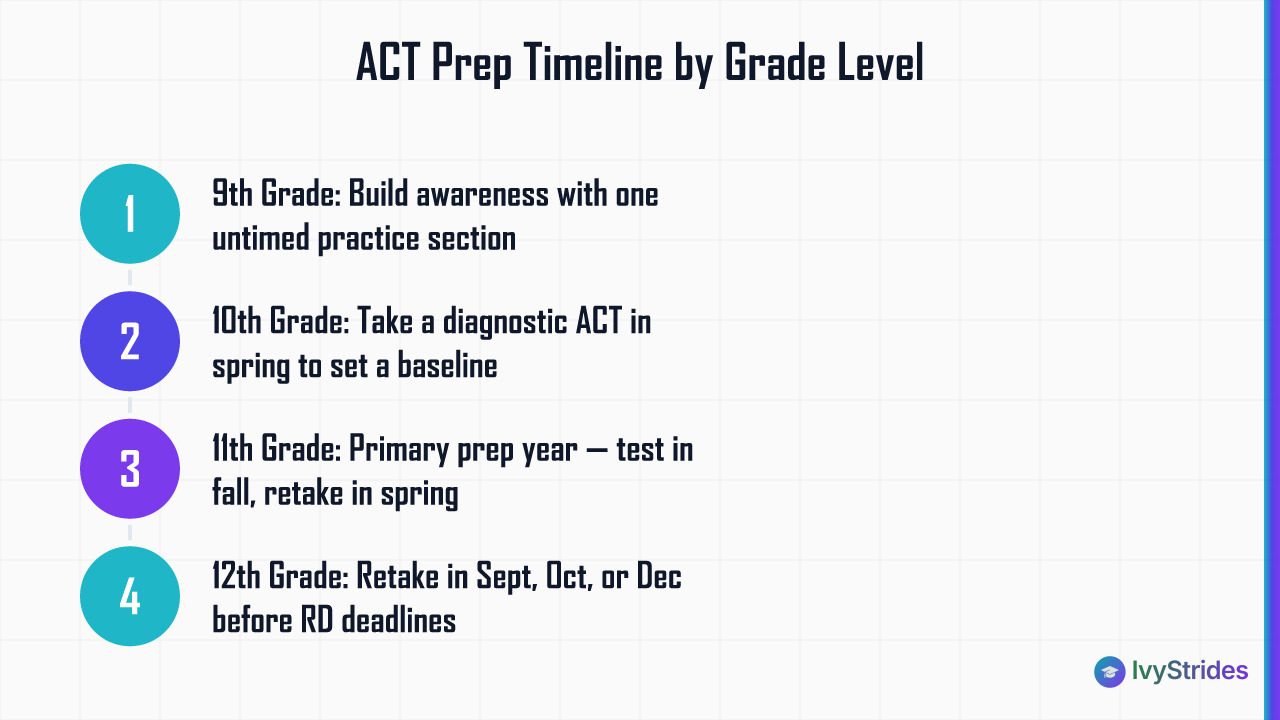
Here's the roadmap parents actually ask for, laid out by grade so you can find your child and know the next move.
9th grade is awareness, not prep. Formal, intensive ACT work this early is unproductive because your student hasn't covered the math and English content the exam tests. If your ninth grader is curious, a single untimed practice section builds familiarity. That's it. Don't spend money here.
10th grade is where a diagnostic earns its keep. A motivated sophomore can take a full official ACT in the spring and treat that score as a baseline. In our coaching, 10th graders who sit an official spring ACT use that real score to build a focused plan for the following year, and the early data removes a lot of junior-year panic. Can you take the ACT in 10th grade? Yes. ACT, Inc. places no grade restriction on registration.
11th grade is the primary prep and testing year for most families. This is when structured study, a first official test in September or October, and a retake window all fit. Junior year is also the collision zone. AP exams land in May, so if your child is juggling ACT prep alongside AP coursework, map both timelines together so an ACT date doesn't sit in the same week as an AP exam. An April or June ACT sidesteps the May crunch cleanly. For families building an AP schedule, our guide on how can parents support ACT prep covers the coordination piece.
12th grade is retake and salvage, not first-attempt territory for most, though it's far from hopeless. Seniors who already have one ACT can retake in September, October, or December and still submit before Regular Decision deadlines.
ACT, Inc. offers test dates in September, October, December, February, April, June, and July. Verify the specific 2025-2026 dates at act.org before you register, because the calendar shifts year to year.
One more thing worth saying plainly: a strong ACT score reduces pressure on other application components, but it works alongside, not instead of, a compelling personal statement and well-crafted supplemental essays. Score and story are two different jobs. Still unsure which test fits your child? Our comparison of the ACT vs SAT: key differences and which test to choose settles it.
Is Your Child Already Behind? The Fear Parents Get Wrong
The fear runs both directions. Start too late and waste an opportunity. Start too early and burn money on prep your child isn't ready for. That fear leaves a lot of families frozen, doing nothing, which is the one genuinely bad option.
Here's the part most parents get wrong: junior year is still an on-time start. In our coaching, students who begin structured prep in junior year with a full diagnostic still reach a typical 3-4 point composite gain before spring test dates. A student who walks in with a 22 composite in October and completes roughly eight weeks of section-targeted coaching typically lands around a 26 by February, not because of a magic method, but because the diagnostic pinpointed which ACT Math and ACT Reading question types were bleeding points, and every session hit those.
Seniors aren't out of the game either. Most Regular Decision deadlines fall between January 1 and January 15, which means a December ACT score still arrives in time. In our coaching, seniors who complete roughly six to eight weeks of targeted section work between a first and second sitting typically see a 2-4 point composite improvement. The catch is timing. Start the moment the first score report arrives; don't wait for winter break.
The diagnostic is your reset button. It replaces "are we behind?" with "here's exactly where we stand and here's the math on the gap." You can start with our act practice test online to get that baseline number.
Not Sure Where Your Child Stands? Get a Diagnostic Snapshot in 15 Minutes.
Book a free strategy call with an IvyStrides ACT coach. We will review your child's current score or practice test results, identify the sections costing the most points, and give you a concrete prep start date and timeline, at no cost.
Step One Before Any Timeline: Take a Diagnostic Test
Every plan we build starts with a full-length official ACT practice test, taken under real conditions: timed, quiet room, no phone. ACT, Inc. publishes official practice tests at act.org, and those are the ones to use, because retired real questions mirror the actual difficulty curve.
The diagnostic produces four section scores, each on the 1 to 36 scale: ACT English, ACT Math, ACT Reading, and ACT Science. The composite is the average of those four, rounded to the nearest whole number. That section-by-section breakdown is the whole point. A 24 composite hiding a 19 in Science and a 28 in English is a completely different prep plan from a flat 24 across the board. The first needs Science passage strategy; the second needs pacing and precision everywhere.
Why does this matter so much? Because in our coaching, students who skip the diagnostic and jump straight to generic content review waste roughly three to four weeks grinding material that isn't costing them points. Targeted weakness work only exists if you first know the weaknesses. This diagnostic-led approach, diagnostic plus targeted weakness work plus spaced retesting plus section-specialist coaching, is the core of our score improvement methodology, and it's why we won't sell a timeline before we see a score.
Before committing to an ACT prep timeline, families who have not yet decided between the two tests should read our full ACT vs SAT comparison to confirm which exam fits their child's strengths. For a broader picture of how we structure prep, see our ACT prep overview. If your child needs more practice material, our roundup of the best ACT practice tests points to the right resources by score band.
How Many Hours Does ACT Prep Actually Take? A Score-Band Breakdown
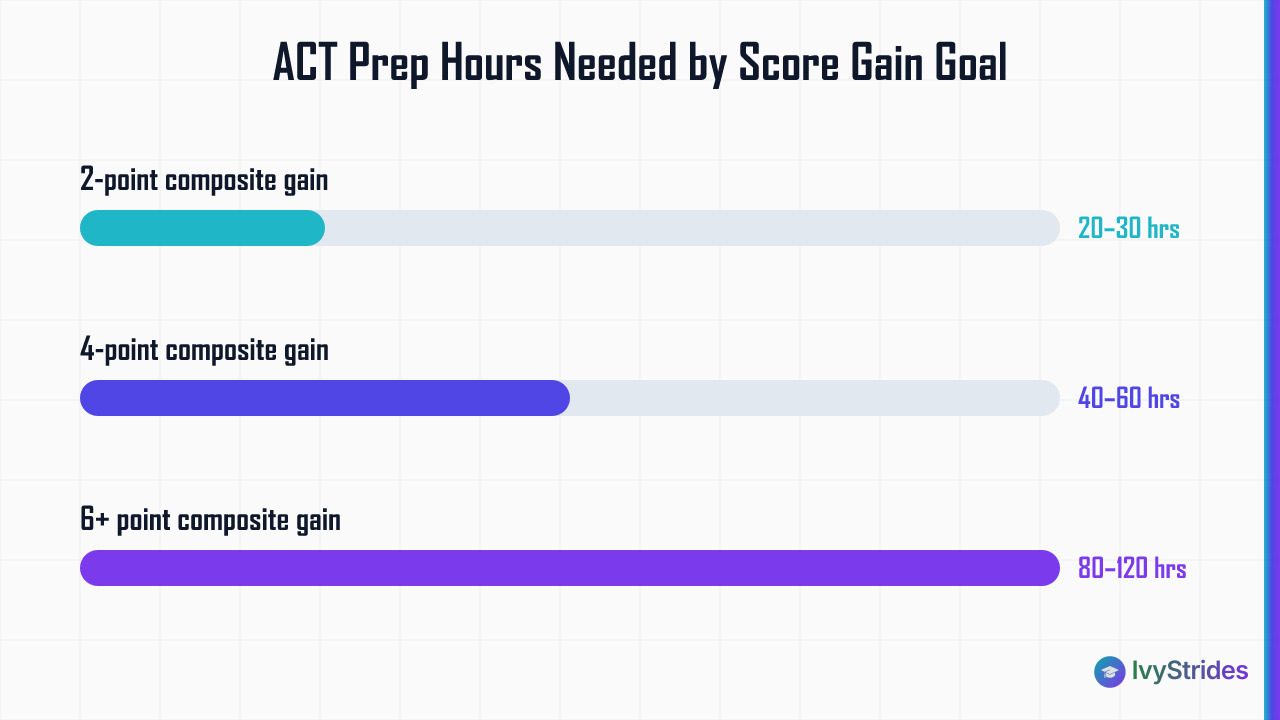
The right start date is inseparable from how many hours your child will need, which depends entirely on the gap between their diagnostic score and their target composite. Here are honest estimates by goal.
A two-point composite gain typically takes roughly 20 to 30 total hours of targeted practice over about six to eight weeks. This is refinement work: tightening pacing, cleaning up careless errors, drilling a handful of recurring question types.
A four-point composite gain typically runs about 40 to 60 total hours over roughly ten to fourteen weeks. At this range you're fixing real content gaps in one or two sections, not just polishing. In our coaching, students at the 20-25 band who complete the full diagnostic-to-retest cycle with targeted weakness work see a typical 4+ point composite improvement, which is the outcome this hour investment is built around.
A six-point-plus gain typically demands roughly 80 to 120 hours over about four to six months, and it almost always requires section-specialist coaching rather than solo study. A jump that size means rebuilding foundational skills, and that's slow, structured work.
Where does your child fall by band? Below 20 composite usually signals foundational content gaps, so budget the longer window. The 20-25 band responds well to roughly 40 to 60 hours of focused work. The 26-30 band is where section-specialist coaching pays off most, because the remaining points hide in specific question types. At 31-36, returns diminish and every hour has to be surgically aimed at the two or three question types still costing points.
Translate that into a weekly plan and the math is simple: a consistent six to eight hours a week across eight weeks adds up to roughly 50 to 65 total study hours, enough for a solid four-point push. For students who want a structured, coach-led version of that plan, our 1-on-1 ACT prep matches each student to specialists by section.
Are ACT Prep Classes Worth It? What the Research and Our Coaching Data Show
Short answer: yes, but the format matters more than the fact that you're paying for it. There are three real approaches, and they suit different students.
Group ACT prep classes move at the pace of the room, which means a strong student waits and a struggling student falls behind. They're inexpensive and fine for general familiarity, but they can't target the specific question types costing your individual child points.
Self-study with official practice tests is a legitimate path for students already scoring 28 and above who need targeted refinement, not foundational instruction. If your child is disciplined and the gaps are narrow, this works.
1-on-1 section-specialist coaching is where the timeline actually compresses. ACT, Inc. is clear that the ACT is not an aptitude test; its questions are tied directly to high school coursework, which means focused prep genuinely moves the score. For students in the 26-30 composite band, section-specialist coaching compresses the prep timeline significantly compared to self-study because every session targets the exact question types costing the most points. In our coaching, students working with separate specialists for ACT Math, ACT English and Reading, and ACT Science outperform students in generalist group classes at the same score band. One coach who "does the ACT" can't match a Science-passage specialist on Science.
Families spend anywhere from roughly $1,500 to $25,000 on prep. At that range, you deserve a documented method matched to your child's diagnostic, not a one-size-fits-all workbook. You can read how we approach that on our About page. To see the specialist model in detail, visit our tutors page.
One caveat worth stating clearly. Even at test-optional schools, a composite of 30 or above typically strengthens an application, so families should verify each target school's current policy before deciding to skip the ACT entirely. Test-optional does not mean scores are ignored; it means they're optional, and a strong one still helps. Check each school's admissions page and cross-reference fairtest.org for current policy. Remember too that the ACT is one pillar alongside GPA, AP scores, and essays. If you're building the essay side, our common app essay tutor support pairs naturally with test prep. For the test-choice question itself, our piece on whether the SAT is harder than the ACT is a useful gut check.
The 2025-2026 ACT Format Changes: What Parents Need to Know Before Setting a Timeline
The ACT is changing, and this affects your timeline directly. ACT, Inc. has announced a redesigned, shorter format taking effect in September 2025, with more flexibility in test structure. Before you register your child for anything, confirm the current specifics at act.org, because the exact section timing and question counts have been updated and are best read straight from the source rather than from any prep blog, including this one.
What does this mean practically? Two things.
If your child is a current junior planning to test before September 2025, use current official ACT materials and prep for the format you'll actually sit. If your child is testing in September 2025 or later, confirm that every practice test and prep book reflects the new format. As of early 2025, most third-party prep materials had not yet been updated, and drilling on a format that no longer exists wastes hours. This is exactly the kind of moving target where a diagnostic on official, current material beats an outdated workbook.
The strategy is unchanged even if the format isn't: diagnose on the format your child will face, then target the weak sections. The container changed; the method didn't. For international families weighing the logistics, our note on ACT fees for international students covers registration cost considerations.
Choosing the Right ACT Test Date: Summer, Fall, or Winter?
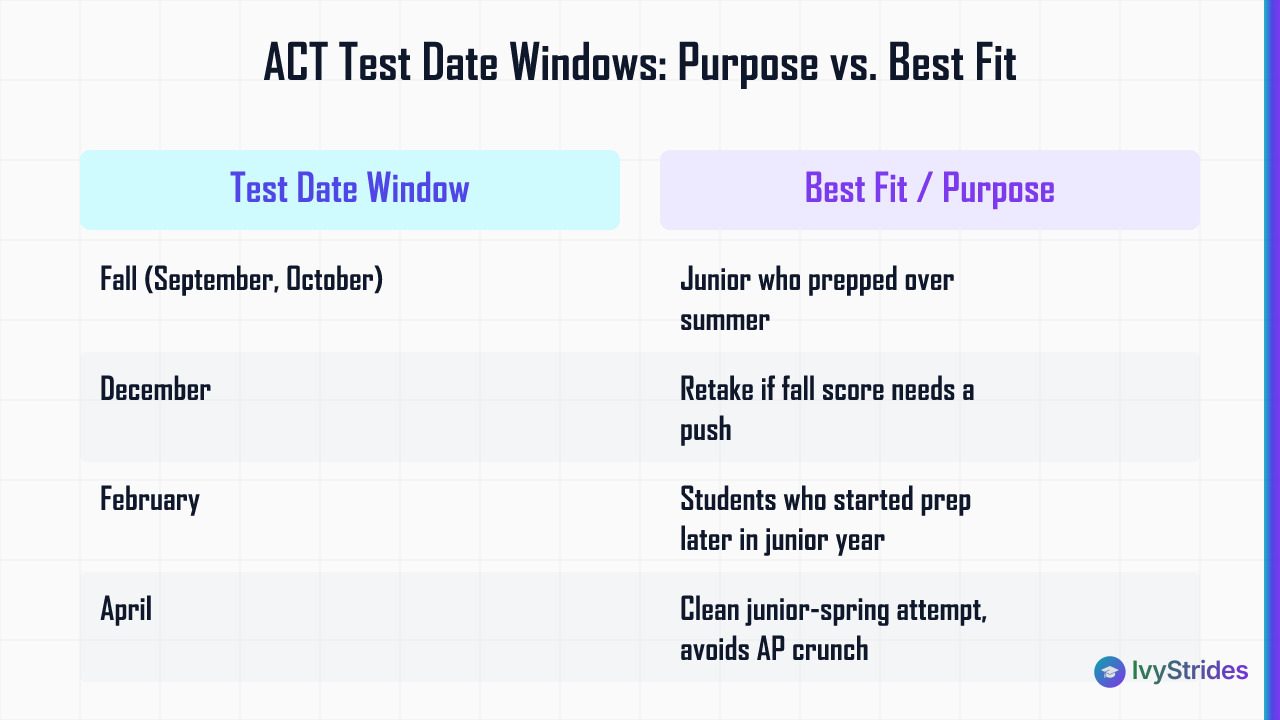
Pick a first date that leaves room for a retake. That's the whole principle. Per ACT, Inc., fall of junior year, September or October, is the most common first sitting, and for good reason: your child prepped over summer and there's a full year of retake options ahead.
Here's how the windows stack up. Fall dates (September, October) suit a junior who prepped over the summer. December is a strong retake window if the fall score needs another push. February works for students who started prep later in junior year. April avoids the May AP crunch and gives a clean junior-spring attempt. June or July allows a summer retake right before senior-year applications open, which is ideal for locking in a final score without senior-fall stress.
Two mechanics change your strategy. First, many colleges superscore the ACT, taking the highest section score across multiple sittings to build a new composite. That's why strategic retesting matters: a student who peaks on Math one date and Reading another can end up with a higher superscore than any single sitting shows. Confirm superscore policy on each target school's admissions page. Second, registration typically closes about four to five weeks before the test date, with late registration available for an added fee. Verify the current deadlines and fees at act.org, since both change annually.
For students building a practice schedule around a specific date, our online act practice test library lets you rehearse under timed conditions before the real thing.
FAQ
Can my child take the ACT in 10th grade?
Yes. ACT, Inc. does not restrict the test to juniors or seniors. Taking the ACT in 10th grade gives your child a real baseline score, surfaces content gaps early, and pulls pressure off junior year. In our coaching, 10th graders who sit an official spring ACT use that score as a diagnostic to build a focused prep plan for the following year.
What is a good ACT score for college admissions?
A composite of 27 sits above the national average and is competitive at many four-year colleges. Selective universities typically expect composites in the 32-35 range, and highly selective schools often report median composites of 34-36. The right target depends entirely on your child's specific school list. Check each school's Common Data Set for the middle 50% ACT range of admitted students, and treat that range as the real target, not a national average.
Is the ACT the same as the SAT?
No. They're separate exams from different organizations: ACT, Inc. administers the ACT, and College Board administers the SAT. The ACT includes a Science section the SAT lacks, uses a 1-36 composite scale rather than the SAT's 400-1600 scale, and runs on different timing and question formats. Some students perform noticeably better on one, which is why taking a diagnostic for both before committing is the smart move.
Can a senior still improve their ACT score enough to matter?
Yes, with the right timeline. Seniors who already have one ACT can retake in September, October, or December before most Regular Decision deadlines in January. In our coaching, seniors who complete roughly six to eight weeks of targeted section work between their first and second sittings typically see a 2-4 point composite improvement. The one rule: start immediately after the first score report lands. Don't wait.
How is the ACT scored, and what does the composite mean?
The ACT produces four section scores, ACT English, ACT Math, ACT Reading, and ACT Science, each on a 1-36 scale. The composite is the average of those four, rounded to the nearest whole number. A composite of 21 sits at roughly the 50th percentile nationally, per ACT, Inc. Colleges that superscore take the highest section score from each test date to build a new composite, which is why strategic retesting can raise a reported score even when a single sitting doesn't jump dramatically.
How early is too early to start ACT prep?
Formal, intensive prep before 9th grade is generally unproductive, because students haven't yet covered the math and English content the ACT tests. Light exposure, like a single practice test in 9th grade for familiarity, is fine. The most efficient window is roughly the three to six months before a first planned official test date, always starting with a diagnostic.
The honest answer to "when should my child start ACT prep" is this: as soon as you have a diagnostic score and a target composite to measure it against. That's the reset button, and it turns a vague fear about timing into a concrete number of weeks and hours.
Ready to Build Your Child's ACT Prep Plan? Start with a Free Call.
Parents and students: book a free 15-minute strategy call with an IvyStrides ACT specialist. You will leave with a diagnostic snapshot, a realistic target composite, and a clear next step, whether that is 1-on-1 prep, a test pack, or a self-study plan.

Award-winning author (South Asian Book Award) and graduate of BITS Pilani and UCLA Luskin School of Public Affairs. Brings a published writer's eye to Common App essays and grammatical precision to SAT and ACT R&W instruction.