
No AP at Your School? How to Take AP Online and Still Earn Credit
On this page
- The Short Answer: Yes, You Can Take AP Online and Have It Count
- Step-by-Step: How to Register for an AP Exam When Your School Doesn't Offer It
- What to Do When Your High School Has No AP Program: Your Three Real Options
- How to Choose the Right Online AP Course (and Avoid the Ones That Won't Prepare You)
- How Colleges View AP Courses You Took Outside Your School
- Free Online AP Courses: What Is Actually Available and What the Trade-Offs Are
- Which AP Subjects Are Easiest to Take Online (and Which Need More Planning)
- FAQ
- Can I self-study for an AP exam without taking any course?
- Will an online AP course show up differently on my transcript than an in-school AP course?
- Does the College Board send AP scores to colleges for free?
- Are there new AP courses I can take online starting in 2026-27?
- How many AP courses should I take if my school offers none?
- Can international students take AP exams online if their school doesn't offer them?
Yes, you can take AP courses online and earn real college credit even if your school offers no AP program. The College Board maintains an AP Course Ledger listing every authorized online provider. You enroll in one of those courses, then arrange to sit the official AP exam at a nearby high school that administers exams. You cannot order the exam as an individual; a school AP coordinator has to do it for you. A score of 3, 4, or 5 can earn college credit, though credit policies vary by college and score threshold.
These rules come directly from College Board's official AP Program documentation. The harder questions are how to verify a provider is legitimate, how to lock in a host school before the November ordering deadline, and how admissions officers actually read a self-arranged AP course. The next sections walk through each.

The Short Answer: Yes, You Can Take AP Online and Have It Count
Here's the mechanic in one paragraph. The College Board authorizes courses (not students) to carry the "AP" label. That authorization list is public and searchable at apstudents.collegeboard.org as the AP Course Ledger. If a provider does not appear on the Ledger, whatever they're selling is AP exam prep, not an AP course. Enroll in a Ledger-listed online provider, then register for the official exam through a nearby school's AP coordinator. Sit the exam in May. Score reports go to colleges the same way they would if you'd taken the course in your own building.
There are more than 38 AP subjects currently offered, and most are available through at least one authorized online provider. Exam fees run roughly $98 per exam for the 2025-26 cycle in the United States, with College Board fee reductions available for students who qualify. Fees for international exams and late-order exams differ; confirm current pricing at apstudents.collegeboard.org before you register.
If you want a curated view of subject-specialist online options, our ap courses online page shows which AP subjects IvyStrides teaches with a per-subject specialist model.
Step-by-Step: How to Register for an AP Exam When Your School Doesn't Offer It
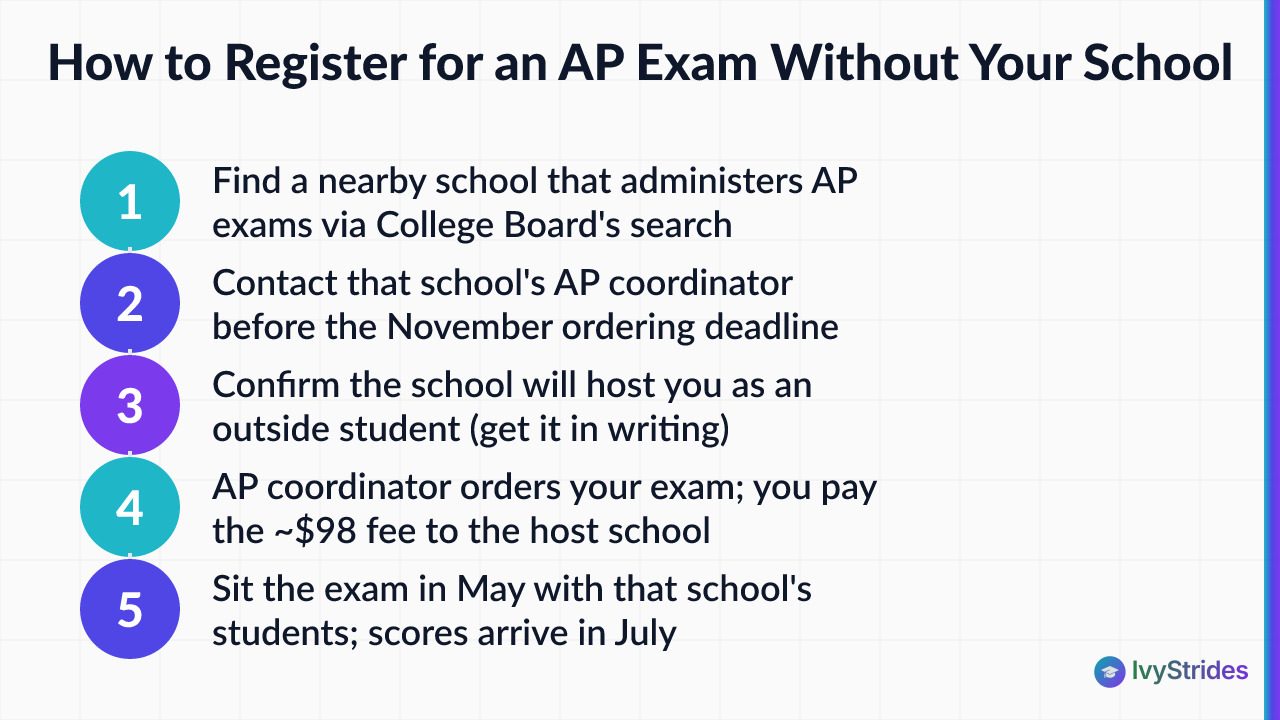
Registration is where most families lose time. Here's the exact sequence.
Step 1. Find a nearby school that administers AP exams. Use College Board's school search at apstudents.collegeboard.org to identify high schools within a reasonable drive that are AP-participating. Public schools, private schools, and some international schools all appear in the search.
Step 2. Contact that school's AP coordinator before the November ordering deadline. For May 2026 exams, the standard AP exam ordering deadline falls in early-to-mid November 2025 (confirm the exact date at apcentral.collegeboard.org). Late orders are possible but carry a late fee. Every AP-participating school has a designated AP coordinator; call the main office and ask for that person by title.
Step 3. Confirm the school will host you as an outside student. Most schools accept outside students, though policies vary. Some charge a small proctoring fee on top of the exam fee. Get this in writing so there's no confusion in the spring.
Step 4. The AP coordinator orders your exam through College Board. You pay the exam fee (roughly $98 in the United States for 2025-26) directly to the host school, which forwards it to College Board. You'll also complete a College Board student registration through AP Classroom or a paper form, whichever the coordinator specifies.
Step 5. Sit the exam in May with that school's students. You show up, present ID, and test. Score reports arrive in July.
A pattern we see repeatedly in our coaching: students arranging their own AP exam registration often underestimate the November ordering deadline. Our coaches flag this in the first session because there's no useful workaround once the window closes; you either wait a full year or pay the late-order fee. Start the host-school conversation in September, not November.
For students outside the United States, the same College Board process applies: find an authorized online AP course, then locate a nearby College Board-approved test center. See our companion piece on how do international students study AP online for the international logistics, including test centers in over 100 countries.
What to Do When Your High School Has No AP Program: Your Three Real Options

Photo by www.kaboompics.com on Pexels
You have three real paths. Each has honest trade-offs.
Option 1. An authorized online AP course from a paid private provider. These providers appear on the AP Course Ledger, use trained AP teachers, and typically deliver live instruction with a defined syllabus mapped to the College Board's course and exam description for each subject. Cost ranges widely. The upside is real instruction, feedback on free-response practice, and someone to answer your question when you're stuck on Unit 6 of AP Calculus BC at 10pm. The downside is price.
Option 2. A state virtual school (sometimes free). Alabama, Florida, and Virginia have historically offered virtual AP programs free to in-state students, with varying availability to out-of-state students. Eligibility rules shift year to year, so confirm directly with the state program before assuming you qualify. When these programs work, they're a strong value. When they don't, the constraint is usually class size and limited teacher access.
Option 3. Self-study using College Board resources and released exams. The College Board permits self-study for most AP exams. You register through a host school's AP coordinator and sit the exam in May. AP Classroom, College Board's free platform, is available to students enrolled in authorized courses. In our coaching with students who moved from self-study to a specialist-taught online AP course, score improvements of roughly 1 to 2 points on the 5-point scale are typical for students completing the full program, particularly in dense-content subjects like AP Chemistry and AP Calculus BC.
One distinction most families miss. Not all "online AP" providers are equal. A generalist online school where one teacher rotates across multiple AP subjects is very different from a per-subject specialist model, where one teacher owns one subject and knows its curriculum framework unit by unit. That difference shows up on the free-response section of the exam, where partial-credit rubrics reward students who use the correct AP terminology and argument structure.
The AP Program is also launching AP Business with Personal Finance and AP Cybersecurity in the 2026-27 school year as part of its AP Career Kickstart initiative (confirm current status at apcentral.collegeboard.org). Whether online providers will offer them from day one depends on provider enrollment timelines. Check the AP Course Ledger in summer 2026 for authorized online options.
For students exploring specific subjects, see our best online ap courses overview. For a walk-through on one of the most-taken exams, our AP US History prep guide covers the period-by-period study rhythm that tends to produce a 4 or 5.
How to Choose the Right Online AP Course (and Avoid the Ones That Won't Prepare You)
Look, this is the section where families lose thousands of dollars if they get it wrong. Here's the filter, in order.
Filter 1. Verify the provider on the AP Course Ledger. Go to apstudents.collegeboard.org, search the Ledger, and confirm the provider and the specific course appear. Only Ledger-authorized courses can be labeled AP on a transcript. Everything else is exam-prep content, which may still be useful but isn't the same thing.
Filter 2. Ask who teaches the course. A per-subject specialist has spent years teaching one AP subject. They know the College Board's course and exam description for that subject unit by unit. They know which free-response prompts recur, which rubric items graders reward, which units to slow down on. A generalist teaching six APs across the year cannot match that depth. Ask directly: "Who teaches AP Chemistry? Do they teach any other AP subject?"
Filter 3. Live instruction versus asynchronous video. Asynchronous video works for review. It doesn't work well for a student learning AP Physics 1 from scratch, where a live teacher can catch a conceptual misunderstanding in real time before it becomes a habit. If you're new to a subject, prioritize live instruction.
Filter 4. Diagnostic-driven or fixed curriculum. A quality provider assesses where each student is before Unit 1 and adjusts pacing. A fixed-curriculum provider moves the whole class through the same content at the same speed regardless of gaps. For a student without prior AP exposure, diagnostic-driven matters more.
Concrete example. A student taking AP Chemistry will encounter nine units in the College Board's official curriculum framework: Unit 1 (Atomic Structure and Properties) through Unit 9 (Applications of Thermodynamics). A specialist chemistry teacher knows that Unit 4 (Chemical Reactions) and Unit 6 (Thermodynamics) drive a large share of the free-response points and calibrates class time accordingly. A generalist teaching chemistry, biology, and environmental science across the same year does not.
Enrolling in an authorized online AP course is only half the equation; pairing it with a diagnostic-driven prep plan is what moves students from a 3 to a 4 or 5 on exam day.
For subject-specific pages, see AP Calculus BC, AP Chemistry, and AP Computer Science A.
How Colleges View AP Courses You Took Outside Your School
Here's the part most students worry about, and the answer is more reassuring than the internet suggests.
Admissions officers evaluate course rigor in the context of your school. They read your transcript alongside your school profile, which lists what AP courses your high school offers. If your school offers no APs, arranging one on your own is read as initiative, not as gaming the system. That's consistent with what admissions offices at selective schools publicly state.
The AP exam score, on a 1 to 5 scale, is the independent verification. It's a standardized, externally graded result that admissions readers trust regardless of where the course was taught. A 5 on AP Calculus BC is a 5 whether you took the course at a residential boarding school, at a state virtual school, or through a paid online provider.
Two caveats matter. First, AP credit policies vary by college and by score threshold. A score of 3 earns credit at some colleges and not at others; a 4 or 5 is accepted at most selective institutions but with different course-equivalency rules. Always check the specific college's AP credit policy on their registrar page before assuming a score will convert to credit. Second, test-optional policies vary by school and year (see the current tracker at fairtest.org), and being test-optional doesn't eliminate the value of strong AP scores. AP scores demonstrate readiness for college-level coursework, which admissions readers weigh heavily even at test-optional institutions.
On the Common App, list online AP courses in the coursework section and note the provider. See commonapp.org for the current coursework and academic history requirements.
A strong AP score earned through a self-arranged online course also gives you a concrete achievement to reference in your college admissions essays, signaling initiative and intellectual drive. That's a real narrative asset. If you want help positioning it, our what should you write your college essay about piece walks through story-selection. For hands-on essay coaching, our common app essay tutor service pairs students with an essay coach.
AP scores, SAT or ACT scores, and admissions essays work together as a single admissions package; a 5 in AP Calculus BC alongside a strong SAT Math score tells a consistent story to admissions readers. Students who are also preparing for the PSAT should know that strong AP coursework in 10th and 11th grade builds the same analytical skills tested on the PSAT, reinforcing both tracks simultaneously.
Admissions outcomes depend on the full application, not AP scores alone. Strong AP performance strengthens your candidacy; it doesn't guarantee admission at any school.
Free Online AP Courses: What Is Actually Available and What the Trade-Offs Are
Honest answer on "free online AP courses approved by College Board": the reality is narrower than the search-result headlines suggest.
State virtual schools. Alabama, Florida, and Virginia have offered free virtual AP programs to in-state students. Out-of-state access varies year to year and is often limited or unavailable. If you live in one of these states, start there. If you don't, most state programs won't admit you.
College Board's AP Classroom. This is a free resource, but only for students who are already enrolled in an authorized AP course. It's not a standalone free course. Once you enroll in a Ledger-listed provider (paid or free), AP Classroom becomes available at no extra cost, with topic questions, progress checks, and released free-response prompts.
Non-authorized free content. Some free online prep platforms offer AP-aligned review videos and practice questions. These can be useful review material for a student already enrolled in an authorized course. They aren't authorized AP courses and don't appear on the AP Course Ledger.
Trade-off, stated plainly. Free state virtual school options vary widely in teacher quality and class size. In our coaching, students who came from large-cohort free programs often had content gaps in specific AP units, most commonly the later, more integrative units where teacher pacing tends to compress. A free option that gets you to a 3 is still valuable, especially if college credit is your priority and your target schools accept a 3. A specialist-taught paid option that gets you to a 5 opens more doors for credit and is worth the cost when the score matters for admissions selectivity.
For a full price breakdown of paid online AP options, see our how much online AP courses cost article. For genuinely free study materials, our free downloads page has practice sets you can use immediately.
Which AP Subjects Are Easiest to Take Online (and Which Need More Planning)
Availability, not difficulty, is the right lens here.
Widest online availability. AP US History, AP English Language and Composition, AP Psychology, AP Human Geography, and AP US Government are widely taught online because they're text-and-argument driven and translate cleanly to a virtual classroom. Nearly every authorized online provider offers them.
Strong online availability with a caveat on lab work. AP Chemistry, AP Biology, and AP Physics 1 all appear across major online providers, but the College Board's course frameworks include a lab component. Quality providers handle this through virtual labs, shipped lab kits, or supplemental in-person lab requirements. Before you enroll, ask specifically how the provider handles the lab requirement.
Excellent fit for online delivery. AP Computer Science A and AP Computer Science Principles are strong online-native subjects. Coding is inherently screen-based; teacher feedback on code happens as naturally online as in person.
Benefits significantly from live instruction. AP Calculus AB and AP Calculus BC are widely available online and gain the most from live specialist instruction. The College Board's AP Calculus BC framework covers ten units, and Unit 4 (Contextual Applications of Differentiation) and Unit 6 (Integration and Accumulation of Change) carry high point weight on both multiple choice and free response. A live specialist walking a student through a related-rates problem in real time is materially more effective than a recorded lecture.
More planning required. AP Studio Art and AP Drawing are portfolio-submission courses, not traditional exams. Online instruction is possible, but portfolio review, materials, and submission logistics are different from a written-exam AP. If this is your path, ask about portfolio workflow specifically.
For subject-specific IvyStrides pages, see AP Calculus AB, AP Physics 1, and AP CS Principles.
FAQ
Can I self-study for an AP exam without taking any course?
Yes, the College Board permits self-study for most AP exams. You register through a nearby school's AP coordinator and sit the official exam in May. In our coaching with students who self-studied versus those who took a specialist-taught online course, students with structured instruction typically score roughly 1 to 2 points higher on the 5-point scale, particularly in dense subjects like AP Chemistry or AP Calculus BC. Self-study is realistic where you already have strong background knowledge; it's harder in dense STEM subjects with heavy lab or problem-solving components.
Will an online AP course show up differently on my transcript than an in-school AP course?
It depends on your school's transcript policy. Some schools add the online course to your official transcript; others don't. What matters most to admissions readers is the AP exam score, which is an independent, standardized result. You can also list the course in the coursework section of the Common App. Admissions officers at selective colleges see self-arranged online AP courses regularly and generally read them as a sign of initiative.
Does the College Board send AP scores to colleges for free?
Each year you take AP exams, you can send one score report for free to a college, university, or scholarship organization of your choice. Additional score reports cost around $15 each per recipient. You can choose which scores to send and which to withhold, though some colleges require all AP scores. Check each college's score reporting policy before submitting.
Are there new AP courses I can take online starting in 2026-27?
Yes. The College Board is launching AP Business with Personal Finance and AP Cybersecurity in the 2026-27 school year as part of its AP Career Kickstart program. Both are project-based courses designed for students interested in real-world applications. Whether authorized online providers offer them from day one depends on provider enrollment timelines; check the AP Course Ledger in summer 2026 for authorized online options.
How many AP courses should I take if my school offers none?
There's no universal number. Admissions officers evaluate rigor in the context of what your school offers. If your school offers no APs, taking two to four self-arranged online AP courses in subjects relevant to your intended major is a strong signal of initiative. Scoring a 4 or 5 on two APs is more valuable than scoring a 3 on five. Prioritize depth over breadth, and choose subjects where you can genuinely invest the roughly 6 to 10 hours per week a rigorous AP course typically requires. If AP Precalculus fits your track, see our AP Precalculus online page. For students going deeper into physics, AP Physics 2 is our follow-on subject page.
Can international students take AP exams online if their school doesn't offer them?
Yes. The College Board has AP exam testing centers in over 100 countries. International students follow the same process: enroll in a College Board-authorized online AP course, then locate a nearby international test center using the College Board's school finder at apstudents.collegeboard.org. Contact the AP coordinator at that center before the November ordering deadline to arrange registration.
The path from "my school has no AP" to "I have a 4 or 5 that counts for college credit" comes down to four moves: verify the provider on the Ledger, lock in a host school by early fall, choose a specialist-taught course over a generalist one when the subject demands it, and pair the course with a diagnostic-driven prep plan.

Two decades teaching quantitative and verbal aptitude on standardized tests. Rare dual expertise across Math and Verbal — particularly effective for students with gaps on both sides. Senior AP Mentor for our Calculus and English tracks.