
Online College Essay Help: How a Review Runs From Outside the US
On this page
- What a College Essay Review Actually Covers Online
- How to Get College Essay Help Online When You Are Outside the US
- Free vs. Paid College Essay Help Online: What Each Level Gives You
- Can AI Tools Replace a Human College Essay Reviewer?
- FAQ: Online College Essay Help
- Can ChatGPT help with college essays?
- Can you hire someone to help with college essays?
- Where can I get help with my college essay?
- Are college essay advisors worth it?
- Your Next Step on an Online Essay Review
Online college essay help is a structured review of your draft by a coach or qualified reader, delivered by video call or written comments on prompt fit, narrative clarity, voice, and word count. It works from anywhere. The Common App personal essay runs a 650-word maximum with seven prompts for 2026-27.
Those prompts and the 650-word cap come from the Common App's essay prompts page. The harder question is which review you actually need, and whether a free reader or a paid coach closes the gap before your first deadline.

What a College Essay Review Actually Covers Online
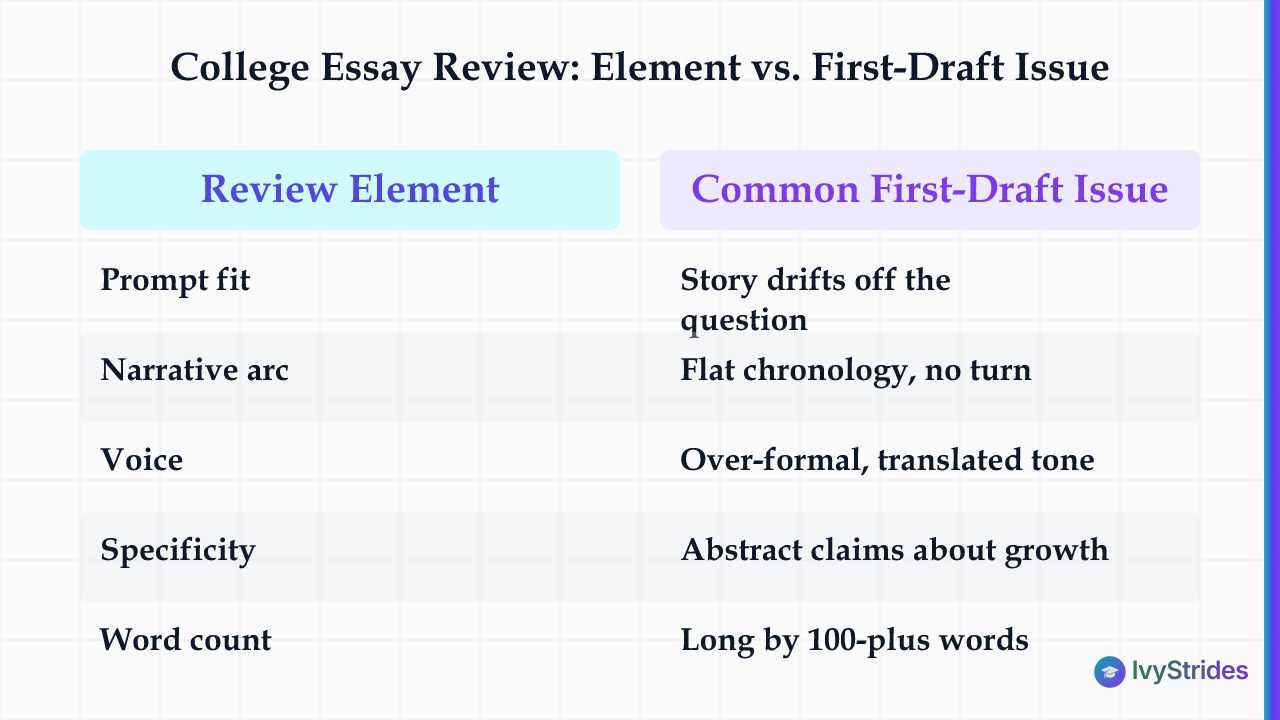
An online college essay review checks your Common App personal essay against five things in order: prompt fit, narrative arc, voice, specificity, and word count. A useful essay review session runs about 45 to 90 minutes. The reviewer reads for what an admissions reader evaluates, not for grammar alone, because a technically clean essay that answers the wrong question still fails.
The Common App gives you seven prompts for 2026-27, unchanged from the prior cycle, and a 650-word limit. Each college decides whether the personal statement is required or optional, and you may submit it to any college regardless. You can also edit the essay an unlimited number of times after your first submission, so a weak early draft is not a trap you are locked into.
Voice comes first, not last. Admissions readers evaluate specificity, authentic voice, and narrative clarity. A reviewer who corrects your commas but flattens your sentence rhythm has made the essay worse. Knowing the criteria a reviewer applies starts with knowing what admissions readers actually reward in a strong essay.
The most common first-draft note a coach gives is to replace a summary claim with a specific scene or moment. In our essay coaching, that same first-draft issue shows up as a strong topic buried under a generic opening paragraph that could belong to any student. The supplemental essays are a separate review track, with their own word limits and prompt logic, and the "Why This College" supplement is one of the supplements students most often write too early.
| Review element | What the reviewer checks | Common first-draft issue |
| Prompt fit | Does the essay answer the prompt | Story drifts off the question |
| Narrative arc | Clear beginning, turn, and change | Flat chronology, no turn |
| Opening hook | First line earns the second | Generic throat-clearing |
| Voice | Sounds like this student | Over-formal, translated tone |
| Specificity | Concrete scenes, not summary | Abstract claims about growth |
| Word count | Within the 650-word limit | Long by 100-plus words |
Once you have feedback from a review session, the next question is which comments to act on and which to set aside; the editing process is where voice is most at risk.
How to Get College Essay Help Online When You Are Outside the US
Online college essay help works the same from Lagos, Seoul, or São Paulo as from Boston, because the review happens on your draft, not in a room. You choose between two formats: a synchronous live video session, where the coach reads and reacts in real time, and asynchronous feedback, where the coach leaves written comments you read on your own schedule. For students in distant time zones, the format choice matters more than geography.
Async solves the clock. A coach in the US and a student in Singapore sit 12 or 13 hours apart, so a live call lands at an awkward hour for one of them. Asynchronous feedback removes that friction: you send the draft at night, the coach comments during their day, and you revise during yours. Live sessions still earn their place for the first conversation, where the coach asks the questions that surface your real story.
Students working with a coach from outside the US often arrive with a draft that reads as translated, because they wrote it in their first language and then rendered it into English rather than drafting in the voice they actually use. IvyStrides essay coaches see this pattern often, and the first job is usually to recover the student's own cadence before touching structure.
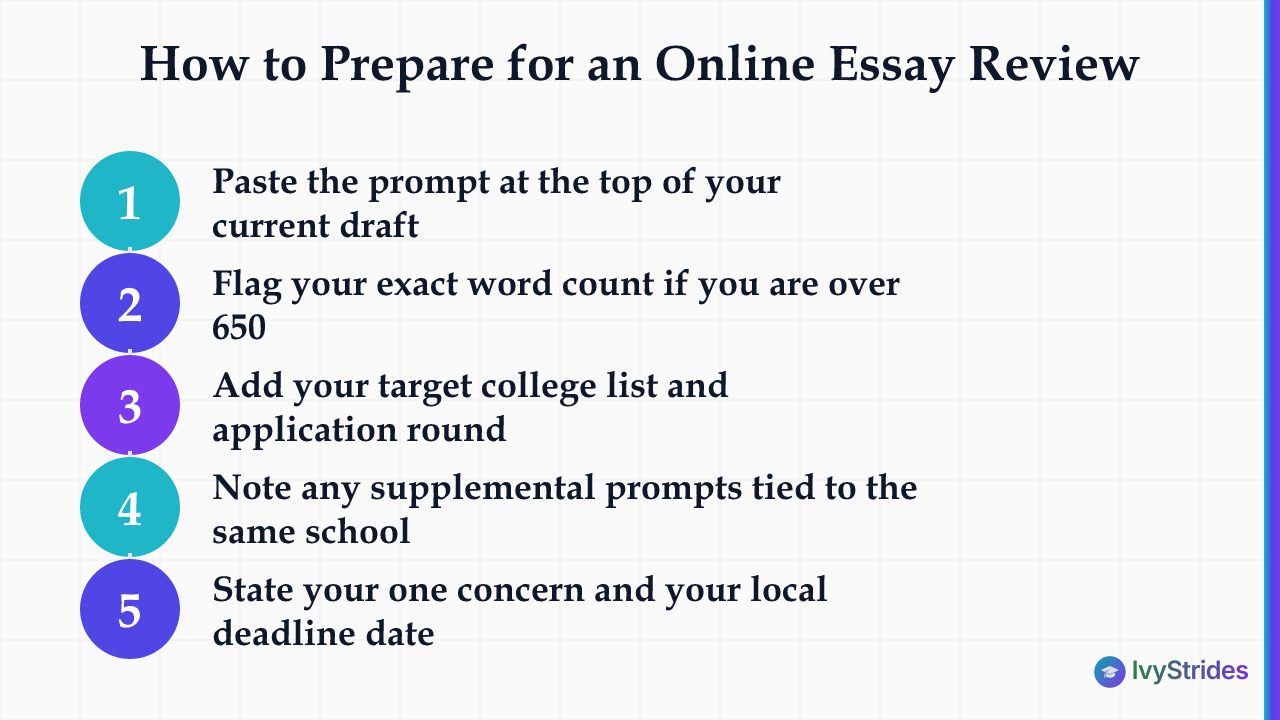
To get useful feedback, give the reviewer enough context. Prepare these before your session.
-
The current draft, with the prompt you chose pasted at the top
-
The exact word count, flagged if you are over 650
-
Your target college list, so the coach reads with those schools in mind
-
Which round you are applying in: Early Decision, Early Action, or Regular
-
Any supplemental prompts tied to the same school
-
The one thing you are unsure about in the draft
-
Your deadline, in your own local date
Essay review sessions need scheduling around application deadlines, and the gap between Early Decision and Regular Decision rounds is shorter than most students expect. The Common App opened for 2026-27 on August 1, 2026, and Early Decision is binding: you may apply ED to only one college, and if admitted you withdraw your other applications. Early Action is non-binding, and admitted students have until May 1 to consider the offer and confirm enrollment, though individual Early Action schools may set earlier reply dates.
One logistics detail international students miss: application deadlines end at 11:59 pm in your own local time zone, not the college's. For families coordinating review across time zones, understanding how parents help without taking over the draft keeps the feedback from becoming a rewrite.
Free vs. Paid College Essay Help Online: What Each Level Gives You
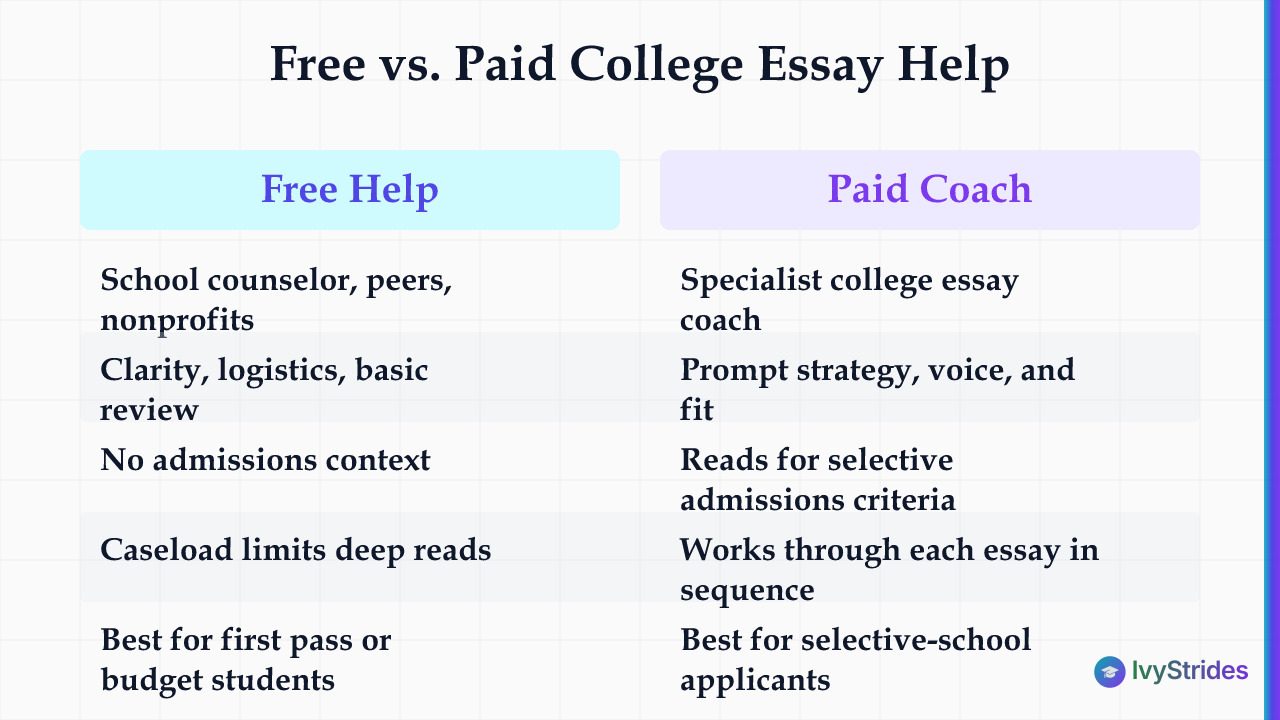
Free college essay help comes from your school counselor, peer readers, and nonprofit review platforms; paid help comes from a specialist college essay coach. The honest line between them is admissions context. A peer tells you a sentence is confusing. A coach tells you whether the story answers what a selective admissions office reads for.
Getting feedback is a skill in itself: knowing who to ask, what to share, and how to frame the request decides whether the comments you get protect your voice or flatten it. The risk with any reviewer, paid or free, is feedback that fixes the grammar but drains the personality.
| Help type | What it covers | What it misses | Best for |
| School counselor | Logistics, basic review | Caseload limits deep reads | First pass, general check |
| Peer review | Clarity, fresh eyes | No admissions context | Catching confusion |
| Nonprofit platform | Structured written notes | Variable reviewer quality | Students on a budget |
| Paid coach | Prompt strategy, voice, fit | Costs money | Selective-school applicants |
Caseload is the real constraint. A school counselor managing hundreds of students cannot read your essay four times. A specialist essay coach works through your personal statement and each supplemental in sequence, keeping your voice intact. In our essay coaching at IvyStrides, every review session starts with the prompt and the student's target college list, because feedback that ignores where the essay is going cannot tell you whether the story you are telling is the right one for the specific application in front of you.
Do not pay for a price you cannot verify. Coaching costs vary widely by provider and package, and any figure quoted without a current source is a guess. The question is not cost alone but fit: if you have a draft and no reader who understands admissions criteria, a specialist coach closes exactly that gap.
Can AI Tools Replace a Human College Essay Reviewer?
AI tools cannot replace a human college essay reviewer, but they handle narrow jobs well: grammar passes, structure checks, and trimming a long draft toward the 650-word limit. They cannot evaluate prompt fit, admissions context, or whether the essay sounds authentically like you. Used to rewrite, they homogenize voice, and a homogenized essay is the opposite of what an admissions reader wants.
Before running any AI tool on a draft, learn what admissions offices currently flag about AI-written essays and what they do not. The other blind spot is topic: AI tools read overused subjects as clean, which is one reason a tired topic still fails to stand out even when the grammar is perfect.
| Task | AI tool | Human coach |
| Grammar and punctuation | Yes | Yes |
| Trim toward 650 words | Yes | Yes |
| Brainstorm topics | Partial | Yes |
| Judge prompt fit | No | Yes |
| Preserve authentic voice | No | Yes |
| Read for admissions fit | No | Yes |
Use AI as a pass, not a pen. Run a grammar check, ask it to flag sentences over 25 words, let it mark where a paragraph sags. Then close it and write the next draft yourself. The moment you let it generate prose, you trade your voice for a fluent average, and admissions readers have read that average thousands of times.
FAQ: Online College Essay Help
Can ChatGPT help with college essays?
ChatGPT can brainstorm, check grammar, and trim a draft toward the 650-word maximum. It cannot judge whether your essay fits the prompt, sounds like you, or meets what a specific admissions office reads for. Treat it as a grammar pass, never as a rewriter, because generated prose flattens the voice that makes an essay yours.
Can you hire someone to help with college essays?
Yes, and it is both legal and common. The ethical line runs between coaching, which means feedback, questions, and structural guidance, and ghostwriting, which means writing the essay for the student. Admissions offices expect the essay to be the student's own work and voice. A coach who rewrites rather than guides builds a document that may not survive an interview or an additional writing sample.
Where can I get help with my college essay?
Options range from free to paid. Free sources include your school counselor, nonprofit review platforms, and peer readers. Paid sources include private essay coaches and college counseling services. For students outside the US, online coaching by video call or written comments is the most practical route. The deciding factor is whether the reviewer understands admissions criteria, not just writing quality.
Are college essay advisors worth it?
A college essay advisor adds the most value when you have a draft but cannot tell whether it answers the prompt, reveals genuine character, or stands apart from similar applicants. If your school counselor carries a caseload of hundreds and you are applying to selective schools, a specialist advisor typically closes that gap. Admissions outcomes depend on the full application, not the essay alone.
Your Next Step on an Online Essay Review
Online college essay help earns its place when you have a draft and no trusted reader who understands what admissions officers evaluate. Pick the format that fits your time zone, prepare your context, and get structured feedback from a qualified human before your first deadline.
- Confirm your chosen prompt and cut your draft to 650 words or fewer
- Decide between a live session and asynchronous written comments
- Gather your target college list and your local deadline
- Use AI only for grammar and length, never for voice
- Line up your reviewer well before the Early Decision date

Award-winning author (South Asian Book Award) and graduate of BITS Pilani and UCLA Luskin School of Public Affairs. Brings a published writer's eye to Common App essays and grammatical precision to SAT and ACT R&W instruction.