
High School Math Competitions: What to Enter in 2026-27, and When
On this page
- The AMC Pathway: AMC 10, AMC 12, and the Road to AIME
- 2026-27 High School Math Competition Calendar: Dates and Registration Windows
- Online and Accessible High School Math Competitions Worth Entering
- How High School Math Competitions Strengthen a College Application
- FAQ: High School Math Competitions
- What are some math competitions for high school students?
- Is AMC harder than SAT?
- What is the most popular math competition?
- What are some good international math competitions for high school students?
- Your Next Step on Choosing a Math Competition
High school math competitions in 2026-27 run from the AMC 10/12 to team invitationals, applied modeling contests, and proof-based programs. A high school math competition is a timed contest testing problem-solving beyond the standard curriculum. The AMC pathway is the primary US national route.
That route leads through the AIME to USAMO or USAJMO, and it starts with one registration most students make through their school. The sections below map each tier, give the 2026-27 dates, and help you pick one competition to enter before the nearest deadline.

The AMC Pathway: AMC 10, AMC 12, and the Road to AIME
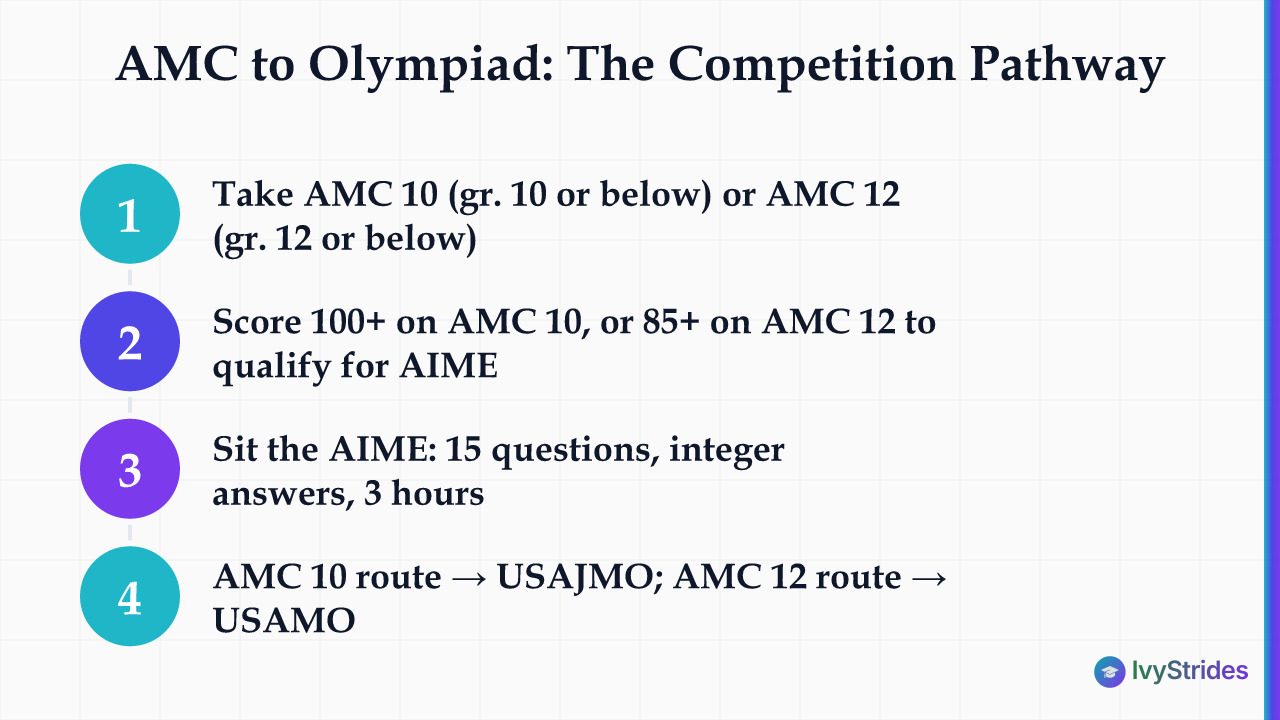
The AMC 10 and AMC 12 are 25-question, 75-minute multiple-choice contests, and they form the primary national pathway in competition mathematics. The Mathematical Association of America (MAA) organizes both, along with the AMC 8 and the AIME, and has run the program since 1950. Scoring is identical on each: 6 points per correct answer, 1.5 points per blank, 0 for a wrong answer, maximum 150.
Eligibility splits by age and grade. You sit the AMC 10 if you are in grade 10 or below and under 17.5 years old on the contest date; you sit the AMC 12 if you are in grade 12 or below and under 19.5 years old (MAA). Each contest runs in an A sitting and a B sitting on separate November dates, and a student may take one of each.
| Feature | AMC 10 | AMC 12 |
| Questions | 25 | 25 |
| Time | 75 minutes | 75 minutes |
| Scoring | 6 / 1.5 / 0 | 6 / 1.5 / 0 |
| Maximum score | 150 | 150 |
| Eligibility | Grade 10 or below, under 17.5 | Grade 12 or below, under 19.5 |
| Sittings | A and B, November | A and B, November |
| Leads to | AIME, then USAJMO | AIME, then USAMO |
If you are eligible for both, the choice between them affects which olympiad pathway you enter, and how to choose between AMC 10 and AMC 12 walks through the full decision.
The AIME is the next rung. The American Invitational Mathematics Examination is a 15-question exam, each answer an integer from 000 to 999, written over 3 hours. From the 2026-27 school year the MAA uses fixed qualifying scores: 100 or higher on the AMC 10, or 85 or higher on the AMC 12 (MAA). Those fixed numbers replaced the old floating cutoffs.
From there the two routes diverge. The AMC 10 route leads to USAJMO qualification; the AMC 12 route leads to USAMO. Your AMC score sets up the next question, whether it clears the threshold, and how many points it takes to qualify for the AIME covers the 100/85 cutoffs and what follows once you qualify.
With 75 minutes over 25 questions, you get about 3 minutes per question (MAA publishes the time and question count; IvyStrides divides them). In our coaching, every plan starts from a timed diagnostic, because first-time entrants who skip one tend to misallocate prep between algebra fluency and combinatorics, two different skills the AMC rewards equally.
2026-27 High School Math Competition Calendar: Dates and Registration Windows
The 2026-27 competition calendar runs from November through late May, and that November window is the busiest. The same AMC program that anchors the olympiad pathway opens the season, so your first decision is whether to register for a November sitting before the school deadline passes. Most of these contests register through a school or a proctor, not the student directly.
| Competition | Format | Key Date(s) | Registration |
| AMC 10A / 12A | Individual, 25q/75min | November 2026 | Through school/MAA |
| AMC 10B / 12B | Individual, 25q/75min | November 2026 | Through school/MAA |
| HiMCM | Team modeling, online | November window | Through COMAP |
| Rose-Hulman | Individual, online | Oct–Nov 2026 | Oct 2 to Nov 6, 2026 |
| USAMTS | Proof-based, online | Rolling rounds | Free, online |
| HMMT November | Team + individual | November 2026 | Team application |
| AIME | 15q/3hr integer answers | Late winter 2027 | By AMC qualification |
| ARML | Regional team | Late May 2027 | Through team captain |
Verify the exact November AMC dates before you register. The MAA publishes the A and B sitting dates on its AMC page, and school coordinators set the local proctoring slot (MAA). Rose-Hulman's online registration opens October 2 and closes November 6, 2026 at 11:59 PM (Rose-Hulman).
HMMT runs two editions a year, a November tournament and a February tournament, both student-run and built around team and individual rounds. HiMCM, the High School Mathematical Contest in Modeling, is internet-based and held in a November window. For 2026 COMAP has published a new AI policy and an updated submission process, so read the current instructions before you start (COMAP).
ARML, the American Regions Mathematics League, lands in late May and is the one most people mean when they say team math. If you want the competitions above paired with summer programs that deepen problem-solving between seasons, that roundup adds the camp side of the calendar.
Online and Accessible High School Math Competitions Worth Entering
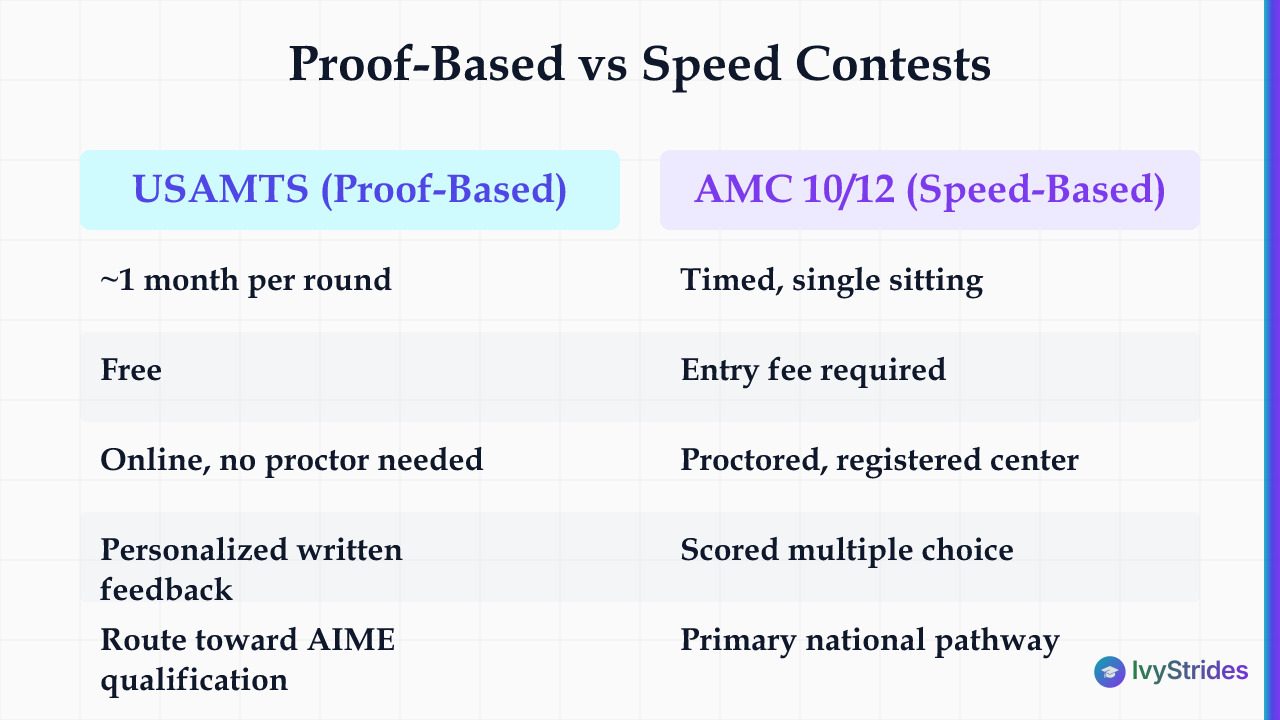
Online math competitions let a student compete from anywhere in the world, and several are free regardless of AMC readiness. The late-May and November contests above assume a proctor or a team; these do not, which matters most for internationally based students and anyone not yet scoring near the AMC range. A proof-based contest like USAMTS is a different skill from a speed contest like the AMC.
USAMTS is where to start if you want to learn proofs. The USA Mathematical Talent Search is free and proof-based, gives you roughly one month per round, and returns personalized feedback on your written solutions. It is one of several routes toward AIME qualification, though AIME entry still requires meeting the AMC score threshold or an alternate path.
| Competition | Best for | Cost | Format |
| USAMTS | Learning proof-writing | Free | Online, ~1 month/round |
| Purple Comet | First team experience | Free | Online, team |
| Rose-Hulman | Timed individual practice | Free/low | Online, timed |
| HiMCM | Applied modeling | Entry fee | Online, team |
| AMC 10/12 | The national pathway | Entry fee | Proctored, individual |
Purple Comet is a free, fully online team competition and a low-pressure way to try a team round before committing to something larger. The AMC 10/12 is open at registered test centers worldwide, so international students sit the same contest on the same national pathway. For students drawn to applied problem-solving, HiMCM is the online math modeling competition most high schoolers reach first.
Here's the part most students miss: knowing which competition fits is half the work, and building the problem-solving depth to compete well is the other half. For olympiad-track and proof-based contests, structured preparation across AMC 8/10/12, AIME, and USAMO/USAJMO pairs each student with a specialist by subject. In our coaching, every plan starts from a timed diagnostic that shows where the points actually leak.
How High School Math Competitions Strengthen a College Application

Photo by Andy Barbour on Pexels
A high school math competition strengthens an application when it produces a verifiable, outside-the-classroom signal, not a line on a résumé. The proof-writing and modeling work from the accessible contests above feeds directly into credentials selective colleges recognize. Admissions outcomes depend on the full application, not any single competition credential, so read what follows as one input among many.
| Achievement | What it signals | Typical application context |
| AMC participation | Interest, initiative | Activities list |
| AIME qualification | Verified quantitative ability | Honors section |
| USAMO / USAJMO | National-tier spike | Strong differentiator |
| HMMT / ARML | Collaboration under pressure | Team activity |
| HiMCM recognition | Applied, written reasoning | Project or portfolio |
AIME qualification is the first signal a reader trusts. It is externally verified: you cleared 100 on the AMC 10 or 85 on the AMC 12 (MAA). USAMO or USAJMO qualification sits above that as a genuine spike, the concentrated, demonstrated excellence that reads as more than a well-rounded profile. Team results from HMMT or ARML show something different: that you collaborate under time pressure, which a solo contest cannot demonstrate.
That spike logic runs through science competitions too, so students who like applied problem-solving alongside pure math can weigh science competitions and research programs on the same terms. Competition work also extends into a research project, and knowing where high school research actually gets published turns a strong season into something an application can carry. To see how one deep interest reads to an admissions office, what a spike in college admissions actually is lays out the mechanism.
FAQ: High School Math Competitions
What are some math competitions for high school students?
The main US contests are the AMC 10/12 (the gateway to AIME and USAMO or USAJMO), HMMT, ARML, HiMCM, and USAMTS. Online options include Purple Comet and the Rose-Hulman competition. The AMC pathway, run by the MAA, is the most widely recognized route nationally and the one most students enter first.
Is AMC harder than SAT?
Yes, significantly. The SAT Math section tests algebra, data analysis, and geometry at a high school curriculum level. The AMC 10/12 asks for creative problem-solving across number theory, combinatorics, and geometry well beyond the standard curriculum, with no partial credit and about 3 minutes per question across 25 questions.
What is the most popular math competition?
The AMC 10 and AMC 12, organized by the MAA, are the most widely entered high school math competitions in the US, with hundreds of thousands of participants each year. They are also the gateway to the AIME and then to the USAMO or USAJMO.
What are some good international math competitions for high school students?
Internationally based students can sit the AMC 10/12 at registered centers worldwide, enter USAMTS and HiMCM online, and work toward the International Mathematical Olympiad through their country's national selection. Purple Comet is free and fully online, an easy first entry from anywhere.
Your Next Step on Choosing a Math Competition
You now have the tiers, the formats, and the 2026-27 windows. The work left is matching one competition to your level and acting before its deadline.
- Pick one contest at your level: USAMTS or Purple Comet if you are new, the AMC 10 or AMC 12 if you are near the range.
- Confirm the exact date and registration deadline on the MAA, COMAP, or Rose-Hulman page.
- Register through your school's math teacher for the AMC, or sign up directly for a free online contest.
- Start timed practice now, so November is your second timed sitting, not your first.

Two decades teaching quantitative and verbal aptitude on standardized tests. Rare dual expertise across Math and Verbal — particularly effective for students with gaps on both sides. Senior AP Mentor for our Calculus and English tracks.