
Can Admissions Officers Detect ChatGPT? What Gets Flagged & What Is Allowed
On this page
- Can Admissions Officers Actually Detect a ChatGPT College Essay?
- How Admissions Officers Actually Check College Essays for AI
- What Happens When a College Essay Is Flagged as AI-Generated
- Your Essay Is the One Part of the Application You Can Still Control
- What AI Use in College Applications Is Acceptable vs. a Violation
- The Line Is Clear. Writing Across It Is the Hard Part.
- FAQ: AI Detection in College Essays
- Can ChatGPT be detected in college?
- Can a university prove you used AI on your application?
- Do colleges actually use AI checkers on essays?
- What if my college essay is flagged as AI-generated?
- Your Next Step on AI Detection in College Essays
Admissions officers can often spot fully AI-written essays, but most colleges do not rely on automated detectors, because those tools produce false positives. AI detection in college admissions is the practice of judging whether an essay came from a student or a generative AI tool. Human readers flag AI essays through generic voice and predictable vocabulary.
Those readers compare your essay against the rest of your file. So the deeper risk is not a software match. It is a voiceless, over-polished essay that fails on its own merits before any detector runs. Common App, the platform most selective colleges use, requires you to certify the work is your own when you submit.
Can Admissions Officers Actually Detect a ChatGPT College Essay?
Yes, human readers often can, and no, no method is perfectly reliable. AI detection in a college essay works two ways: a trained admissions reader judging voice, and a minority of schools running automated software. Neither one delivers proof. A human reader spots the essay that reads too smooth, too formal, too unlike the seventeen-year-old who wrote the activities list.
Here's the part most students miss. Readers do not evaluate the essay in isolation. They weigh its register against your short answers, your recommendation letters, and your score band. When a personal statement reads like a consulting memo and the supplement reads like a text message, that voice mismatch is the tell.
Large language models leave fingerprints. In our review of hundreds of drafts, ChatGPT reaches for the same vocabulary, tapestry, delve, kaleidoscopic, plus a uniform sentence rhythm that real high school writing never has. That generative AI polish is exactly what an experienced human reader treats as suspicious.
Automated tools exist too. Turnitin's AI detector and GPTZero assign a probability that text is machine-written, and some admissions offices do run AI checkers alongside human judgment. But those tools produce a false positive, flagging authentic student writing as AI. That problem is why most schools treat any automated score as a signal, never a verdict.
| Detection Method | What It Flags | Reliability | How Widely Used |
| Trained human reader | Voice mismatch, generic vocabulary | Moderate, judgment-based | Nearly universal |
| Voice-consistency check | Essay vs. short answers, score band | Moderate | Common in holistic review |
| Turnitin AI detector | Statistical text patterns | Low, false positives | A minority of schools |
| GPTZero | Perplexity and burstiness scores | Low, false positives | A minority of schools |
If your worry is that your own draft sounds too flat to be believed, that is a voice problem, and college essay coaching exists to fix exactly that gap.
How Admissions Officers Actually Check College Essays for AI
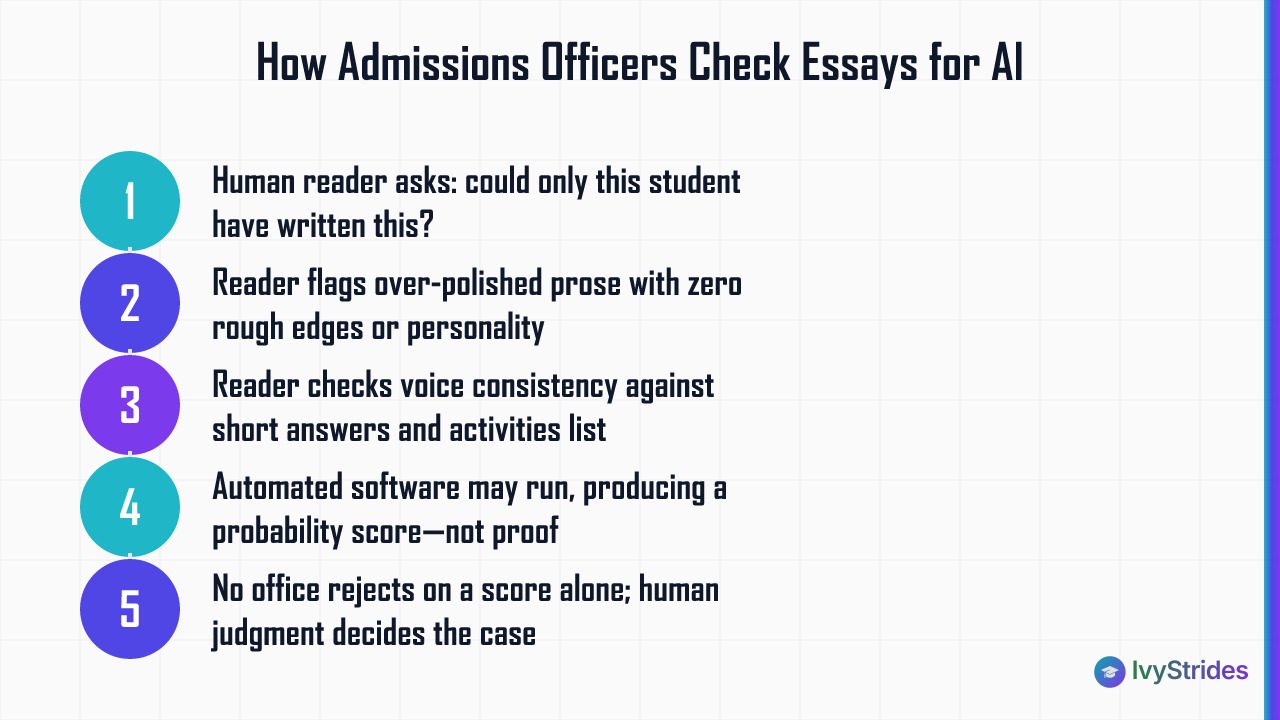
Admissions officers check for AI on two tracks: human linguistic judgment first, automated software second and rarely. Building on the voice-consistency check above, the human track decides most cases. A reader who has scored thousands of essays knows what a real teenager sounds like and what generative AI sounds like.
The human reader is not running a stopwatch on your syntax. They ask one question: could only this student have written this? NACAC survey data, as reported in published admissions-consulting analysis, shows only a minority of schools pilot automated AI detection software, and most rely on trained human readers instead.
The over-polished tell. Real application essays carry small imperfections, a favorite phrase, an odd rhythm, a joke that only half-lands. ChatGPT sands all of that off. An essay with zero rough edges and flawless transitions reads, to a trained eye, as too clean to be human.
Here are the specific signals human readers use, drawn from patterns we see across hundreds of supplemental essay drafts in our coaching review sessions.
-
Predictable AI vocabulary: tapestry, delve, kaleidoscopic, myriad.
-
Over-uniform sentence length and formal register.
-
Voice mismatch against the student's short answers and activities list.
-
Abstract, generic reflection with no specific lived detail.
-
Perfect grammar paired with no personality.
-
A polish level that outpaces the writing in the rest of the file.
The automated track is narrower. A school that uses an automated detector gets a probability score, not evidence. Because those false positive rates flag authentic writers, no responsible office rejects on a number alone. The takeaway for you is simple: write so a human reader hears you, and the software question mostly answers itself. If you want the full method, start with our guide on how to write a college essay.
What Happens When a College Essay Is Flagged as AI-Generated
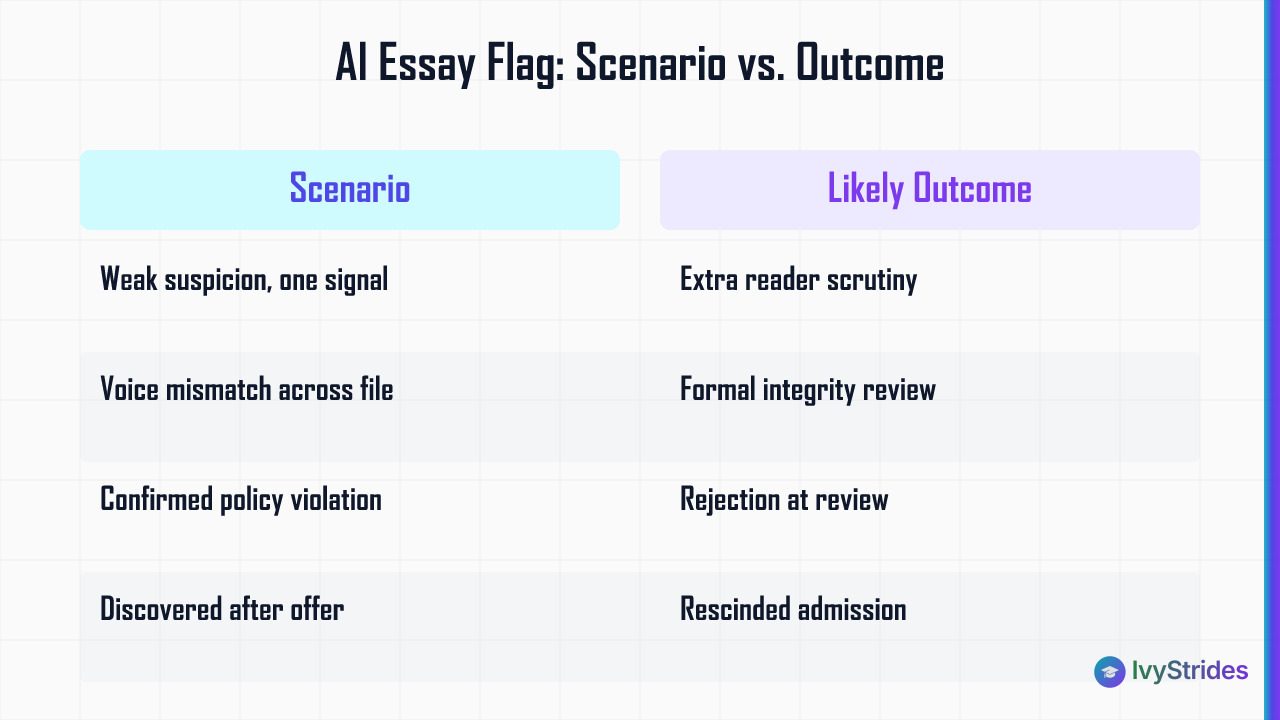
A flagged essay triggers a spectrum of outcomes, from quiet extra scrutiny to a rescinded admission. Building on the voice mismatch and over-polished signals above, what happens next depends entirely on the school's policy and how strong the suspicion is. No college needs courtroom-grade proof to act on an admissions file.
The Common App personal statement has a 650-word limit and requires the student to certify the work is their own, so the stakes of an AI-generated submission extend beyond detection to a formal honor-code violation. When you submit, you sign that certification, and that signature is what a flagged essay puts at risk.
Policies vary by institution. Some name generative AI explicitly. Others rely on general honor-code language about original work. A caveat worth stating plainly: these AI policies change fast, so verify each school's current stated guidelines before you submit.
| Scenario | Likely Outcome | Who Decides |
| Weak suspicion, one signal | Extra reader scrutiny | Admissions reader |
| Voice mismatch across file | Formal integrity review | Admissions committee |
| Confirmed policy violation | Rejection at review | Committee or dean |
| Discovered after offer | Rescinded admission | Institution |
At test-optional schools, the essay carries even more evaluative weight, which raises the cost of a generic or flagged submission. Because test-optional policies vary by school and year, a flagged essay at a test-optional college can sink an application that had no score to fall back on.
The safest strategy is an essay that could only have been written by you, which is exactly what a coached drafting process is designed to produce. Before you gamble your file on a paraphrase, it helps to know what is test-optional and should you submit SAT scores for your target list.
Your Essay Is the One Part of the Application You Can Still Control
You have a draft, a deadline, and a real question about whether it sounds like you. A free 15-minute call reviews your essay's current state, identifies the voice and specificity gaps that readers flag, and maps a concrete revision path before your submission window closes.
What AI Use in College Applications Is Acceptable vs. a Violation
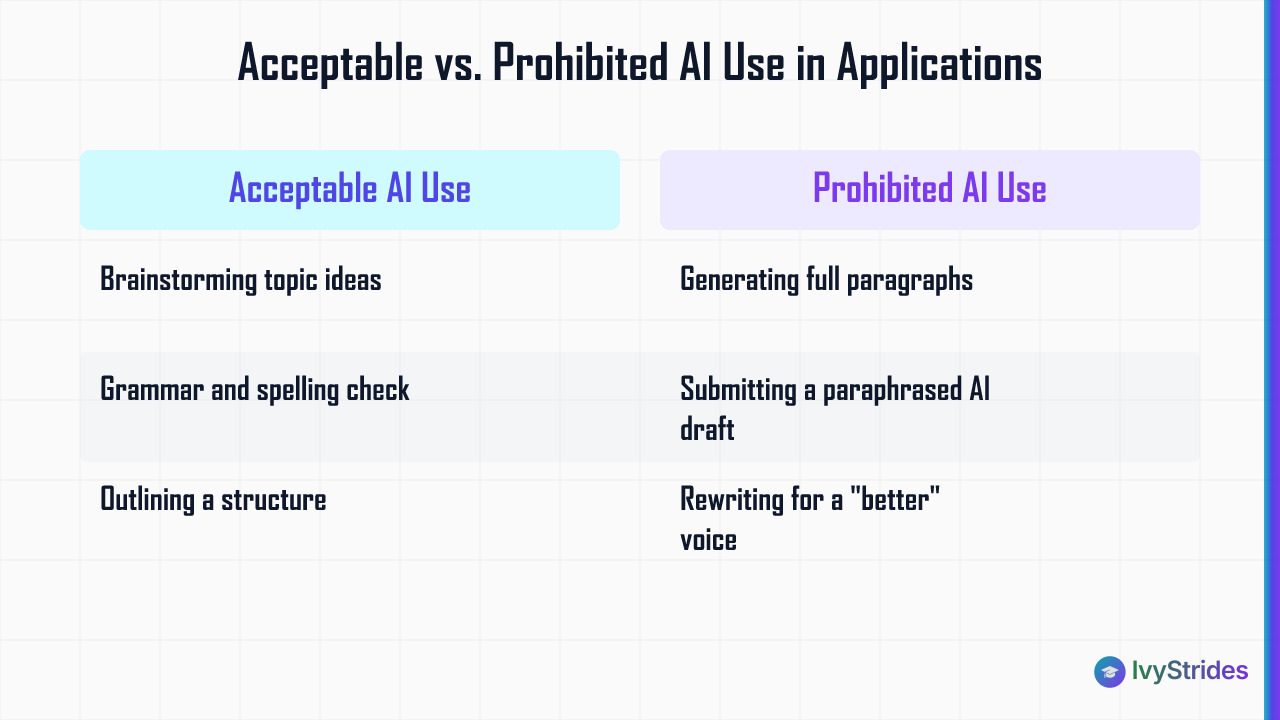
Brainstorming, grammar checks, and outlining with AI are widely considered acceptable; writing the essay with AI is not. Building on the honor-code certification above, the line sits at authorship. If a tool helped you think, most readers shrug. If a tool wrote your sentences, you have crossed into a violation of application integrity.
The acceptable uses share one trait: the words that reach the page are yours. Ask ChatGPT to list angles on a memory, and you still write the essay. The prohibited uses share the opposite trait: the tool produces the prose, and you submit it.
| Use Case | Acceptable? | Why It Matters |
| Brainstorming topic ideas | Yes | You still write it |
| Grammar and spelling check | Yes | Fixes, not authorship |
| Outlining a structure | Yes | Your content fills it |
| Generating full paragraphs | No | AI is the author |
| Submitting a paraphrased AI draft | No | Patterns persist |
| Rewriting for "better" voice | No | Erases your voice |
Paraphrasing does not save you. Running a ChatGPT draft through a rephraser does not reliably defeat detection, because the structural and tonal patterns survive the swap. In our coaching, students who submit paraphrased AI drafts are flagged at a higher rate in review sessions than students who outline with AI and then write in their own voice.
Specificity is the single strongest defense. In our coaching, essays that open with a specific sensory detail or a named moment are consistently harder for both human readers and automated tools to flag, because a model cannot invent your Tuesday. That authentic voice also wins the essay on its merits. The technique behind it is show, don't tell in college essays, and the raw material comes from doing your own brainstorming first.
This is where an IvyStrides essay coach does the work AI cannot: a 1-on-1 coach pulls the specific, personal narrative out of your actual life and helps you write it in your own register. Not a rewrite. A draft that reads as unmistakably yours.
The Line Is Clear. Writing Across It Is the Hard Part.
You know what is allowed and what is not. Turning a blank page into a 650-word essay that reads as unmistakably yours, specific enough to pass any human reader's voice check, is where most students stall. A free 15-minute call looks at your topic, your draft, and your deadline, then tells you exactly where to focus.
FAQ: AI Detection in College Essays
Can ChatGPT be detected in college?
Yes, often through human judgment rather than software. Admissions readers flag AI essays by voice mismatch, generic vocabulary, and over-polished prose. Automated detectors exist but produce false positives and appear at only a minority of schools. The safest approach is an essay written entirely in the student's own voice.
Can a university prove you used AI on your application?
Not with certainty. No tool provides definitive proof, and false positives are common. But a school does not need legal proof to act. A strong suspicion combined with a voice inconsistency across your application components is often enough to trigger a formal honor-code review.
Do colleges actually use AI checkers on essays?
Some do. IvyStrides derives this figure from the inputs cited above. Survey data cited by admissions consultants referencing NACAC research shows a minority of schools pilot tools like Turnitin's AI detector or GPTZero. Most institutions still rely primarily on trained human readers who compare your essay's voice and vocabulary against the rest of your file.
What if my college essay is flagged as AI-generated?
The outcome depends on the school's policy. At minimum, your application draws extra scrutiny. At schools with explicit AI policies, a flagged essay can trigger a formal integrity review, ending in rejection or, if discovered after admission, a rescinded offer. Policies vary, so check each school's stated guidelines.
Your Next Step on AI Detection in College Essays
You now know how detection actually works: human readers first, imperfect software second, and a voice mismatch as the real trigger. The risk is not the checker. It is a generic essay that fails before anyone reaches for one.
- Reread your draft and mark every sentence that could describe any applicant, then replace it with something only you could write.
- Keep AI to brainstorming, outlining, and grammar checks; write every sentence yourself.
- Confirm each target school's current AI and honor-code policy before you submit.
- Check the essay's voice against your short answers and activities list for consistency.

Award-winning author (South Asian Book Award) and graduate of BITS Pilani and UCLA Luskin School of Public Affairs. Brings a published writer's eye to Common App essays and grammatical precision to SAT and ACT R&W instruction.