
College Essay Editing: When to Revise and When to Start Over
On this page
- Revise or Restart: How to Diagnose Your College Essay Draft
- Red Flags in Your College Essay That Signal a Restart
- How to Edit a College Essay Draft Without Losing Your Voice
- Is It Okay to Use AI to Edit Your College Essay?
- FAQ: College Essay Editing
- How do I edit my college essay?
- Is it okay to use AI to edit college essays?
- Is a 300-word college essay too short?
- Where can I get free college essay editing?
- Your Next Step on the Revise-or-Restart Decision
College essay editing starts with one question: is the story the problem, or is the execution the problem? If your topic is specific, honest, and only you could have written it, revise. If the draft reads like a resume or opens on a platitude, starting over usually saves time.
That decision matters because every hour on the wrong draft is an hour you lose before the deadline. The Common App personal essay runs to a 650-word maximum (Common App first-year application, hosted by Harvard College). This guide gives you criteria for both paths and a two-pass editing process for the one you keep.
Revise or Restart: How to Diagnose Your College Essay Draft
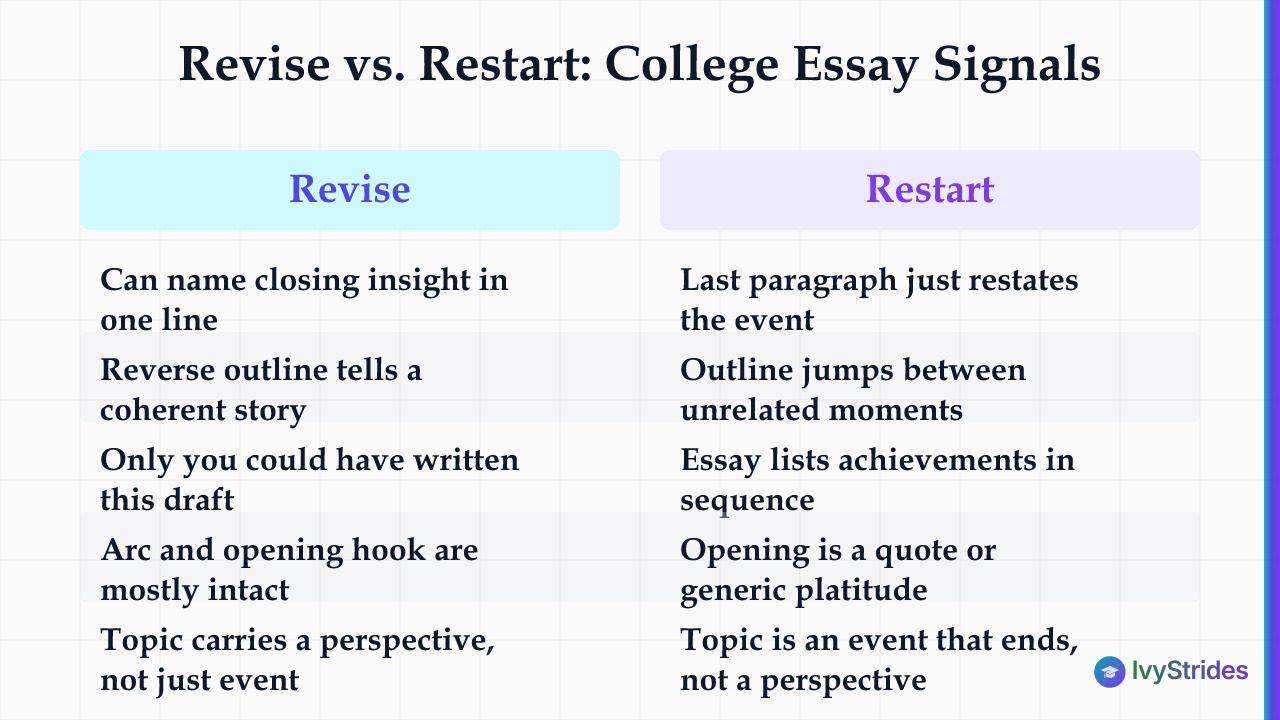
College essay editing is a decision process, not a grammar pass. Before you touch a single sentence, run two questions against your draft: does it carry a clear narrative arc, and can you name the closing insight in one sentence? If both answers are yes, you have a surface problem and you revise. If either is no, you may have a structural problem.
The "so what" test comes first. Read your last paragraph and ask what the essay actually argues about you. A strong closing insight tells an admissions reader something your transcript cannot. If the ending only restates the event, the topic has not earned 650 words yet.
Reverse outline before you decide. Write down the first sentence of each paragraph in order, then read that list on its own. A reverse outline exposes the real structure under the prose. If those sentences tell a coherent story, your opening hook and arc are mostly intact and you are revising. If they jump between unrelated moments, the problem is structural.
A draft can need a restart even when the writing is strong, if the topic cannot carry the weight of a 650-word personal statement because the student chose an event rather than a perspective. An event ends. A perspective can be examined from several angles, which is what fills a page with specificity.
One scheduling note lowers the stakes of this call: you get unlimited edits to the personal essay after your first application submission (Common App support). Submitting to an early college does not lock the essay for later ones. Once your own pass is done, getting college essay feedback means briefing a second reader without handing over your voice.
| Signal | What it means | Right path |
| You can name the closing insight in one line | Structure holds | Revise |
| Reverse outline tells a coherent story | Arc is intact | Revise |
| Only you could have written this draft | Voice is present | Revise |
| Essay lists achievements in sequence | Reads like a resume | Restart |
| Opening is a quote or generic platitude | Weak opening hook | Restart or rewrite hook |
| Last paragraph just restates the event | No "so what" | Restart |
Red Flags in Your College Essay That Signal a Restart
A start-over signal is any pattern that makes a draft structurally unsalvageable no matter how clean the sentences get. The reverse outline from the diagnostic above can surface these red flags before you finish reading.
The resume essay walks through activities in order: debate captain, then volunteer trip, then research internship. Your Common App activities section already holds up to ten activities, each with a 150-character details field (Common App). The essay is the one place to show a perspective, not re-list the achievements.
The trauma dump without insight describes a hard experience but never reflects on what it changed in how you think. The cliche topic, the generic platitude opening, and the "big game" narrative round out the set. These are structurally hard to make specific, and no line-level editing fixes a topic that cannot reach insight. Certain angles rarely survive revision, and the topics that work against a personal statement share this exact failure to reach a "so what."
One thing a restart does not mean: starting the whole application over. The seven Common App prompts are unchanged for 2026-27 (Common App), the seventh being an essay on any topic you choose. A draft written for last cycle still fits this year's prompts, so a restart rewrites the essay, not the plan around it.
If the checklist below surfaces problems you cannot resolve in two passes, that is your signal to bring in a coach who reads the draft before deadline pressure becomes acute. Ask for a read that starts from your existing draft and names whether the story or the execution is the problem before any revision begins.
Start-over checklist, does your draft have any of these:
- Reads like a sequential list of accomplishments
- Opens with a famous quote or a general truism
- Describes a hard event but never reflects on it
- Uses a topic many applicants use the same way
- Has no sentence only you could have written
- The closing paragraph restates the opening
- You cannot answer "so what?" in one line
How to Edit a College Essay Draft Without Losing Your Voice
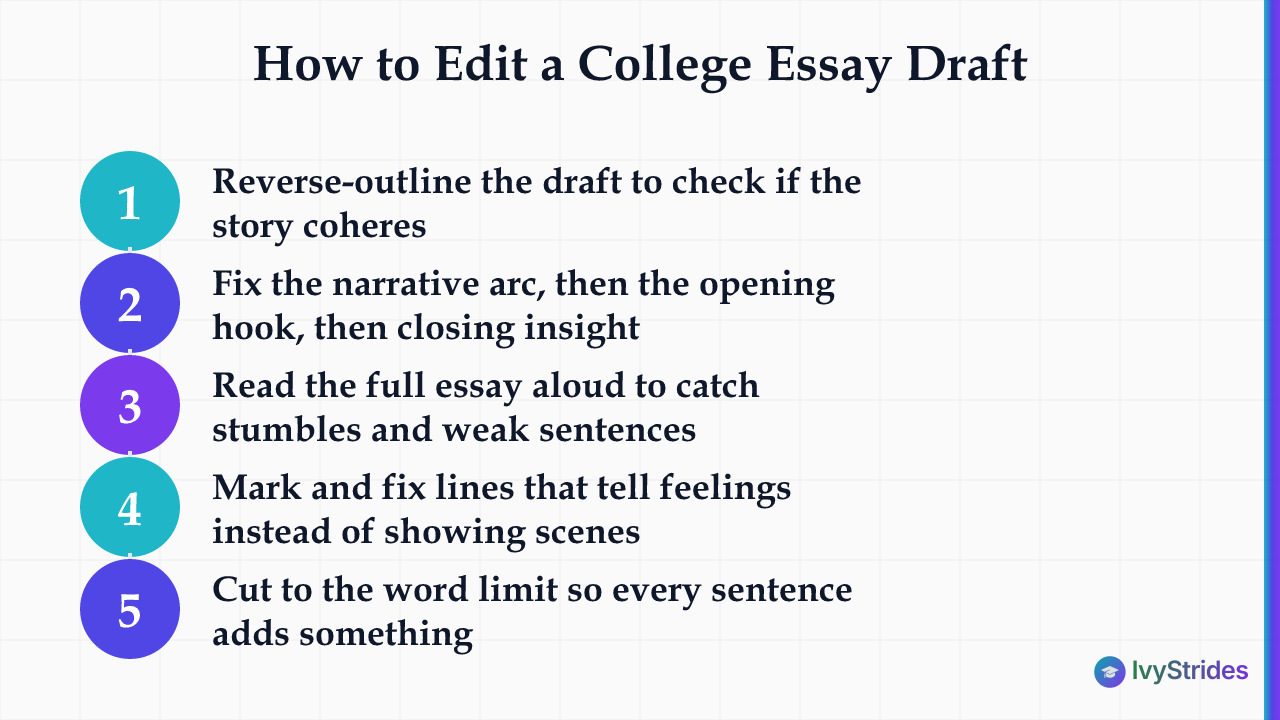
A college essay revision runs in two passes, structural first and line-level second, with voice preservation as the through-line.
Pass one is structural. Start from the reverse outline you built during the diagnostic. Fix the narrative arc, then the opening hook, then the closing insight, in that order. Never edit a sentence until the paragraph around it earns its place, because polishing a paragraph you later cut wastes the time you were trying to save.
Pass two is line-level. Read the whole essay aloud. Reading aloud catches what silent reading skips: the sentence you stumble over is the one a reader stumbles over too. Then mark each line that tells the reader what to feel rather than showing the scene that creates the feeling, and fix it by showing the scene instead of naming the emotion.
On a supplemental essay draft, review the opening sentence first, because you can revise it without rewriting the rest. Each college sets its own word count for those essays (Common App support), so check each one, and apply the same show-don't-tell discipline whatever the limit. One timing note: application deadlines end at 11:59 pm in your own local time zone, not the college's (Common App support). Still, finish the structural pass days ahead.
Voice preservation is where a parent's help needs the most care. Help with structure and typos; resist rewriting sentences into an adult register. If feedback keeps overwriting how you sound and two passes have not resolved it, a coach who improves structure while keeping the student's own voice is the reader to ask next.
| Step | What to do | What to look for |
| 1 | Reverse-outline the draft | Does the story cohere? |
| 2 | Fix the narrative arc | Each paragraph moves forward |
| 3 | Sharpen the opening hook | A scene, not a platitude |
| 4 | Name the closing insight | One line only you could write |
| 5 | Read aloud, line by line | Stumbles, telling, filler |
| 6 | Cut to the 650-word limit | Every sentence adds something |
Is It Okay to Use AI to Edit Your College Essay?
AI editing tools can catch grammar and flag awkward phrasing, but they cannot judge whether your story is the right one. An AI model does not know your closing insight, your specificity, or your emotional truth, so it optimizes toward correct and generic, which is not the same as good.
Voice flattening is the real risk. Caltech's admissions guidelines warn that relying on AI to craft your essay dilutes your own expression and perspective (Caltech). Common App's fraud policy counts it as fraud to pass off the substantive output of an AI platform as your own original work (Common App). Colleges can set their own AI rules, so check each one, and keep these tools to a final grammar check, never a paragraph rewrite.
| Task | AI tool useful? | Why or why not |
| Spotting comma and tense errors | Yes | Pattern-matching, low risk |
| Flagging a run-on sentence | Yes | Mechanical, you approve the fix |
| Choosing which story to tell | No | It cannot weigh your real life |
| Judging specificity and insight | No | No sense of what only you lived |
| Rewriting a paragraph in "better" prose | No | Flattens your voice |
Each college decides whether the personal essay is required or optional (Common App support), and the essay is one part of a full application, never a guarantee on its own. An AI grammar pass does not change that, so put the time into a draft only you could have written.
FAQ: College Essay Editing
How do I edit my college essay?
Start with a structural pass. Reverse-outline the essay by writing down the first sentence of each paragraph, then check whether those sentences tell a coherent story. Fix structure before you fix sentences. Then do a line-level pass, reading aloud to catch awkward phrasing, and cut any sentence that does not add new information or feeling.
Is it okay to use AI to edit college essays?
AI tools can flag grammar errors and awkward phrasing, which helps. The risk is voice flattening: an AI rewrite can swap your phrasing for formal, generic sentences. Passing off AI-written content as your own work also counts as fraud under Common App's policy, and colleges can add their own rules. Use AI for a final grammar check, not for rewriting paragraphs, and read the result aloud to confirm it still sounds like you.
Is a 300-word college essay too short?
For the Common App personal statement, 300 words sits well under the 650-word maximum and is usually too short to develop a story with real specificity and insight. Common App's own instructions treat 650 words as a limit, not a goal, so use the room your story needs. For a supplemental essay with a 250-word cap, 300 words would exceed the limit, so always check each college's stated number.
Where can I get free college essay editing?
Free options include your school's writing center, a trusted teacher who already knows your voice, and peer readers who can tell you what they remember after one read. Free AI grammar tools catch surface errors. For structural feedback on whether the story itself is working, ask a reader with admissions-essay experience rather than a general proofreader.
Your Next Step on the Revise-or-Restart Decision
The editing decision is a time-allocation problem, and you can settle it today.
- Build a reverse outline and read the paragraph openers on their own.
- Run the "so what" test on your closing paragraph.
- Check your draft against the start-over checklist above.
- If it passes, start the structural pass; if it fails, choose a new angle before you write a word.

Award-winning author (South Asian Book Award) and graduate of BITS Pilani and UCLA Luskin School of Public Affairs. Brings a published writer's eye to Common App essays and grammatical precision to SAT and ACT R&W instruction.