
Is a 28 a Good ACT Score? What 26, 28, and 30 Mean for College Admissions

On this page
- What a 28 ACT Score Actually Means: Percentile and National Context
- Which Colleges Are Realistic With a 28 ACT Score?
- Should You Retake the ACT After a 28? A Practical Decision Framework
- Can You Get Into a Top School With a 28? What Harvard and Highly Selective Colleges Actually See
- How Hard Is It to Score a 28 on the ACT? Putting the Number in Perspective
- What Is a 28 ACT Score Equivalent to on the SAT?
- From 28 to 30 or 32: A Realistic Score-Improvement Plan
- Frequently Asked Questions About a 28 ACT Score
- Is a 28 ACT score good enough for scholarships?
- Is a 28 a good ACT score for a sophomore taking the test for the first time?
- Should I submit a 28 ACT score to test-optional schools?
- What does a 28 composite look like if my section scores are uneven?
- Is a 27 ACT score meaningfully different from a 28?
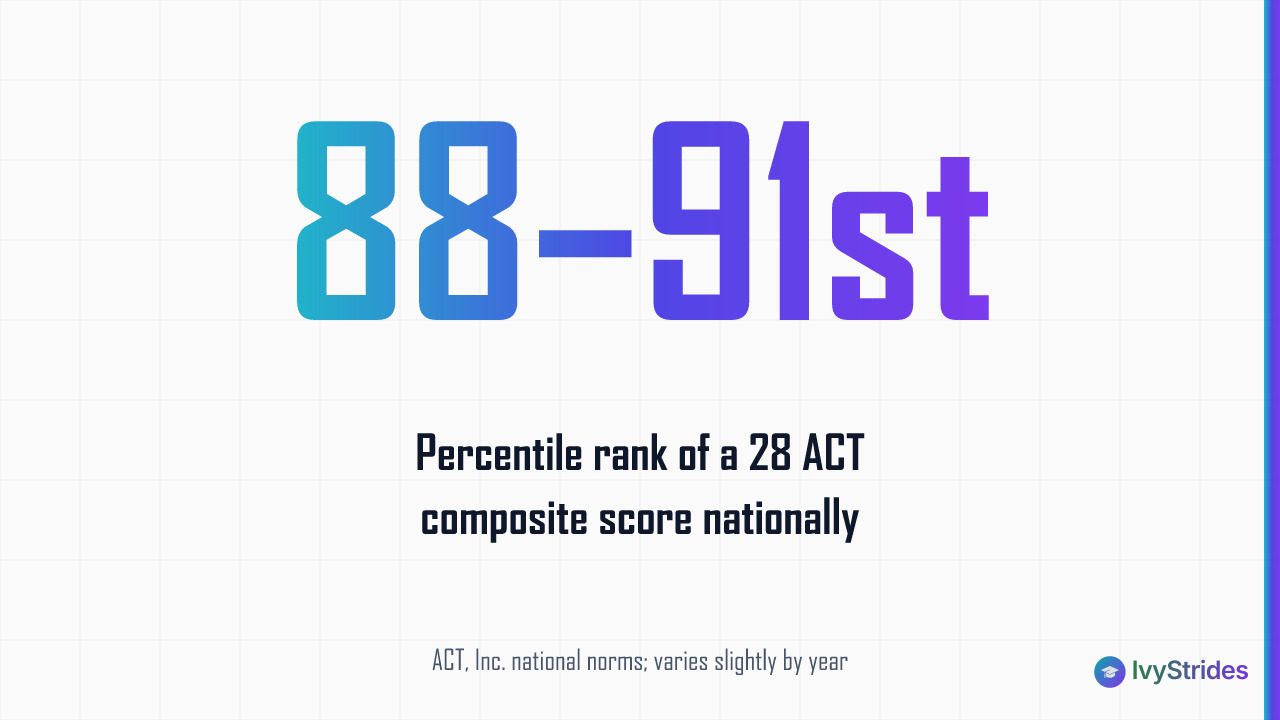
Yes, a 28 is a strong ACT composite. Per ACT, Inc. national norms, a 28 sits at roughly the 88th to 91st national percentile, meaning you scored higher than about 9 in 10 test-takers. It's competitive at many selective colleges and clears merit scholarship thresholds at a range of public universities. It falls below the middle 50% range at highly selective schools, where typical admitted students score 33 or higher.
These percentile figures come from ACT, Inc.'s annually published national norms. The harder question, and what the rest of this article answers, is whether your 28 is good enough for your specific target list, and whether the prep hours needed to push it to 30 or 32 are a better investment than redirecting that time to essays and AP scores.
What a 28 ACT Score Actually Means: Percentile and National Context
The ACT composite runs on a 1 to 36 scale, calculated as the average of four section scores: English (75 questions, 45 minutes), Math (60 questions, 60 minutes), Reading (40 questions, 35 minutes), and Science (40 questions, 35 minutes). A 28 composite means the average of your four section scores rounds to 28.
The national average ACT composite hovers around 20 to 21. A 28 sits roughly eight points above that average. Per ACT, Inc.'s national norms, a 28 places you in approximately the 88th to 91st percentile depending on the testing year. Percentile values shift slightly each year as ACT, Inc. updates the norms tables.
Here's the part most students miss. A 28 composite can hide significant section imbalance. A student with a 24 in Math and a 32 in Reading averages to 28. So does a student with 28s straight across. Those two profiles look identical on a transcript and lead to very different prep plans. The first has one obvious lever to pull. The second requires more distributed work.
That distinction matters more than the composite number itself when you sit down to plan a retake.
Which Colleges Are Realistic With a 28 ACT Score?
A 28 is typically competitive at many selective colleges and sits near or within the middle 50% range at most state flagships per published Common Data Set figures. It's typically below the median at highly selective schools.
Some illustrative examples (verify each via the school's current Common Data Set before applying):
- University of Georgia: middle 50% ACT roughly 27 to 33. A 28 sits comfortably inside.
- University of Wisconsin-Madison: middle 50% roughly 27 to 33. A 28 is within range.
- University of Texas at Austin: middle 50% roughly 27 to 34. A 28 is at the lower end of competitive.
- Penn State, Indiana University, University of Pittsburgh: a 28 is at or above the median.
At highly selective schools, the picture changes. MIT, Harvard, Yale, Princeton, and Columbia typically report middle 50% ACT ranges of 34 to 36 per their published Common Data Set figures. A 28 is typically materially below these medians.
A 28 paired with a compelling Common App personal statement and strong supplemental essays can outperform a 30 with a generic application at many selective schools. Admissions readers are reading thousands of files. A score that clears the threshold and an essay that lands beats a higher score and a forgettable one, almost every time.
Test-optional policies vary by school and year, so a 28 that falls below a school's middle 50% range may be better withheld at certain institutions. Check each school's current policy via the FairTest tracker before deciding whether to submit. A handful of schools still review the optional ACT Writing section, so if your target list includes any that request it, a strong essay score can complement your 28 composite. We cover that in detail in our breakdown of the ACT Writing test and how to score 11+.
On merit aid: many public universities (University of Alabama, University of Mississippi, and others) set automatic merit scholarship thresholds at 28 to 30 composite. These dollar amounts and cutoffs shift year to year, so verify on each school's financial aid page. A one-point gain from 27 to 28, or 28 to 30, can be worth thousands of dollars in renewable aid.
If Notre Dame is on your list, read Should You Apply to the University of Notre Dame for a candid look at where a 28 lands in that admit pool.
Should You Retake the ACT After a 28? A Practical Decision Framework
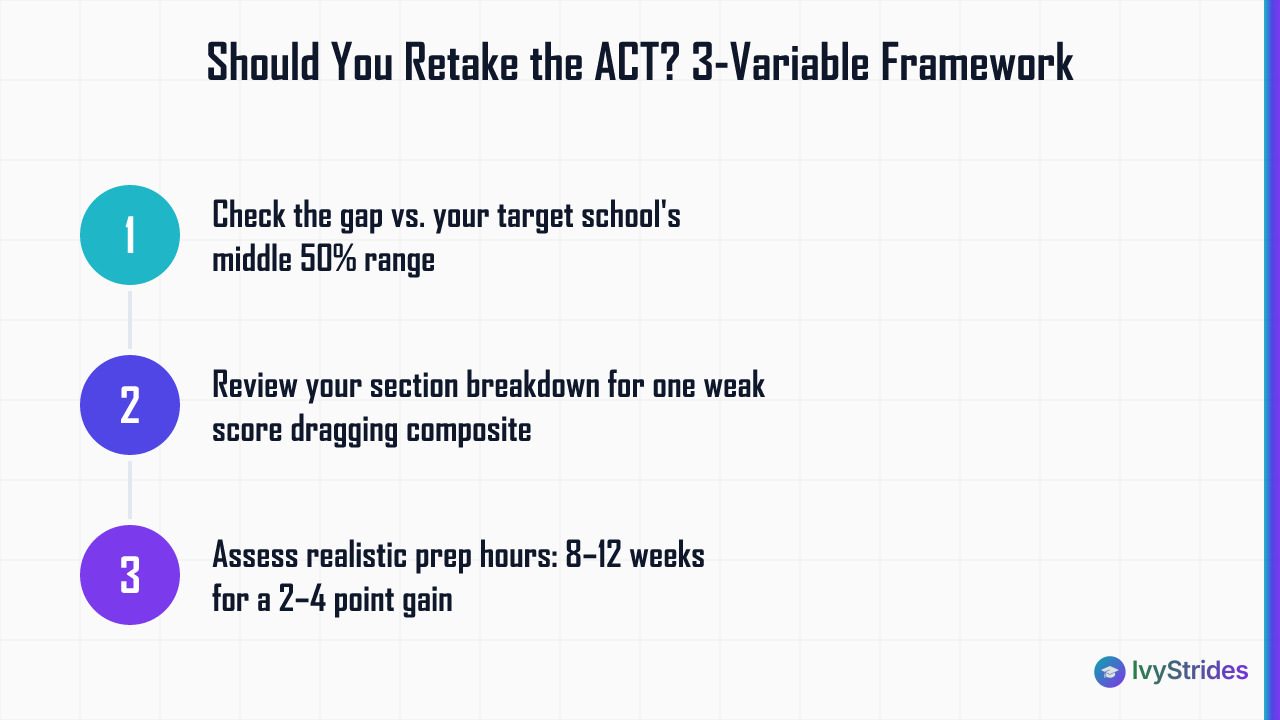
Retaking after a 28 is a strategic call, not an automatic one. Three variables decide it.
1. The gap between your current score and your target school's median per their published Common Data Set. If your highest-reach school has a middle 50% starting at 30, you have a real gap to close. If all your target schools sit at 25 to 30 middle 50%, you're typically already in range, and your prep hours may have higher ROI elsewhere.
2. Your section-score breakdown. In our coaching, a 28 with a single weak section (say, a 24 in Math) is typically the most promising retake profile we see per ACT's official prep guidance. Closing that one section often lifts the composite 2 to 3 points without touching the others. A 28 across all four sections is harder to move because the work spreads thin.
3. Realistic prep hours available before the next test date. In our coaching with students starting at a 28 composite, a focused 8 to 12 week prep cycle targeting the weakest one or two sections typically yields a 2 to 4 composite point gain. Reaching 32 or higher from 28 generally takes 12 to 20 weeks of consistent work.
Here's the asymmetry that surprises most students. Moving from 24 to 28 is often faster than moving from 28 to 32. The 28 to 32 range requires mastery of ACT Math trigonometry and advanced algebra, ACT Reading paired passages and inference questions, and ACT Science conflicting viewpoints sets. These are the question types ACT, Inc. uses to separate scorers in the top decile, and they don't yield to general review.
Retake clearly makes sense when:
- Your target school median is 30 or higher and you're at 28.
- One section (often Math or Science) is dragging an otherwise stronger profile.
- You have at least 8 weeks before your next test date and 6 to 8 prep hours per week available.
Retake may not be the priority when:
- All your target schools have medians at or below 28.
- You have limited prep time and stronger ROI sits in essay work or AP score preparation.
- You've already retaken twice and section scores have plateaued.
A junior we worked with last fall had a 28 composite with a 24 in Math, 30 in English, 29 in Reading, and 29 in Science. Ten weeks of focused work on ACT Math trigonometry and advanced algebra (not general review of all four sections) lifted her to a 31 on retake. The Math section moved from 24 to 29. The other three held.
If you're already at 28 and wondering what the next milestone looks like, our breakdown of what a 32 ACT score means for highly selective admissions shows exactly which doors open at that range.
Once you decide to retake, locking in a test date is the first concrete step. The full ACT test dates and registration deadlines for 2026 are listed in our schedule guide. For students who want section-specialist support, our 1-on-1 ACT prep pairs you with coaches who focus exclusively on one section.
Can You Get Into a Top School With a 28? What Harvard and Highly Selective Colleges Actually See
Honest answer: a 28 is typically well below the median at the most selective schools in the country. Per current Common Data Set reports, Harvard's middle 50% ACT range typically runs roughly 34 to 36. Yale, Princeton, Columbia, and MIT typically report similar ranges, 34 to 36 with some variation by year.
Under test-optional policies, submitting a 28 to these schools is unlikely to help and may hurt. The straight recommendation: either withhold the score, or invest in a retake targeting 33 or higher. Test-optional policies vary by school and year, so always verify the current policy directly via the school's admissions page or the FairTest tracker.
Now, the nuance. Holistic review means a 28 doesn't automatically disqualify a student. Admissions readers consider essays, AP exam scores, recommendation letters, course rigor, extracurricular depth, and demonstrated interest. Students do get admitted to highly selective schools with below-median scores. The rest of the application has to be exceptional. Not strong. Exceptional.
A 28 applicant to Harvard needs the kind of personal statement and supplementals that admissions officers remember. Strong AP exam scores (4s and 5s across multiple subjects) help signal academic readiness when the test score is below median. National-level extracurricular accomplishment helps. A unique angle helps.
If Ivy-level schools are on your list, our breakdown of Apply to Cornell University in 2026 covers the academic profile that competes at that tier. For another Ivy angle, see Should You Apply to Brown University for the full-application read.
How Hard Is It to Score a 28 on the ACT? Putting the Number in Perspective
A 28 puts you above roughly 9 in 10 test-takers nationally. Fewer than 1 in 10 students who sit for the ACT score at this level or higher. By any reasonable measure, that's hard.
The implication of a 28 depends heavily on when you scored it.
For a sophomore on a first attempt: a 28 is an excellent starting point. You have one to two years before application deadlines and meaningful room to build toward 30 to 32 through a structured improvement cycle. Sophomores at 28 are often students with strong reading skills who haven't yet covered all the Math content tested (precalculus, trigonometry, harder algebra II topics). The natural arc of junior-year coursework alone tends to lift Math scores.
For a junior on a second or third attempt: a 28 may represent a plateau. General review won't move it. What moves it is targeted section work on the specific question types holding you back.
In our coaching with students at the 28 composite level, the pattern is consistent. Strong ACT English scores (grammar and rhetoric rules are learnable and stick), with a weaker section in ACT Math (trigonometry, complex algebra at the 28+ band) or ACT Science (data interpretation under tight pacing) dragging the composite down.
One misconception worth correcting. The ACT Science section is not a science knowledge test. It tests data reading, graph interpretation, and experimental reasoning under time pressure. Students who prep it as a content test waste hours. Students who prep it as a pacing and pattern-recognition test improve fast.
To benchmark where you stand, you can take a full-length act practice test online under timed conditions.
What Is a 28 ACT Score Equivalent to on the SAT?
Per the official College Board and ACT, Inc. concordance table, an ACT composite of 28 corresponds to approximately an SAT score of 1310 to 1340. See College Board's SAT Suite for the full concordance reference.
Concordance is approximate, not exact. Both scores are accepted equally at virtually every US college, so you don't need to convert for submission purposes. Where concordance matters is the test-selection decision: if your SAT practice score is materially higher than your ACT score (say, an SAT diagnostic equivalent to an ACT 31 or 32), switching tests may be more efficient than continuing ACT prep.
Before committing to another ACT prep cycle, it's worth confirming the ACT is the right test for you. Our ACT vs SAT: which test is right for you comparison walks through format, timing, and scoring differences so you can make that call with data. If you want a more focused take on relative difficulty, see is the SAT harder than the ACT.
From 28 to 30 or 32: A Realistic Score-Improvement Plan

Photo by Andy Barbour on Pexels
Here's the methodology we use with students starting at a 28. Four steps.
Step 1: Take a full-length official ACT practice test under timed conditions. Real timing. No breaks beyond the official ones. This establishes a true baseline and, more importantly, reveals which section is dragging the composite down. Without this diagnostic, you're guessing.
Step 2: Analyze section scores and sub-scores to find the highest-use weakness. A 24 in Math means trigonometry and advanced algebra are the targets. A 25 in Science means pacing on conflicting viewpoints passages is the issue. A 26 in Reading often means inference and paired-passage questions. Diagnose first. Drill second.
Step 3: Work with a section-specialist coach on targeted weakness drills, not general review. In our coaching, students who focus on their two weakest question types per section see faster composite gains than students who review everything. A Math specialist who works exclusively on ACT Math (not a generalist tutor covering all four sections) brings a different level of pattern recognition.
Step 4: Retest on a second full-length practice test after typically 4 to 6 weeks per ACT's official prep guidance. Measure retention. Recalibrate. In our coaching, if the targeted section moved 2 to 3 points and the others held steady, the plan is working. If the targeted section moved but another dropped, fold that section into the next cycle.
Timeline reality check:
- 28 to 30: typically 6 to 10 weeks of focused prep. At 6 to 8 hours per week, that's roughly 40 to 60 total hours.
- 28 to 32: typically 12 to 20 weeks at the same weekly cadence, roughly 80 to 120 total hours.
These ranges assume consistent weekly work and a clear weakness diagnosis. Individual results vary based on starting section profile, prep consistency, and time available before the next test date. For students completing the IvyStrides 1-on-1 ACT program, a 4+ composite point gain is typical.
For more on how we structure section-specialist work, see our ACT prep overview. You can also meet the section-specialist ACT coaches who handle each section.
Frequently Asked Questions About a 28 ACT Score
Is a 28 ACT score good enough for scholarships?
Often, yes. Many public universities set automatic merit scholarship thresholds at 28 to 30 composite, so a 28 can qualify at a range of schools. Thresholds vary by institution and change year to year, so verify directly on each school's financial aid or scholarship page before assuming eligibility. A one-point gain from 28 to 29 or 30 can unlock several thousand dollars in renewable aid at certain institutions.
Is a 28 a good ACT score for a sophomore taking the test for the first time?
Yes. A 28 as a first attempt in sophomore year is a strong starting point. With one to two years before application deadlines, a student at this level has a realistic path to 30 to 32 through a structured, diagnostic-driven prep cycle. Sophomores at 28 are particularly well-positioned because junior-year math coursework naturally lifts the Math section score over time.
Should I submit a 28 ACT score to test-optional schools?
It depends on the school's middle 50% range. If a 28 falls within or above the school's reported range, submitting is generally neutral to positive. If the school's middle 50% starts at 30 or higher, withholding the score and strengthening other application components is often the better strategy. Check each school's current test-optional policy at FairTest and on the institution's admissions page. For broader context on what's required in 2026, see do colleges still require the SAT in 2026.
What does a 28 composite look like if my section scores are uneven?
A 28 composite can mask significant section-score variation. A student with a 24 in ACT Math and a 32 in ACT Reading averages to 28, but has a clear, targetable weakness. In our coaching, identifying and closing that single-section gap is often the fastest path to a 30+ composite. A 28 with even scores across all four sections is harder to move because the work spreads across multiple skill areas.
Is a 27 ACT score meaningfully different from a 28?
A 27 typically sits at roughly the 85th percentile, compared to 88th to 91st for a 28 per ACT's published percentile ranks. The practical admissions difference is small at most schools. But a 28 crosses certain merit scholarship thresholds that a 27 does not. If you're at 27, a one-point gain to 28 may be worth targeting specifically for scholarship eligibility.
A 28 is a real accomplishment. Whether it's the right score to submit, or the right score to retake, comes down to your target list, your section breakdown, and the hours you have before your next test date. None of those answers come from a percentile table. They come from looking at your actual scores against your actual schools.

Award-winning author (South Asian Book Award) and graduate of BITS Pilani and UCLA Luskin School of Public Affairs. Brings a published writer's eye to Common App essays and grammatical precision to SAT and ACT R&W instruction.