
How the Digital SAT Is Scored: Adaptive Modules and the 1600 Scale

On this page
- The Short Answer: How the Digital SAT Is Scored
- How the Adaptive Module Routing Works (And Why It Sets Your Score Ceiling)
- Not Sure Which Module Is Capping Your Score?
- From Raw Answers to a Scaled Score: How the Conversion Actually Works
- The Two Sections in Detail: R&W and Math Question Counts, Time, and Content
- How a Digital SAT Score Is Calculated: A Step-by-Step Walkthrough
- What Your Digital SAT Score Actually Means: Percentiles and College Context
- When Digital SAT Scores Are Released and Where to Find Them
- How the Digital SAT Scoring Compares to the Old Paper SAT
- What a Perfect 1600 Requires (And What It Means for Your Application)
- How IvyStrides Uses the Scoring Structure to Build Your Prep Plan
- FAQ
- How is a digital SAT score calculated step by step?
- Is the digital SAT graded on a curve?
- Is 1200 out of 1600 a good SAT score?
- Is a 1600 SAT or 36 ACT harder to achieve?
- How long does it take to get digital SAT scores after the test?
- Can I tell which Module 2 I received during the test?
- Does the digital SAT have a wrong-answer penalty?
- How does superscoring work with the digital SAT?
- Ready to Turn Scoring Knowledge Into a Higher Score?
Same number of questions right as your friend, 80 points apart on the score report? You're not imagining it.
The digital SAT is scored on a 400–1600 scale. It has two sections, Reading and Writing (R&W) and Math, each scored 200–800. Within each section, you complete two adaptive modules. Your performance in Module 1 determines whether you receive an easier or harder Module 2. A harder Module 2 unlocks higher scaled scores. An easier Module 2 caps your section score at roughly 620–630 regardless of how many questions you answer correctly. Raw scores (one point per correct answer, no penalty for wrong answers) are converted to scaled scores using Item Response Theory equating, which accounts for question difficulty. Per College Board, the scale and structure have been in place since the digital SAT launched in March 2024.
That's the whole engine in one paragraph. The rest of this article unpacks why it matters for your prep.
The Short Answer: How the Digital SAT Is Scored
Hold these numbers in your head before anything else.
The exam runs 98 questions across 2 hours and 14 minutes. R&W is 54 questions in 64 minutes, split into two 32-minute modules. Math is 44 questions in 70 minutes, split into two 35-minute modules. Every correct answer earns one point. Wrong answers and blank answers both score zero. That's it for the raw scoring rules.
Raw scores then convert into two section scores between 200 and 800, which add up to your 400–1600 composite. The conversion isn't a flat curve. It's an equating process that factors in which Module 2 version you received, which is where most of the confusion (and most of the score difference between you and your friend) comes from.
Want a sense of how this fits into your test day? Our breakdown of how long is the SAT walks through the full timing block by block.
How the Adaptive Module Routing Works (And Why It Sets Your Score Ceiling)
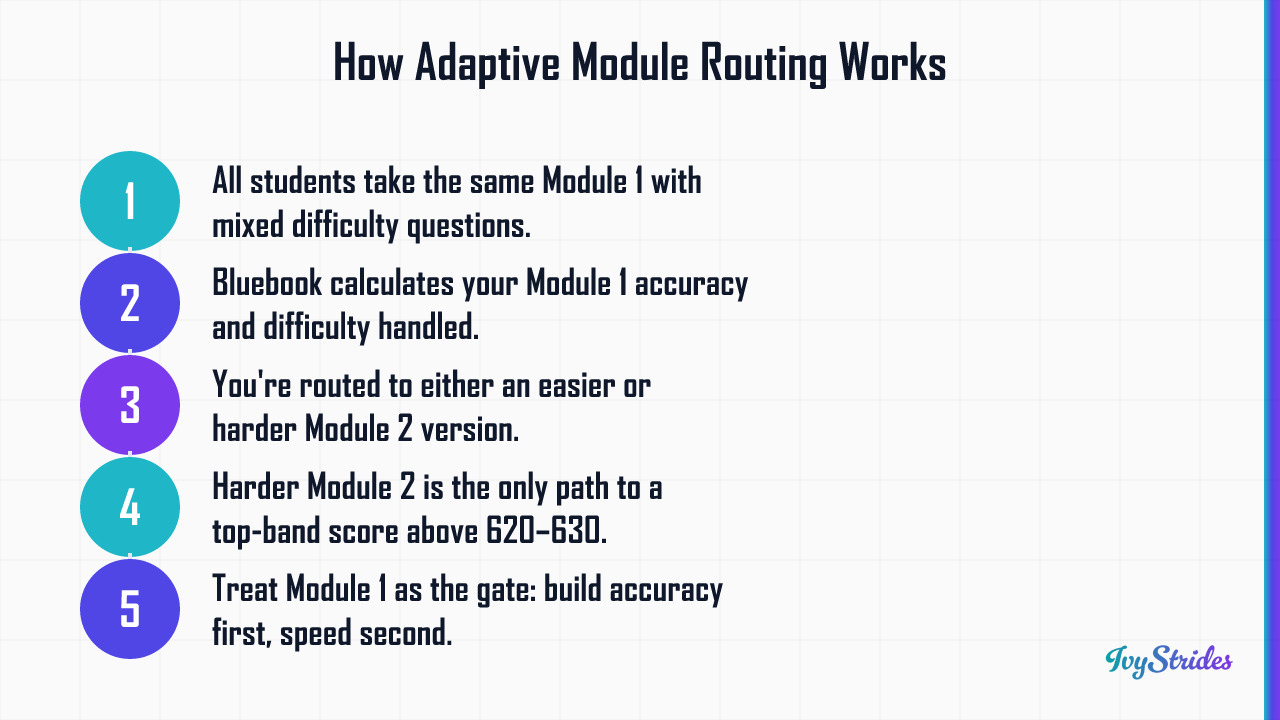
This is the part the College Board page glosses over, and it's the single most important mechanic to understand.
Every student starts each section with the same Module 1, a mix of easier, medium, and harder questions. When you finish Module 1, the Bluebook app does an invisible calculation. Based on how many questions you got right and which difficulty levels you handled, it routes you into one of two Module 2 versions: an easier Module 2 or a harder Module 2.
Here's the part most students miss. The harder Module 2 is the only path to a top-band score. If you get routed to the easier Module 2, your section score caps at approximately 620–630, even if you answer every single question on that module correctly. In our coaching with students in the 1100–1300 band, the most common reason for a score plateau is being routed to the easier Module 2 in R&W, typically because of accuracy gaps in the Standard English Conventions or Craft and Structure domains in Module 1.
Because Module 1 performance determines which Module 2 you receive, pacing and accuracy in the first 27 R&W questions carry more strategic weight than most students realize, a point covered in depth in our guide to the Information and Ideas domain on the digital SAT. The same logic applies to grammar. If conventions errors are dragging your Module 1 accuracy, our piece on Standard English Conventions on the SAT covers the high-frequency rules.
The Bluebook app handles the adaptive routing invisibly between modules, so understanding the app's interface before test day removes one variable from an already high-stakes morning. You won't see a label telling you "this is the harder Module 2." Students sometimes guess based on how difficult the questions feel, but that's not a reliable signal mid-test. Focus on accuracy, not diagnosis.
The tactical implication is simple. Treat Module 1 as the gate. Build accuracy first, speed second.
Not Sure Which Module Is Capping Your Score?
In a free 15-minute strategy call, an IvyStrides coach will review your practice test results, identify your module routing pattern, and tell you exactly which content domains to target first. No obligation, no sales pitch.
From Raw Answers to a Scaled Score: How the Conversion Actually Works
Say you finish the test with 40 out of 44 correct in Math. What turns that into a number between 200 and 800?
The conversion uses something called Item Response Theory (IRT) equating. In plain language: IRT looks at how hard each question you saw actually was, statistically, based on data from thousands of test-takers. It then converts your raw score into a scaled score that reflects both how many questions you got right and how difficult those specific questions were.
Is the digital SAT graded on a curve? Not in the way most students mean. A traditional curve adjusts your score based on how the other students who took your test performed. IRT doesn't work that way. It adjusts based on the calibrated difficulty of the questions themselves. Two students who answered 40 out of 44 Math questions correctly can receive different scaled scores if one was routed to the harder Module 2 and one to the easier. The student on the harder Module 2 will score higher, because the equation rewards the difficulty of the items handled.
This is why a digital SAT scoring chart, the kind you'd use to estimate your score from a practice test, has to be specific to the practice test you took. College Board publishes a conversion table for each official practice exam. If you want help running the numbers, our sat calculator walks through the estimation step by step.
If your student has already taken the PSAT/NMSQT, they have already experienced the same adaptive two-module structure. The PSAT simply uses a 320–1520 scale instead of 400–1600, making it a direct preview of how digital SAT scoring feels. For students still in 9th or 10th grade, our PSAT practice tests give the same Bluebook-style experience. For a deeper look at how the PSAT scale maps onto National Merit and the SAT, see our explainer on psat score range.
The Two Sections in Detail: R&W and Math Question Counts, Time, and Content
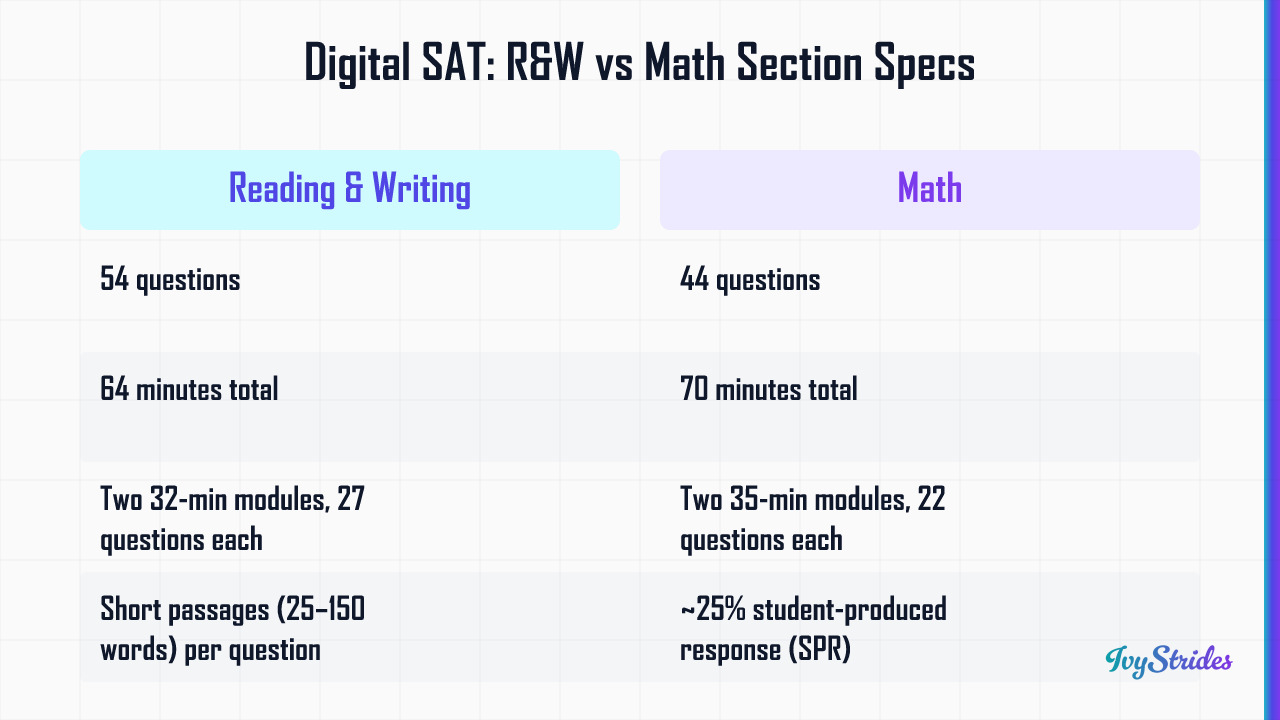
Concrete specs, section by section.
Reading and Writing (R&W): 54 questions, 64 minutes, split into two 32-minute modules of 27 questions each. Each question is paired with its own short passage or passage pair, typically 25 to 150 words. No long reading passages with five questions attached. That was the old paper format. Questions fall into four content domains: Information and Ideas (comprehension and inference), Craft and Structure (vocabulary in context, text structure, cross-text comparisons), Expression of Ideas (rhetorical synthesis, transitions), and Standard English Conventions (grammar and punctuation).
Math: 44 questions, 70 minutes, split into two 35-minute modules of 22 questions each. Calculator is allowed on every Math question, including Module 1. The Bluebook app has the Desmos graphing calculator built in, which is genuinely powerful if you know how to use it for systems of equations, function graphing, and inequality regions. Roughly a quarter of Math questions are student-produced response (SPR), meaning you type in the answer rather than choose from four options.
Two things to notice. First, R&W has more questions per minute than Math, so pacing pressure is sharper there. Second, because Math allows calculator use throughout, the "calculator-allowed vs. no-calculator" strategy from the old paper SAT no longer applies. For a full breakdown of the question distribution, see how many questions are on the SAT. If geometry is your weak spot, our refresher on SAT geometry formulas covers the formulas you actually need.
How a Digital SAT Score Is Calculated: A Step-by-Step Walkthrough
Just finished a practice test and want to know what you'd score? Here's the sequence:
-
Count correct answers per section. That's your raw score. Maximum is 54 for R&W and 44 for Math. Wrong answers and blank answers both count as zero. There is no guessing penalty, ever.
-
Identify which Module 2 you received. On an official Bluebook practice test, the app does this automatically. On a paper-and-pencil simulation, you'll need a scoring chart that specifies the module difficulty path.
-
Apply IRT equating. The raw score and the Module 2 difficulty band combine to produce a scaled section score between 200 and 800. College Board's official scoring page describes the methodology.
-
Add your section scores. R&W section score + Math section score = your 400–1600 composite.
One practical note. An official Bluebook practice test produces an estimated composite using the same adaptive engine the real exam uses. That's the closest preview you can get. Paper-based practice tests can approximate scores but can't replicate the routing decision. For practice materials and conversion tables, browse our free downloads. When you're ready to schedule the real thing, check SAT test dates 2026 for upcoming windows.
What Your Digital SAT Score Actually Means: Percentiles and College Context
A number on a screen isn't meaningful until you know what it represents. Here's the rough percentile map, drawn from College Board's published distribution data:
- 1200: roughly 74th percentile. You scored higher than about three-quarters of test-takers.
- 1300: roughly 87th percentile.
- 1400: roughly 95th percentile.
- 1500: roughly 99th percentile.
- 1600: above the 99th percentile. Fewer than 1% of test-takers reach this score.
The average digital SAT score sits around 1010–1020, based on College Board's most recent published cohort data. For more on what specific score bands signal, see our read on is 1540 a good sat score. For the mid-range, see is a 1300 sat good.
Now the admissions piece. A 1200 is a competitive score at many four-year colleges but falls below the typical mid-50% range at highly selective schools. The University of Pennsylvania's recent Common Data Set shows a mid-50% range of roughly 1510–1570, which means half of admitted students scored in that band. Our explainer on upenn sat requirements digs into the specifics.
Two important caveats. Test-optional policies vary by school and year. Many selective colleges allow students to apply without submitting scores, but policy details shift annually. Check FairTest and each college's admissions page for current rules. Second, even at score-required schools, admissions decisions depend on the full application: GPA, course rigor, essays, recommendations, and extracurriculars. A strong score opens doors. It doesn't unlock them.
Superscoring adds another layer. Many colleges will combine your highest R&W score from one test date with your highest Math score from another, producing a higher composite than either single sitting. That changes retake strategy. If your Math jumped 60 points but R&W dropped 20, the superscore captures the gain.
Once you understand how the scoring engine works, the natural next question is how long it realistically takes to move your score, which our digital SAT score improvement timeline guide answers with specific hour-count and week-count benchmarks.
When Digital SAT Scores Are Released and Where to Find Them
Digital SAT scores typically post within a few days of the test date, much faster than the two-to-three week wait of the old paper format. You'll find them in your College Board student account at satsuite.collegeboard.org.
Your score report includes the 400–1600 composite, the two section scores (R&W and Math), subscores broken out by content domain, and cross-test indicators. The domain-level detail is what coaches care about most, because it shows you whether your gap is in Standard English Conventions versus Craft and Structure, or in algebra versus advanced math.
For the specific release date tied to your test administration, our calendar in when do SAT scores come out is updated each season. When you're ready to send scores to schools, our guide on how to send SAT scores to colleges walks through the process and the fee structure.
How the Digital SAT Scoring Compares to the Old Paper SAT
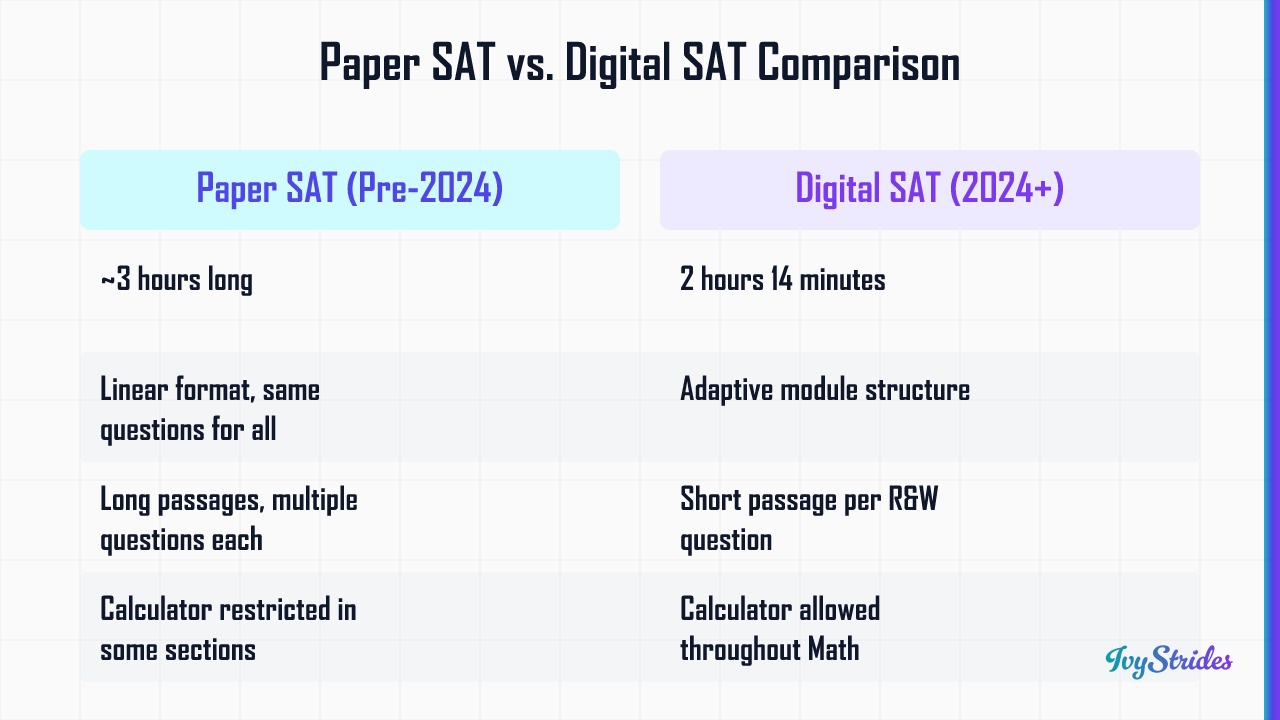
The scale is the same. The structure isn't.
Pre-March 2024, the SAT was a linear, paper-and-pencil test. Every student got the same questions in the same order. Sections were longer, the test ran nearly four hours including the optional essay, and the scoring used a more traditional equating model without adaptive routing.
The digital SAT keeps the 400–1600 scale and the two-section format. Per College Board, scores between the paper SAT and the digital SAT are designed to be comparable on the same scale. A 1400 means roughly the same thing in terms of percentile and college admissions context regardless of which format was taken.
What changed: the test is shorter (2 hours 14 minutes vs. about 3 hours), each R&W question has its own short passage instead of long passages with multiple questions attached, calculators are allowed throughout Math, the optional essay was discontinued, and the adaptive module structure replaced the linear format. Tracking down a score from a pre-2024 administration? Our piece on how to find old SAT scores covers the steps.
What a Perfect 1600 Requires (And What It Means for Your Application)
A 1600 is rare. Fewer than 1% of test-takers reach it (College Board score reports).
On the digital SAT, the mechanical requirements are clear. You need to be routed to the harder Module 2 in both R&W and Math, and you need to answer essentially every question correctly across all four modules. The routing requirement matters more than students assume. Even an exceptional test-taker who slips on two or three Module 1 questions can find themselves stuck on the easier Module 2, capped at roughly 630 in that section, walking out with a 1230 instead of a 1500.
Is a 1600 SAT harder than a 36 ACT? Both are extremely rare. A similar fraction of test-takers earn each. The deeper answer: neither is required for admission anywhere, including the most selective colleges in the country. Admissions committees evaluate the full application, and a 1540 with stronger essays and rigorous coursework will outperform a 1600 with weak supplemental materials.
For a deeper look at what a perfect score actually requires and what it signals to colleges, see our analysis of the highest SAT score possible. If your target list includes Ivies, our piece on is 1500 a good SAT score for Ivy League is the more useful benchmark for most students.
How IvyStrides Uses the Scoring Structure to Build Your Prep Plan
Knowing how scoring works is step one. Step two is using that knowledge to target the right things.
Every IvyStrides prep plan starts with a full-length Bluebook diagnostic. Not a short quiz. Not a few sample questions. A real practice test. In our coaching, students who complete a full-length Bluebook practice test before their first session consistently show us a clearer picture of their module routing pattern than any short quiz can provide. That diagnostic tells us two things: which Module 2 the student is currently routing to in each section, and which content domains are driving the accuracy gap.
From there, the plan gets specific. A junior we worked with last fall scored 580 R&W on her first diagnostic and routed to the easier Module 2 every time. We didn't drill random R&W questions. We targeted the Module 1 accuracy gap, specifically Information and Ideas and Standard English Conventions, with a section-specialist coach who teaches R&W full-time. Six weeks later, she was consistently routing to the harder Module 2 and scored 680 R&W on her next official test. That's not magic. That's diagnostic, targeted weakness work, and spaced retesting, applied in the right order.
Math gets a different coach who teaches Math full-time. No generalists. This is one of the structural reasons typical outcomes for students completing the program land around 200+ points of improvement. We work the lever that actually moves the score, which is Module 1 accuracy and routing. Not every student hits that number, and we don't promise it; results depend on starting score, hours invested, and timeline. But the methodology is the same regardless of band.
If you want to see how this works for your student's specific score band, our 1-on-1 SAT prep page lays out the structure. You can also meet the tutors who specialize by section. For students focused on the math section, browse our online SAT Math tutor roster whose Math score is the limiting factor. For students balancing SAT prep with AP coursework, our ap classes online are taught by per-subject specialists, because AP and SAT prep together form one connected admissions strategy.
FAQ
How is a digital SAT score calculated step by step?
First, count your correct answers in each section to get your raw score. There's no penalty for wrong answers. Then College Board applies Item Response Theory equating, which factors in the difficulty of the Module 2 you received, to convert your raw score to a scaled section score between 200 and 800. Add both section scores for your 400–1600 composite. The harder your Module 2, the higher your potential scaled score for the same number of correct answers.
Is the digital SAT graded on a curve?
Not in the traditional sense. The digital SAT uses Item Response Theory (IRT) equating rather than a simple curve. IRT accounts for the difficulty of the specific questions you answered, particularly which Module 2 you received, when converting your raw score to a scaled score. Two students with the same number of correct answers can receive different scaled scores if they were routed to different Module 2 difficulty levels.
Is 1200 out of 1600 a good SAT score?
A 1200 places a student at approximately the 74th percentile nationally (College Board BigFuture), scoring higher than about three-quarters of test-takers. It's a competitive score for many four-year colleges but falls below the typical mid-50% range at highly selective schools, which often start at 1400+. Whether 1200 is "good enough" depends on the student's target college list. Test-optional policies at many schools mean a strong application can offset a score in this range.
Is a 1600 SAT or 36 ACT harder to achieve?
Both are extremely rare. Fewer than 1% of test-takers achieve a 1600 on the SAT, and a similar fraction score a 36 on the ACT (College Board score reports). On the digital SAT, a 1600 requires being routed to the harder Module 2 in both sections and answering every question correctly, a combination that demands consistent accuracy and strong Module 1 performance. Neither score is required for admission to any college, including the most selective.
How long does it take to get digital SAT scores after the test?
Digital SAT scores are typically released within a few days of the test date, significantly faster than the paper-based format. College Board posts scores to your student account at satsuite.collegeboard.org. Exact release dates vary by administration, so check the specific test date's score release schedule on the College Board site or our SAT test dates guide.
Can I tell which Module 2 I received during the test?
No. The Bluebook app doesn't label modules as "easy" or "hard" during the exam. Students sometimes perceive a harder Module 2 as more difficult, but this isn't a reliable signal in the moment. The only way to know which module you received is to review your score report after results are released. In our coaching, we advise students not to try to assess module difficulty mid-test, because it disrupts focus.
Does the digital SAT have a wrong-answer penalty?
No. The digital SAT awards one point for each correct answer and zero points for incorrect or blank answers. There's no deduction for wrong answers. Students should always attempt every question, even if they need to make an educated guess. Leaving a question blank and answering it incorrectly have exactly the same effect on your raw score.
How does superscoring work with the digital SAT?
Superscoring means a college takes your highest section score from each test date and combines them into a new composite. If you scored 680 R&W and 620 Math on one date, then 650 R&W and 700 Math on another, your superscore would be 680 + 700 = 1380. Many colleges superscore the digital SAT, but policies vary, so always check the specific college's Common Data Set or admissions page. Superscoring makes strategic retaking more valuable.
The scoring engine isn't mysterious once you see it: raw answers, Module 2 routing, IRT equating, section scores, composite. Where most students lose points isn't on the questions they think are hard. It's on Module 1 accuracy in domains they could have nailed with targeted prep.
Ready to Turn Scoring Knowledge Into a Higher Score?
Understanding how the digital SAT is scored is step one. Step two is a personalized plan that targets your specific Module 1 accuracy gaps and routes you to the harder Module 2. Book a free 15-minute call with an IvyStrides section-specialist coach to get your diagnostic snapshot and a concrete next step.

Two decades teaching quantitative and verbal aptitude on standardized tests. Rare dual expertise across Math and Verbal — particularly effective for students with gaps on both sides. Senior AP Mentor for our Calculus and English tracks.