
How to Send SAT Scores to Colleges in 2026 (Step-by-Step Guide)
On this page
- Quick Answer: How to Send SAT Scores
- 3 Ways to Send SAT Scores to Colleges (And Which One You Should Choose)
- 1. Free Score Reports During SAT Registration (Pre-Test Submissions)
- 2. Sending Scores After SAT Results Are Released (Post-Test Submission)
- 3. Archived or Mail-In Score Requests
- How Much Does It Cost to Send SAT Scores in 2026?
- How Long Does It Take to Send SAT Scores?
- When to Send SAT Scores to Colleges (Deadline Guide for 2026–27)
- Early Decision & Early Action Deadlines
- Regular Decision Deadlines
- Scholarship & Rolling Admissions Deadlines
- SAT Score Choice: Which Scores Should You Send?
- How to Send SAT Scores to the Common App
- Self-Reporting vs. Official SAT Score Reports
- How to Send SAT Scores for Free
- How to Send SAT Scores to International Universities
- Can I Send SAT Scores After the Application Deadline?
- Can Parents Send SAT Scores on Behalf of Students?
- Common Mistakes When Sending SAT Scores (And How to Avoid Them)
- What Is an SAT Score?
- Why Send Your SAT Scores?
- Who Should Receive Your Scores?
- Where Do You Send SAT Scores?
- How to Get SAT Scores Early
- SAT Score Sending FAQs
- How Can Parents Support SAT Score Reporting?
- IvyStrides Strategy: Send Smart, Not Scared
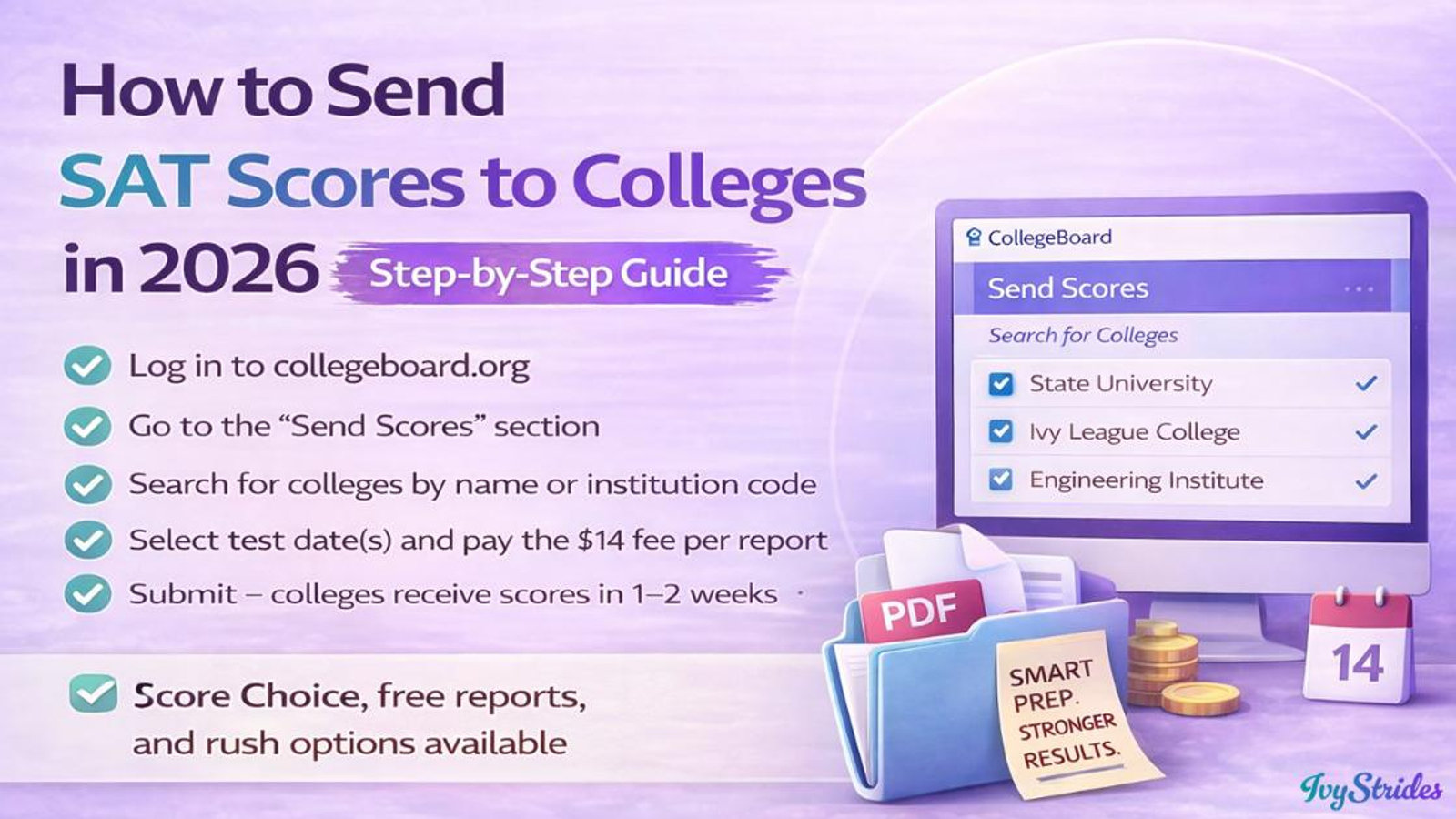
Quick Answer: How to Send SAT Scores
Here's the short version:
-
Log in to your College Board account at collegeboard.org.
-
Go to the "Send Scores" section.
-
Search for colleges by name or 4-digit institution code.
-
Select the SAT test date(s) you want to send (use Score Choice if available).
-
Pay the fee ($14 per report, or free if you selected colleges during registration).
-
Submit - colleges receive scores in 1–2 weeks (standard) or 2–4 business days (rush).
That's it. Keep reading for the full breakdown of every method, cost, timeline, and strategy for the 2026–27 admissions cycle.
Most students choose to send their SAT scores after they are released, which allows them to review their results and select which test dates to send. Scores are usually sent digitally and take about 1–2 weeks to reach colleges. You can also choose between standard delivery (included in the base fee) and rush reporting, which delivers scores in 2–4 business days for an additional cost. Keep in mind that scores are not sent on weekends or holidays, so planning around college deadlines is essential.
At IvyStrides, we help you achieve your best SAT scores through our SAT prep programs. We provide strategic practice test series, mentorship, counseling, and effective guidance to help you send your scores the smart way. Our expert mentors guide you step by step on what scores to send, where to send them, and when - so you can reduce stress while studying for the SAT and focus on what matters.
From choosing your best scores to understanding college requirements, we make sure your scores reach the right place at the right time, without stress. Because at IvyStrides, sending scores is part of scoring success.
3 Ways to Send SAT Scores to Colleges (And Which One You Should Choose)
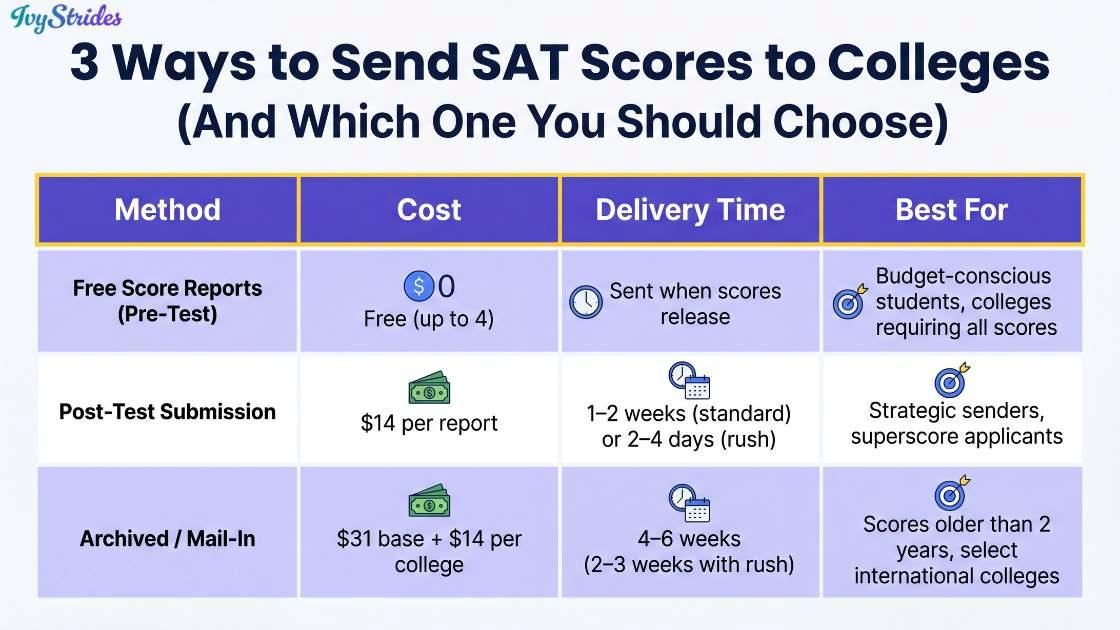
Once you've completed the SAT, the next big step is making sure your scores reach the right colleges. But did you know there are multiple ways to send your SAT scores, and that each method comes with its own pros and cons?
Each college may evaluate your scores differently, and how, when, and where you send them can directly impact your admission chances. Whether you're aiming to save money, play it safe, or deal with special circumstances like older scores or international colleges, it's essential to understand your options.
Here's how to choose the best way to send your SAT scores for the 2026–27 admissions cycle.
1. Free Score Reports During SAT Registration (Pre-Test Submissions)
When you register for the SAT on the College Board website, you're offered four free score reports. You must select the colleges to receive them before test day. These reports are sent automatically after your scores are available.
Important: You also have a 9-day window after test day to add or change your four free score recipients. After that window closes, you'll need to pay for additional reports.
Step-by-Step Process:
-
Go to collegeboard.org and sign in or create an account.
-
Begin SAT registration by selecting a test date and center.
-
During registration, you'll be prompted to enter up to four college codes (use the College Board's code lookup tool).
-
Complete payment and submit your registration.
-
Your scores will be sent to the selected colleges once the results are released.
Pre-Test SAT Score Submission is Best For:
- Budget-conscious students
- Students applying to colleges that require all SAT scores
- Confident test-takers aiming for target scores on their first try
Limitations of Sending SAT Scores When You Register:
- You can't review your score before it's sent
- No option to use Score Choice
- Not ideal if you're unsure of your performance
Colleges That Require All Scores: Harvard, Yale, Stanford, and Georgetown require all scores, so early submission may work well for them.
2. Sending Scores After SAT Results Are Released (Post-Test Submission)
This method is ideal for students who want to take a strategic approach to score sending, particularly when applying to colleges that offer superscoring , where your highest section scores from multiple test dates are combined for a better overall score.
By waiting until your SAT scores are released, you have the advantage of reviewing your performance before deciding which scores to send and to which colleges. This allows you to present your best possible academic profile.
To find out exactly when your scores will be available, check our guide on when SAT results come out.
However, it's crucial to monitor application deadlines closely, as score processing and delivery can take several days to a couple of weeks. Planning ahead ensures your scores arrive on time without added stress.
Step-by-Step Process:
-
After taking the SAT, wait for your scores to be released (typically 10–14 days).
-
Log in to your College Board account.
-
Go to the "Send Scores" section.
-
Search for colleges by name or institution code.
-
Select the specific test date(s) you want to send using Score Choice.
-
Review your selections and complete payment.
-
Submit your request.
-
Colleges will typically receive the scores within 1–2 weeks.
Post-Test Submission is Best For:
- Students applying to colleges that superscore
- Students wanting to review their scores first
- Strategic score submission across multiple schools
Limitations of Sending Scores After Results Are Released:
- Each report costs $14
- Might miss early deadlines if you delay
- Needs active tracking of score release dates
Colleges That Superscore: NYU, Boston University, the University of Chicago, and Cornell combine your best section scores across different test dates.
3. Archived or Mail-In Score Requests
This method should be used only if your SAT was taken more than two years ago, as these scores are no longer available through the standard online system. Additionally, some international colleges or institutions with manual admissions processes may request scores to be sent in this format.
Since this process is slower and involves higher fees compared to digital submissions, it's important to plan well in advance to avoid missing deadlines or facing delays in application review.
Step-by-Step Process:
-
Download and print the Archived Score Report Request Form from the College Board website.
-
Fill out the form with:
- Your personal details
- Test date and location
- Colleges you want to send scores to
-
Include payment: $31 base fee + $14 per score recipient.
-
Optional: add $31 for rush service.
-
Mail or fax the completed form and payment to the College Board address/fax number listed on the form.
-
Allow 4–7 weeks for processing (or 2–3 weeks with rush service).
Mail-In Requests Are Best For:
- Students with older test dates (2+ years)
- International colleges with limited digital infrastructure
Limitations of Mail-In Requests:
- Takes longer (up to 5–7 weeks)
- Extra fees apply
- Risk of delay or loss in the mail
Mail-Only or Hybrid Colleges: Some smaller international universities or less tech-enabled institutions in Eastern Europe, Africa, or Southeast Asia may require this method.
How Much Does It Cost to Send SAT Scores in 2026?
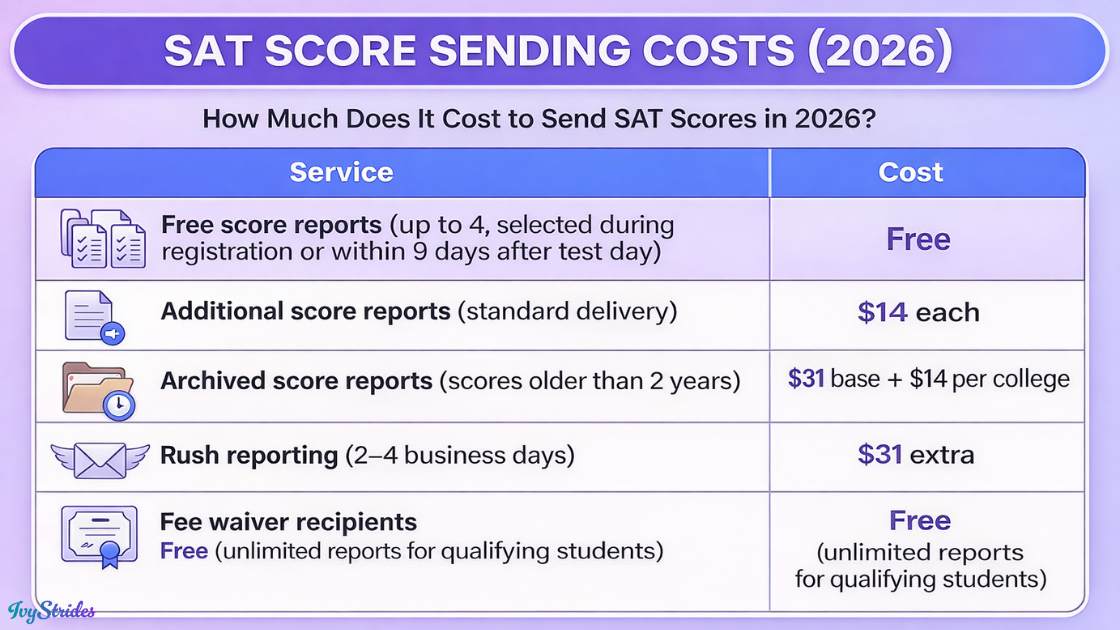
Here's a quick breakdown of all College Board score-sending fees for 2026:
| Service | Cost |
| Free score reports (up to 4, selected during registration or within 9 days after test day) | Free |
| Additional score reports (standard delivery) | $14 each |
| Archived score reports (scores older than 2 years) | $31 base + $14 per college |
| Rush reporting (2–4 business days) | $31 extra |
| Fee waiver recipients | Free (unlimited reports for qualifying students) |
Fee Waivers: If you received an SAT fee waiver, you're eligible for unlimited free score reports. Check with your school counselor to confirm your eligibility. According to the College Board, students who qualify for fee waivers based on family income can send scores at no cost.
How Long Does It Take to Send SAT Scores?
This is one of the most common questions we hear. Here's a clear timeline:
| Delivery Method | Processing Time | Best For |
| Standard delivery | 1–2 weeks | Regular Decision, early planning |
| Rush reporting | 2–4 business days | Tight deadlines, ED/EA cutoffs |
| Archived (mail-in) | 4–7 weeks (2–3 weeks with rush) | Older scores, international mail |
Important Notes:
- Scores are not processed on weekends or holidays.
- Processing begins after your scores are released - SAT results typically come out 10–14 days after test day. Check our guide on when SAT results come out for exact dates.
- "Delivered" means sent to the college , it may take an additional 1–3 days for the school to match scores to your application file.
- To confirm receipt, check your college application portal or contact the admissions office directly.
When to Send SAT Scores to Colleges (Deadline Guide for 2026–27)
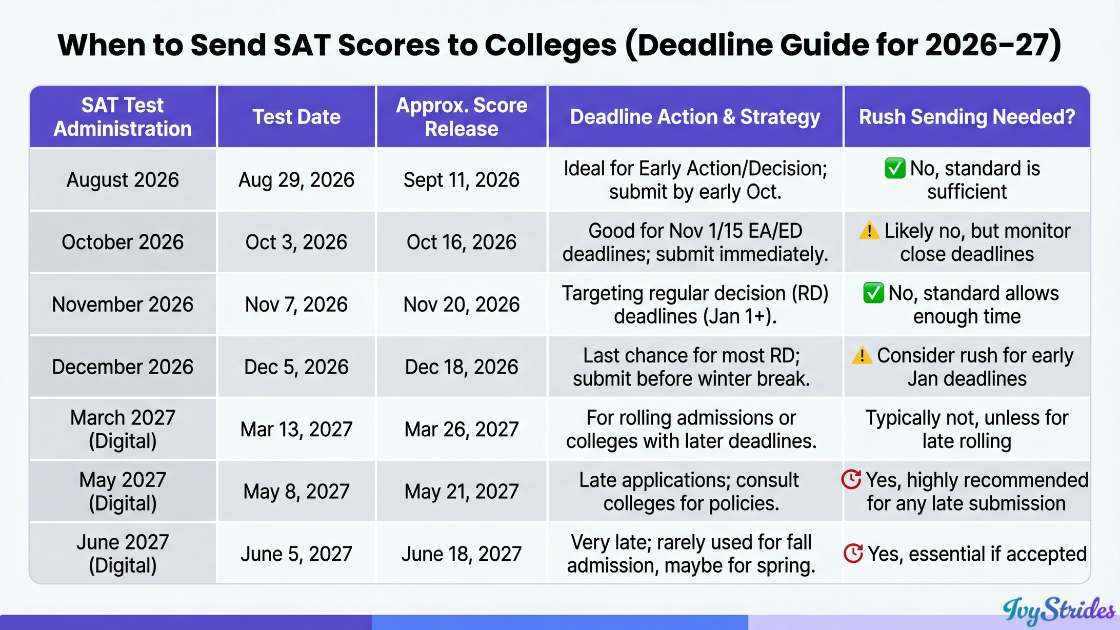
Timing is everything when it comes to sending your SAT scores. SAT scores are typically released 2 to 3 weeks after your test date, and if you're using standard delivery, it takes an additional 1–2 weeks for colleges to receive them.
Always allow for a minimum of 3–4 weeks between your SAT date and your earliest application deadline, unless you're using rush reporting. That means you need to plan ahead to avoid missing critical application deadlines.
Early Decision & Early Action Deadlines
Early Decision (ED): Most ED deadlines fall around November 1. Send your scores immediately after they're released. Since these deadlines are tight, you can't afford delays. Consider rush reporting if scores come out close to the cutoff date.
Early Action (EA): Typically due between November 1 and November 15. The same urgency applies - send scores as soon as they're available.
***Pro Tip:***If you're taking the October SAT and applying ED/EA, your scores should be released in mid-to-late October. Use rush reporting as a safety net if your deadline is November 1.
Regular Decision Deadlines
Regular Decision (RD): Most RD deadlines fall between January 1 and January 15. You have a bit more flexibility. Sending your scores within a week or two of release usually ensures they arrive on time. Still, don't delay , colleges may start reviewing applications as they arrive.
Scholarship & Rolling Admissions Deadlines
Scholarship Deadlines: Some merit-based scholarships have early deadlines, often as early as October or November. Don't assume your scholarship deadline matches your application deadline - check each program individually.
Rolling Admissions: These colleges review applications as they come in. In this case, the earlier, the better. Sending your SAT scores soon after they're released gives you the best shot at early review and scholarship consideration.
| Deadline Type | Typical Date Range (2026–27) | When to Send Scores |
| Early Decision (ED) | November 1, 2026 | Immediately after release; use rush if needed |
| Early Action (EA) | November 1–15, 2026 | Immediately after release |
| Regular Decision (RD) | January 1–15, 2027 | Within 1–2 weeks of release |
| Scholarship | October–December 2026 | As early as possible |
| Rolling Admissions | Ongoing | The earlier, the better |
If You're Retaking the SAT: Hold off on sending your scores until you've received results from your latest attempt. But be careful - this only works if your new scores arrive before your college's deadline. If you're cutting it close, use rush reporting or send the earlier scores just in case. Not sure how many attempts you should plan for? Read our guide on how many times you can take the SAT.
SAT Score Choice: Which Scores Should You Send?
Score Choice is a College Board feature that lets you choose which SAT test dates to send to colleges. It's available for most schools and gives you control over your score profile.
Rules Around Score Choice and Superscoring:
- Score Choice: You choose which test dates to send; available for most colleges.
- Superscoring: Some colleges combine your best section scores across dates. This means sending multiple test dates can actually help you.
- Strategy: Send multiple dates if your section scores improved over time.
Which scores are competitive enough to send? That depends on the school. For example, if you're wondering what a 1520 SAT score means for your applications, that score is competitive at nearly every school in the country. Our mentors at IvyStrides typically recommend sending scores that fall within or above a college's middle 50% range.
Colleges that require all scores: Some schools - like Harvard, Yale, Stanford, and Georgetown - ask you to send scores from every test date. For these schools, Score Choice doesn't apply. If you're applying to Carnegie Mellon, check their specific policy, as it may differ from other selective schools.
How to Send SAT Scores to the Common App

You cannot upload or send SAT scores directly through the Common App. The Common App only allows you to self-report scores. Official score reports must be sent separately through the College Board.
Here's how to handle both:
Step 1 - Send official scores via College Board:
-
Log in to your College Board account.
-
Go to the "Send Scores" section.
-
Search for each college by name or 4-digit institution code.
-
Choose the SAT dates you want to send.
-
Pay the fee (if applicable), and submit.
Step 2 - Self-report on Common App:
-
In your Common App profile, go to the "Testing" section.
-
Indicate whether you want to self-report scores.
-
Input your scores manually (optional but recommended).
-
Mark that you've sent official scores via the College Board.
Bottom line: Always do both - self-report AND send official scores - unless the college explicitly says they accept self-reporting only.
Self-Reporting vs. Official SAT Score Reports
| Feature | Self-reporting | Official Score Report |
| How it works | You type scores into Common App or Coalition App | College Board sends scores directly to the college |
| Cost | Free | $14 per report (or free with fee waiver/registration picks) |
| Accepted for admissions decisions? | At some colleges (for initial review) | Required by most colleges to validate results |
| When is it needed? | During application submission | Before enrollment or as specified by the college |
| Verification | Unofficial , not validated | Official , sent directly from College Board |
Our recommendation: Always self-report AND send official scores. Some colleges accept self-reported scores for the initial admissions review but require official reports before you can enroll. Check each school's policy carefully.
How to Send SAT Scores for Free
There are two main ways to send SAT scores without paying:
1. Use your 4 free score reports. When you register for the SAT, you can designate up to 4 colleges to receive your scores for free. You can also add or change these recipients during the 9-day window after test day.
2. Fee waiver eligibility. If you qualify for an SAT fee waiver (based on family income), you can send unlimited free score reports. Ask your school counselor if you're eligible.
Tips to maximize free sends:
- Use your 4 free reports for schools you're confident about applying to.
- If you're unsure about your college list, wait until the 9-day post-test window to finalize your free picks.
- Fee waiver students should take full advantage - there's no limit on free reports.
How to Send SAT Scores to International Universities
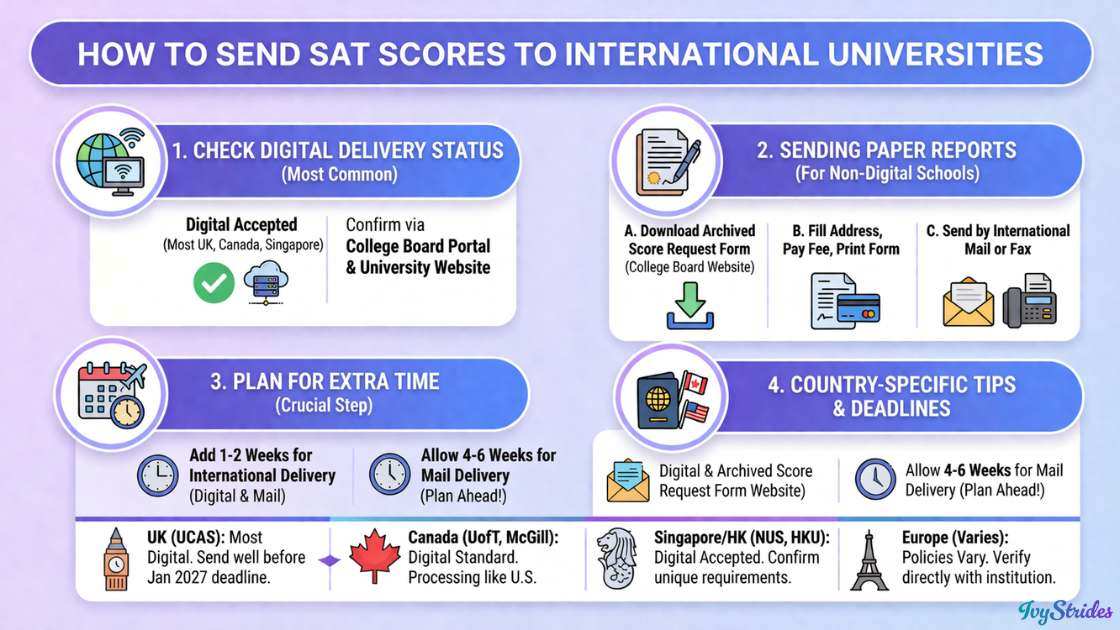
First, check if the international school accepts digital delivery through the College Board. Most major universities in the UK, Canada, and Singapore accept digital reports.
Some smaller or less tech-integrated colleges may require a paper report. In that case:
-
Download the Archived Score Request Form from the College Board website.
-
Fill in the school address and details.
-
Pay the fee and send it by mail or fax.
-
Expect 4–5 weeks for delivery by mail; plan ahead for international timelines.
***Pro Tip:***For international delivery, always add an extra 1–2 weeks to your timeline estimate. Postal delays are common, and some institutions take additional time to process paper reports.
Can I Send SAT Scores After the Application Deadline?
Yes, but with caution. If your scores are released shortly after the deadline, most colleges will still review them as long as they arrive within a few days.
- Use Rush Reporting to speed up delivery (2–4 business days).
- Contact the college admissions office to let them know your scores are en route.
***Pro tip:***Always confirm score arrival by checking your college application portal or calling the admissions office.
In our experience working with 1,000+ students at IvyStrides, most colleges are understanding about scores arriving a few days late - especially if you've proactively communicated with admissions. But don't rely on this as a strategy. Plan ahead whenever possible.
Can Parents Send SAT Scores on Behalf of Students?
Yes , but only if they have access to the student's College Board login. The College Board does not offer a parent-facing score send portal.
Important Guidelines:
- Account info must be accurate.
- College codes should be verified before payment.
- The student should be aware of what's being sent.
- Do not create a duplicate parent account to send scores , it may cause confusion or delays.
Common Mistakes When Sending SAT Scores (And How to Avoid Them)
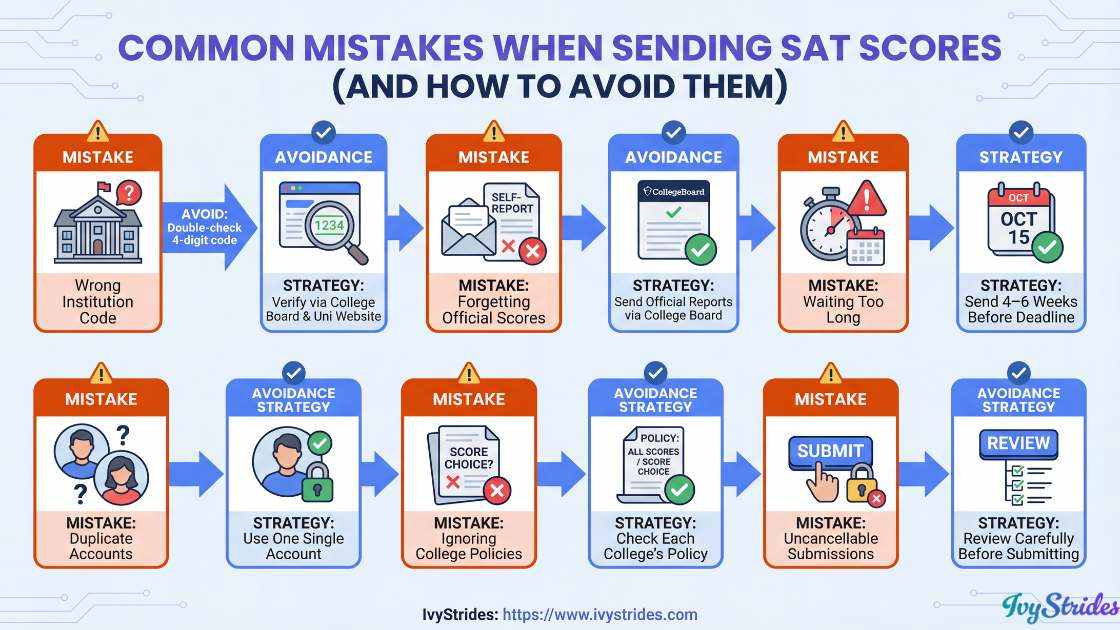
Sending scores sounds simple, but small errors can cause big headaches. Here are the most common mistakes we see at IvyStrides:
- Wrong institution code. Double-check the 4-digit code for every college. Similar-sounding schools can have different codes.
- Forgetting to send official scores after self-reporting. Self-reporting on Common App is not enough. Most colleges require official reports from the College Board.
- Waiting too long to send. Standard delivery takes 1–2 weeks. If you wait until the last minute, your scores may arrive late.
- Not using the 9-day free window. You can add or change your 4 free score recipients for up to 9 days after test day - don't miss this.
- Creating duplicate College Board accounts. This can cause scores to be split across accounts, leading to delays and confusion.
- Ignoring college-specific policies. Some schools require all scores; others accept Score Choice. Check each college's policy before sending.
Feeling overwhelmed? Our mentors can help you navigate the process. You might also find it helpful to explore strategies to overcome SAT anxiety - the stress doesn't have to stop at test day.
What Is an SAT Score?
SAT scores range from 400 to 1600, combining Evidence-Based Reading & Writing and Math. Colleges use them to compare applicants on a national scale.
Why Send Your SAT Scores?
Scores validate your academic readiness. They show colleges that your hard work paid off. They help colleges assess your fit, offer merit scholarships, and sometimes satisfy placement requirements.
Should you still send scores in 2026? Even with many colleges adopting test-optional policies, submitting a strong SAT score can strengthen your application. If your score falls within or above a school's middle 50% range, sending it is almost always a good idea. If you're unsure, talk to your counselor or an IvyStrides mentor.
Who Should Receive Your Scores?
- Undergraduate admissions offices
- Scholarship offices (for score-based grants)
- Athletic departments (for NCAA eligibility)
Where Do You Send SAT Scores?
To send your SAT scores to colleges, you must use the College Board portal, specifically the "Send Scores" section of your account. Each college has a unique 4-digit institution code that identifies it in the system. You'll need to enter this code accurately when selecting where to send your scores.
You can search for the code by college name directly on the College Board website or use the official code list. Colleges only accept official scores directly from the College Board, so accurate and timely submission is essential to ensure your scores are matched with your application file.
If you're applying to multiple schools, you'll need to repeat this process for each one. Remember, the first four reports are free (if chosen before your test date or within 9 days after); after that, a fee applies for each additional school.
How to Get SAT Scores Early
You can't receive your official SAT scores before the College Board releases them (typically 10–14 days after test day). However, here are a few tips:
- Check your College Board account on score release day. Scores are usually posted online before any email notification is sent.
- Know the exact release date. Check our guide on when SAT results come out for the 2026–27 schedule.
- Set up score notifications. Enable email and text alerts in your College Board account so you're notified the moment scores drop.
- Plan your send strategy in advance. Have your college list and institution codes ready so you can send scores the same day they're released.
There is no way to pay for early access to your scores. Rush reporting only speeds up delivery to colleges - it does not give you your scores sooner.
SAT Score Sending FAQs
How do I confirm that a college received my SAT scores?
Check your college's application portal. Most schools update your checklist once scores are received. You can also call or email the admissions office to confirm.
What if my scores are delayed by the College Board?
Occasionally, the College Board holds scores for additional review. If this happens, you'll be notified. Contact the admissions offices of your colleges to let them know about the delay.
Do all colleges require official SAT scores?
No. Some colleges accept self-reported scores for the admissions review and only require official reports after you've been admitted and decide to enroll. Check each school's policy.
Can I cancel a score send after I've submitted it?
No. Once you've submitted a score send request through the College Board, it cannot be canceled or reversed.
Has the Digital SAT changed the score-sending process?
The transition to the Digital SAT has not changed how you send scores. The process through your College Board account remains the same. Scores from the Digital SAT are sent electronically just like previous versions.
What if I sent scores to the wrong college?
Unfortunately, you can't redirect a score report once it's been sent. You'll need to submit a new request (and pay the fee) for the correct college. Double-check institution codes before submitting.
Do I need to send SAT scores if a college is test-optional?
Not required, but recommended if your score is strong. A competitive SAT score can strengthen your application even at test-optional schools.
What If You Forget, Delay, or Mess It Up?
- Forgot to send? Do it ASAP with Rush Reporting if needed.
- Delayed by the College Board? Sometimes they hold scores for review , you'll be notified.
- Sent to the wrong school? No worries about the wrong school receiving scores, but you'll need to log in and select the correct college again. You'll be charged for the new report.
Do I Need to Send Official Scores Even If I Self-Reported?
Yes. Whether you're sending SAT scores through College Board or ACT scores through ACT, self-reporting your scores in an application (like Common App or Coalition App) is not enough for most colleges. They typically require official score reports sent directly from the testing organization. Self-report for convenience, but send the official scores to validate your application.
How Can Parents Support SAT Score Reporting?
- Help your teen check deadlines.
- Pay fees or request waivers.
- Track score release timelines.
- Coordinate with IvyStrides to keep application timelines tight and on target.
If you're a parent helping your student prepare, our 30-day SAT study plan can also help you both stay organized leading up to test day.
IvyStrides Strategy: Send Smart, Not Scared
At IvyStrides , we don't just prep you for the SAT - we guide your post-test strategy, too. From choosing which scores to send and understanding college policies, to walking through Common App syncing, our mentors help make sure nothing gets missed.
With experience helping 1,000+ students navigate the admissions process, our tutors know exactly when to use rush reporting, how to leverage Score Choice, and which colleges require all scores. We take the guesswork out of score sending so you can focus on the rest of your application.

Rajesh is a technology leader, entrepreneur, and angel investor with 28+ years in Business & Technology Leadership and Product & Solution Engineering. He is passionate about education, mentoring, and driving digital transformation.