
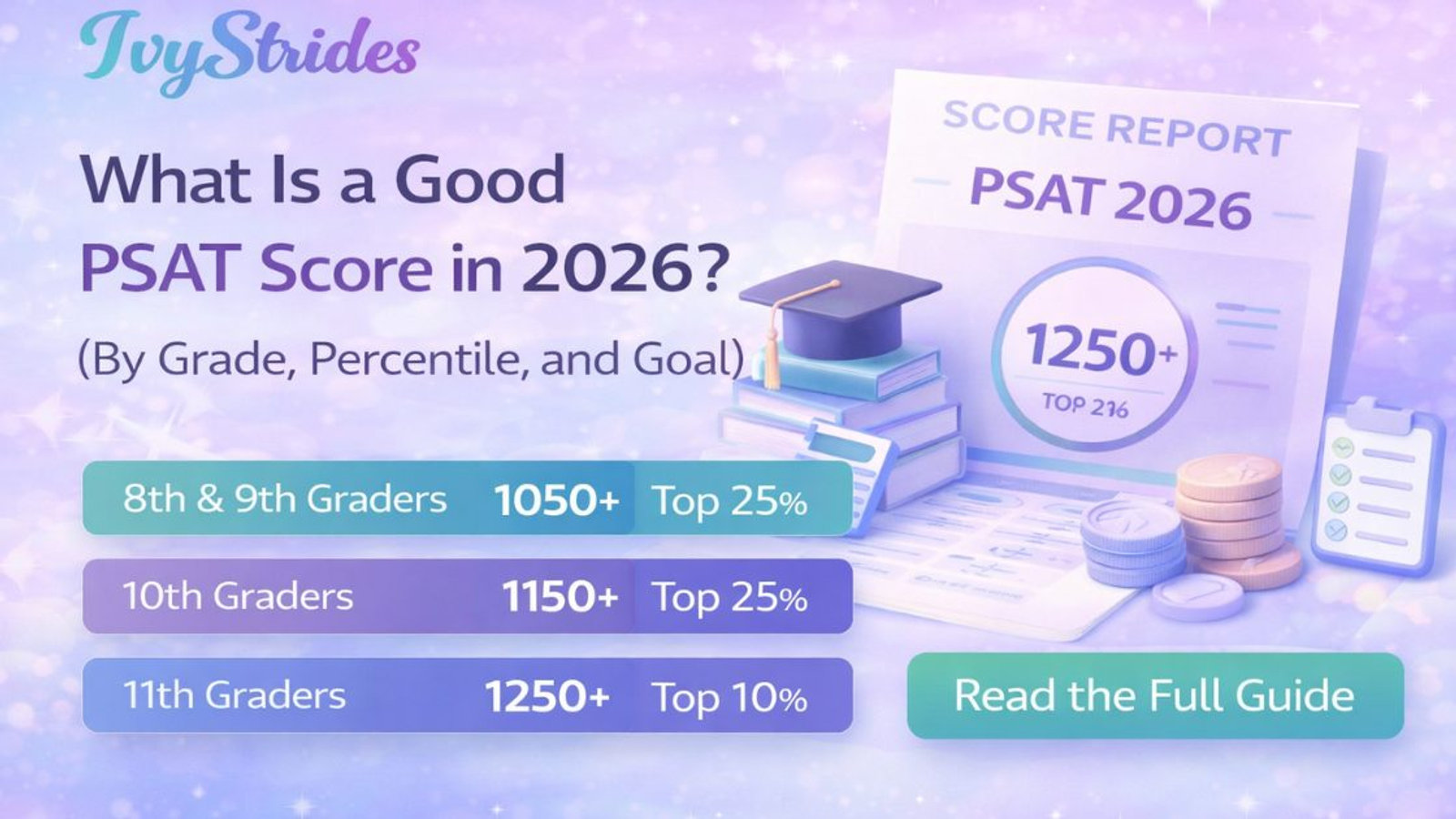
What Is a Good PSAT Score in 2026? (By Grade, Percentile, and Goal)
On this page
- Quick Answer: Good PSAT Score Benchmarks for 2026
- What Is the PSAT (And Why It Matters Before the SAT)?
- PSAT Score Range: How Scoring Works in 2026
- What Is the Highest PSAT Score Possible?
- Total Score vs. Section Scores: What Matters More
- PSAT Percentiles Explained (2026 Data)
- Good PSAT Score by Grade: 8th, 9th, 10th, and 11th
- PSAT 8/9 Score Range (8th and 9th Graders)
- Good PSAT Score for 10th Graders (PSAT 10)
- Good PSAT Score for 11th Graders (PSAT/NMSQT)
- Is [Score] a Good PSAT Score? (Score-by-Score Breakdown)
- Is 900 a Good PSAT Score?
- Is 950 a Good PSAT Score?
- Is 1000 a Good PSAT Score?
- Is 1050 a Good PSAT Score?
- Is 1100 a Good PSAT Score?
- Is 1200 a Good PSAT Score?
- Is 1290 a Good PSAT Score?
- Is 1300 a Good PSAT Score?
- Average PSAT Scores in 2026 (National Data)
- What Score Do You Need for National Merit Scholarships?
- How the PSAT Selection Index Works
- 2026 National Merit Cutoff Estimates by State
- PSAT to SAT Score Conversion: What Your PSAT Predicts
- What PSAT Score Do Colleges Want?
- Is Your PSAT Score "Good Enough" for Your Goals? (Goal-Setting Guide)
- If You’re Aiming for a 1400+ SAT Score
- Planning for Ivy League or Top 25 Schools?
- Think Diagnostic, Not Final Verdict
- How to Improve Your PSAT Score (Actionable Study Plan)
- Focus on High-Impact Areas First
- Use Digital-Format Practice Tests
- Try the IvyStrides Smart PSAT Review
- Free IvyStrides Tools You Can Start With Today
- FAQs About PSAT Scores
- Do Colleges See My PSAT Score?
- Can I Retake the PSAT?
- When Are PSAT Scores Released in 2026?
- Does the PSAT Affect My GPA or Transcript?
- Is There Such a Thing as a "Bad" PSAT Score?
- Where Can I Find Free PSAT Practice Tests?
- What's the Difference Between the PSAT and SAT?
The term "good PSAT score" can mean different things depending on your grade and goals. A score that's impressive for a 10th grader might fall short for an 11th grader aiming for National Merit recognition. It gets even more confusing when comparing across different versions of the test, like PSAT 8/9, PSAT 10, and PSAT/NMSQT, since each has its own scoring scale and purpose.
IvyStrides helps students decode what their PSAT score really means. In our programs, we prepare students for their SAT through customized practice test series, mentorship, counseling, and effective study techniques.
In this guide you'll learn how your PSAT score connects to your SAT score, what benchmarks matter for 2026, and what steps to take next based on where you are right now.
Quick Answer: Good PSAT Score Benchmarks for 2026
Here's a snapshot of what "good" looks like at each level. Use this as your quick reference before diving into the details below.
| Percentile Tier | 10th Graders (PSAT 10) | 11th Graders (PSAT/NMSQT) | What It Means |
| 90th+ percentile | 1350+ | 1350+ | National Merit–level, elite |
| 75th percentile | 1150–1200 | 1200–1250 | Strong college-bound score |
| 50th percentile | 960–1010 | 1000–1050 | Average among peers |
| 25th percentile | 800–850 | 830–880 | Below average; room to grow |
Key takeaway: If you're scoring at or above the 75th percentile for your grade, you're in strong shape. If you're below the 50th percentile, don't panic - the PSAT is diagnostic, not a verdict. It's your starting line, not your finish line.
What Is the PSAT (And Why It Matters Before the SAT)?
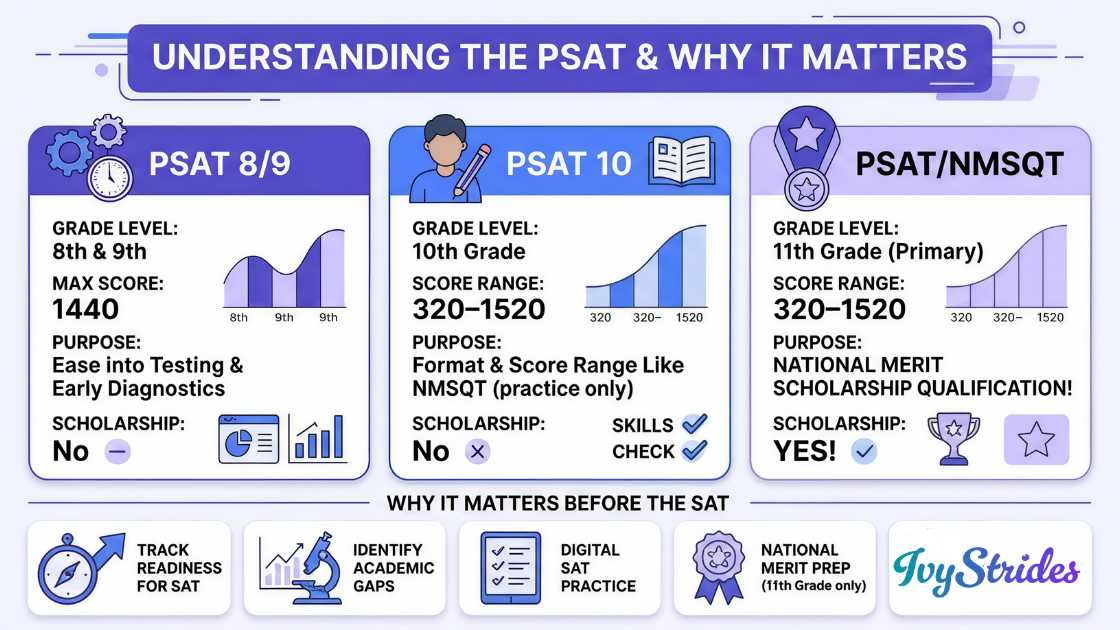
ThePSAT, also known as the Preliminary SAT, is a practice version of the Digital SAT test. The PSAT isn't a single test. It's a set of different versions made for students at different grade levels to match where they are in school and how ready they are before actual SAT exams.
- PSAT 8/9 is for 8th and 9th graders and has a maximum score of 1440. It helps students ease into standardized testing without pressure.
- PSAT 10 is offered to 10th graders with the same format and score range as the PSAT/NMSQT (320–1520), but it doesn't count for National Merit.
- PSAT/NMSQT is taken in 11th grade and is the only version that qualifies students for the National Merit Scholarship Program.
Although none of these scores go to colleges, they're powerful indicators for SAT success. They help students and educators understand early strengths and gaps, especially with the new Digital SAT format.
IvyStrides uses PSAT results as a launchpad to build smarter pathways with personalized strategies.
PSAT matters as it helps to:
- Track your readiness for the SAT
- Qualify for National Merit Scholarships (only in 11th grade)
- Identify academic strengths and gaps
PSAT Score Range: How Scoring Works in 2026
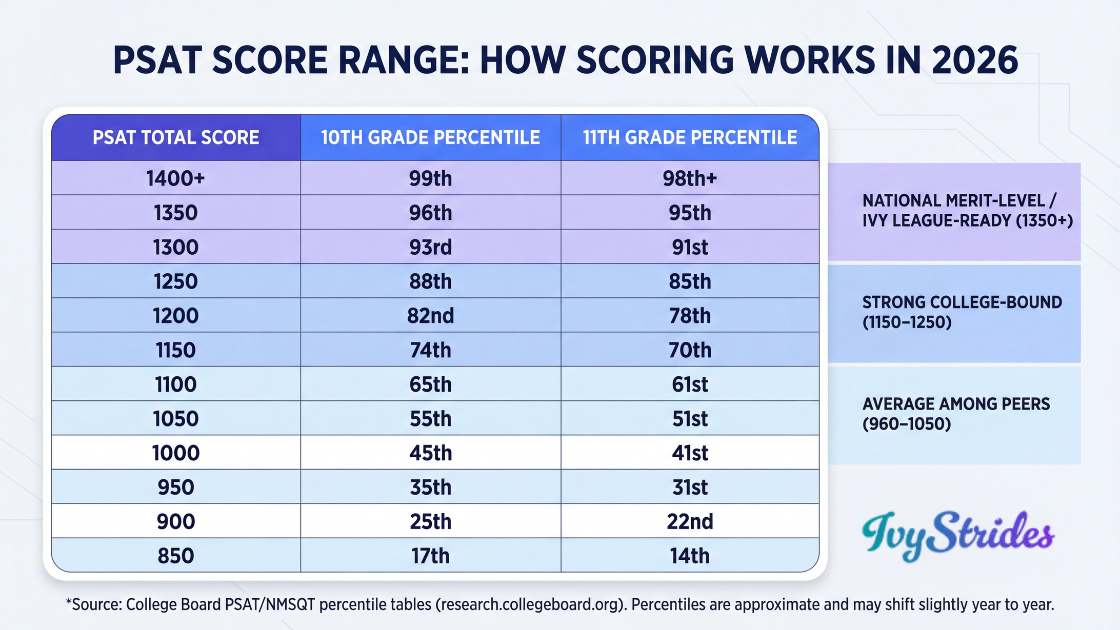
Understanding the PSAT score range is the first step to knowing where you stand. Each version of the PSAT has its own scoring scale, and the structure mirrors the Digital SAT.
| “Good” PSAT score depends on your grade and goals. Here’s a quick breakdown: - Above 90th percentile (1350+): National Merit–level, Ivy League–ready - 75th percentile (1200–1290): Strong college-bound student - 50th percentile (1050–1100): Average among peers |
Many students wonder What is a good PSAT score for 2026 digital SAT exams?” but the answer to this question depends on your grade level, your academic goals, and how you plan to use the score. According to the College Board benchmarks.
What Is the Highest PSAT Score Possible?
The maximum PSAT/NMSQT and PSAT 10 score is 1520 not 1600 like the SAT. This is because the PSAT tests a slightly narrower difficulty range. Each section (Evidence-Based Reading and Writing + Math) is scored from 160 to 760.
For the PSAT 8/9, the max score is 1440 (120–720 per section).
So if you're comparing your PSAT score to SAT benchmarks, remember: a perfect 1520 on the PSAT is roughly equivalent to a 1520 on the SAT in terms of percentile standing - both place you at the very top.
Total Score vs. Section Scores: What Matters More
When students receive their PSAT score report, the first thing they look at is the total score, which ranges from 320 to 1520. While this number gives a quick snapshot of performance, it’s not the full story.
What colleges and SAT prep courses (like IvyStrides) focus on are the Evidence-Based Reading and Writing (EBRW) and Math, each scored from 160 to 760.
Why do section scores matter? Because they reveal where your strengths and weaknesses lie. A 1200 total score could mean you're evenly balanced, or it could mean you're strong in Math but lagging in Reading. When preparing for the SAT or qualifying for National Merit, knowing your section breakdown helps you focus on improving your weaker area , whether that's SAT reading speedoralgebra fundamentals.
PSAT Percentiles Explained (2026 Data)
Percentiles tell you how your score compares to other test-takers. A 75th percentile score means you scored higher than 75% of students who took the same test.
According to College Board's 2025–26 nationally representative percentile data, here's how PSAT/NMSQT scores map to percentiles for 10th and 11th graders:
| PSAT Total Score | 10th Grade Percentile | 11th Grade Percentile |
| 1400+ | 99th | 98th+ |
| 1350 | 96th | 95th |
| 1300 | 93rd | 91st |
| 1250 | 88th | 85th |
| 1200 | 82nd | 78th |
| 1150 | 74th | 70th |
| 1100 | 65th | 61st |
| 1050 | 55th | 51st |
| 1000 | 45th | 41st |
| 950 | 35th | 31st |
| 900 | 25th | 22nd |
| 850 | 17th | 14th |
Source: College Board PSAT/NMSQT percentile tables (research.collegeboard.org). Percentiles are approximate and may shift slightly year to year.
Notice that the same score yields a slightly higher percentile for 10th graders than 11th graders. That's because the 11th-grade test-taker pool tends to be more competitive.
Good PSAT Score by Grade: 8th, 9th, 10th, and 11th
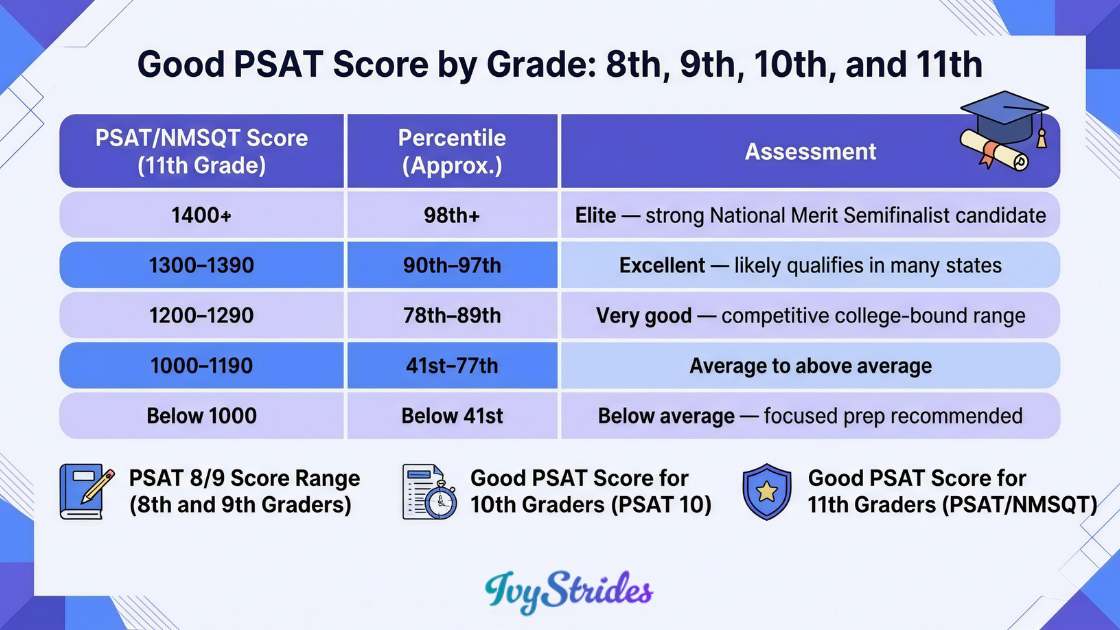
The PSAT isn’t a one-size-fits-all test; it comes in three versions designed for different grade levels, each with slightly different expectations and score ranges:
PSAT 8/9 Score Range (8th and 9th Graders)
PSAT 8/9 uses a 240–1440 scale. This version introduces students to the SAT format early. A "good" score at this level varies, but scoring above 900 typically indicates you're on track. Focus here should be on building test-taking habits and understanding question types, not obsessing over scores.
| PSAT 8/9 Score | What It Means |
| 1200+ | Excellent , well ahead of grade-level expectations |
| 1000–1190 | Strong , on track for a competitive PSAT/NMSQT score later |
| 800–990 | Average , solid foundation to build on |
| Below 800 | Below average , focus on core reading and math skills |
Good PSAT Score for 10th Graders (PSAT 10)
PSAT 10 uses the 320–1520 scale. This test mirrors the PSAT/NMSQT in structure, but doesn't qualify you for scholarships. At this stage, a score of 1050–1100+ shows you're progressing well. It's also a checkpoint to see if you're ready to take the SAT early.
| PSAT 10 Score | Percentile (Approx.) | Assessment |
| 1300+ | 90th+ | Exceptional , National Merit track |
| 1150–1290 | 70th–89th | Strong college-bound score |
| 960–1140 | 40th–69th | Average range , good starting point |
| Below 960 | Below 40th | Below average , time to build a prep plan |
If you're a sophomore wondering "is my PSAT score good for a 10th grader?" - anything above 1100 puts you ahead of most peers, and above 1200 signals you're on a strong trajectory toward the SAT.
Good PSAT Score for 11th Graders (PSAT/NMSQT)
PSAT/NMSQT uses the same 320–1520 scale and is identical in format to the PSAT 10, but is used for National Merit Scholarship eligibility. This is where scoring high (typically 1350+) matters more strategically, especially if you're aiming for competitive schools or merit aid.
| PSAT/NMSQT Score (11th Grade) | Percentile (Approx.) | Assessment |
| 1400+ | 98th+ | Elite , strong National Merit Semifinalist candidate |
| 1300–1390 | 90th–97th | Excellent , likely qualifies in many states |
| 1200–1290 | 78th–89th | Very good , competitive college-bound range |
| 1000–1190 | 41st–77th | Average to above average |
| Below 1000 | Below 41st | Below average , focused prep recommended |
When to start thinking about National Merit? If you're scoring above 1200 in 10th grade, it's time to seriously consider working toward National Merit cutoffs. IvyStrides recommends identifying your state's past cutoffs and tailoring prep accordingly. We even offer Selection Index tracking tools to make it easy.
Is [Score] a Good PSAT Score? (Score-by-Score Breakdown)
This is the section where we answer the most common "is my score good?" questions directly. Find your score below.
Is 900 a Good PSAT Score?
A 900 falls around the 25th percentile for 10th graders and the 22nd percentile for 11th graders. It's below average for both groups, but perfectly normal for 8th or 9th graders taking the PSAT 8/9. If you're in 10th or 11th grade, a 900 means there's significant room for improvement , and that's okay. With a structured study plan, students at this level often see 150–250+ point gains.
Is 950 a Good PSAT Score?
A 950 puts you near the 31st–35th percentile, depending on your grade. It's slightly below the national average. For a sophomore, this is a reasonable starting point. For a junior, it signals that focused prep , especially in your weaker section - can make a big difference before the SAT.
Is 1000 a Good PSAT Score?
A 1000 is right around the national average for 10th graders (roughly 45th percentile) and slightly below average for 11th graders (41st percentile). It's a solid baseline. With targeted practice, you're well-positioned to reach 1200+ on the SAT.
Is 1050 a Good PSAT Score?
A 1050 is slightly above average , around the 51st–55th percentile. You're outperforming about half of test-takers. This is a good launching point for SAT prep, and students at this level often reach 1250–1350 on the SAT with consistent effort.
Is 1100 a Good PSAT Score?
Yes, 1100 is a solid score , roughly the 61st–65th percentile. You're above average and on track for a 1200–1300+ SAT score with focused preparation. If you're a sophomore, this is an excellent position to be in.
Is 1200 a Good PSAT Score?
Absolutely. A 1200 places you around the 78th–82nd percentile. You're in a strong college-bound range and well on track for a 1300–1400+ SAT. At this level, fine-tuning your weaker section and practicing under timed conditions can push you into elite territory.
Is 1290 a Good PSAT Score?
A 1290 is an excellent score , around the 89th–91st percentile. You're knocking on the door of National Merit territory. Depending on your state's cutoff, you may be just a few points away from Semifinalist status. Focus on maximizing your Selection Index (more on that below).
Is 1300 a Good PSAT Score?
Yes , 1300 is outstanding. You're in the top 7–10% of all test-takers. In many states, this score qualifies you for National Merit Semifinalist consideration. With the right prep, you're looking at a 1400–1500+ SAT score. Schools like Brown, Duke, and Johns Hopkins are within reach.
Average PSAT Scores in 2026 (National Data)
According to College Board's most recent data, here are the approximate national averages:
| Test Version | Average Total Score | Average EBRW | Average Math |
| PSAT 8/9 | ~870 | ~440 | ~430 |
| PSAT 10 | ~960 | ~490 | ~470 |
| PSAT/NMSQT (11th grade) | ~1000 | ~510 | ~490 |
These figures are based on College Board's 2025–26 reporting cycle. Exact averages may vary slightly by administration.
If your score is at or near these averages, you're right in the middle of the pack. That's a perfectly fine starting point , but if your goal is a competitive SAT score or National Merit, you'll want to aim well above these numbers.
What Score Do You Need for National Merit Scholarships?
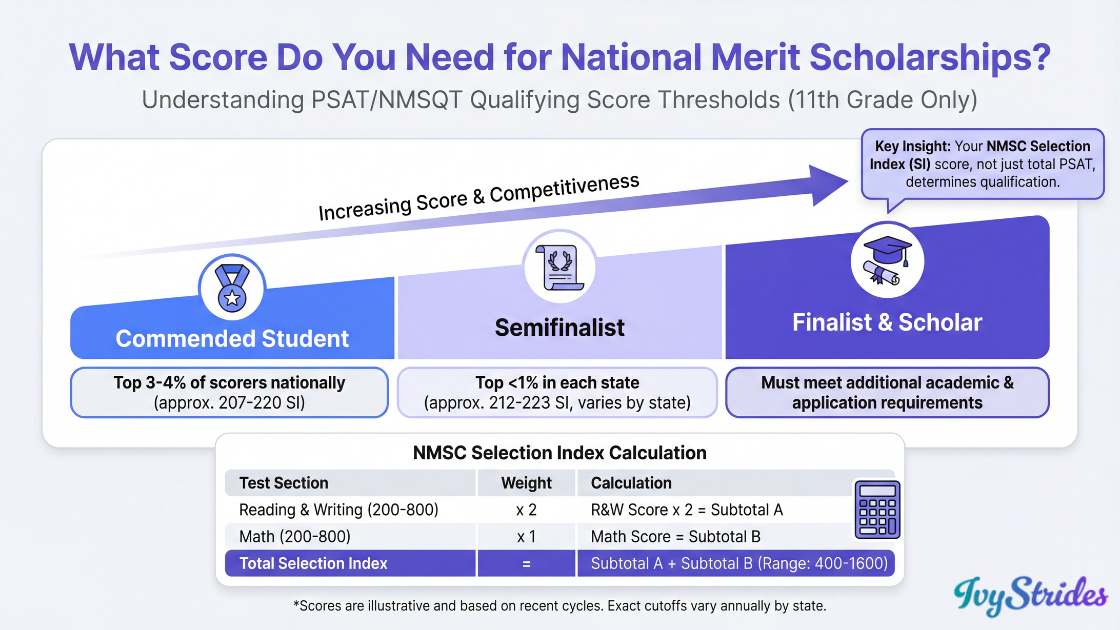
Many students (and parents) mistakenly assume that a high total PSAT score is all you need for scholarships. But National Merit qualification works differently, and understanding it early gives you a major edge.
The PSAT/NMSQT (Preliminary SAT/National Merit Scholarship Qualifying Test) is more than just a practice SAT. It offers real academic and financial benefits, especially when taken seriously in the 11th grade.
Taking the PSAT/NMSQT also connects you with:
- National Hispanic Recognition Program
- National Indigenous Recognition Program
- Other diversity and merit-based initiatives
Only 11th-grade students qualify. PSAT 8/9 and PSAT 10 do not count toward National Merit consideration.
How the PSAT Selection Index Works
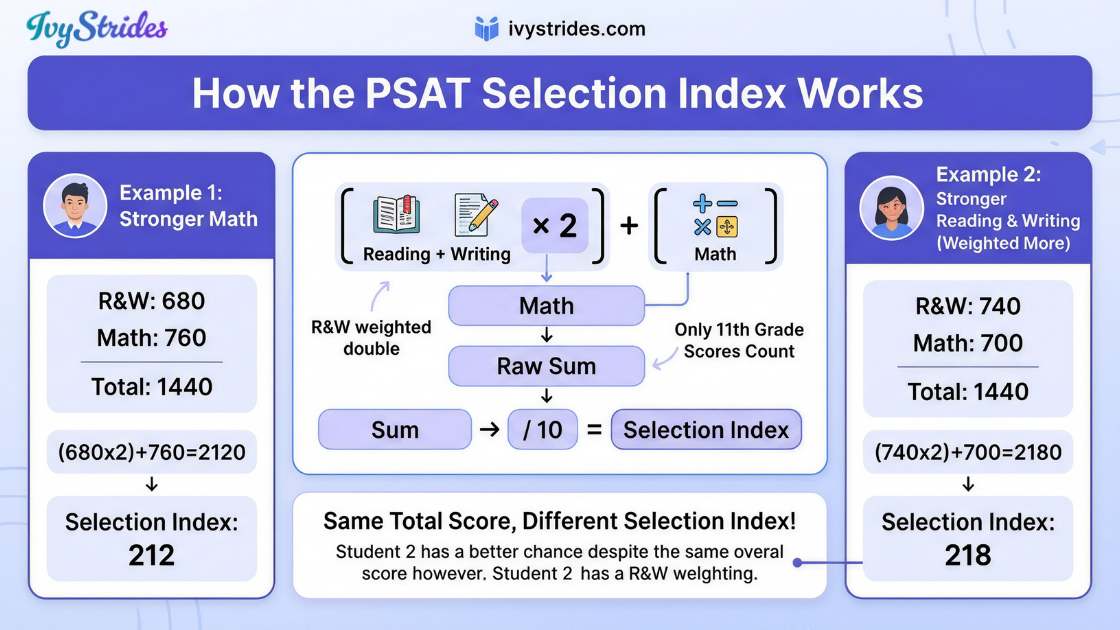
National Merit doesn't use your regular total PSAT score (out of 1520). Instead, it uses a Selection Index, calculated like this:
(Reading + Writing) × 2 + Math, then divide by 10
Example:
- Reading & Writing: 750
- Math: 710
- → (750 × 2) + 710 = 2210 → Selection Index = 221
Reading & Writing sections carry more weight than Math. It's possible for two students with the same total score to have different Selection Indexes, and only one may qualify.
2026 National Merit Cutoff Estimates by State
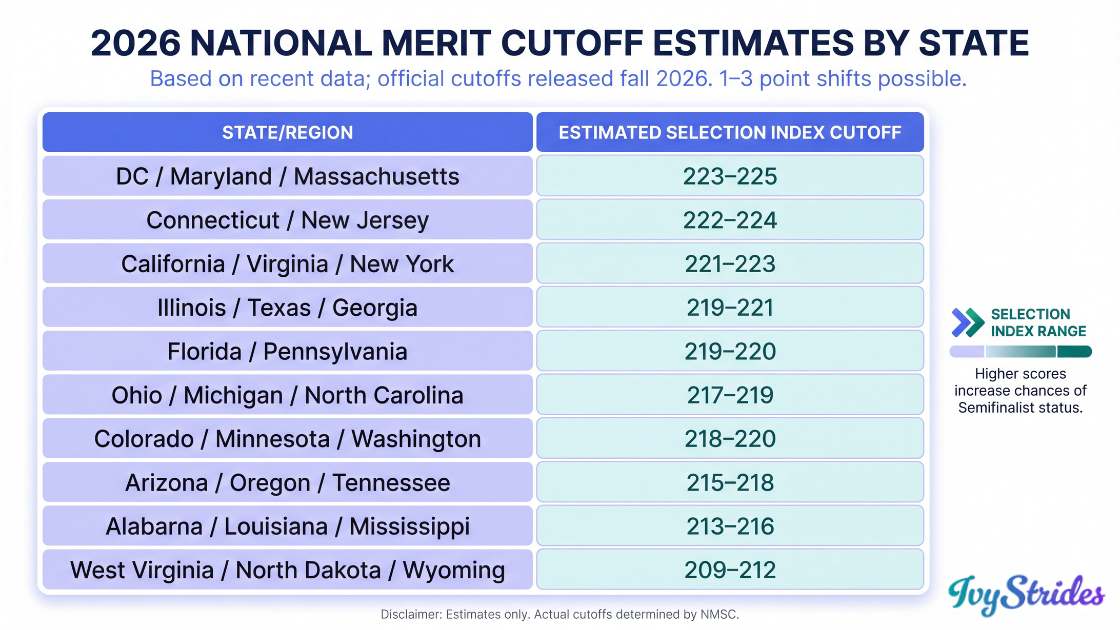
Your qualifying Selection Index depends on your state, not a universal cutoff. Here's how it looks based on recent data:
| State/Region | Estimated Selection Index Cutoff |
| DC / Maryland / Massachusetts | 223–225 |
| Connecticut / New Jersey | 222–224 |
| California / Virginia / New York | 221–223 |
| Illinois / Texas / Georgia | 219–221 |
| Florida / Pennsylvania | 219–220 |
| Ohio / Michigan / North Carolina | 217–219 |
| Colorado / Minnesota / Washington | 218–220 |
| Arizona / Oregon / Tennessee | 215–218 |
| Alabama / Louisiana / Mississippi | 213–216 |
| West Virginia / North Dakota / Wyoming | 209–212 |
These are estimates based on recent trends. Official 2026 cutoffs will be released by the National Merit Scholarship Corporation (NMSC) in fall 2026. Cutoffs can shift 1–3 points year to year.
Only about 1% of all test-takers become National Merit Semifinalists. Being just 1–2 points below your state's cutoff could be the difference between getting that recognition or not.
PSAT to SAT Score Conversion: What Your PSAT Predicts
Since the PSAT and SAT are part of the same SAT Suite, your PSAT score is a strong predictor of SAT performance. The PSAT maxes out at 1520 while the SAT goes to 1600, so the top end of the scale differs , but in the mid-ranges, scores translate closely.
Here's an approximate PSAT-to-SAT conversion table:
| PSAT Score | Estimated SAT Score Range |
| 1400+ | 1480–1560+ |
| 1300 | 1370–1450 |
| 1200 | 1270–1350 |
| 1100 | 1170–1250 |
| 1000 | 1060–1150 |
| 900 | 950–1050 |
Based on College Board's SAT Suite concordance data and IvyStrides' internal student performance tracking. Actual SAT scores depend on prep quality and test-day performance.
The key insight: most students improve 50–150 points from PSAT to SAT with focused preparation. Students who work with structured programs like IvyStrides often see even larger gains because they target specific weaknesses identified by their PSAT section scores.
If you're curious about how SAT scoring works in detail, check out our guide on how many questions are on the SAT.
What PSAT Score Do Colleges Want?
Here's the good news: colleges do not see your PSAT score. It's not part of your admissions file, and no school will ever request it.
But your PSAT score is a strong indicator of where you'll land on the SAT , and that score matters. Here's how PSAT ranges roughly map to college tiers:
| PSAT Score | Projected SAT Range | College Tier |
| 1350–1520 | 1450–1560+ | Ivy League / Top 10 (e.g., UPenn, UChicago) |
| 1200–1340 | 1300–1450 | Top 25–50 (e.g., Rice, WashU) |
| 1050–1190 | 1150–1300 | Top 50–100 state and private universities |
| Below 1050 | Below 1150 | Many state universities; focus on score improvement |
So while colleges don't "want" a specific PSAT score, your PSAT tells you whether you're on pace for the SAT score your target schools expect.
Is Your PSAT Score "Good Enough" for Your Goals? (Goal-Setting Guide)
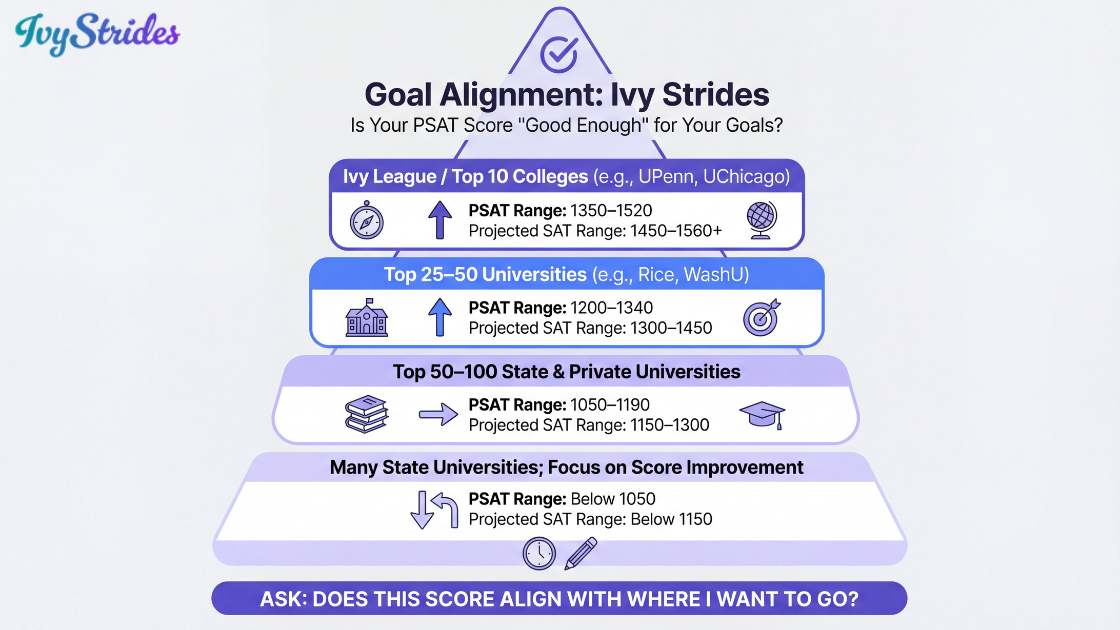
A "good" PSAT score is only meaningful when tied to a specific outcome. Instead of asking whether your number is high or low, ask: Does this score align with where I want to go?
If You’re Aiming for a 1400+ SAT Score
Then your PSAT goal should fall between 1150 and 1250. This range shows you're building a solid foundation, and with targeted prep, you can scale up by 150–250 points, especially if you’re still in 10th or early 11th grade.
Planning for Ivy League or Top 25 Schools?

You’ll want to be in the top 90th percentile early, even as a sophomore. A PSAT score of 1300+ is a strong indicator you're on track, but remember: elite colleges don’t just care about your final SAT score. Early academic signals matter, and your PSAT is one of them.
If you're setting ambitious goals, the WOOP goal-setting framework can help you build a realistic plan around your target score.
Think Diagnostic, Not Final Verdict
The PSAT isn’t about impressing colleges , it’s about identifying gaps. Use it as a diagnostic checkpoint. Which section is holding you back? Is timing or confidence the issue?
IvyStrides helps decode what your PSAT score says and turns it into an actionable SAT preparation plan. Students who treat the PSAT as a learning tool (not a pass/fail score) improve their SAT scores faster and more strategically.
How to Improve Your PSAT Score (Actionable Study Plan)
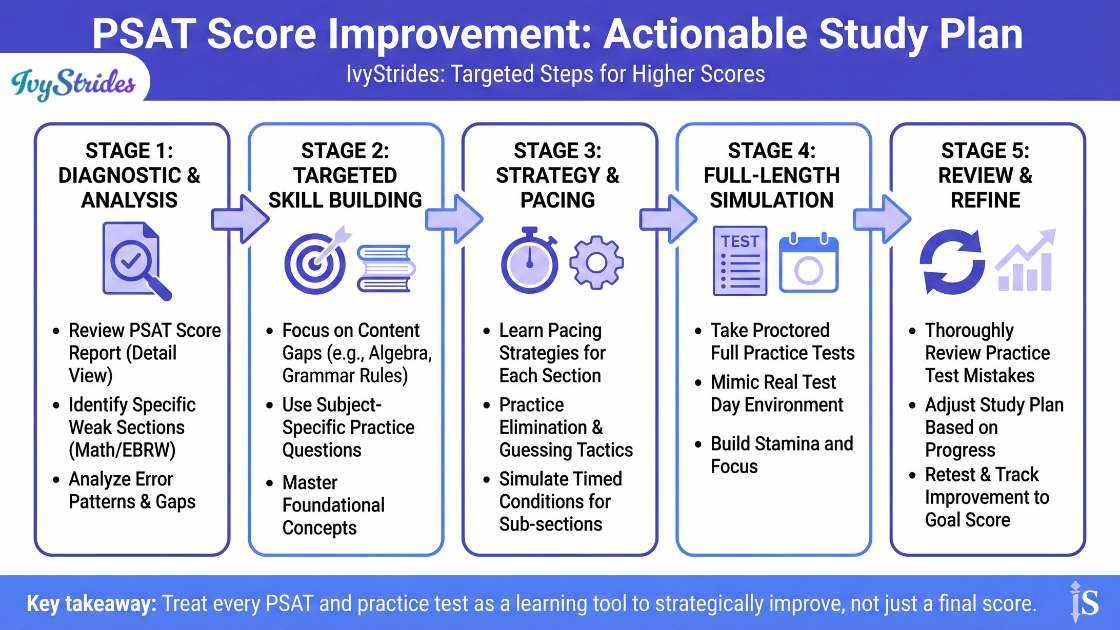
Improving your PSAT score isn't about grinding through endless practice questions , it's about targeting the right areas from day one. Whether you're in 9th grade or approaching the PSAT/NMSQT in 11th, here's how to study smarter, not harder.
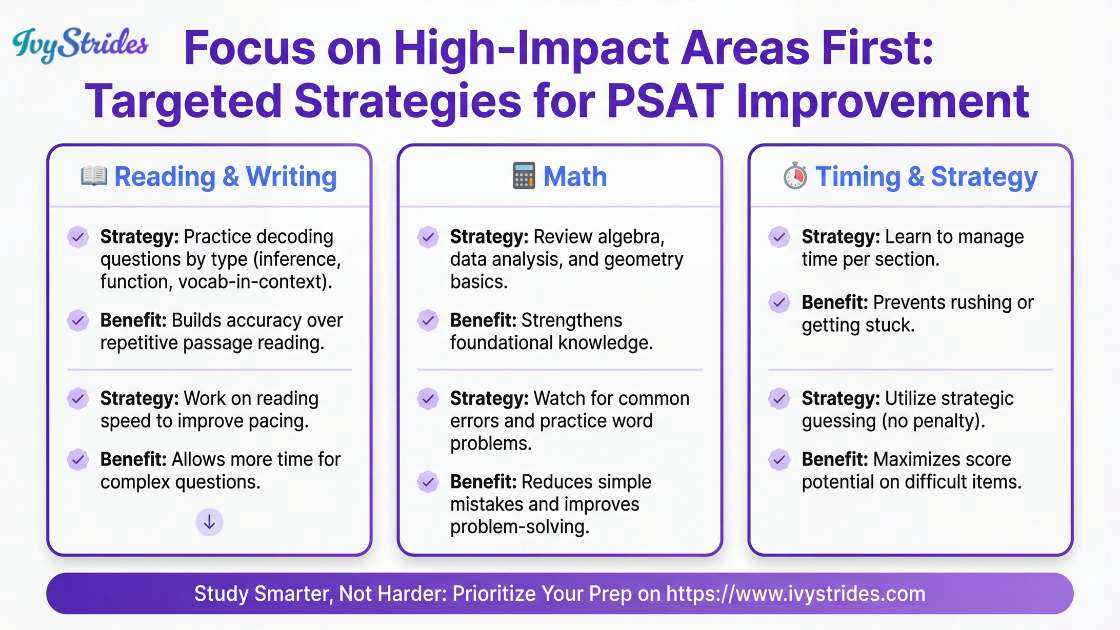
Focus on High-Impact Areas First
- Reading & Writing: Practice decoding questions by type - inference, function, vocabulary-in-context - not just reading long passages over and over. Work on your SAT reading speed to improve pacing.
- Math: Review algebra, data analysis, and geometry basics. Most score gaps are due to simple errors, not complex math. Watch out for common quadratic formula mistakes and practice SAT word problems.
- Timing: Learn how to manage your time per section. Most students either rush too early or get stuck on hard questions. Should you guess on the SAT?Yes , there's no penalty, and strategic guessing is a skill.
Use Digital-Format Practice Tests
Don't rely on outdated paper PDFs. The Digital PSAT uses Bluebook, with adaptive modules and screen-based navigation. IvyStrides mock tests replicate the actual testing experience, helping you feel at ease and confident when it counts.
If test anxiety is holding you back, read our guide on strategies to overcome SAT anxiety - the same techniques apply to the PSAT.
Try the IvyStrides Smart PSAT Review
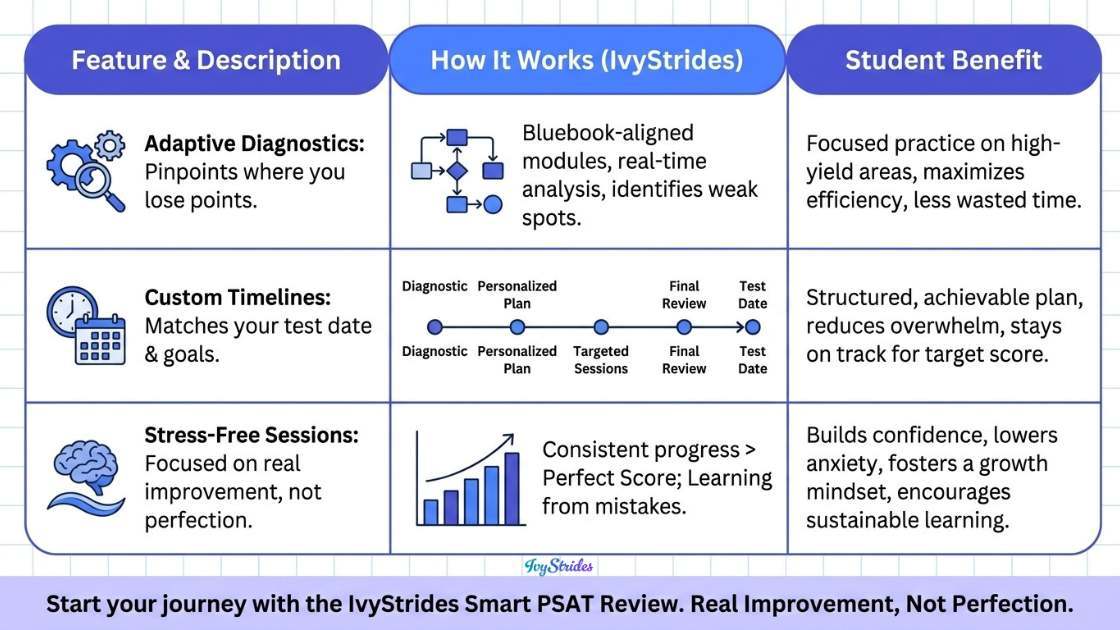
Our unique strategy includes:
- Adaptive diagnostics that pinpoint where you lose points
- Custom timelines to match your test date and goals
- Stress-free sessions focused on real improvement, not perfection
Students who start with a diagnostic approach and follow a structured timeline - like our 30-day SAT study plan - consistently see the biggest score jumps.
Free IvyStrides Tools You Can Start With Today
- Vocabulary flashcards with context-based learning
- Timing templates to help manage reading/math pace
- Mistake log sheets that help track progress and patterns
Looking for full-length practice? Check out our PSAT practice teststo simulate the real Bluebook experience from home.
Ready to raise your score? Download IvyStrides' Free PSAT Growth Toolkit and start your plan today - no guesswork, just guided progress.
FAQs About PSAT Scores
Navigating your PSAT score can feel more confusing than it should be. Below are straightforward answers to the most common (and often misunderstood) questions students and parents ask.
Do Colleges See My PSAT Score?
No. Colleges do not receive PSAT scores. The test is primarily for practice, scholarships (like National Merit), and academic tracking. You can share it with counselors or use it in IvyStrides sessions for personalized planning, but it's not part of your admissions file.
Can I Retake the PSAT?
Yes, you can take the PSAT once per academic year per version. Most students take:
- PSAT 8/9 in 8th or 9th grade
- PSAT 10 in 10th grade
- PSAT/NMSQT in 11th grade (this is the only one that counts for National Merit)
Unlike the SAT, which you can take multiple times, each PSAT version is offered just once per year.
When Are PSAT Scores Released in 2026?
For the October 2026 PSAT/NMSQT administration, scores are typically released 6–8 weeks after your test date , usually in mid-December 2026. You'll receive an email from College Board when they're ready to view on your account.
For the PSAT 10 and PSAT 8/9 (administered in spring), scores usually arrive within 2–3 months of the test date. Check your College Board account for the most up-to-date timeline.
Want to know how score release timelines work for the SAT too? See our guide on when SAT results come out.
Does the PSAT Affect My GPA or Transcript?
No. Your PSAT score has no effect on your GPA, class rank, or transcript. It's a diagnostic tool. But it can be included in honors programs, scholarships, or academic enrichment programs that recognize high scorers.
Is There Such a Thing as a "Bad" PSAT Score?
Technically, no - any PSAT score is valuable if used correctly. The only "bad" score is one you ignore or don't learn from. IvyStrides helps turn any baseline score into a clear, customized plan for improvement.
Where Can I Find Free PSAT Practice Tests?
College Board offers free practice through the Bluebook app, which simulates the actual digital testing experience. IvyStrides also provides PSAT and SAT practice tests designed to mirror real test conditions, with detailed score reports and section-level analysis.
For additional prep, try pairing practice tests with spaced repetition study techniques to maximize retention. And make sure you're not pulling all-nighters before test day , it hurts more than it helps.
What's the Difference Between the PSAT and SAT?
Both tests are part of the College Board's SAT Suite and share the same format (Reading & Writing + Math, digital adaptive). The main differences: the PSAT maxes out at 1520 (vs. 1600 for the SAT), tests a slightly narrower difficulty range, and is shorter. If you're unsure whether to focus on the SAT or ACT, your PSAT score can help guide that decision.

Hemant is a seasoned entrepreneur, investor, and growth strategist with deep ground in education and technology-driven learning. His core training is in Mathematics and Physics — he authored Physics for IB Diploma: Ultimate Revision Guide, recognized as a top student resource.