
How to Attack the Information and Ideas Domain on the Digital SAT

On this page
- What the Information and Ideas Domain Actually Tests (And How It Fits the Digital SAT)
- Central Ideas and Details Questions: The One-Sentence Summary Test
- Inference Questions: Why 'Plausible' Is Not Enough
- Why Information and Ideas Errors Keep Repeating (And What to Do About It)
- Not Sure Which Question Type Is Costing You Points?
- Command of Evidence Questions: Textual vs. Quantitative (Two Different Attacks)
- Why Information and Ideas Errors Are Different From Math Errors (And Why That Matters for Your Score)
- Step 1: Run a Diagnostic to Find Your Actual Point Leak in This Domain
- How Information and Ideas Fits Into Your Broader SAT R&W Strategy
- FAQ
- How many Information and Ideas questions are on the Digital SAT?
- What is the difference between a central ideas question and an inference question on the SAT?
- What are the two types of command of evidence questions on the Digital SAT?
- Is Information and Ideas harder in Module 2 of the Digital SAT?
- How do I know if Information and Ideas is my biggest R&W point leak?
- Can I improve my Information and Ideas score without a tutor?
- Ready to Stop Losing Points in Information and Ideas?
The Information and Ideas domain is one of four content domains in the Digital SAT Reading and Writing section. It covers three question types: central ideas and details, inferences, and command of evidence (both textual and quantitative). Each type has a distinct failure mode. Central ideas questions trip students who pick a true detail instead of the main point. Inference questions reward only answers directly supported by the passage text. Command of evidence questions require identifying the claim before evaluating the evidence. Treating all three as one block is the most common reason students keep missing them.
If half your last practice test's R&W errors carry that same domain label, the label isn't the diagnosis. The question type underneath it is.
What the Information and Ideas Domain Actually Tests (And How It Fits the Digital SAT)
The Digital SAT Reading and Writing section runs 54 questions across two adaptive modules of 32 minutes each, per the College Board. Module 1 performance routes you to either an easier or a harder Module 2. Each question stands alone with its own short discrete passage, typically 25 to 150 words. No long passages with eight questions attached.
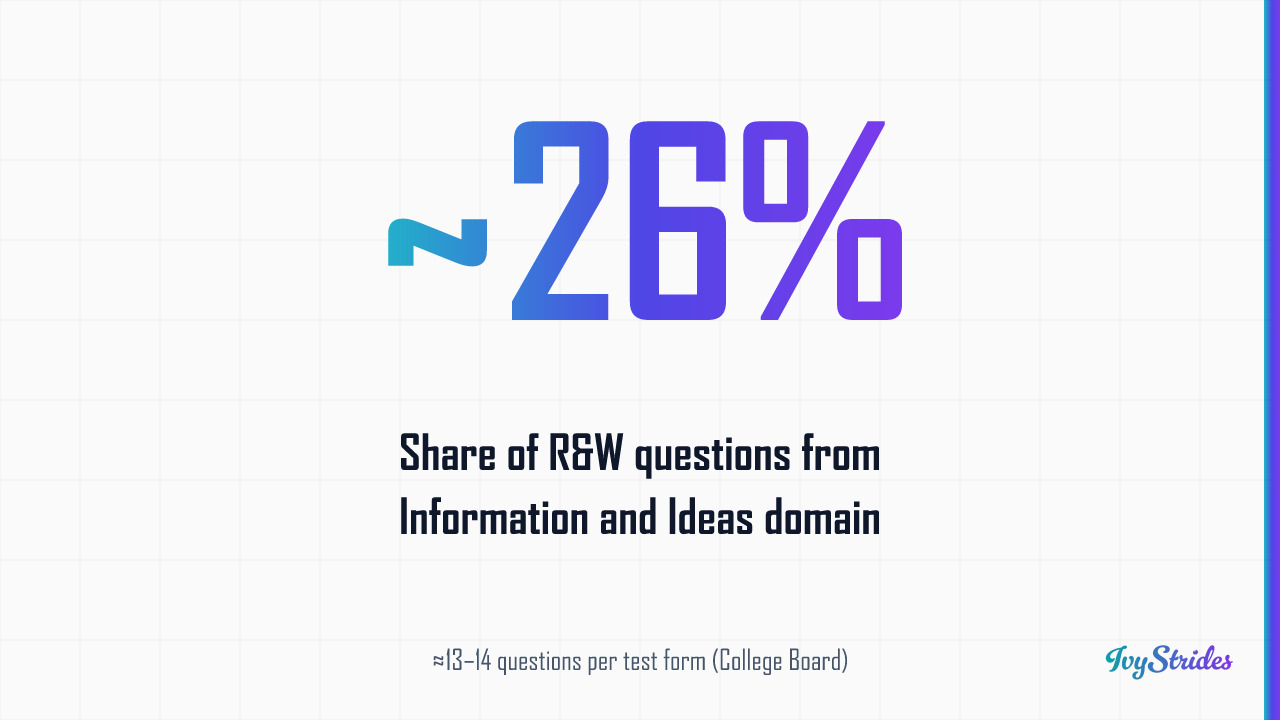
R&W splits into four content domains: Information and Ideas, Craft and Structure, Expression of Ideas, and Standard English Conventions. Information and Ideas accounts for roughly 26% of R&W questions per College Board's content framework, which works out to about 13 to 14 questions across both modules. The exact count varies by test form.
Within Information and Ideas, you'll see three question types. Central ideas and details questions ask for the passage's main point. Inference questions ask what the passage most strongly suggests. Command of evidence questions split into two subtypes: textual (pick the quote that supports a claim) and quantitative (interpret a table, graph, or chart paired with a passage).
Three question types. Three different attack sequences. If you're studying them as one bucket, that's the first leak. For a wider view of how this section fits the test, see our sat prep study guide.
Central Ideas and Details Questions: The One-Sentence Summary Test
These questions sound like: "Which choice best states the main idea of the text?" or "Which choice best describes the overall structure of the text?" The trap is almost always the same. Three of the four answer choices contain something the passage actually says. Only one captures what the passage is about.
Here's the tactic. Before you read any answer choice, write or whisper a one-sentence summary of the passage. Then test each choice against that summary. The correct answer survives. The detail-traps don't, because they describe one corner of the passage but fail the whole-passage test.
In our coaching with students in the 1200 to 1350 score band, central ideas errors most often come from selecting the first plausible answer rather than testing it against the full passage. A sophomore we worked with last fall had this exact pattern: she'd read the passage, see choice (B) say something accurate, click, and move on. Choice (D), which captured the actual main point, never got weighed because she'd already committed. The one-sentence summary test fixed the habit in two weeks.
Central ideas questions cluster on literary excerpts and scholarly essay passages, where the writer may state a claim early and then qualify it. The qualification is often where the main idea actually lives. Read to the end before you summarize.
Inference Questions: Why 'Plausible' Is Not Enough
Spot the signal phrases first: "most strongly suggests," "can reasonably be inferred," "most likely." Once you see them, switch into a stricter mode of reading.
The rule is simple and ruthless. The correct answer must be directly supported by the passage text. Not plausible in the real world. Not a reasonable assumption. Not something a smart person would conclude. Textually grounded.
Wrong answers on inference questions are often true statements about the world that the passage doesn't actually say. That's what makes them sticky. You read choice (C), it sounds correct, you've read something like it before, and you click. But if you can't point to the specific line that forces that conclusion, it's the wrong answer.
The elimination drill: cross out any choice that requires information not in the passage. Apply a "show me the line" rule before you commit. If you can't find the supporting line in under fifteen seconds, the answer probably isn't there. In our coaching with students targeting 1400+, inference errors drop significantly when students apply a strict show-me-the-line rule before selecting an answer.
One pacing note. Inference questions on short passages should take no more than 60 to 75 seconds. Students who re-read the entire passage for each answer choice burn time without gaining accuracy. Read the passage once, read the question, locate the relevant lines, then evaluate.
Why Information and Ideas Errors Keep Repeating (And What to Do About It)
Here's the part most students miss. Reviewing your wrong answers by domain label produces almost no improvement. "I got six Information and Ideas questions wrong" tells you nothing about what to fix. The domain is too big. The three question types inside it test different skills, reward different habits, and punish different mistakes.
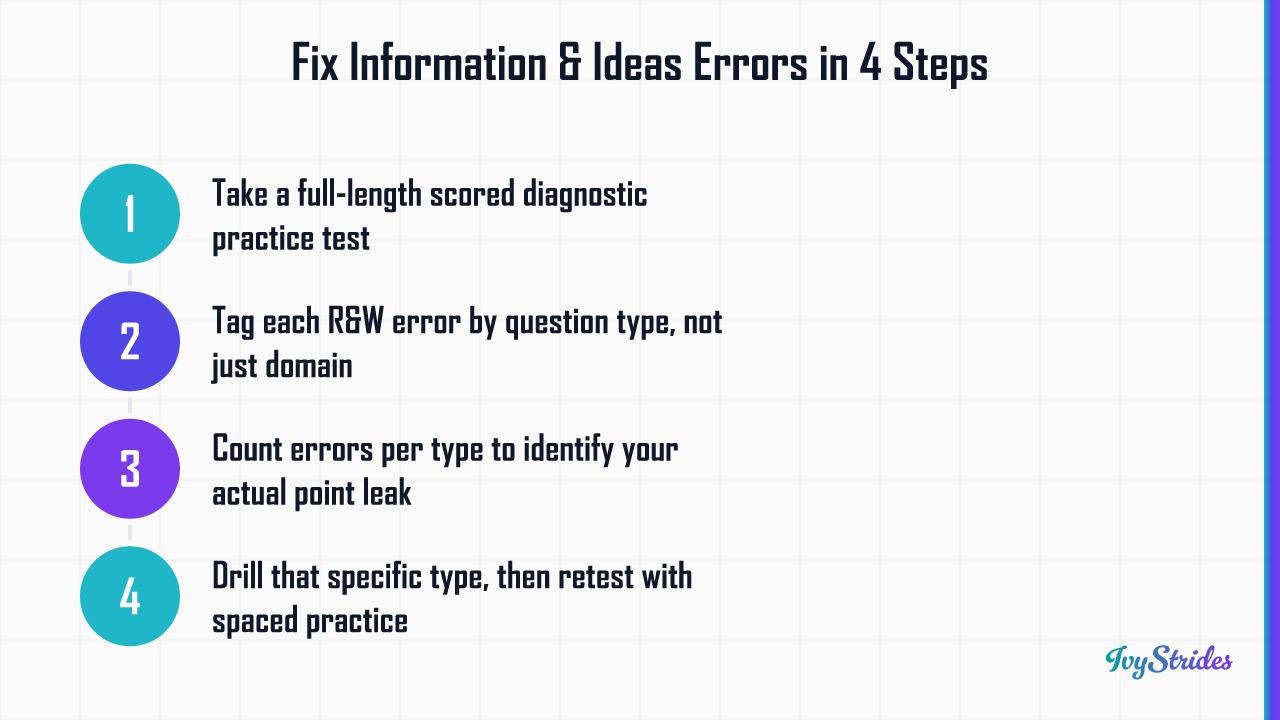
What works: tag each Information and Ideas error by question type. Central ideas. Inference. Command of evidence (textual). Command of evidence (quantitative). Then count. The type with the most errors is your actual leak.
In our coaching, students who tag each R&W error by question type, not just domain, identify their actual leak within one scored practice test. A student scoring 1300 overall may be losing 4 to 6 points in R&W from a single question type within Information and Ideas. That's enough to shift the section score by 20 to 30 points when corrected, because the Digital SAT's adaptive logic compounds early-module accuracy into Module 2 routing.
This is the IvyStrides methodology in plain form: full-length diagnostic, error tagging by question type, targeted drill on the specific type, spaced retesting with a section-specialist R&W coach. Volume isn't the lever. Diagnosis is. If you need a full-length test to run this diagnosis, our sat test platform gives you a scored, College Board-aligned form.
Not Sure Which Question Type Is Costing You Points?
In a free 15-minute strategy call, an IvyStrides R&W specialist will review your practice test errors, identify your Information and Ideas point leak by question type, and recommend a targeted plan. No commitment required. Students and parents both welcome.
Command of Evidence Questions: Textual vs. Quantitative (Two Different Attacks)
Command of evidence is two question types wearing the same name. Confusing them costs points.
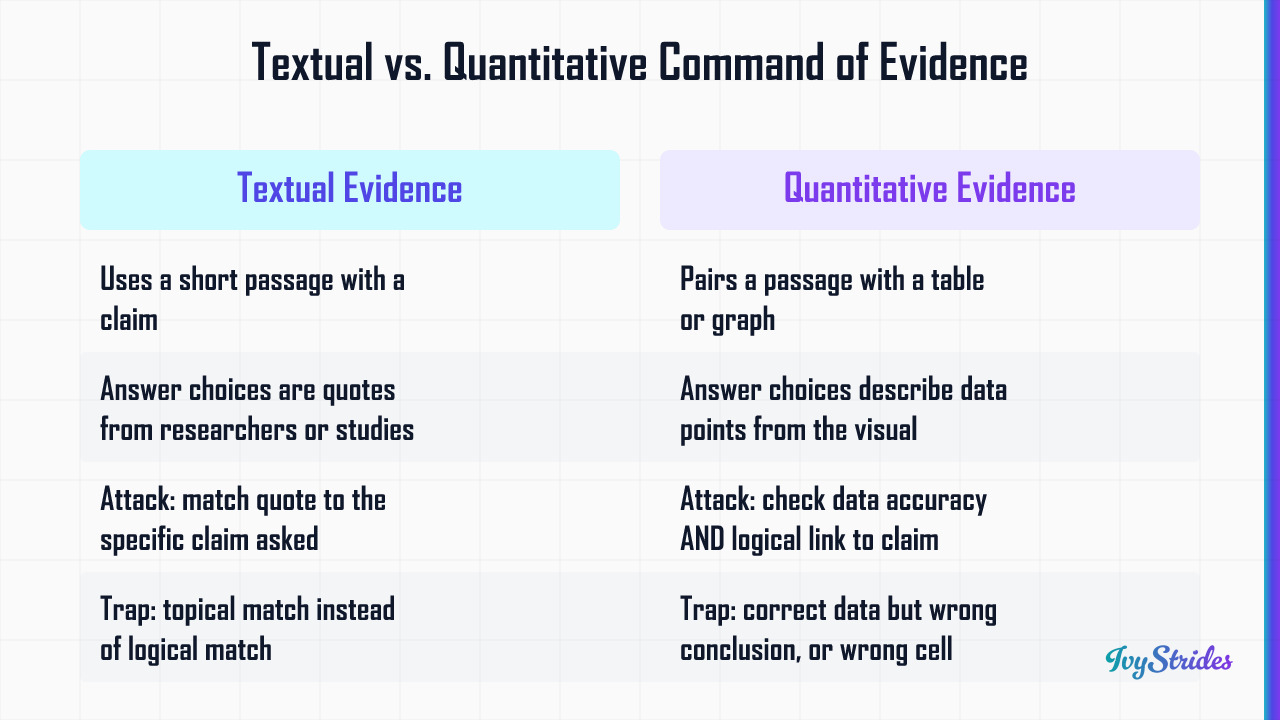
Textual command of evidence gives you a short passage stating a claim or scenario, then asks which quote (usually from a researcher, an author, or a study) would best support that claim. The attack sequence is claim-first:
-
Read the claim in the question stem before you read the answer choices.
-
Predict what kind of evidence would support that claim. What would you expect to see?
-
Evaluate each quote against the claim, not against the passage in general.
The wrong-answer trap here: a quote that's genuinely true and relevant to the passage's topic but supports a slightly different claim than the one asked about. Students who skim the question stem and look at the quotes get pulled toward the topical match instead of the logical match.
Quantitative command of evidence pairs a passage with a table, graph, or bar chart and asks which answer choice accurately uses the data to support or illustrate the passage's claim. Different attack:
-
Read the passage claim first.
-
Identify the relevant row, column, or data point in the table or graph.
-
Check whether the answer choice (a) accurately describes that data point AND (b) connects it back to the claim.
Both conditions have to hold. The most common trap: an answer choice that describes the data correctly but draws a conclusion the passage doesn't make, or vice versa. Numbers check out, logic doesn't. Or the logic flows but the answer cites the wrong cell of the table.
In our coaching with students at the 1400 to 1500 score band, quantitative command of evidence is the single most common Information and Ideas error type. These students have the reading skill. What they miss is the discipline of checking both the data accuracy and the logical link to the passage claim in the same beat. College Board's Digital SAT sample questions include both textual and quantitative examples worth working through carefully. For score-band-specific tactics on this question type, see our breakdown of command of evidence score band strategy.
Why Information and Ideas Errors Are Different From Math Errors (And Why That Matters for Your Score)
SAT Math and SAT R&W share the same adaptive pacing logic. Module 1 performance routes you to an easier or harder Module 2. But the error-pattern diagnosis is completely different: Math errors cluster around concept gaps, while R&W Information and Ideas errors almost always trace back to a specific question-type habit, not a knowledge gap.
That distinction changes how you study. If you keep missing quadratics in SAT Math, the fix is learning quadratics. If you keep missing inference questions, you don't have an inference knowledge gap. You have an inference habit gap: you're picking plausible answers instead of textually grounded ones. More passages won't fix it. A different attack sequence will.
Honestly, this is why students who misdiagnose R&W errors as "reading comprehension" and respond by reading more passages plateau. We see the pattern constantly. A junior we worked with last spring had done 200 extra practice questions on his own before our first call, scored the same on his next test, and walked in convinced he "just wasn't good at reading." He was. He'd been drilling volume against a habit error. Two weeks of show-me-the-line drill on inference questions moved his R&W by 40 points.
Module routing makes the stakes higher. A student who corrects a command of evidence habit in Module 1 is more likely to be routed to the harder Module 2, where the ceiling for R&W scores above 650 lives. One fixed habit, two modules of compounded benefit. For the parallel logic on the Math side, see our walkthrough of sat math topics 2026.
Step 1: Run a Diagnostic to Find Your Actual Point Leak in This Domain
Before you can fix an Information and Ideas point leak, you need a full-length practice test to confirm which of the three question types, central ideas, inferences, or command of evidence, is actually responsible for the drop.
Here's the three-step process we run with every new R&W coaching student.
Step 1: Take a full-length, scored Digital SAT practice test. Not a section. Not a half test. A full form, timed, in one sitting. Anything shorter distorts the data.
Step 2: Tag every wrong R&W answer by question type. Don't stop at "Information and Ideas." Label each error: central ideas, inference, command of evidence (textual), or command of evidence (quantitative). Then count. The type with the highest frequency is your primary leak.
Step 3: Drill that specific type for two weeks, then retest. Targeted question-type drill, not generic R&W practice. Then run another full-length test to confirm the fix held. This is spaced retesting, and it's how you know the change is real and not a one-test fluke.
A student in the 1250 to 1350 band who has 5+ Information and Ideas errors is typically losing 30 to 50 points in R&W that can be recovered through question-type-specific drill over 4 to 6 weeks, in our coaching. The work is targeted, the timeline is honest, and the mechanism is documented. For practice sets you can use during the targeted-drill phase, our command of evidence practice questions post gives you scored items by subtype.
How Information and Ideas Fits Into Your Broader SAT R&W Strategy
Information and Ideas is one domain of four. Once you've fixed your leak there, the same diagnostic logic applies to the rest.
Standard English Conventions is a rules-based domain. Punctuation, sentence structure, subject-verb agreement. It responds to different drill methods than Information and Ideas, because the underlying skill is rule application, not reading judgment. If you're missing comma splices, you don't need to read more carefully. You need to learn the rule and drill it. See our breakdown of SAT Standard English Conventions for the rule-by-rule attack plan.
Craft and Structure covers vocabulary in context, text structure analysis, and cross-text connections. A third distinct skill set, with its own habits and traps.
Expression of Ideas asks about rhetorical synthesis and transitions, which is a writing-strategy skill rather than a reading-comprehension skill.
The prioritization logic: fix the domain with the most errors first, not the domain that feels hardest. Feelings are unreliable diagnostics. The error log isn't. In our coaching, students who address their highest-error domain first see the fastest score movement; spreading effort evenly across all four domains is less efficient than targeted domain work.
This is what section-specialist R&W coaching means at IvyStrides. The R&W coach isn't a generalist teacher running you through passages. The coach diagnoses domain-level and question-type-level patterns, then targets the specific habit that's costing you the most points. For a fuller view of how we structure score-band-specific coaching, our SAT prep overview walks through the methodology end to end.
FAQ
How many Information and Ideas questions are on the Digital SAT?
College Board's content specifications indicate Information and Ideas accounts for roughly 26% of R&W questions. With 54 total R&W questions across both modules, that's approximately 13 to 14 questions per test. The exact count varies slightly by test form, so don't anchor on a precise number.
What is the difference between a central ideas question and an inference question on the SAT?
Central ideas questions ask for the main point or primary purpose of the entire passage. Inference questions ask what the passage most strongly suggests or implies. Central ideas answers must capture the whole passage; inference answers must be directly supported by specific passage text, not just the overall topic. Different scope, different evidence standard.
What are the two types of command of evidence questions on the Digital SAT?
Textual command of evidence asks you to select the quote from a passage or study that best supports a given claim. Quantitative command of evidence presents a table, graph, or chart alongside a passage and asks which answer choice accurately uses the data to support or illustrate the passage's claim. Each subtype needs its own attack sequence: claim-first for textual, data-then-logic for quantitative.
Is Information and Ideas harder in Module 2 of the Digital SAT?
If your Module 1 performance routes you to the harder Module 2, the Information and Ideas questions you see will be more difficult. Expect more complex passages, subtler wrong-answer traps in inference questions, and more ambiguous data in quantitative command of evidence questions. The question types stay the same. The difficulty of the passages and distractors increases.
How do I know if Information and Ideas is my biggest R&W point leak?
Take a full-length Digital SAT practice test and tag each wrong R&W answer by content domain. If Information and Ideas has the most errors, it's your primary leak. Within that domain, further tag each error as central ideas, inference, or command of evidence (textual or quantitative) to identify the specific question type to target first.
Can I improve my Information and Ideas score without a tutor?
Yes, with a structured approach: run a diagnostic, tag errors by question type, apply the question-type-specific tactic (one-sentence summary test for central ideas, textual-grounding rule for inferences, claim-first sequence for command of evidence), and retest. Students who work with a section-specialist R&W coach typically see faster improvement because the coach identifies habit errors that are hard to self-diagnose. The framework, though, is actionable independently.
You don't have a reading problem. You have a question-type problem, and now you know which three to look for. Tag your next practice test, find your highest-frequency type, apply the matching tactic. The points are recoverable when the work is targeted.
Ready to Stop Losing Points in Information and Ideas?
Book a free 15-minute SAT strategy call. Bring your practice test. An IvyStrides section-specialist will pinpoint your exact question-type leak and map out the next four to six weeks of targeted R&W work. Students and parents both welcome.

Award-winning author (South Asian Book Award) and graduate of BITS Pilani and UCLA Luskin School of Public Affairs. Brings a published writer's eye to Common App essays and grammatical precision to SAT and ACT R&W instruction.