
SAT Geometry Formulas You Actually Need to Memorize (2026)
On this page
- 2026 digital SAT updates: what the SAT formula sheet really changes
- What’s different in 2026 (and what isn’t)
- What the SAT tends to do with geometry now
- Essential SAT geometry formulas (Tier 1: memorize these first)
- Triangles (high frequency)
- Rectangles and polygons (high frequency)
- Circles (high frequency)
- Coordinate geometry essentials (high frequency)
- Essential SAT geometry formulas (Tier 2: memorize if you want a time edge)
- Parallel lines and angle relationships
- Arc length and sector area (occasional)
- Volume (shows up, but usually straightforward)
- Similarity and scaling (very useful)
- Essential SAT geometry formulas list (core memorization)
- 1) Area formulas (know cold)
- 2) Perimeter calculations (and around-the-edge formulas)
- 3) Volume formulas (3D)
- 4) Triangle properties (angles + sides)
- 5) Coordinate geometry
- 6) Angle relationships (diagram decoding)
- Memorization vs. provided SAT math formulas: what you can’t rely on
- Typically provided (still don’t depend on it)
- Not provided (memorize)
- Strategic memorization priorities (what we push first)
- Memorization strategies and techniques (our system for 2026)
- The 7-minute “formula loop” (daily)
- Memory aids that reduce mix-ups
- Retention strategy: interleaving
- Build “confusion pairs” flashcards
- Put geometry into your overall SAT calendar
- SAT geometry formulas in action: 6 SAT-style examples (no fluff)
- Example 1: special right triangle
- Example 2: circle diameter trap
- Example 3: distance formula
- Example 4: scaling volume
- Example 5: perimeter vs. area
- Example 6: corresponding angles
- Visual formula reference guide: shapes and diagrams to picture
- Triangle area = half a rectangle
- 30-60-90 labeling
- Circle: radius vs. diameter
- Coordinate triangle for distance
- Angle relationships quick sketch (parallel lines)
- Downloadable SAT Geometry cheat sheet (copy/paste)
- Common mistakes with geometry formulas (and how our students stop them)
- Mistake 1: right formula, wrong measurement
- Mistake 2: mixing arc length and sector area
- Mistake 3: algebra errors inside geometry
- Practice problems by formula type (do these in 12 minutes)
- Triangles
- Circles
- Coordinate geometry
- Scaling
- FAQ: SAT geometry formulas (quick answers)
- Next steps: make these formulas automatic with IvyStrides
If you’re searching for sat geometry formulas, you don’t need a textbook list, you need the short set that actually shows up on test day, plus a plan to remember them under pressure. At IvyStrides, we coach students to stop over-memorizing and start scoring by mastering the formulas the SAT repeats in different disguises. This guide separates what the College Board gives you in the digital exam from what you must know cold, then shows when to use each formula, how to memorize faster, and how to avoid the traps that cost points.
Quick navigation (internal links):
- 2026 digital SAT updates
- Tier 1 formulas
- Tier 2 formulas
- Essential formulas list (categorized)
- Memorization vs. provided formulas
- Memorization strategies
- Formula application examples
- Visual reference guide
- Practice sets
- FAQ
2026 digital SAT updates: what the SAT formula sheet really changes
The SAT is digital and module-based (adaptive). That affects pacing and how you access references, but it doesn’t remove the need to memorize key geometry formulas for SAT, especially the ones tied to triangle properties, circle geometry, coordinate geometry, and core angle relationships.
What’s different in 2026 (and what isn’t)
-
You’ll still get a built-in reference sheet (often called the SAT formula sheet) inside the testing app.
-
You won’t get every geometry relationship you need. The SAT provides a few “foundation” formulas, then asks questions that require one or two extra steps.
-
Updated test structure (digital): Math is still 2 modules, and your performance in Module 1 influences the difficulty of Module 2. That’s why we treat Module 1 as “no silly errors allowed.”
-
New digital format implications: the formula sheet is clickable/on-screen, which means:
- you can’t quickly annotate it the way you would on paper,
- it can interrupt flow if you keep reopening it,
- and it’s easy to misread a formula when you’re rushing.
-
2026 test format updates (what to watch): The College Board can tweak wording, interface, or reference-sheet layout. In our program, we train students to verify the reference sheet in Bluebook practice tests and then build a memorization plan around it. Even if the sheet “adds” something, speed still comes from recall.
For a bigger map of what the SAT tests, see our breakdown of SAT Math Topics Decoded (2025).
What the SAT tends to do with geometry now
In digital format, geometry questions often look “simple,” but they hide the real skill: picking the right relationship quickly (triangle similarity, circle radius/diameter, slope/perpendicular, area formulas vs. perimeter calculations, and volume formulas vs. linear dimensions).
Essential SAT geometry formulas (Tier 1: memorize these first)
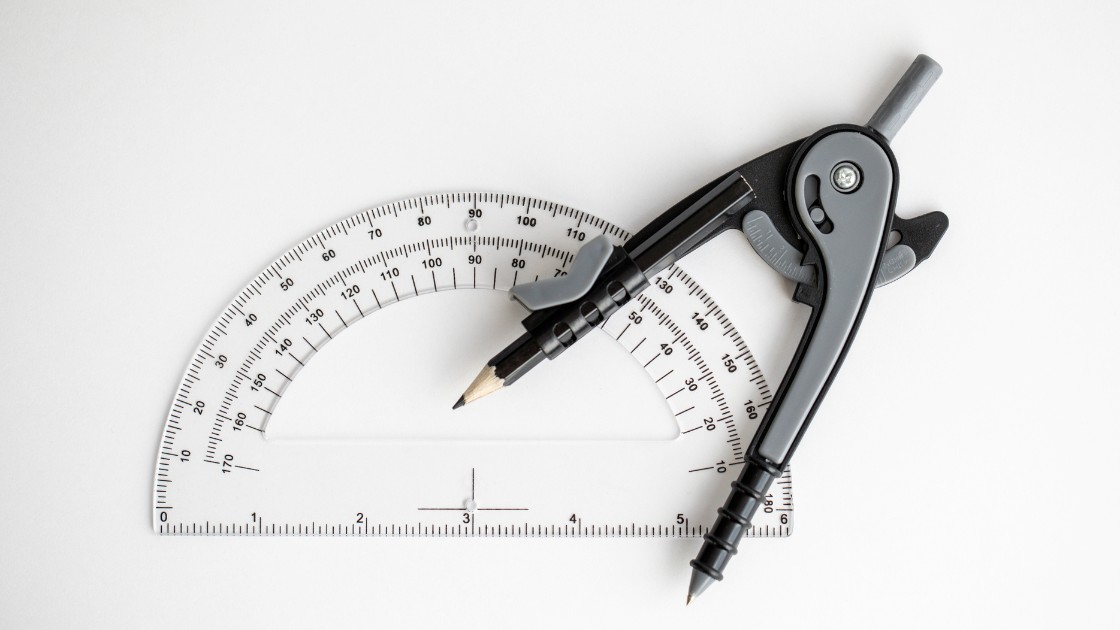
This is the core SAT Geometry cheat sheet we make our students master early. These appear directly or power other relationships.
Triangles (high frequency)
- Triangle angle sum: (A+B+C=180^\circ)
- Area of triangle: (A=\frac{1}{2}bh)
- Pythagorean theorem: (a^2+b^2=c^2) (often provided, but memorize anyway for speed)
- 45-45-90 triangle: legs (=x, x), hypotenuse (=x\sqrt2)
- 30-60-90 triangle: short (=x), long (=x\sqrt3), hypotenuse (=2x)
When the SAT uses these: missing side lengths, diagonal problems in rectangles, ladder/shadow setups, and “find area” questions where the height isn’t drawn. (That last one is pure triangle properties + smart labeling.)
Rectangles and polygons (high frequency)
- Perimeter of rectangle: (P=2l+2w)
- Area of rectangle: (A=lw)
- Interior angles of a polygon: ((n-2)\cdot 180^\circ)
- Each interior angle (regular n-gon): (\frac{(n-2)180^\circ}{n})
When the SAT uses these: “regular polygon” angle questions, perimeter vs. area comparisons, and composite figures. This is where students confuse perimeter calculations (adding side lengths) with area formulas (multiplying base × height).
Circles (high frequency)
- Circumference: (C=2\pi r)
- Area: (A=\pi r^2)
- Diameter-radius: (d=2r)
When the SAT uses these: “wheel rotation distance,” shaded region area, and radius/diameter bait-and-switch. Most circle questions are just clean circle geometry plus careful reading.
Coordinate geometry essentials (high frequency)
- Slope: (m=\frac{y_2-y_1}{x_2-x_1})
- Distance: (d=\sqrt{(x_2-x_1)^2+(y_2-y_1)^2})
- Midpoint: (M=\left(\frac{x_1+x_2}{2},\frac{y_1+y_2}{2}\right))
When the SAT uses these: finding side lengths on grids, proving right angles (perpendicular slopes), and “find the center” problems. On the SAT, coordinate geometry often disguises the Pythagorean theorem as the distance formula.
Essential SAT geometry formulas (Tier 2: memorize if you want a time edge)
Tier 2 formulas appear less often, but they save time when they do show up, especially for students chasing 700–800.
Parallel lines and angle relationships
- Vertical angles are equal
- Linear pair sums to (180^\circ)
- Alternate interior angles are equal (parallel lines)
- Corresponding angles are equal (parallel lines)
SAT pattern: the diagram looks messy, but the math is one-line if you spot the relationship. If your student is a “diagram freezer,” we train a simple routine: mark parallel lines, mark the transversal, then label equal angles before doing any algebra.
Arc length and sector area (occasional)
- Arc length: (s=\frac{\theta}{360^\circ}\cdot 2\pi r)
- Sector area: (A=\frac{\theta}{360^\circ}\cdot \pi r^2)
SAT pattern: “fraction of a circle” questions that punish students who mix up arc vs. area.
Volume (shows up, but usually straightforward)
- Rectangular prism: (V=lwh)
- Cylinder: (V=\pi r^2h)
- Cone: (V=\frac13\pi r^2h)
- Sphere: (V=\frac43\pi r^3)
SAT pattern: unit conversions, radius/diameter confusion, and “what happens to volume if dimensions scale?” These are the most common volume formulas we see tested.
Similarity and scaling (very useful)
- Similar figures scale factor: (k=\frac{\text{new}}{\text{old}})
- Perimeter scales by: (k)
- Area scales by: (k^2)
- Volume scales by: (k^3)
Our IvyStrides students pick up points here fast because the SAT loves “double the radius” style questions.
Essential SAT geometry formulas list (core memorization)
This is the “one-page” list we use in our program. It’s the same content as Tier 1/Tier 2, but categorized the way the SAT actually triggers them, by problem type.
1) Area formulas (know cold)
- Triangle: (A=\frac12 bh)
- Rectangle: (A=lw)
- Circle: (A=\pi r^2)
- Sector: (A=\frac{\theta}{360^\circ}\pi r^2)
Use when: the question says area, mentions shaded regions, or asks about “how much space” inside a boundary.
2) Perimeter calculations (and around-the-edge formulas)
- Rectangle: (P=2l+2w)
- Circle circumference: (C=2\pi r)
- Arc length: (s=\frac{\theta}{360^\circ}\cdot 2\pi r)
Use when: the question says perimeter, circumference, distance around, fencing, borders, or “how far a wheel travels.”
3) Volume formulas (3D)
- Prism: (V=lwh)
- Cylinder: (V=\pi r^2h)
- Cone: (V=\frac13\pi r^2h)
- Sphere: (V=\frac43\pi r^3)
Use when: the figure is 3D (or the units are cubic), or the prompt mentions filling, capacity, or scaling a solid.
4) Triangle properties (angles + sides)
- Angle sum: (180^\circ)
- Pythagorean theorem: (a^2+b^2=c^2)
- 45-45-90: (x, x, x\sqrt2)
- 30-60-90: (x, x\sqrt3, 2x)
Use when: right angles, diagonals, symmetric triangles, or “find the missing side.”
5) Coordinate geometry
- Slope, distance, midpoint
Use when: you’re given points, a grid, or line language like parallel/perpendicular.
6) Angle relationships (diagram decoding)
- Vertical, linear pair, corresponding, alternate interior
Use when: parallel lines or transversals appear, or the problem says “find (x)” with lots of angle labels.
Memorization vs. provided SAT math formulas: what you can’t rely on

Students lose time because they assume the SAT formula sheet covers everything. It doesn’t.
Typically provided (still don’t depend on it)
The SAT reference commonly includes:
- (A=\pi r^2), (C=2\pi r)
- (A=lw), (A=\frac12 bh)
- (V=lwh), (V=\pi r^2h), (V=\frac13\pi r^2h), (V=\frac43\pi r^3)
- Often (a^2+b^2=c^2)
But here’s IvyStrides’ rule: if you need it more than twice per practice test, memorize it. Clicking to a reference breaks rhythm and increases careless mistakes, especially in a timed, adaptive setting.
Not provided (memorize)
- Special right triangles (30-60-90, 45-45-90)
- Slope/distance/midpoint (core coordinate geometry)
- Arc length and sector area
- Polygon interior angle sum
- Similarity scaling rules
- The quick “angle facts” set (the angle relationships section above)
Strategic memorization priorities (what we push first)
- Special right triangles + Pythagorean
- Slope/distance/midpoint
- Scaling rules ((k, k^2, k^3))
- Arc/sector
Memorization strategies and techniques (our system for 2026)
At IvyStrides, we don’t tell students to “just drill.” We teach a system so the formulas stick across weeks, not just the night before.
The 7-minute “formula loop” (daily)
Do this once per day for 10 days:
- Write Tier 1 formulas from memory (2 minutes).
- Check and correct with a master list (1 minute).
- Do 3 micro-problems (4 minutes): one triangle, one circle, one coordinate.
This works because you practice recall, not recognition. Our students feel the difference by day 4.
Memory aids that reduce mix-ups
- Triangle area: “Triangle is half a rectangle.”
- 30-60-90: “short, long, hyp = (x, x\sqrt3, 2x)” (always in that order).
- Scaling: “line, square, cube” → (k, k^2, k^3).
Retention strategy: interleaving
We interleave:
- 2 triangle questions
- 1 circle question
- 1 coordinate geometry question
- 1 mixed scaling question
Build “confusion pairs” flashcards
- Arc length vs. sector area
- Radius vs. diameter
- Area scale (k^2) vs. volume scale (k^3)
Put geometry into your overall SAT calendar
Use our Secret SAT Study Plan for 2026 and swap in the formula loop above.
SAT geometry formulas in action: 6 SAT-style examples (no fluff)
Example 1: special right triangle
45-45-90, leg = 7 → hypotenuse (=7\sqrt2)
Example 2: circle diameter trap
Diameter 10 → radius 5 → area (=25\pi)
Example 3: distance formula
(d=\sqrt{(7-1)^2+(10-2)^2}=\sqrt{6^2+8^2}=10)
Example 4: scaling volume
Side triples → volume ×27
Example 5: perimeter vs. area
Perimeter 20, length 6 → (2l+2w=20) → (w=4)
Example 6: corresponding angles
Corresponding angles are equal → (65^\circ)
Visual formula reference guide: shapes and diagrams to picture
Triangle area = half a rectangle
+--------+
| \ |
| \ | Same base, same height
| \ | Triangle is half
| \ |
+--------+
A = (1/2) b h
30-60-90 labeling
/|
2x/ | x√3 (long leg)
/ |
/___|
x (short leg)
Circle: radius vs. diameter
(diameter) --------10--------
<---r=5--->
Area = πr², Circumference = 2πr
Coordinate triangle for distance
B(x2,y2) *
|\
| \
| \ d
| \
A(x1,y1)*----*
Δx
Δy is vertical, Δx is horizontal
d = √(Δx² + Δy²)
Angle relationships quick sketch (parallel lines)
/ transversal
/
= = = = = line 1
\
\
= = = = = line 2
Corresponding angles match “same corner.”
Alternate interior angles are equal inside the lines.
Linear pair sums to 180° on a straight line.
Downloadable SAT Geometry cheat sheet (copy/paste)
Tier 1
- Triangle angles: (180^\circ)
- Triangle area: (\frac12 bh)
- Pythagorean: (a^2+b^2=c^2)
- 45-45-90: (x, x, x\sqrt2)
- 30-60-90: (x, x\sqrt3, 2x)
- Rectangle area: (lw), perimeter: (2l+2w)
- Circle area: (\pi r^2), circumference: (2\pi r)
- Slope: (\frac{\Delta y}{\Delta x})
- Distance: (\sqrt{(\Delta x)^2+(\Delta y)^2})
- Midpoint: averages of coordinates
Tier 2
- Polygon interior sum: ((n-2)180^\circ)
- Arc length: (\frac{\theta}{360}2\pi r)
- Sector area: (\frac{\theta}{360}\pi r^2)
- Volume scaling: (k^3), area scaling: (k^2)
Common mistakes with geometry formulas (and how our students stop them)
Mistake 1: right formula, wrong measurement
Plugging in diameter instead of radius, or using slanted length as height.
Mistake 2: mixing arc length and sector area
- Arc length uses circumference
- Sector area uses area
Mistake 3: algebra errors inside geometry
Square roots, signs, and setup mistakes. Related guide: Mistakes to Avoid in Quadratic Formula.
Practice problems by formula type (do these in 12 minutes)
Triangles
- Legs 9 and 12 → hypotenuse
- Base 10, area 35 → height
Circles
- Circumference (18\pi) → radius
- Sector (90^\circ), radius 8 → sector area
Coordinate geometry
- Slope through (2,5) and (6,1)
- Midpoint of (-4,7) and (10,-1)
Scaling
- Rectangle sides double → area factor
- Cylinder radius doubles, height same → volume factor
FAQ: SAT geometry formulas (quick answers)
- Most students need 15–20 formulas/relationships.
- SAT provides areas/volumes and often Pythagorean; memorize special triangles, coordinate, scaling, arc/sector.
- Best method: active recall + 3 quick problems daily.
- Geometry appears regularly and often as multi-skill questions.
- Calculator exists, but many are faster without it.
- If you forget: derive, estimate, move on.
- No major new topics; digital format rewards speed + accuracy.
- Use triggers: right angle, circle slice, grid points, scaling language.
- Most common: special triangles, triangle area, circle area/circumference, slope/distance, scaling.
- Avoid mix-ups with confusion-pair drills + mixed practice.
Next steps: make these formulas automatic with IvyStrides
Memorizing sat geometry formulas is only step one. Scoring higher comes from recognizing patterns fast, avoiding traps, and staying steady across adaptive modules. At IvyStrides, we build that through targeted diagnostics, short daily recall loops, and timed mixed sets that mirror real digital SAT pacing. If you want a coach to check your setup habits, fix recurring errors, and turn your formula knowledge into points, our team can help you get there.

Hemant is a seasoned entrepreneur, investor, and growth strategist with deep ground in education and technology-driven learning. His core training is in Mathematics and Physics — he authored Physics for IB Diploma: Ultimate Revision Guide, recognized as a top student resource.