
Does Digital SAT Module 1 Lock In Your Score Ceiling?
On this page
- The Direct Answer: Yes, Module 1 Sets a Real Score Ceiling
- How the Digital SAT Adaptive Routing Actually Works
- What the Score Ceiling Looks Like in Practice: Easy vs. Hard Module 2
- Why Getting the Easy Module 2 Feels Unfair (But Is Statistically Sound)
- What Module 1 Performance Actually Signals to the Algorithm
- What the Score Ceiling Means for Your College Target
- How to Prepare for Module 1 So the Routing Takes Care of Itself
- Frequently Asked Questions About Digital SAT Module Routing and Score Ceilings
- What is the difference between SAT Module 1 and Module 2?
- What is the maximum score possible if you get the easy Module 2?
- What is the point of adaptive testing if it caps my score?
- How rare is a 1420 SAT score?
- Can I get a 1600 if I am routed to the easy Module 2?
- Does the routing decision happen separately for Reading and Writing versus Math?
- Does the PSAT work the same way?
- Should I just switch to the ACT?
- One Last Thing
Yes. Module 1 effectively sets a ceiling on your Digital SAT section score, and if you're routed to the easier Module 2, no amount of perfect work on that second module will push you past roughly the high 500s to low 600s in that section. The Digital SAT is adaptive: your performance on Module 1 routes you to either a harder Module 2 (Module 2B) or an easier Module 2 (Module 2A). Reaching scores above approximately 650 per section, or a composite above roughly 1250, requires the harder pathway. Module 1 is the highest-use block of the entire test.
If a tutor, a friend, or a Reddit thread told you that bombing Module 1 already capped your score, that's not test-prep folklore. The math behind it is worth understanding before you book another practice test.

The Direct Answer: Yes, Module 1 Sets a Real Score Ceiling
Here's the part most students miss. The Digital SAT isn't one test. It's a two-stage adaptive test, and the second stage you receive is decided entirely by how you handle the first.
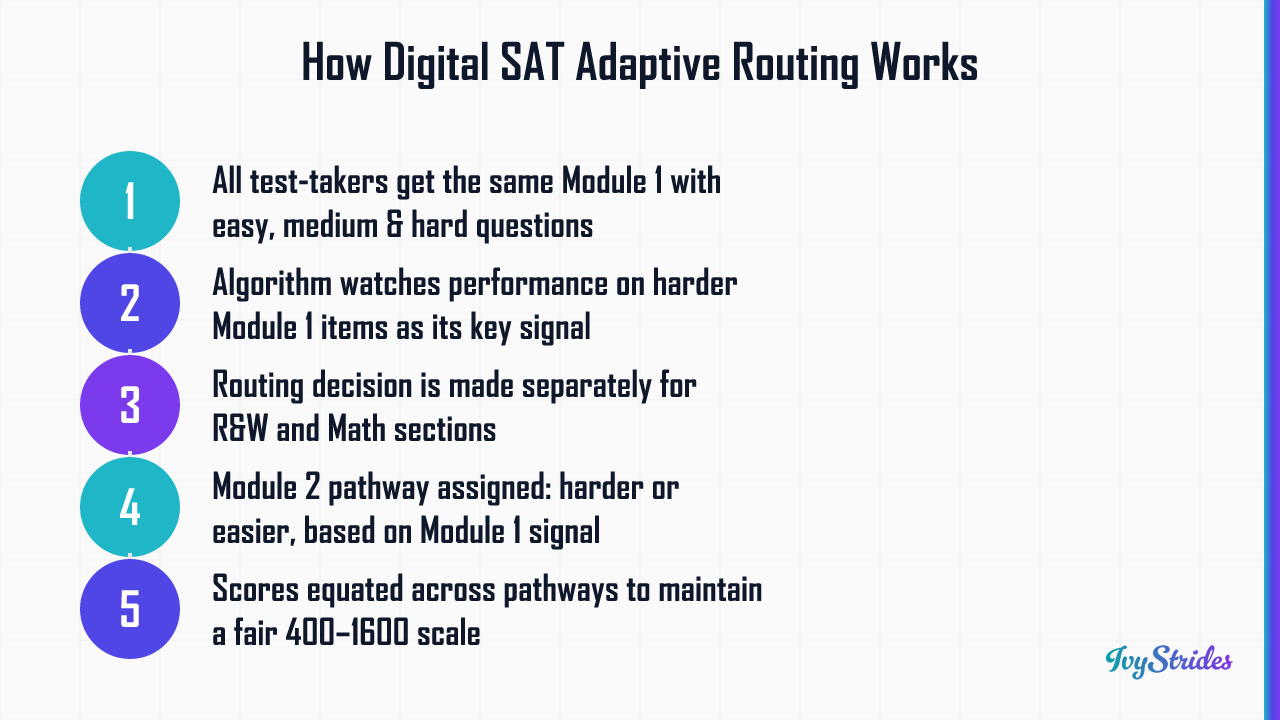
Per College Board, each section, Reading and Writing and Math, opens with Module 1, which contains a broad mix of easy, medium, and hard questions. Based on how you perform on that first module, the second module routes you to either a harder set (Module 2B) or an easier set (Module 2A). Same question count, same time limit, very different difficulty distribution.
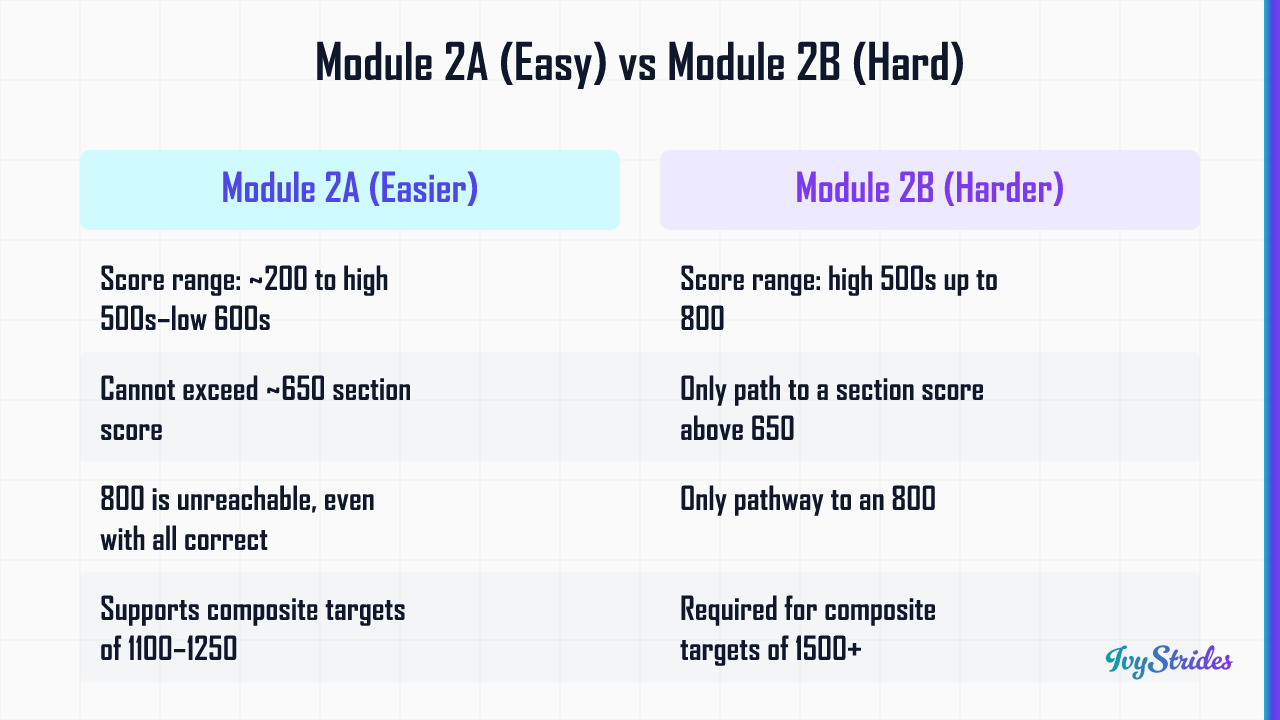
The ceiling on the easier Module 2 is real. Based on observed score distributions across the new test, students routed to Module 2A in a section typically cap out somewhere in the high 500s to low 600s, even with a perfect raw score on that module. An 800 in either section is only reachable through Module 2B. If both sections route you to Module 2A, your composite is realistically capped near 1150 to 1250.
College Board doesn't publish the exact routing threshold or the precise ceiling figure. We're working from observed score distributions, the published adaptive structure, and what we see across student score reports in our coaching. For a deeper look at how scaled scores are calculated across both modules and what the 400-1600 scale actually measures, see our breakdown of how the Digital SAT is scored.
How the Digital SAT Adaptive Routing Actually Works
Two sections. Two modules each. Two independent routing decisions.
Reading and Writing gives you 27 questions in Module 1 across 32 minutes, then 27 questions in Module 2 across another 32 minutes. Math gives you 22 questions in Module 1 across 35 minutes, then 22 questions in Module 2 across another 35 minutes. These counts and times are published by College Board.
The piece that surprises most families: routing is section-independent. You can finish R&W and get routed to easy Module 2 there, then sit down for Math and get routed to hard Module 2. Or the reverse. The algorithm doesn't pool your performance across sections. It looks at each one separately.
Module 1 itself is the same backbone for every test-taker on a given form. College Board describes it as containing "a broad mix of easy, medium, and hard questions." That mix is the diagnostic. The algorithm watches how you handle the harder items in particular and uses that signal to decide your Module 2 pathway.
How many versions of the Digital SAT exist? Multiple parallel forms are administered per test date for security reasons, all equated to the same 400-1600 scale. Equating is what keeps scores comparable across forms and across the easy versus hard Module 2 pathways. For more on the question-count side of the format, see our breakdown of how many questions are on the SAT. For timing, see how long is the SAT test.
What the Score Ceiling Looks Like in Practice: Easy vs. Hard Module 2
Let's get specific. Here's what each routing pathway means for your final section score.
Routed to Module 2A (easier): Your section score lands somewhere between roughly 200 and a ceiling in the high 500s to low 600s. Even if you answer all 27 R&W questions or all 22 Math questions correctly. The item pool in Module 2A doesn't contain enough high-difficulty questions to demonstrate top-band ability, so the scaling can't push you past that cap.
Routed to Module 2B (harder): Your section score can range from roughly the high 500s up to 800. This is the only pathway to a section score above 650, and the only pathway to an 800.
What does that mean for composite targets?
| Target Composite | Routing Required |
| 1100-1250 | Easy Module 2 in both sections is possible |
| 1300-1400 | Hard Module 2 in at least one section, likely both |
| 1500+ | Hard Module 2 in both sections, near certain |
| 1600 | Hard Module 2 in both sections, plus near-perfect accuracy |
A student who answers every question correctly on Module 2A still can't reach an 800 in that section. The ceiling isn't about effort within Module 2. It's about which Module 2 you were given. If you want to play with score combinations, the sat calculator is a useful sanity check. And if you're benchmarking your target, here's our take on is 1540 a good sat score.
Why Getting the Easy Module 2 Feels Unfair (But Is Statistically Sound)
The Reddit posts about this are real. Students walk out of the test, realize the second module felt suspiciously easy, and panic. The frustration is understandable. The system, though, isn't broken.
Adaptive tests like the Digital SAT use item response theory, a way of estimating a student's ability based on which questions they get right and the known difficulty of those questions. A correct answer on a hard item carries more information about your ability than a correct answer on an easy item. By routing students into harder or easier Module 2s, the test concentrates its measurement precision where each student actually sits on the ability scale. That's the point.
Here's the practical implication. If you sat the test again tomorrow at the same preparation level, you'd almost certainly get the same routing. The ceiling isn't bad luck. It reflects your current preparation. Which is also why it's movable.
In our coaching, students who move from easy-module routing to hard-module routing typically do so after 6 to 10 weeks of targeted Module 1 work focused on medium-to-hard difficulty items. Not on more practice tests in general. On the specific question types within Module 1 that drive the routing signal.
A junior we worked with last fall started at a 1180 with easy-module routing in both sections. She didn't need more practice tests. She needed someone to look at her error log and tell her that her Module 1 wrong answers were clustering on Advanced Math and Command of Evidence items, both of which are routing-critical. Eight weeks later, her practice tests routed her to hard Module 2 in both sections. That's the pattern we see repeatedly.
One coaching observation worth flagging: students who skip hard Module 1 questions to manage pacing often receive easy Module 2 routing, regardless of how cleanly they finish Module 2 later. The harder Module 1 items are exactly the ones the algorithm is watching.
For students ready to start with a dedicated coach, our 1-on-1 SAT prep program pairs you with a section specialist for exactly this kind of work. And if you're weighing how many retakes to plan for, see how many times can you take the SAT.
What Module 1 Performance Actually Signals to the Algorithm
College Board doesn't publish the exact routing threshold or the precise number of questions that trigger one pathway over the other. What we can say, based on the published structure and observed score outcomes, is that performance on the harder items inside Module 1 carries disproportionate weight.
In our coaching, students who consistently answer roughly 70 to 75% or more of Module 1 questions correctly, including the medium-to-hard items, are far more likely to receive hard Module 2 routing. Pure accuracy on the easy items isn't enough. The algorithm needs to see you handle difficulty.
In Reading and Writing, the harder Module 1 items tend to cluster in two domains:
- Command of Evidence: questions asking you to select a quotation or data point that best supports a given claim. These reward careful argument tracking and are heavily weighted in routing. Because Command of Evidence questions separate students routed to hard Module 2 from those routed to easy, the strategy shifts meaningfully between the 1200, 1400, and 1500+ score bands. See our breakdown of Command of Evidence by score band.
- Craft and Structure: vocabulary-in-context and rhetorical purpose questions, where the trap answers look reasonable on a quick read.
Information and Ideas questions also appear across both Module 1 and Module 2 and carry significant weight in R&W routing. Strengthening this domain is one of the fastest ways to improve your Module 1 performance, and our SAT Information and Ideas strategy article walks through the question types in detail.
In Math, the difficulty drivers in Module 1 are:
- Advanced Math: quadratics, nonlinear equations, function notation, and systems with nonlinear components.
- Harder Algebra: linear systems with abstract parameters, inequality problems with multiple constraints.
Problem-Solving and Data Analysis and Geometry/Trigonometry appear in Module 1 too, but the bulk of routing-relevant difficulty sits in Algebra and Advanced Math. If your Module 1 errors cluster there, that's where the targeted work goes.
What the Score Ceiling Means for Your College Target
The ceiling matters in proportion to how far above it your target schools sit.
Aiming at UPenn? The middle-50% SAT range is 1510 to 1570 per the school's Common Data Set. A composite ceiling of 1250 from dual easy-module routing isn't in that conversation. Stanford and MIT sit in a similar band, with middle-50% ranges in the 1510 to 1580 range. Hard Module 2 routing in both sections is a prerequisite for competitive scores at any of these schools. For more on what scores fit which tier, see our analysis of upenn sat requirements. For an Ivy-specific framing, see is 1500 a good sat score for ivy league.
What about superscoring? College Board supports it, and many colleges consider your highest section scores across multiple test dates. But each individual test date still has its own module routing, so superscoring doesn't bypass the ceiling. It just means you can attack R&W on one date and Math on another, if that's strategically useful. When you're ready to report scores, here's how to send sat scores to colleges.
One caveat worth surfacing. If a student's realistic ceiling given current Module 1 performance falls below a target school's 25th-percentile score, it's worth reviewing whether that school's test-optional policy changes the submission calculus. Test-optional policies vary by school and by year; check FairTest.org for current school-by-school status. Test-optional isn't a substitute for score improvement at competitive schools, where submitting strong scores remains a meaningful signal. For some target lists, though, the policy genuinely changes the strategy.
How to Prepare for Module 1 So the Routing Takes Care of Itself
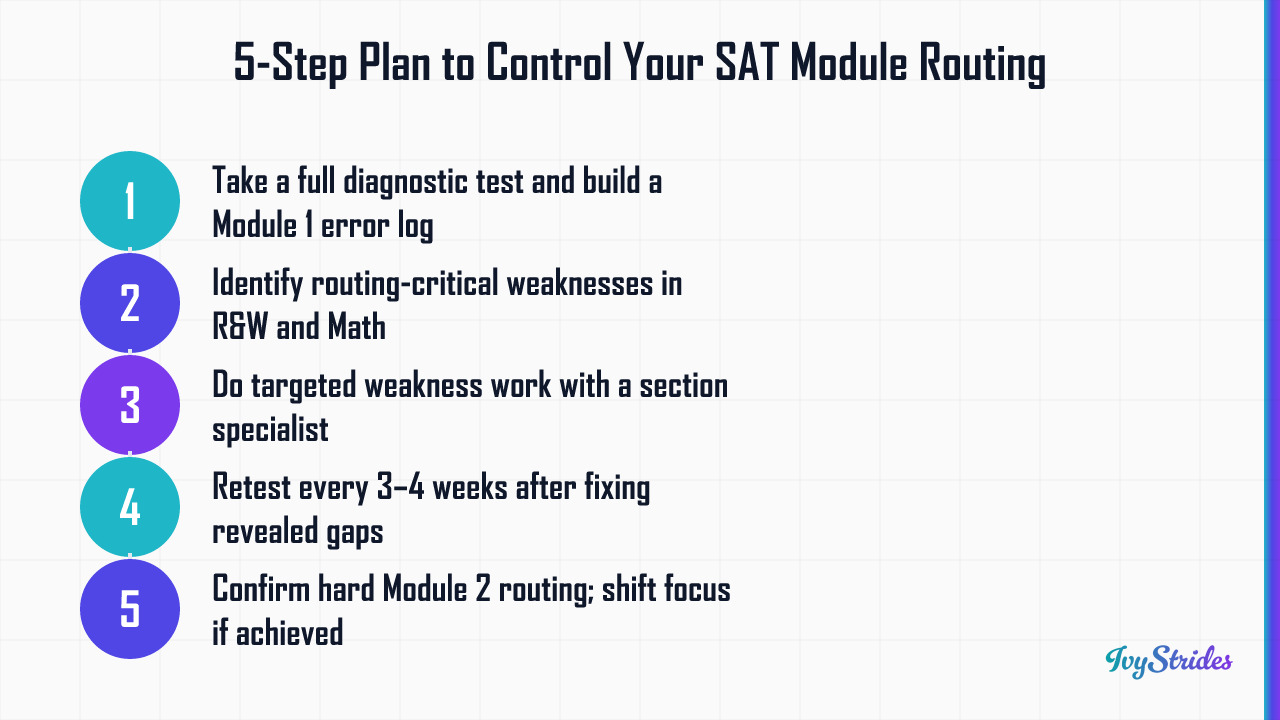
If Module 1 is the highest-use part of the test, your preparation should reflect that. Here's the methodology we use.
Step 1: Take a full diagnostic. Not a short quiz. A full-length practice test under realistic conditions. You need to see which Module 2 you currently route to in each section, and you need a clean error log organized by Module 1 question type. This is non-negotiable. Every plan we build starts here.
Step 2: Identify your routing-critical weaknesses. In R&W, that usually means a careful look at Command of Evidence, Craft and Structure, and Standard English Conventions. Standard English Conventions items in R&W Module 1 are often the most predictable question type to master quickly, and consistent accuracy here contributes directly to a harder Module 2 routing. Our SAT Standard English Conventions article walks through the rule set. In Math, it usually means Advanced Math and the harder Algebra items.
Step 3: Targeted weakness work with a section specialist. This is where generalist tutoring loses to specialist tutoring. The student who's bleeding points on quadratics doesn't need someone who also teaches R&W. They need a Math coach. If that's your situation, our Online SAT Math tutor page walks through how we structure that work.
Step 4: Spaced retesting every 3 to 4 weeks. Not weekly. Practice tests are diagnostic instruments, not training reps. You take one, you analyze it, you spend three to four weeks fixing what it revealed, you take another.
Step 5: Confirm routing on the retest. The goal is observable. Did you route to hard Module 2 this time? If yes, the next phase shifts to Module 2 accuracy. If no, the Module 1 work continues.
For students completing this program, we typically see module routing shift within 6 to 10 weeks of consistent targeted practice. Some students move faster. Some need 12 to 14 weeks, especially if they started with significant gaps in Algebra fundamentals or R&W reading speed. Honest timelines matter here. There's no two-week fix for routing.
When you're ready to plan your test calendar, here are the current sat test dates 2026.
Frequently Asked Questions About Digital SAT Module Routing and Score Ceilings
What is the difference between SAT Module 1 and Module 2?
Module 1 in each section, R&W and Math, contains a broad mix of easy, medium, and hard questions, and it's the same diagnostic backbone for every test-taker on a given form. Module 2 difficulty depends on your Module 1 performance. Strong performance routes you to the harder Module 2 (Module 2B); weaker performance routes you to the easier Module 2 (Module 2A). Both modules have the same number of questions and the same time limit per section, but the difficulty distribution differs significantly.
What is the maximum score possible if you get the easy Module 2?
Based on observed score distributions and the structure of the adaptive system, Module 2A imposes a ceiling of approximately the high 500s to low 600s per section, even with a perfect raw score on that module. The composite ceiling when routed to easy modules in both sections is roughly 1150 to 1250. College Board doesn't publish the exact figure, but the item pool in Module 2A doesn't contain enough high-difficulty questions to scale you above that band.
What is the point of adaptive testing if it caps my score?
Adaptive testing lets the Digital SAT measure a student's ability more precisely with fewer questions by concentrating items in the difficulty range closest to that student's actual performance level. The ceiling isn't a penalty. It's a measurement artifact. A student routed to Module 2A receives a score that reflects current preparation, and that preparation is trainable. The ceiling shifts upward as Module 1 performance improves.
How rare is a 1420 SAT score?
A 1420 places a student at approximately the 95th to 96th percentile of test-takers, meaning roughly 4 to 5 students out of every 100 score at or above this level. Reaching 1420 almost certainly requires the hard Module 2 in at least one section, and likely both. For more context on what counts as competitive, see our breakdown of a good sat score 2026.
Can I get a 1600 if I am routed to the easy Module 2?
No. A 1600 requires an 800 in both R&W and Math, and an 800 in either section is only achievable through the hard Module 2 pathway. Module 2A doesn't contain the high-difficulty items needed to demonstrate 800-level ability. If 1600 is the target, the entire preparation strategy needs to focus on ensuring hard Module 2 routing in both sections.
Does the routing decision happen separately for Reading and Writing versus Math?
Yes. The Digital SAT routes each section independently. You can receive hard Math Module 2 and easy R&W Module 2 on the same test date, or vice versa. Your composite ceiling depends on the routing outcome in each section separately, so preparation needs to address each section's Module 1 performance as a distinct goal.
Does the PSAT work the same way?
Yes. The PSAT/NMSQT uses the same two-module adaptive structure, scaled to a lower 320 to 1520 range per College Board's PSAT documentation. Students who've taken the PSAT already have firsthand experience with how module routing feels in a real testing environment. For a side-by-side, see is the psat harder than the sat. For practice sets, head to our PSAT practice tests.
Should I just switch to the ACT?
Maybe. Students who are consistently routed to easy Module 2 and find the ceiling frustrating sometimes ask whether the ACT, which doesn't use section-level adaptive routing in the same way, might be a better fit for their score profile. It's worth a real diagnostic on both tests before deciding. The ACT rewards a different skill mix, particularly faster reading pace and a Science section the SAT doesn't have.
One Last Thing
The ceiling is real. It's also movable. Where you sit today reflects current preparation, not permanent ability, and the path from easy-module routing to hard-module routing is a known, structured 6-to-10-week sequence for most students who put in the focused work. The students who get stuck are usually the ones grinding more practice tests without addressing the specific Module 1 question types that drive routing. The students who break through treat Module 1 as the single highest-use block of their prep, and they get a second set of eyes on their error log.

Two decades teaching quantitative and verbal aptitude on standardized tests. Rare dual expertise across Math and Verbal — particularly effective for students with gaps on both sides. Senior AP Mentor for our Calculus and English tracks.