
SAT with Time and a Half: Extended Time Accommodation Guide

On this page
- How Long Is the Digital SAT with Time and a Half (50%)? The Direct Answer
- Exact Timing for Each Digital SAT Module with Time and a Half
- How the Bluebook App Enforces Time
- The Adaptive Module 2 Under Extended Time
- Who Qualifies for Extended Time on the SAT and How to Apply
- Not Sure If Your Accommodation Plan Is Working for Your Score Goals?
- Is Extended Time on the SAT Reported to Colleges?
- Can You Get Extended Time for Anxiety on the SAT?
- How to Use Extended Time Strategically by Score Band
- SAT vs ACT with Extended Time: Which Test Benefits More from Extra Minutes
- Extended Time on the PSAT and What It Means for National Merit
- Test Day Checklist for Students Testing with Extended Time
- FAQ
- How long is the SAT with time and a half?
- How do SAT extended time accommodations actually work on test day?
- Does taking the SAT with extended time hurt your chances with colleges?
- Should I feel bad about using extended time on the SAT?
- How much time do I have per question on the digital SAT with time and a half?
- Can I get extended time on the SAT for anxiety?
- How long is the SAT with double time (double time)?
- Ready to Build a Prep Plan Around Your Actual Testing Conditions?
On the digital SAT with time and a half (50% extended time), total testing time is 3 hours and 21 minutes, not counting breaks. Reading and Writing Modules 1 and 2 each run 48 minutes; Math Modules 1 and 2 each run 52.5 minutes.
These figures come directly from College Board's official extended-time accommodation guidance; the mandatory 10-minute break between R&W and Math is separate from the per-module clock, and additional or extended breaks must be approved separately through the Services for Students with Disabilities office. Including the standard break, plan for roughly 3.5 hours of seat-time. The rest of this guide covers per-module pacing, what 50% extended time changes about test-day strategy, and what to do if you're still in the SSD approval queue.
How Long Is the Digital SAT with Time and a Half (50%)? The Direct Answer
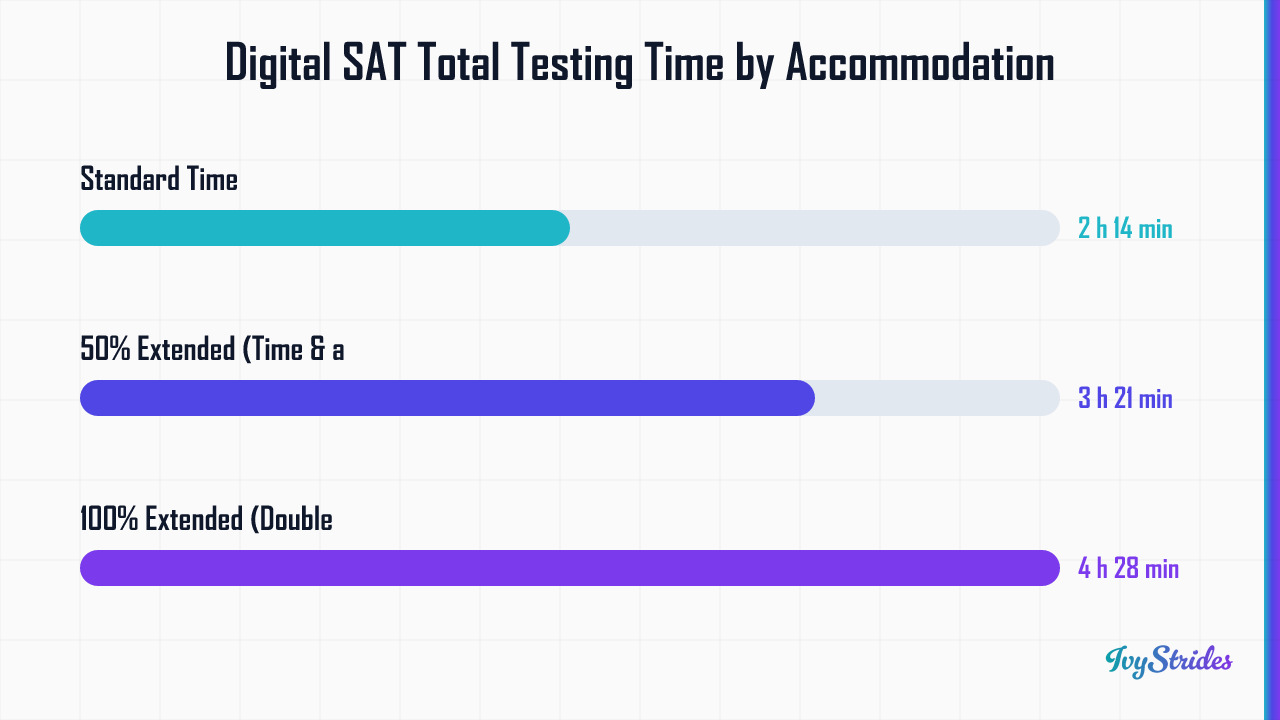
Here's the per-module breakdown so you can plan your day:
| Section / Module | Standard Time | 50% Extended (Time and a Half) | 100% Extended (Double Time) |
| R&W Module 1 (32 Q) | 32 min | 48 min | 64 min |
| R&W Module 2 (32 Q) | 32 min | 48 min | 64 min |
| Math Module 1 (22 Q) | 35 min | 52.5 min | 70 min |
| Math Module 2 (22 Q) | 35 min | 52.5 min | 70 min |
| Total testing time | 2 h 14 min | 3 h 21 min | 4 h 28 min |
A mandatory break sits between the R&W and Math sections. Under standard conditions, that break is 10 minutes. Additional or extended breaks can be approved as a separate accommodation through the College Board Services for Students with Disabilities (SSD) office. They're not automatic with time and a half.
Two notes before we go deeper. Every figure above reflects the current digital SAT (post-March 2024), not the legacy paper exam. If you want to see how those minutes convert into points, our breakdown of how the digital SAT is scored walks through the conversion from raw performance to the 1600 scale.
Exact Timing for Each Digital SAT Module with Time and a Half
Because the digital SAT uses an adaptive two-module structure, understanding how extended time applies to each module separately is essential before building your prep plan.
Per-question math under time and a half:
- R&W Module 1: 48 minutes ÷ 32 questions = 90 seconds per question (standard: 60 seconds)
- R&W Module 2: 48 minutes ÷ 32 questions = 90 seconds per question
- Math Module 1: 52.5 minutes ÷ 22 questions ≈ 143 seconds per question (standard: 95 seconds)
- Math Module 2: 52.5 minutes ÷ 22 questions ≈ 143 seconds per question
That cushion changes the strategic picture, especially in Math. An extra 48 seconds per question, on average, is enough to redo a multi-step algebra problem with full work shown, or to plug answers back in to check.
How the Bluebook App Enforces Time
The Bluebook app handles this automatically (College Board accommodations). When a student is approved for 50% extended time, the accommodation attaches to their College Board profile, and Bluebook reads that flag when the test launches. The timer at the top of the screen reflects the extended module length, not the standard one. You don't track anything manually. You shouldn't have to ask a proctor to add time.
Here's the part most students miss: check your Bluebook profile a week before test day. If the accommodation isn't showing, the time you walk in expecting won't be the time the app gives you. Fix it before you sit down.
The Adaptive Module 2 Under Extended Time
Module 2 difficulty adjusts based on Module 1 performance. That's true under every timing condition. Extended time doesn't change the adaptive logic; it just gives you more minutes inside whichever Module 2 you earn. For the strategic implications for upper-band students, see our piece on the digital sat module 1 score ceiling.
For upcoming administrations, check the latest sat test dates and backplan your accommodation approval timeline from there.
Who Qualifies for Extended Time on the SAT and How to Apply
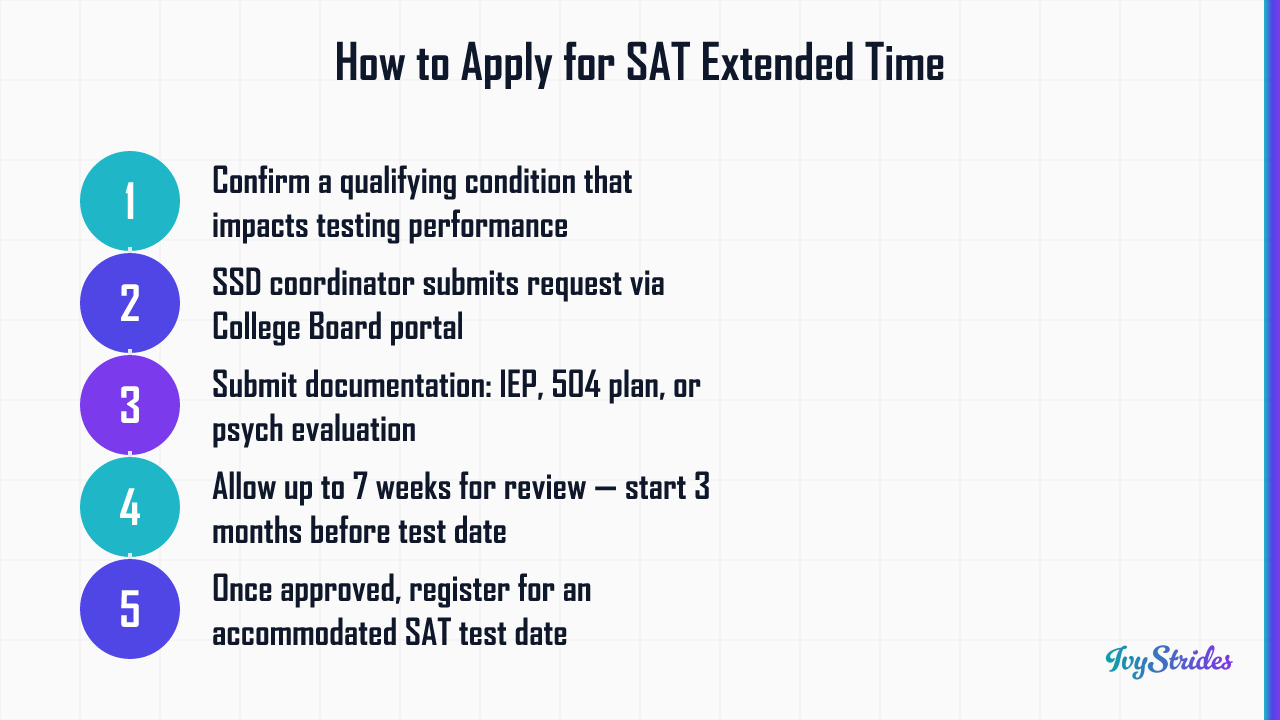
This is where most families get stuck. The process is real, and it has hard deadlines.
Qualifying conditions. College Board's SSD office reviews requests for students with documented disabilities. Common qualifying categories include learning disabilities (dyslexia or a specific reading disorder, for example), ADHD, physical disabilities, chronic medical conditions, and some psychiatric conditions when functional impairment is documented. The condition must impact the student in a testing context, not just in daily life.
The SSD coordinator submits the request. In nearly every case, the request goes through your high school's SSD coordinator (sometimes the counselor, sometimes a learning specialist). They submit through the College Board accommodations portal on the student's behalf. Parents and students can't bypass this step unless the student is homeschooled or attends a school without an SSD coordinator, in which case the family applies directly to College Board.
Documentation. College Board accepts psychoeducational evaluations, IEPs, 504 plans, and medical documentation from licensed providers. Here's the part most families miss: an IEP or 504 plan does not automatically transfer to College Board. School-based accommodations and College Board accommodations are two different approvals. You need the latter to test with extended time on the SAT, PSAT, and AP exams.
Timeline. Accommodation approval must be in place before you register for a specific test date, and the review can take up to seven weeks. In our coaching, we recommend starting the SSD process at least three months before the target test date. A junior we worked with last spring got her approval letter ten days before her test; she'd practiced everything under standard timing and had to recalibrate her pacing on the fly. She still scored well. She lost the upside the accommodation was supposed to give her.
Once approval is in hand, move forward with sat registration and select your accommodated test date. If plans change, our guide on how to cancel sat registration covers the refund and reschedule windows.
Not Sure If Your Accommodation Plan Is Working for Your Score Goals?
Book a free 15-minute strategy call. Our coaches will review your current accommodation status, your diagnostic score, and build a prep plan that fits your actual testing conditions.
Is Extended Time on the SAT Reported to Colleges?
Short answer: no.
College Board does not flag or annotate official score reports to indicate that a student tested with accommodations. When an admissions officer opens your score report, they see your scores, your section scores, and the date. They don't see "tested with extended time." This policy is documented on the College Board accommodations site.
A few honest caveats:
- Test-optional policies vary by school and by application year. Verify each target school's current policy directly on its admissions page or via the FairTest tracker before deciding whether to submit scores.
- Some colleges ask students to self-disclose disabilities in supplemental application materials, especially when requesting on-campus accommodations. That's a separate decision from your score report and not something the SAT score report triggers.
- Admissions outcomes depend on your full application, not test scores alone.
For students still weighing which exam to submit, our sat vs act comparison breaks down the strategic differences.
Can You Get Extended Time for Anxiety on the SAT?
Possibly. The bar is specific.
College Board evaluates anxiety-based accommodation requests case by case. A diagnosed clinical anxiety disorder (generalized anxiety disorder, panic disorder, specific phobia) with documented functional impairment on standardized testing may qualify. General nervousness before a high-stakes exam does not. Documentation has to come from a licensed psychologist or psychiatrist and must specifically address how the condition affects testing performance, not just daily life.
Test anxiety alone doesn't qualify a student for a formal accommodation. Students who experience significant anxiety should still know that targeted pacing strategies can reduce time pressure without an official approval.
So what if you don't qualify and you still feel the pressure? Two things actually work. Take full-length practice tests under realistic timing so the clock stops feeling foreign on test day. Then learn a pacing protocol that lets you skip and return without spiraling. Our piece on 10 Strategies to Overcome SAT Anxiety and Boost Your Score walks through the specific tactics our coaches use with anxious testers. You can also download practice material from our free sat resources library.
How to Use Extended Time Strategically by Score Band
Extra minutes don't automatically translate into extra points. How you spend them matters.
Extended time changes your pacing math. It doesn't change which question types cost students the most points. A diagnostic test under your actual accommodation conditions is still the right starting point.
Sub-1200 band. In our coaching with students at this band, the biggest leak is careless errors on questions students could answer correctly with more attention. The extra time should fund careful re-reading, restating the question in your own words before answering, and verifying answer choices against the passage or your work. Don't use the extra minutes to attempt harder questions you haven't yet trained on. Use them to lock in points on questions you already understand.
1200-1400 band. The extra time is most valuable on Math Module 2 hard questions and on R&W command of evidence score band questions, which require multi-step reasoning. Students at this band typically have the content knowledge; they just run out of room to execute. Time and a half lets you set up the algebra cleanly, plug back in, and verify.
1400+ band. At this level, extended time rarely changes how many questions you attempt. You were already finishing. What it changes is your accuracy on the hardest adaptive Module 2 items. Use the buffer for verification, not for new attempts.
The rule across all bands: practice under your actual accommodation conditions. Take at least two full-length official SAT practice tests with the extended per-module timer running. Standard-time prep doesn't calibrate you correctly. If you need help structuring this into a weekly plan, our sat study plan template is built to flex around accommodation conditions.
SAT vs ACT with Extended Time: Which Test Benefits More from Extra Minutes
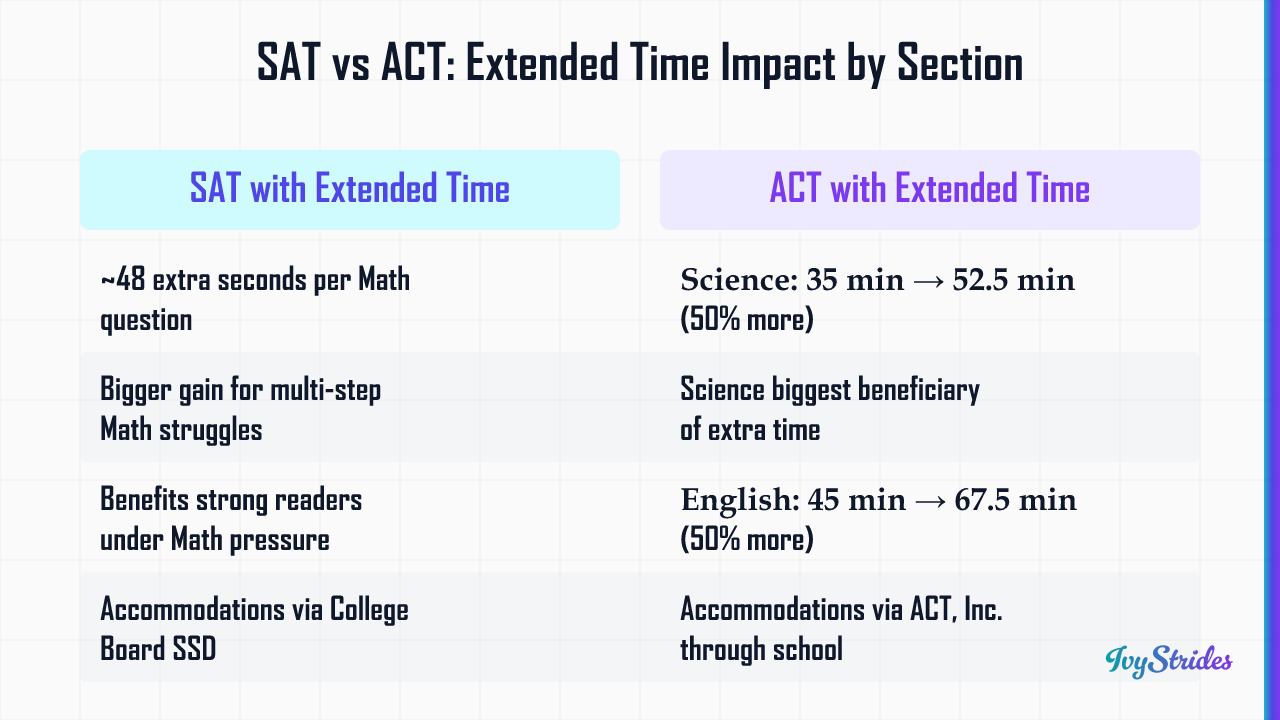
Students who qualify for extended time on the SAT often qualify on the ACT as well, so comparing how each test uses that extra time is worth doing before committing to one exam.
The ACT offers 50% and 100% extended time accommodations through a parallel process to College Board's SSD. The application goes through the student's school. Full details are on ACT, Inc.'s accommodations page.
Where extra time matters most on the ACT:
- ACT Science: 40 questions in 35 minutes standard becomes 52.5 minutes (ACT's documented 50% extended time policy) with extended time. Science is heavily passage-driven (data representation, research summaries, conflicting viewpoints), and the extra time changes whether you can actually read the passages instead of skimming.
- ACT English: 75 questions in 45 minutes standard becomes 67.5 minutes with time and a half. Per-question pressure drops sharply.
- ACT Reading: 40 questions across four passages in 35 minutes becomes 52.5 minutes, which often allows full re-reading of paired passages.
In our coaching, students with processing-speed accommodations often find the ACT Science section the biggest beneficiary of extra time. Students whose strength is reading but who struggle with multi-step Math under pressure often see the larger gain on the SAT, where time and a half buys roughly 48 extra seconds per Math question.
Still deciding? Look at act vs sat difficulty for the strategic comparison. Then run a timed diagnostic from our act practice test online library to see which test your accommodated profile actually scores higher on.
Extended Time on the PSAT and What It Means for National Merit
If you are on the National Merit track, the same extended time accommodation applies to the PSAT/NMSQT, and the per-section timing follows the same proportional structure as the SAT.
According to College Board's PSAT/NMSQT documentation, the PSAT/NMSQT with extended time runs 3 hours and 22 minutes of testing time. The accommodation must be approved through your school's SSD coordinator before the October PSAT administration; if it isn't in the system by then, you test under standard conditions.
For National Merit purposes, here's the part that matters: the National Merit Scholarship Corporation evaluates the Selection Index score itself, not the testing conditions that produced it. A 1480 with extended time and a 1480 under standard timing are treated the same way for Semifinalist consideration. State cutoffs don't adjust for accommodation status.
PSAT 10 is a separate assessment for 10th graders and uses the same College Board SSD framework for accommodations. If you're a sophomore reading this, start the process now so the accommodation is active when you sit for the PSAT/NMSQT junior year.
For score-band context, check whether is 1280 a good psat score places you in National Merit range for your state. You can also calibrate with our PSAT practice tests.
Test Day Checklist for Students Testing with Extended Time
A few things differ when you test with an accommodation. Plan for them.
Arrival and check-in. Students with accommodations are often placed in a separate testing room. Arrival time may be earlier, and check-in may run longer because the proctor verifies your accommodation in the system. Read your admission ticket carefully; it specifies your reporting time.
Bluebook setup. The accommodation should already be reflected in your Bluebook app profile. Verify this the week before. If it's missing, contact College Board SSD immediately, not the morning of the test.
What to bring. Your admission ticket, a valid photo ID, an approved calculator (the satsuite.collegeboard.org calculator policy applies regardless of accommodation status, though Bluebook also includes a built-in Desmos), your charged testing device, and a charger. Snacks and water for the break if your testing location permits them. Our full sat test day checklist covers the rest.
Time enforcement. Bluebook handles the per-module timer automatically. You shouldn't need to ask a proctor to adjust anything during the test. If the timer at the top of your screen reads standard time, not your extended time, stop and alert the proctor before starting the module. Don't begin and try to fix it later.
Technical issues. If the app freezes or the timer behaves strangely, the proctor contacts College Board. Don't restart the app on your own. For more on what to pack and how to settle in the night before, see our guide on What Should I Bring to the SAT?. For final-week prep, browse our sat last minute tips.
FAQ
How long is the SAT with time and a half?
With extended time, the digital SAT has 3 hours and 21 minutes of testing time, not counting breaks. Including the mandatory break between the Reading and Writing section and the Math section, plan for approximately 3.5 hours from the start of the first module to the end of the last. This figure comes directly from College Board's official accommodations documentation.
How do SAT extended time accommodations actually work on test day?
Students approved for extended time are typically placed in a separate testing room. The Bluebook app automatically applies the extended time to each module, so you don't need to track it manually. The per-module time (48 minutes for each R&W module under extended time, for example) is set in the app before the test begins. If there's a discrepancy, alert the proctor immediately rather than starting the module.
Does taking the SAT with extended time hurt your chances with colleges?
No. College Board does not flag or annotate official score reports to indicate that a student tested with accommodations. Colleges receiving your scores can't tell from the score report whether you used extended time. Admissions offices evaluate the score itself, not the testing conditions. Some colleges do ask students to self-disclose disabilities in supplemental materials, but that's a separate decision from the score report.
Should I feel bad about using extended time on the SAT?
No. Extended time is a documented accommodation for a documented need, not an advantage. College Board's SSD process requires evidence of a qualifying condition and its impact on standardized testing. In our coaching, students who use their accommodation strategically and practice under their actual conditions consistently perform better than students who feel guilty and underuse the extra minutes. The accommodation exists to create a level playing field.
How much time do I have per question on the digital SAT with time and a half?
About 90 seconds per question on each R&W module (48 minutes for 32 questions) and about 143 seconds per question on each Math module (52.5 minutes for 22 questions). Standard timing is roughly 60 seconds per R&W question and 95 seconds per Math question. The extra time is most valuable on multi-step Math questions and on R&W questions that require careful re-reading of paired passages.
Can I get extended time on the SAT for anxiety?
Possibly, but only if the anxiety is a diagnosed clinical condition with documented functional impairment on standardized testing, not general nervousness. College Board evaluates these requests case by case and requires documentation from a licensed psychologist or psychiatrist. Students who experience test anxiety without a clinical diagnosis can still improve performance through targeted pacing strategies and timed practice.
How long is the SAT with double time (double time)?
With double time, the digital SAT has 4 hours and 28 minutes of testing time, not counting breaks. Each R&W module runs 64 minutes and each Math module runs 70 minutes. Double time requires separate eligibility documentation and is approved for students with more significant functional impairments than those who qualify for extended time.
Getting the accommodation is half the work. Using it well is the other half. Practice under your real conditions, calibrate pacing against your actual diagnostic, and treat the extra minutes as a tool, not a safety net.
Ready to Build a Prep Plan Around Your Actual Testing Conditions?
Whether you have a 50% accommodation or are testing under standard timing, IvyStrides coaches start with a diagnostic test and build a personalized plan from your real score, not a generic curriculum. Book a free 15-minute call to get started.

Award-winning author (South Asian Book Award) and graduate of BITS Pilani and UCLA Luskin School of Public Affairs. Brings a published writer's eye to Common App essays and grammatical precision to SAT and ACT R&W instruction.