
UPenn SAT Requirements 2026: Scores, Policy, Deadlines & How to Get In

On this page
- Does UPenn Require SAT Scores? (2026–2027 Testing Policy)
- UPenn Testing Waiver Option
- UPenn SAT Score Range: What Scores Do You Need?
- UPenn SAT Math vs. Reading & Writing Scores
- UPenn ACT Score Range
- Can You Get Into UPenn With a 1450 or 1480 SAT?
- Does UPenn Superscore the SAT and ACT?
- How to Build a UPenn Superscore Strategy
- Does UPenn Accept Self-Reported SAT Scores?
- UPenn SAT Code and How to Send Scores
- UPenn Acceptance Rate and Admissions Statistics (Class of 2029)
- UPenn Early Decision vs. Regular Decision
- UPenn Application Deadlines for 2026–2027
- How to Apply to UPenn: Step-by-Step Guide
- UPenn Supplemental Essay Tips (2026–2027 Prompts)
- UPenn Cost of Attendance and Financial Aid
- How IvyStrides Helps You Meet UPenn SAT Requirements
- What If Penn Isn't the Final Destination?
- Frequently Asked Questions About UPenn SAT Requirements
- Final Word: Your Path to Penn
Located in Philadelphia, the University of Pennsylvania is an Ivy League research university with extremely high standards and an equally low admit rate. It's Benjamin Franklin's vision of combining knowledge with real-world application brought to life. The Wharton School of Business is a world-renowned institution and a leader in undergraduate business education, alongside top-tier engineering (SEAS), nursing, arts, and science programs.
With an acceptance rate of just 4.1%, understanding the UPenn SAT requirements and how to prepare for them is one of the first steps to building a strong application.
Elon Musk, Anil Ambani, and Noam Chomsky are some of the leading names in the world, and a common factor among all these leaders is that they hold UPenn alumni status. Penn is considered a "One University" system, which means it allows students with academic curiosity to enroll in courses across schools and merge their interests.
However, the exclusivity of the University of Pennsylvania is significant, and that acceptance rate means getting admitted to UPenn requires preparation, vision, and guidance.
Does UPenn Require SAT Scores? (2026–2027 Testing Policy)
Yes , UPenn requires SAT or ACT scores. Starting with the 2025–2026 admissions cycle, the University of Pennsylvania reinstated its test-required policy. This means all applicants must submit SAT or ACT scores as part of their application. UPenn is no longer test-optional.
According to Penn Admissions, standardized test scores are a required component for all first-year applicants. This applies to both Early Decision and Regular Decision applicants for the Class of 2030 and beyond.
This is a significant shift from the temporary test-optional policy Penn adopted during the COVID-19 pandemic. If you're applying to UPenn in the 2026–2027 cycle, plan to take the SAT or ACT well in advance of application deadlines.
UPenn Testing Waiver Option
Penn does offer a testing waiver for students who face genuine hardship in accessing the SAT or ACT. Per UPenn's official testing page, students who cannot take a standardized test due to financial, geographic, or other documented barriers may request a waiver through the admissions office. This is not a blanket test-optional policy - it is a case-by-case accommodation. Contact Penn Admissions directly if you believe you qualify.
UPenn SAT Score Range: What Scores Do You Need?
UPenn's middle 50% SAT score range for the Class of 2029 is 1510–1570. This means 25% of admitted students scored below 1510, and 25% scored above 1570. The average SAT score for admitted students is approximately 1540.
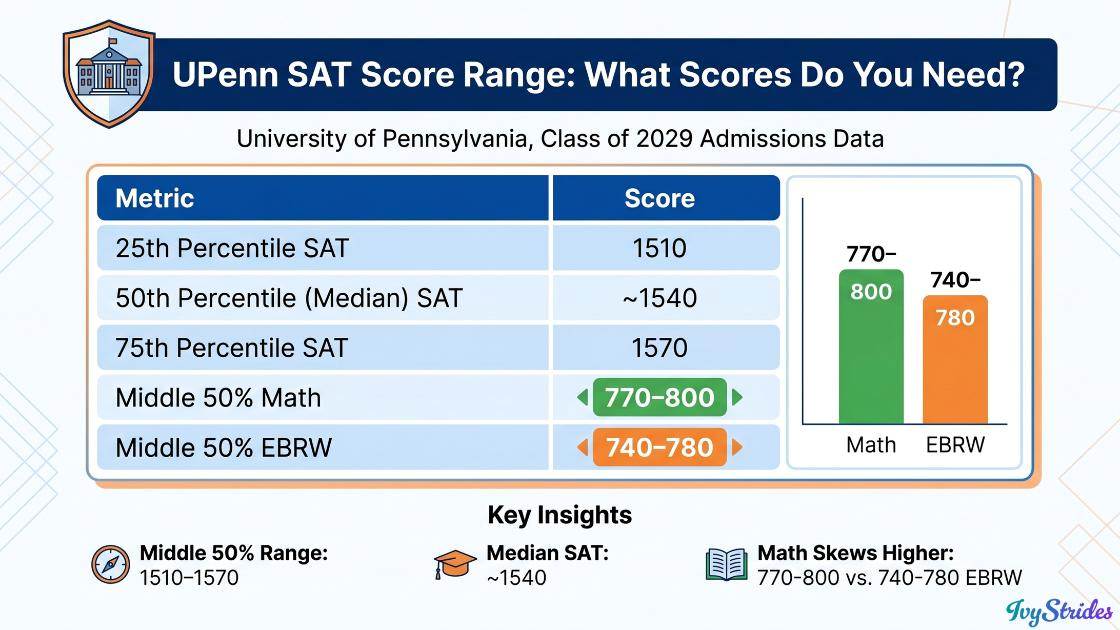
Here's a breakdown of UPenn SAT score data:
| Metric | Score |
| 25th Percentile SAT | 1510 |
| 50th Percentile (Median) SAT | ~1540 |
| 75th Percentile SAT | 1570 |
| Middle 50% Math | 770–800 |
| Middle 50% EBRW | 740–780 |
A 1520 SAT score places you solidly within UPenn's middle 50% range and makes you a competitive applicant from a testing standpoint.
Reaching this level typically requires consistent practice, targeted strategy, and, for many students, support through online SAT coaching or guided prep programs.
UPenn SAT Math vs. Reading & Writing Scores
UPenn's admitted student data shows that Math scores skew slightly higher than Evidence-Based Reading and Writing (EBRW) scores. The middle 50% for Math is approximately 770–800, while EBRW falls around 740–780.
What does this mean for your prep strategy?
- If you're strong in math, protect that score and focus improvement efforts on EBRW.
- If EBRW is your strength, invest heavily in math prep - especially SAT algebra questions and data analysis - since the math ceiling at Penn is very high.
- Use SAT reading speed strategies to improve your pacing and accuracy on the verbal sections.
UPenn ACT Score Range
For students submitting ACT scores, UPenn's middle 50% ACT range is 34–36. Penn treats SAT and ACT scores equally in the admissions process, so submit whichever test reflects your strengths. Not sure which test suits you? Compare the ACT vs SAT to find your best fit.
Can You Get Into UPenn With a 1450 or 1480 SAT?
This is one of the most common questions we hear. Here's an honest assessment:
- 1450 SAT: This score falls below UPenn's 25th percentile (1510). While Penn uses holistic review and exceptional extracurriculars, essays, or recruited athlete status could compensate, a 1450 puts you at a statistical disadvantage. If you have time, retaking the SAT is strongly recommended.
- 1480 SAT: Closer to the 25th percentile but still below it. A 1480 is competitive at many top-30 schools, but for UPenn specifically, you'd want the rest of your application to be exceptionally strong. If possible, aim for one more sitting to push into the 1510+ range.
Remember: Penn superscores, so even incremental improvements across sittings can push your composite into a competitive range.
This is where theIvyStrides SAT Prep Program comes in. Think of it as a personal training camp for the Digital SAT: 26 live classes across 13 weeks, 100+ hours of drills, and 10 adaptive mocks. By exam day, you won't just be ready - you'll be performing at your peak.
Does UPenn Superscore the SAT and ACT?
Yes. UPenn superscores both the SAT and the ACT. According to Penn's official testing page, the admissions office will take your highest section scores across multiple test sittings and combine them into a single composite superscore.
For the SAT, Penn takes your highest Evidence-Based Reading and Writing score and your highest Math score from any sitting.
For the ACT, Penn takes your highest score from each of the four sections (English, Math, Reading, Science) across all sittings to create your best composite.
This policy is a major advantage for applicants who plan strategically.
How to Build a UPenn Superscore Strategy
Every applicant should approach superscoring with a plan. Here's how to make the most of it:
- Plan Multiple Test Attempts: The smart strategy is to plan for two to three test attempts. Your first test (Grade 11 spring) sets a baseline, the second (early Grade 12) targets improvement, and a third (if needed) sharpens weak spots. Learn more about how many times you can take the SAT to optimize your superscore.
- Focus on Section-by-Section Growth: Since Penn takes your best scores by section, you don't need to be perfect everywhere in one attempt. Maybe your math is strong in one sitting, but reading lags behind. In your next attempt, focus intensively on improving SAT reading or writing, knowing that Penn will combine your top scores.
- Use Smart Prep Resources: At IvyStrides, we guide students with data-driven diagnostics that show not just your overall score, but your sectional performance trends. This means you're not just retaking blindly - you're targeting where you need to improve. Our small-batch live SAT classes and adaptive mock tests are designed to help students maximize sectional growth.
- Retake with Intent, Not Panic: Many students waste attempts by rushing into retakes without a strategy. Superscoring rewards deliberate improvement. Between sittings, focus on topic-level drills - for example, mastering evidence-based reading strategies or practicing questions for SAT algebra.
- Space Your Sittings 4–8 Weeks Apart: This gives you enough time to train with full adaptive mocks and address weaknesses without losing momentum.
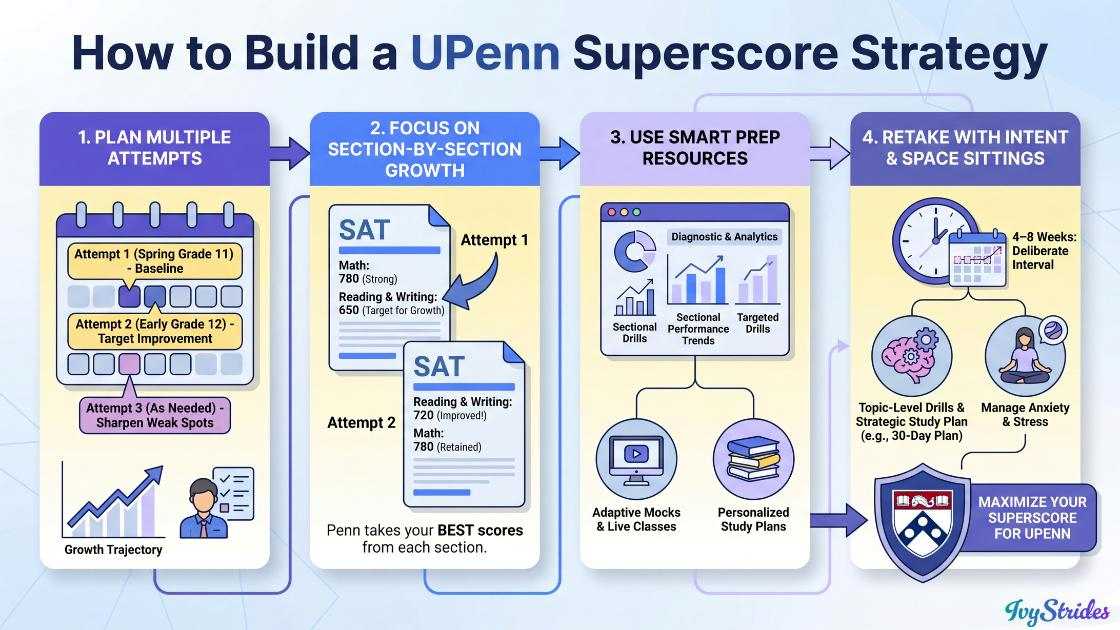
Consider following a 30-day SAT study plan between sittings to make focused, measurable progress. And if test anxiety is affecting your performance, explore strategies to overcome SAT anxiety and learn how to reduce stress while studying for the SAT.
With IvyStrides, you don't just take the SAT - you engineer your superscore strategy with expert mentors, adaptive tests, and personalized study plans. That's how our students consistently move from the 1400s into the 1500+ Ivy League range.
Does UPenn Accept Self-Reported SAT Scores?
Yes. UPenn accepts self-reported SAT and ACT scores on your application. You do not need to send official score reports from College Board or ACT, Inc. at the time of application.
Here's how it works:
- At Application: Enter your scores directly in the Common App or Coalition App. Penn will review these self-reported scores during the admissions process.
- Upon Enrollment: If you are admitted and choose to enroll at Penn, you will then be required to submit official score reports from College Board or ACT, Inc. Your official scores must match what you self-reported.
- Accuracy Matters: Self-reported scores must be accurate. Any discrepancy between self-reported and official scores could jeopardize your admission.
This policy saves applicants the cost of sending multiple official score reports during the application phase. You only pay to send official scores once - to the school you'll attend.
UPenn SAT Code and How to Send Scores
The UPenn College Board SAT code is 2926. Use this code if you want to send official SAT score reports directly to Penn through College Board.
Does UPenn require all SAT scores?
No. Penn participates in College Board's Score Choice program. This means you can choose which SAT scores (by sitting date) to send to Penn. You are not required to submit scores from every SAT sitting.
However, since Penn superscores, it's generally in your best interest to send all sittings - Penn will only consider your highest section scores. Sending all scores gives Penn the most data to build your best possible superscore.
Want to know when SAT results come out so you can plan your score-sending timeline? Check our guide for the latest release dates.
UPenn Acceptance Rate and Admissions Statistics (Class of 2029)
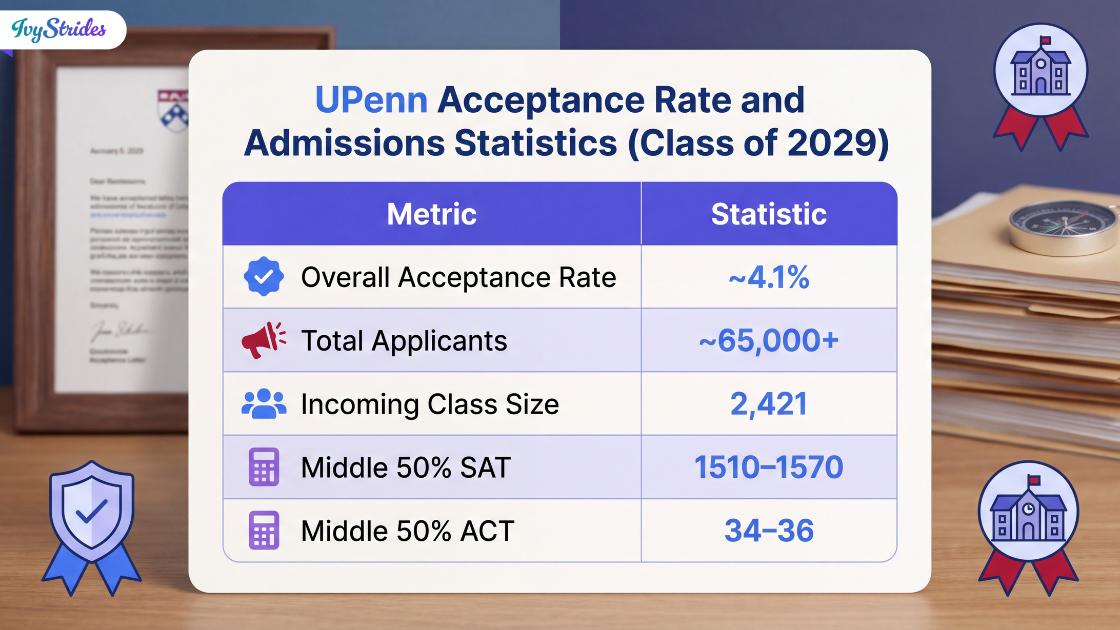
UPenn is one of the most selective universities in the world. Here are the key admissions statistics for the Class of 2029:
| Metric | Statistic |
| Overall Acceptance Rate | ~4.1% |
| Total Applicants | ~65,000+ |
| Incoming Class Size | 2,421 |
| Middle 50% SAT | 1510–1570 |
| Middle 50% ACT | 34–36 |
UPenn Early Decision vs. Regular Decision
Applying Early Decision (ED) to Penn offers a meaningful admissions advantage. While Penn does not publish exact ED acceptance rates every year, historical data shows that ED admit rates are significantly higher than RD rates - typically in the range of 15–20% compared to roughly 3–4% for Regular Decision.
This doesn't mean ED is "easier." The ED pool tends to be self-selecting (stronger applicants who are certain Penn is their first choice), and recruited athletes and legacy applicants are more concentrated in the ED round. But if Penn is your clear top choice and your application is ready, ED is strategically advantageous.
UPenn Application Deadlines for 2026–2027
Here are the key application deadlines for the 2026–2027 admissions cycle (Class of 2031). Always verify exact dates on Penn's official admissions website, as deadlines can shift slightly year to year.
| Deadline | Date |
| Early Decision (ED) Application | November 1, 2026 |
| Early Decision Financial Aid Forms | November 6, 2026 |
| ED Decision Release | Mid-December 2026 |
| Regular Decision (RD) Application | January 5, 2027 |
| RD Financial Aid Forms | February 1, 2027 |
| RD Decision Release | Late March / By April 1, 2027 |
| Last SAT for ED | November 2026 |
| Last SAT for RD | December 2026 |
| Last ACT for ED | October 2026 |
| Last ACT for RD | December 2026 |
Important: Always verify Penn's "last acceptable test date" on the official testing page for your specific cycle. Plan to take the SAT or ACT at least one sitting before the last acceptable date so you have a backup opportunity.
How to Apply to UPenn: Step-by-Step Guide
UPenn applications are submitted through the Common App or Coalition App. You'll need to decide between:
- Early Decision (ED): Binding, with a November 1 deadline. Best if Penn is your clear first choice and you already have a strong SAT score.
- Regular Decision (RD): January 5 deadline, giving you more time to polish essays and retake tests.
Your application must include transcripts, recommendations, essays, and SAT/ACT scores. The supplemental essays are a critical aspect of the UPenn application process where you must explain how you'll engage with one of Penn's schools and communities.
Here is a streamlined step-by-step guide for undergraduate applicants:
Step 1 - Confirm your target school at Penn. Decide whether you're applying to the College of Arts & Sciences, Engineering (SEAS), Wharton, or the School of Nursing. Your choice shapes your supplements, recommender selection, and course highlights.
Step 2 - Choose your application plan (ED or RD). Early Decision is binding and due November 1. Apply ED only if Penn is your first choice and your testing and essays are already strong. Regular Decision is due January 5 and gives more time for testing and essays.
Step 3 - Create your Common App account and add "University of Pennsylvania." Complete your profile, family, education, and activities sections accurately. Select your Penn school (from Step 1) inside the Penn section.
Step 4 - Map your SAT/ACT plan to the deadlines. Plan to have your best scores ready by October (for ED) or December (for RD). Always verify Penn's "last acceptable test date" on the official site for your cycle, then work backward to schedule prep and mocks.
Step 5 - Decide SAT vs. ACT using your skill set. Pick the test that suits your strengths. The SAT emphasizes math and data analysis; the ACT has a faster pace and includes science reasoning.
Not sure which is right for you? Read our ACT vs SAT comparison guide.
Step 6 - Build a superscore strategy (if you'll retake). Penn superscores both SAT and ACT, so each sitting can improve your composite. Space sittings 4–8 weeks apart and train with full adaptive mocks.
Step 7 - Request transcripts and the school report early. Tell your counselor your ED/RD plan and deadlines. Confirm how your high school sends official transcripts and the counselor report.
Step 8 - Secure your recommenders (2 teachers + counselor). Choose teachers from core academics (ideally Grade 11/12) who can speak to rigor, initiative, and fit for your intended Penn school. Share your résumé and give at least 3–4 weeks' notice.
Step 9 - Draft the Common App personal essay (650 words). Pick a prompt that reveals your voice, growth, and judgment. Avoid résumé rehashing; show reflection and impact.
Step 10 - Write Penn's supplemental essays (they change yearly). Expect a "Why Penn?" prompt and school-specific questions. Go beyond name-dropping - connect your interests to Penn's concrete resources (courses, labs, centers, clubs) and explain what you'll contribute.
Step 11 - Complete testing and enter scores correctly. Enter your self-reported SAT/ACT scores in the application. Official score reports are required only upon enrollment. If English isn't your primary language or schooling medium, plan to take an approved English proficiency exam per Penn's guidance.
Step 12 - Prepare activity descriptions. Use strong action verbs and quantified outcomes. Prioritize depth over breadth. Align highlights with the Penn school you selected.
Step 13 - Review fees and request a fee waiver if needed. UPenn's application fee is $75. If cost is a barrier, request a fee waiver through your counselor or the Common App.
Step 14 - Submit financial aid forms on time. Complete the CSS Profile and, for U.S. citizens/permanent residents, the FAFSA. Timelines differ for ED vs. RD - submit early to receive a complete aid assessment with your decision.
Step 15 - Submit your application (ED by Nov 1; RD by Jan 5). Do a final pass: names match transcripts, activities are prioritized, essays are proofread, and recommenders have submitted. Hit submit before the last day to avoid portal traffic issues.
Step 16 - Activate the Penn Applicant Portal and track your checklist. After submitting, watch for Penn's portal email. Log in to confirm all materials (transcripts, recs, testing, fee/waiver) have arrived. Follow up promptly on any missing items.
Step 17 - Participate in an alumni interview if offered. Not guaranteed, but if invited, prepare 2–3 stories that show curiosity, initiative, and community impact. Bring thoughtful questions about Penn's culture and opportunities.
Step 18 - Decisions and next steps. ED decisions typically release in mid-December. RD decisions release in late March or early April. If admitted, send official test scores, review your financial aid package, and compare it to your family's plan. For ED admits, you'll confirm enrollment and withdraw from other applications.
Step 19 - If deferred or wait-listed, act strategically. Send a Letter of Continued Interest with meaningful updates - academic achievements, research, leadership impact. Avoid repeating your application; add new value.
Step 20 - Keep your options strong. Penn is ultra-selective. Maintain momentum for other top schools; your SAT prep, essays, and profile translate directly to Yale, Columbia, Princeton, and beyond.
Explore our guides on applying to Brown University, Johns Hopkins, Duke, andRice University.
UPenn Supplemental Essay Tips (2026–2027 Prompts)
When it comes to the University of Pennsylvania, your SAT score gets you through the door, but your essays are what make you memorable. Every applicant submits the 650-word Common App personal statement and Penn-specific supplemental essays that change year to year. Together, these pieces give the admissions committee a window into your intellectual curiosity, values, and fit for Penn's unique culture.
Many students fall into the trap of writing generic, predictable essays that admissions officers have read thousands of times. Talking vaguely about "wanting to change the world" or simply listing achievements isn't enough. At Penn, you need to show specificity, authenticity, and impact.
Here are smart tips on how to write a strong UPenn essay:
- Anchor to Penn's Schools and Resources: Penn wants to see that you've done your homework. Don't just say you're interested in "business." If you're applying to Wharton, mention the Wharton Behavioral Lab or the Joseph Wharton Scholars program and connect it to your spike , whether that's leading a school business club or launching a social enterprise.
- Show Intellectual Curiosity Beyond Grades: Penn's essay readers are looking for thinkers. For example, if you're into bioengineering, explain how a high school research project made you curious about Penn's Singh Center for Nanotechnology. Go deeper than academics - link ideas to lived experiences.
- Tell a Story, Not a Résumé: A great essay zooms in on a single moment or theme. Maybe it's the day you failed at a robotics competition but learned resilience, or how translating for your grandparents sparked your love for linguistics. Stories that show growth are more powerful than lists of achievements.
- Be Honest About Challenges: Admissions officers respect vulnerability. If you've faced setbacks - academic, personal, or financial - share how you responded with resilience. Penn values grit and initiative just as much as polished accomplishments.
- Balance Ambition with Contribution: Penn is a community-oriented Ivy. Your essays should answer not only "What will I gain at Penn?" but also "What will I contribute to Penn?" Maybe it's research, cultural perspective, or leadership. Show you'll both grow from and add to the Penn community.
IvyStrides' Essay Coaching Program isn't just about grammar checks - it's about strategy. With one-on-one mentorship, we help you:
- Brainstorm strong ideas that highlight your spike and personal growth.
- Structure your essays so every paragraph has purpose and flow.
- Refine your voice so your writing feels authentic but polished.
- Align your story with Penn's values, whether you're applying to Wharton, SEAS, Nursing, or Arts & Sciences.
Think of us as your editor-in-chief + mentor. We don't just edit - we guide you through multiple drafts until your essays create impact.
Get Common App Essay Coaching with IvyStrides and ensure your essays aren't just read - they're remembered.
UPenn Cost of Attendance and Financial Aid
The cost of attendance at Penn is approximately $85,000 per year. But here's the good news: Penn is committed to meeting 100% of demonstrated financial need.
- Families earning under $65,000 usually pay nothing for tuition, room, or board.
- Families earning under $100,000 with typical assets receive financial aid packages that cover tuition entirely.
- Nearly 45% of students receive financial aid.
- International students are considered for need-based support as well.
- Penn's financial aid comes in the form of grants (free money), not loans, for students with demonstrated need.
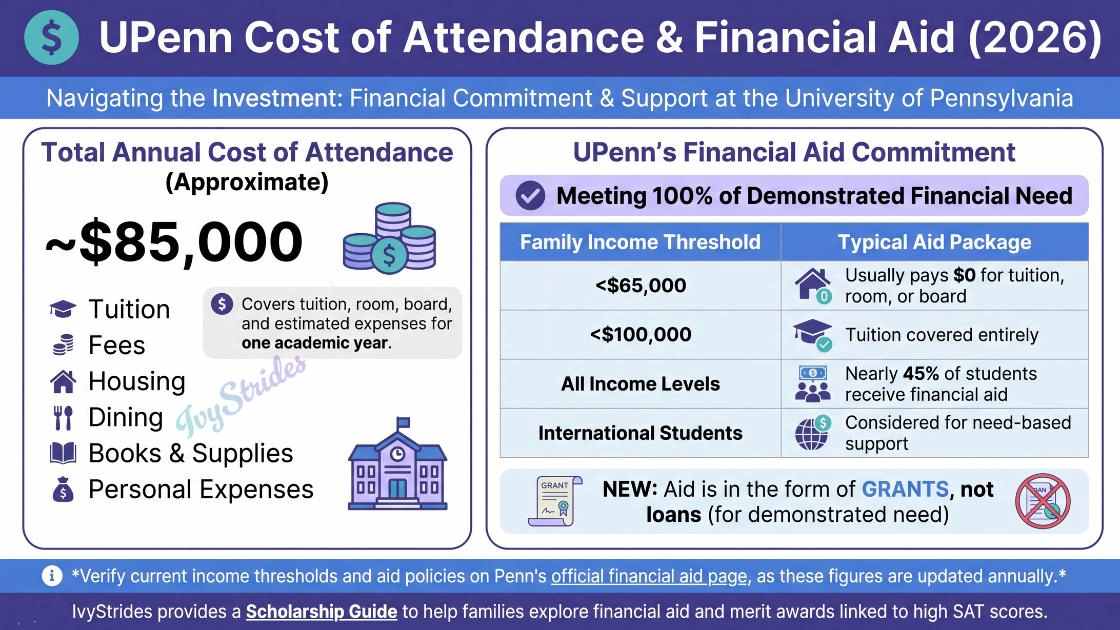
Verify current income thresholds and aid policies on Penn's official financial aid page, as these figures are updated annually.
Don't let costs deter you. IvyStrides provides a Scholarship Guide to help families explore financial aid and merit awards linked to high SAT scores.
How IvyStrides Helps You Meet UPenn SAT Requirements
Meeting UPenn's SAT requirements takes more than just practice - it takes a strategic, data-driven approach. Here's how IvyStrides supports students targeting Penn and other top schools:
- SAT Prep Program: 26 live classes across 13 weeks, 100+ hours of drills, and 10 adaptive mocks designed for the Digital SAT.
- SAT Practice Tests: Full-length adaptive mock tests that simulate real test conditions - your "flight simulator" for the Digital SAT.
- Superscore Strategy Coaching: Personalized study plans that target your weakest sections between sittings, so every retake has a purpose.
- Essay Coaching : One-on-one mentorship for your Common App personal statement and Penn supplemental essays.
- Scholarship Guidance: Help navigating financial aid applications and identifying merit-based opportunities.
Our students consistently move from the 1400s into the 1500+ range with deliberate, section-focused prep. That's the IvyStrides difference.
What If Penn Isn't the Final Destination?
Even if Penn isn't where you land, the preparation journey takes you closer to other Ivy League schools like Harvard, Yale, Princeton, or Columbia. The same SAT prep, essays, and profile-building make you competitive at MIT, Stanford, and other top institutions.
Check out our guides on University of Chicago SAT requirements and Washington University in St. Louis for more options.
More importantly, you gain lifelong skills like critical thinking, leadership, and resilience that outlast admissions.
Frequently Asked Questions About UPenn SAT Requirements
What SAT score is required for UPenn?
UPenn requires SAT scores for all applicants. The middle 50% SAT range for admitted students is 1510–1570. While there is no official minimum score, scoring within or above this range makes you competitive.
Is UPenn test-optional?
No. UPenn reinstated its test-required policy starting with the 2025–2026 admissions cycle. All applicants must submit SAT or ACT scores. A testing waiver is available for students with documented hardship.
Does UPenn superscore the SAT?
Yes. UPenn superscores the SAT by taking your highest Evidence-Based Reading and Writing score and highest Math score across all sittings.
Does UPenn superscore the ACT?
Yes. UPenn also superscores the ACT, taking the highest score from each of the four sections across all sittings.
Can I get into UPenn with a 1450 SAT?
A 1450 falls below UPenn's 25th percentile of 1510. While holistic review means no score is an automatic rejection, a 1450 puts you at a statistical disadvantage. Retaking and aiming for 1510+ is strongly recommended.
Is a 1480 good enough for UPenn?
A 1480 is close to but still below UPenn's 25th percentile. It's possible to be admitted with a 1480 if the rest of your application is exceptionally strong, but aiming higher through superscoring will strengthen your candidacy.
Does UPenn accept self-reported SAT scores?
Yes. You can self-report SAT and ACT scores on your application. Official score reports are required only if you enroll.
Does UPenn require all SAT scores?
No. Penn participates in Score Choice, so you can select which SAT sittings to send. However, since Penn superscores, sending all sittings is generally advantageous.
What is UPenn's SAT code?
The College Board SAT code for UPenn is 2926.
What is UPenn's acceptance rate?
UPenn's overall acceptance rate is approximately 4.1% (Class of 2029). Early Decision acceptance rates are historically higher than Regular Decision rates.
Final Word: Your Path to Penn
Meeting the University of Pennsylvania SAT requirements is only the first step - essays, recommendations, and a strong profile carry your application the rest of the way. UPenn is not just a university; it's a global network of innovation and leadership. But getting in requires clarity, precision, and mentorship.
At IvyStrides, we give you:
- SAT Prep for top scores.
- SAT Practice Tests for superscoring.
- Essay Coaching for unforgettable applications.
- Scholarship guidance to make Penn affordable.
Your UPenn dream is ambitious - but achievable with the right guidance.

Hemant is a seasoned entrepreneur, investor, and growth strategist with deep ground in education and technology-driven learning. His core training is in Mathematics and Physics — he authored Physics for IB Diploma: Ultimate Revision Guide, recognized as a top student resource.