
How to Study for the ACT: A Coach's Complete Prep Plan

On this page
- The Short Answer: How to Study for the ACT in Four Steps
- Step 1: Take a Diagnostic Test Before You Study Anything
- I Don't Know Where to Start: Building Your ACT Study Plan From Scratch
- Not Sure Where Your ACT Score Stands Right Now?
- How Long Should You Study for the ACT? Timelines by Score Goal
- Section-by-Section Study Tactics: What to Focus on in Each Part of the ACT
- ACT English: 75 Questions in 45 Minutes
- ACT Math: 60 Questions in 60 Minutes
- ACT Reading: 40 Questions in 35 Minutes Across 4 Passages
- ACT Science: 40 Questions in 35 Minutes Across 6-7 Passages
- How ACT Scores Compare: What a 27, 31, or 34 Actually Means
- Free and Paid Resources: How to Study for the ACT Online and on a Budget
- When to Consider 1-on-1 ACT Coaching Instead of Self-Study
- FAQ
- Is a 31 ACT the same as a 1400 SAT?
- Is a 27 ACT a good score?
- How does a high raw-score percentage translate to the ACT composite scale?
- How do I actually study for the ACT if I don't know where to start?
- Can I meaningfully improve my ACT score in one week?
- How does a 1350 SAT compare to a 29 ACT?
- Ready to Build a Real ACT Study Plan?
To study for the ACT effectively, take a full-length, timed diagnostic test first to establish your baseline composite and identify which sections cost you the most points. Then build a weekly study plan that targets those weak sections first, using official practice materials from ACT, Inc.. Most students need 3 to 6 months of consistent prep, roughly 6 to 10 hours per week, to gain 4 or more composite points. Students with less time can still make meaningful gains in one month by focusing exclusively on their two lowest-scoring sections.
The format, timing, and scoring details below come from ACT, Inc. The harder question is how to convert a baseline score into a weekly schedule that actually moves the composite, and that's where the next section starts.
Our ACT coaches have guided students through every score band from 17 to 35; the framework below comes directly from that coaching experience.
The Short Answer: How to Study for the ACT in Four Steps
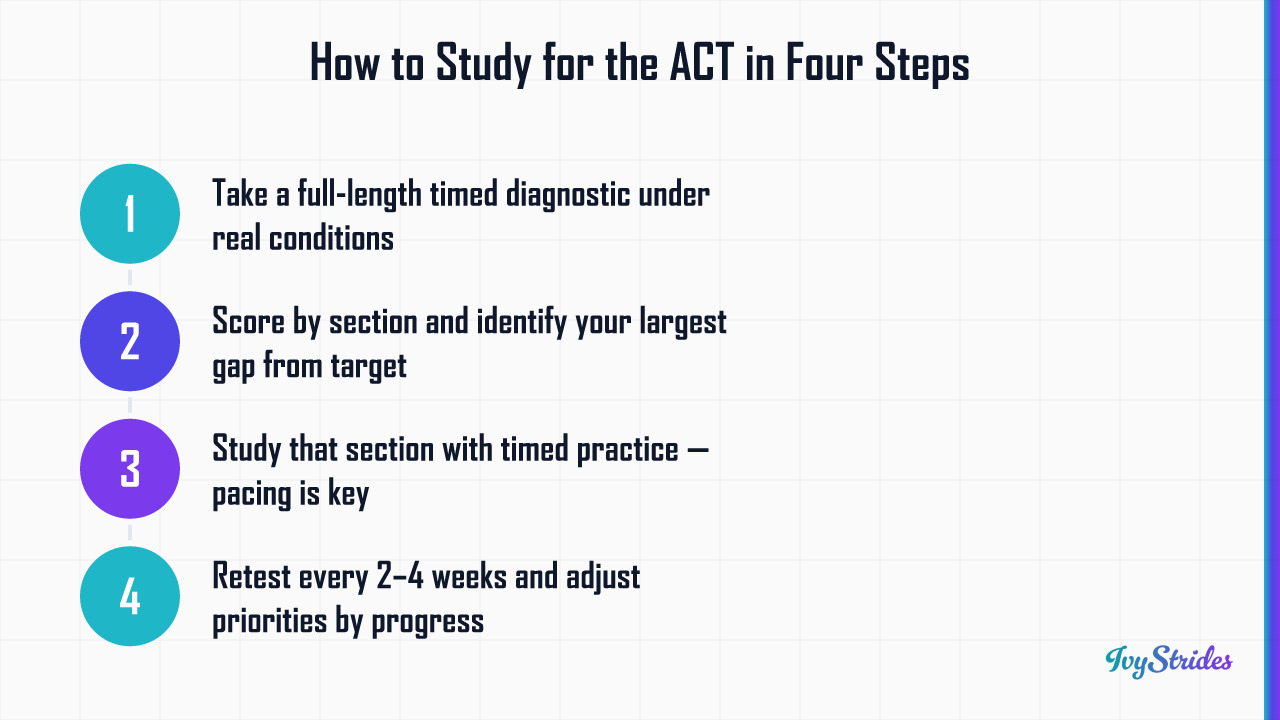
Here's the four-step framework, in order:
-
Take a full-length, timed diagnostic under real conditions: English 45 minutes, Math 60 minutes, Reading 35 minutes, Science 35 minutes (per ACT, Inc.).
-
Score by section and identify the largest gap between your section score and your target composite. That section is where you start.
-
Study that section with timed practice, not untimed content review. Pacing is half the test.
-
Retest with a fresh full-length every 2 to 4 weeks, then adjust your priorities based on which section moved and which didn't.
Plan on 3 to 6 months for a 4+ composite point gain, at 6 to 10 hours per week. Students who try to compress that into two weeks rarely move more than a point or two, and only if they're already disciplined test-takers. Before committing to an ACT study plan, students who haven't yet chosen between the two tests should read our breakdown of ACT vs Digital SAT transitions to confirm which exam fits their strengths.
Step 1: Take a Diagnostic Test Before You Study Anything
The diagnostic test isn't optional. It's the single non-negotiable move in ACT prep, and skipping it is the most common reason students plateau.
The ACT composite is the average of your four section scores (English, Math, Reading, Science), rounded to the nearest whole number on a 1-36 scale, per ACT, Inc. The national average composite sits around 19.5. To know what to study, you need to know which of those four section scores is dragging your average down hardest.
Free, official ACT practice tests are available at act.org. Use those, not third-party imitations. Real retired ACT questions match the actual test's difficulty curve and question style; nothing else does. Take the test in one sitting, with the exact timing above, with a phone timer and no pauses. Score each section separately. Then look at the gap between each section score and your target composite. The largest gap is your first study priority. Everything else waits.
Here's the part most students miss. In our coaching with students who skip the diagnostic, we routinely see weeks burned on content review for skills the student already had. A junior we worked with last fall came in convinced her Math was the problem, spent three weeks drilling algebra, then took a practice test and discovered her Math was already a 29. Reading was the 22. Three weeks, no movement.
For a parallel framework on the SAT side, see our sat study guide pdf.
I Don't Know Where to Start: Building Your ACT Study Plan From Scratch
So you have your diagnostic results. What do you actually do on Monday at 7pm?
Here's the score-band framework we use in coaching:
- 18-22: Prioritize ACT English fundamentals (comma usage, subject-verb agreement, sentence boundaries) and ACT Reading pacing. These two sections offer the fastest composite gains because the rules are finite and learnable.
- 23-27: Focus on ACT Math sub-skills (intermediate algebra, coordinate geometry) and ACT Science passage speed. This band usually has solid English but loses points to careless math errors and Science timing.
- 28-32: Target ACT Science Conflicting Viewpoints passages and ACT Math trigonometry and advanced algebra. At this level, the remaining points sit in the hardest questions, not the easy ones.
- 33-36: Eliminate careless errors. Students here usually have the knowledge; they need flawless execution under time.
A realistic weekly schedule for a 3-month plan looks like this: three sessions per week, 90 minutes each. Split each session 40/50 between content review and timed practice. One session per week should be exclusively timed section practice with no breaks. Every other week, do a full-length practice test on a Saturday morning, then spend Sunday reviewing every wrong answer.
The IvyStrides methodology stacks four things: diagnostic, targeted weakness work, spaced retesting, and section-specialist coaching. Each piece matters. A diagnostic without targeted work is just a score on a page. Targeted work without retesting doesn't confirm the skill stuck. And section-specialist coaching matters because the person who teaches ACT Reading well is rarely the same person who teaches ACT Math well. In our coaching, students on a structured weekly plan consistently outperform those who study in unscheduled bursts, even when total hours are similar.
For students who want to study online for the ACT, start with our online act practice test library and work through full-length sections under timing. If your composite hasn't moved after two retests, that's the signal to consider 1-on-1 ACT prep with a section specialist.
Not Sure Where Your ACT Score Stands Right Now?
Book a free 15-minute strategy call with an IvyStrides ACT coach. We'll review your diagnostic results, identify your highest-leverage section, and give you a concrete next step. No commitment required, and parents are welcome on the call.
How Long Should You Study for the ACT? Timelines by Score Goal
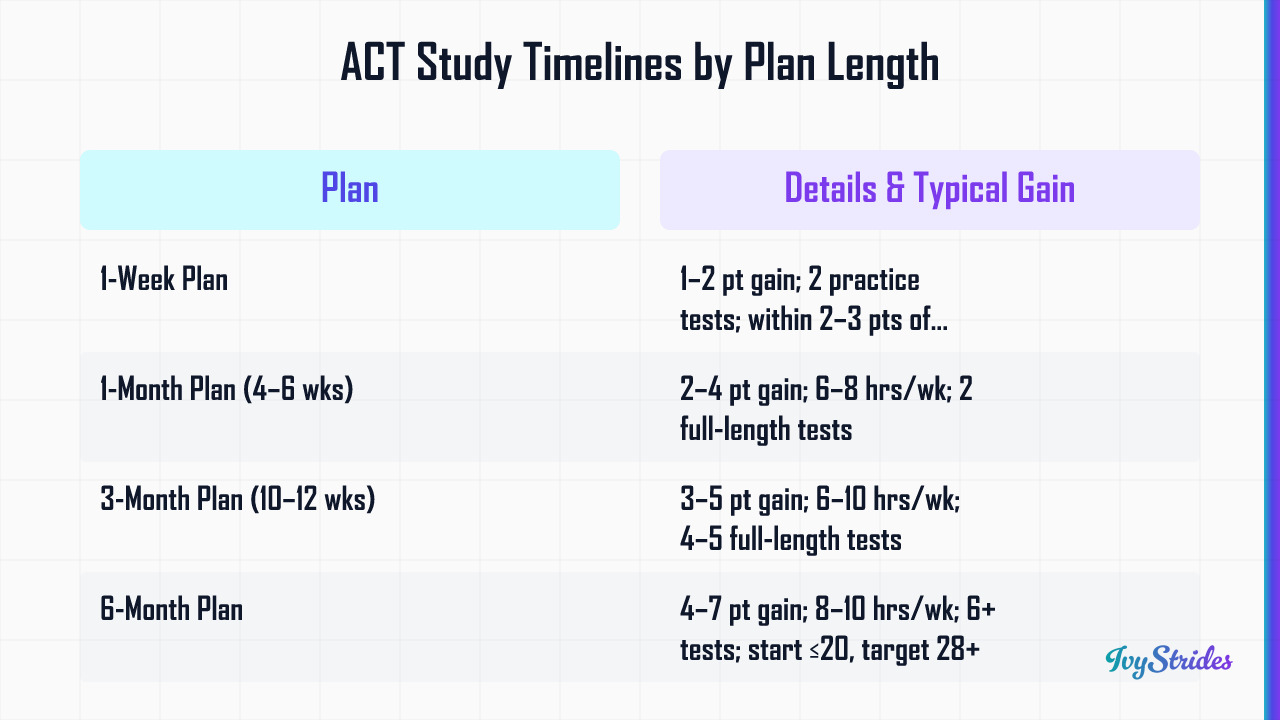
The honest answer depends on your baseline, your target, and how disciplined you are about the diagnostic-first approach. Here are the four timeline scenarios we use with students.
1-week plan. Realistic only if you're already within 2 to 3 points of your target (a realistic short-window gain when prep is highly focused on the weakest section). Take one full-length practice test on day one. Spend days two through six reviewing every wrong answer and drilling pacing on your two weakest sections. Take a second practice test on day seven. Typical gain: 1 to 2 composite points, and only for students with a clean error pattern. If you're 5+ points below target, one week won't get you there.
1-month plan. 4 to 6 weeks, 6 to 8 hours per week. Focus on your two weakest sections; the other two get maintenance practice only. Take two full-length practice tests across the month, two weeks apart, with full review of every wrong answer in between. Typical gain in our coaching: 2 to 4 composite points.
3-month plan. 10 to 12 weeks, 6 to 10 hours per week. Cover all four sections systematically, spending the first 4 weeks on your two weakest and the rest balancing across all four. Take four to five full-length practice tests across the program. Typical outcome in our coaching: 3 to 5 composite point gain for students completing the program.
6-month plan. Built for students starting from a 20 or below and targeting a 28+. 8 to 10 hours per week. Six or more full-length practice tests. Typical outcome in our coaching: 4 to 7 composite point gain for students completing the program, though individual results depend on baseline, consistency, and hours invested.
A note for students also prepping for the PSAT: PSAT prep and ACT prep share overlapping math and reading skills, so a strong ACT study plan often accelerates PSAT readiness as a side benefit. If you're balancing both, the math foundation you build for the ACT carries over. For comparison with the SAT side, our 30-Day SAT Study Plan 2026 to Boost Your SAT Score Fast uses the same diagnostic-first structure. And for students wondering how their PSAT score factors in, see what is a good psat score.
Section-by-Section Study Tactics: What to Focus on in Each Part of the ACT
Each ACT section rewards a different cognitive skill set, so the study tactics for ACT English grammar differ meaningfully from the reasoning-speed strategies that drive ACT Science scores. Here's what to actually do in each.
ACT English: 75 Questions in 45 Minutes
That's about 36 seconds per question. The most frequently tested rules, in our experience: comma usage (restrictive vs. non-restrictive clauses), subject-verb agreement (especially with intervening prepositional phrases), pronoun-antecedent agreement, and transition word choice (however vs. therefore vs. beyond that). Roughly 35% of the section is rhetorical skills questions, which ask whether a sentence or paragraph serves the passage's purpose. These aren't grammar questions, they're editing-judgment questions.
Study tactic: drill rules in 15-minute bursts, then run a full timed passage (about 9 minutes per passage) at the end of each session. The trap most students fall into is studying rules untimed forever and never building the speed.
ACT Math: 60 Questions in 60 Minutes
Calculators are permitted on all 60 questions. The sub-skill distribution, per ACT, Inc.: roughly 40% pre-algebra and elementary algebra, 15% intermediate algebra, 15% coordinate geometry, 23% plane geometry, 7% trigonometry. If you're scoring below 24, prioritize algebra before geometry. That's where the volume is. If you're scoring 28+, the trigonometry and advanced algebra questions are the points you're missing, even though they're only 7-15% of the section.
For a deeper look at math topic coverage, see sat math topics. Many of the underlying skills overlap with ACT Math.
ACT Reading: 40 Questions in 35 Minutes Across 4 Passages
Pacing benchmark: 8 to 9 minutes per passage, including question-answering. The four passage types are fixed in order: Literary Narrative, Social Science, Humanities, Natural Science. In our coaching, students who read the passage first and annotate main ideas (one short note per paragraph) outperform those who skip to questions and hunt for answers. The skip-and-hunt approach feels faster but burns time on re-reading.
ACT Science: 40 Questions in 35 Minutes Across 6-7 Passages
This is the section students most often misunderstand. ACT Science is a reading and reasoning test, not a science knowledge test. Three passage types appear:
- Data Representation passages reward graph-reading speed. Read the axis labels and units first, then go to the questions. You rarely need to read the surrounding text.
- Research Summaries passages describe experiments. Identify the independent and dependent variables and what's being compared across experiments.
- Conflicting Viewpoints passages present two opposing scientific positions and ask you to identify points of agreement and disagreement. This is the hardest passage type and the most common pacing trap.
In our coaching, students in the 24-28 score band most commonly plateau because they run out of time on Conflicting Viewpoints and guess on the final 5 to 8 questions, costing 2 to 3 composite points. The fix is practicing Conflicting Viewpoints passages in isolation, timed, until you can finish one in 6 minutes.
Students taking rigorous AP courses often find that the analytical reading and data interpretation skills built in ACT prep transfer directly to AP exam performance, particularly in ap chemistry and AP Calculus.
How ACT Scores Compare: What a 27, 31, or 34 Actually Means
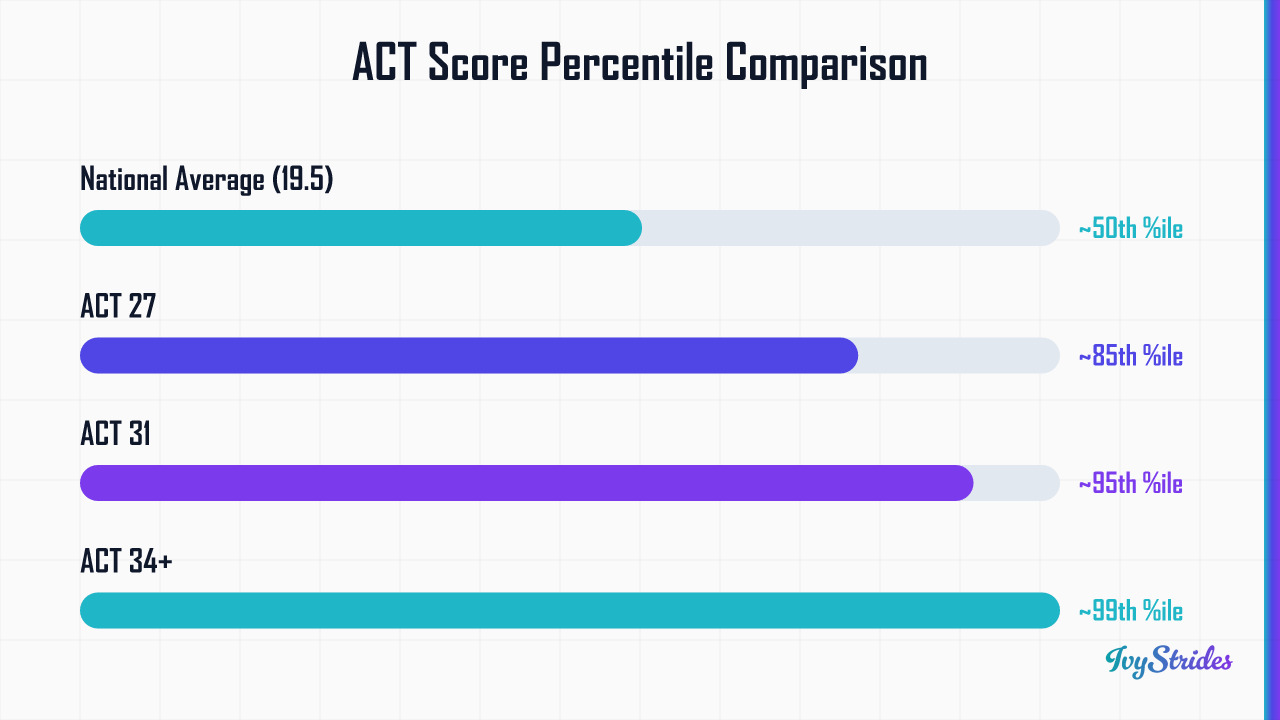
A composite score of 31 or higher places a student above the 95th percentile nationally, according to ACT, Inc.'s published score-to-percentile data, and within the mid-50% range at many selective universities, making ACT prep a direct lever on admissions outcomes. Here's how the key bands break down.
ACT 27: approximately 85th percentile nationally. Competitive for many state flagship universities. Below the mid-50 range at highly selective schools, where mid-50 ACT ranges typically run 33-35 (Ivies, MIT, Stanford). Is a 27 a "bad" score? No. It's well above the national average of 19.5. Whether it's good enough depends on your target school list.
ACT 31: approximately 95th percentile (per ACT, Inc.'s score-percentile reference). Within or above the mid-50 range at many top-25 universities. A 31 is a strong score for most selective applications.
ACT 34+: approximately 99th percentile. Competitive at the most selective institutions, where a 34 typically sits at the 50th percentile of admitted students.
SAT-to-ACT concordance. Per official ACT, Inc. and College Board concordance tables: an ACT 31 corresponds to approximately an SAT 1400; an ACT 29 corresponds to roughly an SAT 1330-1350; an ACT 27 corresponds to about an SAT 1280. Is a 1400 SAT or 31 ACT better? They're statistically equivalent. Colleges that accept both treat them as comparable. The better score is whichever you can achieve more reliably on test day. For a deeper look at how percentiles translate, see sat percentiles.
One caveat on test-optional admissions: policies vary by school and by application year, and test-optional doesn't mean test-blind. A strong score still helps in most test-optional contexts. Verify each school's current policy directly, and cross-reference with FairTest for the latest updates.
A competitive ACT score strengthens the quantitative side of an application, but admissions officers at selective schools weigh essays equally heavily. ACT prep and essay coaching work best as a coordinated strategy, not sequential tasks. Students working on their applications should pair their score plan with a common app essay tutor early, ideally the summer before senior year.
Free and Paid Resources: How to Study for the ACT Online and on a Budget
The highest-quality free ACT prep materials come from one place: ACT, Inc. The official site provides free full-length practice tests and a Question of the Day, all built from real retired ACT questions. Use these first, before any third-party prep book.
A note on free online prep: official ACT, Inc. materials at act.org are the primary free source for ACT-specific practice. Some third-party prep platforms focus exclusively on SAT and don't offer ACT-equivalent depth. When studying for the ACT, treat the official act.org content as your primary resource and supplement it with third-party material only after you've worked through the official material.
When are free resources enough? If you're within 2 to 3 points of your target, disciplined about timing, and willing to review every wrong answer in writing, you can make meaningful gains with free materials alone. A senior we coached two cycles ago hit a 32 starting from a 29 on official materials and a tracked error log, no 1-on-1 coaching involved.
When does coaching add value? When you're stuck. If your composite hasn't moved across two consecutive full-length practice tests, you have a specific sub-skill gap that self-study materials don't diagnose precisely enough. A section-specialist coach watches you work a problem, identifies the exact step where your reasoning breaks, and closes that gap faster than another practice test will.
That is exactly what ACT 1-on-1 prep at IvyStrides is built for. A dedicated section-specialist coach (English, Math, Reading, or Science) works with you one-on-one on the specific question types that cost you points, with a diagnostic-driven plan, weekly accountability checkpoints, and a target composite mapped to your top-choice schools. If you have already done two diagnostic tests and your score is flat, that is the signal to bring in a coach rather than buying another practice book.
For students who want structured, scored, full-length practice with answer explanations, our ACT test packs sit between fully self-directed study and 1-on-1 coaching.
When to Consider 1-on-1 ACT Coaching Instead of Self-Study
Three signals tell us a student needs coaching, not more practice tests:
-
The composite hasn't moved across two full-length practice tests. Same score, same sections, no progress. That's a sub-skill gap, not an effort gap.
-
The student can't articulate why they're missing questions. "I don't know, I just got it wrong" is the answer that points to coaching. Self-study only works when you can diagnose your own errors.
-
Practice test scores are wildly inconsistent. A 28 one week, a 24 the next, a 27 the week after. Inconsistency usually means a pacing or anxiety issue that benefits from external structure.
The IvyStrides model uses section specialists, not generalists. One coach for ACT English and Reading, a different coach for ACT Math and Science. We do this because the skills don't overlap as much as people assume. The tutor who can explain trigonometry cleanly is rarely the same person who can teach you how to read a Conflicting Viewpoints passage in 6 minutes. You can meet the tutors and see how each one specializes.
In our coaching with students in the 24-28 band, the most common plateau cause is ACT Science pacing on Conflicting Viewpoints, costing 2 to 3 composite points. We've seen this pattern dozens of times, and the fix is specific and repeatable. For students completing the IvyStrides 1-on-1 ACT program, a 4+ composite point improvement is a typical result; individual outcomes depend on baseline score, hours invested, and consistency of practice.
A note for parents reading this. The financial investment in coaching varies by program length and session count. Weigh it against the long-term impact of a higher composite score on scholarship eligibility and admissions outcomes at your child's target schools. A 4-point composite gain at many state universities translates to merit aid awards that pay for the coaching several times over. A parent recently asked us whether coaching was worth it for a junior already at a 29; her son's target school had a mid-50 of 32-34, so even a 2-point gain reshaped his aid picture. If you'd like to discuss whether coaching fits your child's situation, you can talk to our counsellors directly.
FAQ
Is a 31 ACT the same as a 1400 SAT?
Per official ACT, Inc. and College Board concordance tables, a 31 ACT corresponds to approximately a 1400 SAT. Colleges treat the two scores as equivalent, so the better score is whichever you can achieve more reliably on test day. If you haven't chosen between the tests yet, take a full-length diagnostic of each before committing to a prep plan.
Is a 27 ACT a good score?
A 27 ACT places you at approximately the 85th percentile nationally, per ACT, Inc.'s score-percentile data,, which is well above average and competitive for many universities. At highly selective schools (those with mid-50 ACT ranges of 33-35), a 27 falls below the typical admitted range. Whether a 27 is "good enough" depends on your target school list, not on the score in isolation.
How does a high raw-score percentage translate to the ACT composite scale?
The ACT doesn't report a raw percentage. It converts raw section scores to scaled section scores on a 1-36 scale, then averages the four section scores into a composite. A student answering roughly 75% of questions correctly across all four sections would typically land in the composite range of 22 to 25, depending on the specific test form's difficulty distribution.
How do I actually study for the ACT if I don't know where to start?
Don't open a prep book yet. Download a free official ACT practice test from act.org, take it under strict timing conditions (English 45 min, Math 60 min, Reading 35 min, Science 35 min), and score each section separately. The section with the largest gap from your target score is where you study first. Everything else follows from that baseline.
Can I meaningfully improve my ACT score in one week?
A one-week plan can produce small gains, typically 1 to 2 composite points, for students already close to their target who have a clear picture of their specific error patterns. If you're more than 3 points below your target, one week isn't enough for meaningful composite improvement. A one-month or three-month plan is the realistic option.
How does a 1350 SAT compare to a 29 ACT?
Per concordance tables from College Board and ACT, Inc., a 29 ACT corresponds to approximately a 1330-1350 SAT. In practical terms, the scores are statistically equivalent, and colleges that accept both will treat them as comparable. Submit whichever score is higher relative to the school's published mid-50 range.
A good ACT study plan isn't complicated, but it has to be honest. Honest about your baseline, honest about your target, honest about how many hours per week you can actually commit. The students who improve the most aren't the ones who study the longest. They're the ones who diagnose first, target their weakest section, and retest on a schedule.
Ready to Build a Real ACT Study Plan?
In 15 minutes, an IvyStrides ACT coach will map your baseline score to your target, identify your two highest-leverage sections, and recommend the right prep path, whether that's self-study, a test pack, or 1-on-1 coaching. Open to students and parents.

Award-winning author (South Asian Book Award) and graduate of BITS Pilani and UCLA Luskin School of Public Affairs. Brings a published writer's eye to Common App essays and grammatical precision to SAT and ACT R&W instruction.