
Why Should You Take the PSAT? What Each Grade Actually Gets
On this page
- What Each PSAT Gives You by Grade: 9th, 10th, and 11th
- The National Merit Pathway: What the PSAT/NMSQT Unlocks for Juniors
- How the PSAT Format Mirrors the SAT and Why That Matters
- What Your PSAT Score Report Actually Tells You (and How to Use It)
- FAQ: Taking the PSAT
- What are the benefits of taking a PSAT?
- How much does it cost to take the PSAT?
- Is the PSAT similar to the SAT?
- Do colleges care about PSAT?
- Your Next Step With the PSAT
The PSAT/NMSQT is a College Board test that juniors take to enter the National Merit Scholarship Program, which will award over $29 million in 2028. Every PSAT version also gives you timed, SAT-style practice in the Bluebook app and a score report that shows what to study next, at a list price of $18 or less.
Is the PSAT worth your time? What you gain, and what to aim for, depends on your grade. With the fall 2026 in-school window closed, freshmen and sophomores can look to spring 2027, sophomores can plan for the PSAT/NMSQT as juniors in fall 2027, and juniors who tested can turn to their score reports and the SAT.

What Each PSAT Gives You by Grade: 9th, 10th, and 11th
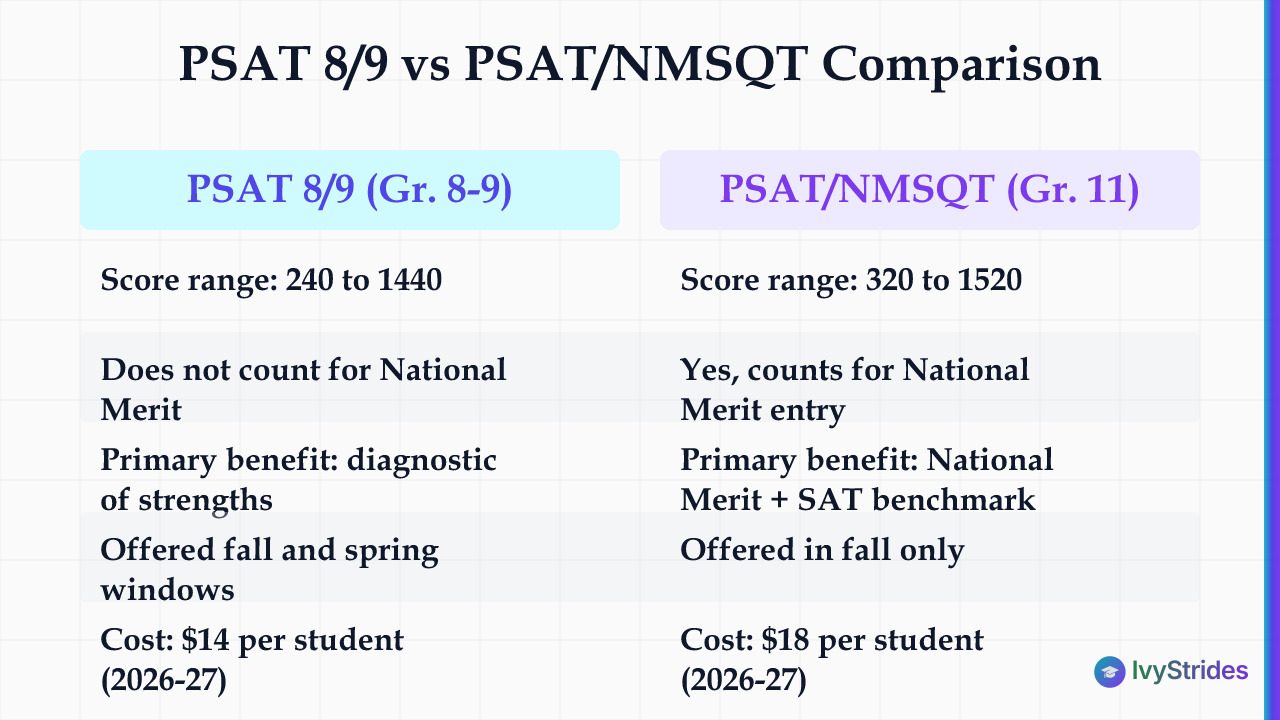
The PSAT comes in three versions. College Board sets the PSAT 8/9 for grades 8 and 9, and the PSAT 10 and PSAT/NMSQT for grades 10 and 11. The PSAT/NMSQT runs in fall and the PSAT 10 in spring, so your school decides which one a 10th grader sits. The PSAT 8/9 runs in both.
For most students, only junior year counts. The PSAT/NMSQT is the qualifying test for the National Merit Scholarship Program; NMSC states the PSAT 10 and PSAT 8/9 will not be considered for entry. On the usual four-year path you must take it in grade 11, so a sophomore who sits it must test again as a junior to enter. The PSAT 8/9 carries a different score range, which is why knowing which version of the PSAT applies to your grade matters before you sit down.
| Grade | Test Version | Score Range | Counts for National Merit Entry? | Primary Benefit |
| 8 or 9 | PSAT 8/9 | 240 to 1440 | No | Diagnostic of your strengths |
| 10 | PSAT 10 (spring) or PSAT/NMSQT (fall) | 320 to 1520 | No, on the usual four-year path | Benchmark toward the SAT |
| 11 | PSAT/NMSQT | 320 to 1520 | Yes, if you meet entry requirements | National Merit entry plus SAT benchmark |
Source: College Board and NMSC.
The fall 2026 in-school window, October 1 to 30, 2026, has closed. College Board's spring 2027 window for the PSAT 10 and PSAT 8/9 runs March 1 to April 30, 2027, so a sophomore or freshman can still test if the school offers one.
Current sophomores aiming at National Merit take the PSAT/NMSQT as juniors in fall 2027, entering the competition that awards scholarships in 2029; ask your counselor for the date. Schools or districts handle PSAT registration, so you do not register on your own. College Board's list pricing is $18 per student for the PSAT/NMSQT and PSAT 10 in 2026-27, and $14 for the PSAT 8/9. Some districts and schools cover all or part of it, and some add an administrative fee.
The National Merit Pathway: What the PSAT/NMSQT Unlocks for Juniors

Photo by Mario Spencer on Pexels
The National Merit Scholarship Program uses the NMSC Selection Index from the PSAT/NMSQT as an initial screen of entrants. The index doubles your Reading and Writing section score, adds your Math section score, and divides the total by 10, on a scale of 48 to 228. So a 650 Reading and Writing and a 630 Math give (2 × 650 + 630) ÷ 10, which is 193.
The path narrows quickly. Students who took the PSAT/NMSQT in October 2026 and met the other program requirements entered the 2028 competition; nearly all are juniors (NMSC). From that pool, NMSC identifies 50,000 high scorers.
About 34,000 of those high scorers become Commended Students. They do not continue in the competition for National Merit Scholarships, though some may be candidates for Special Scholarships. About 16,000 advance as Semifinalists. NMSC puts Finalists at about 15,000, and roughly half win a Merit Scholarship.
| Recognition Level | How Many | What It Requires | When Notified |
| Semifinalist | ~16,000 | Highest-scoring entrants in each state | Early September 2027 |
| Commended Student | ~34,000 | National qualifying score | Late September 2027 |
| Finalist | ~15,000 | Meets academic and other requirements | February 2028 |
| Merit Scholar | ~half of Finalists | Chosen from Finalists | Beginning March 2028 |
Source: NMSC.
In 2028, NMSC will award some 6,700 National Merit Scholarships plus approximately 620 Special Scholarships from corporate sponsors, a combined value of over $29 million.
NMSC says Semifinalist qualifying scores vary from state to state and from year to year, and Commended Students earn that standing on a national score that may also vary yearly, so no single cutoff applies. If your junior-year test is still ahead, push your Selection Index as high as you can rather than aim at a fixed number. Award amounts differ too, so weigh what National Merit scholarship benefits are worth in dollars against that effort.
And if you missed the fall 2026 test? A junior who missed it because of illness, an emergency, or another extenuating circumstance must write to NMSC as soon as possible and no later than April 1, 2027, to request another route of entry, so settle what happens if you miss the junior-year PSAT with your counselor well before then.
How the PSAT Format Mirrors the SAT and Why That Matters
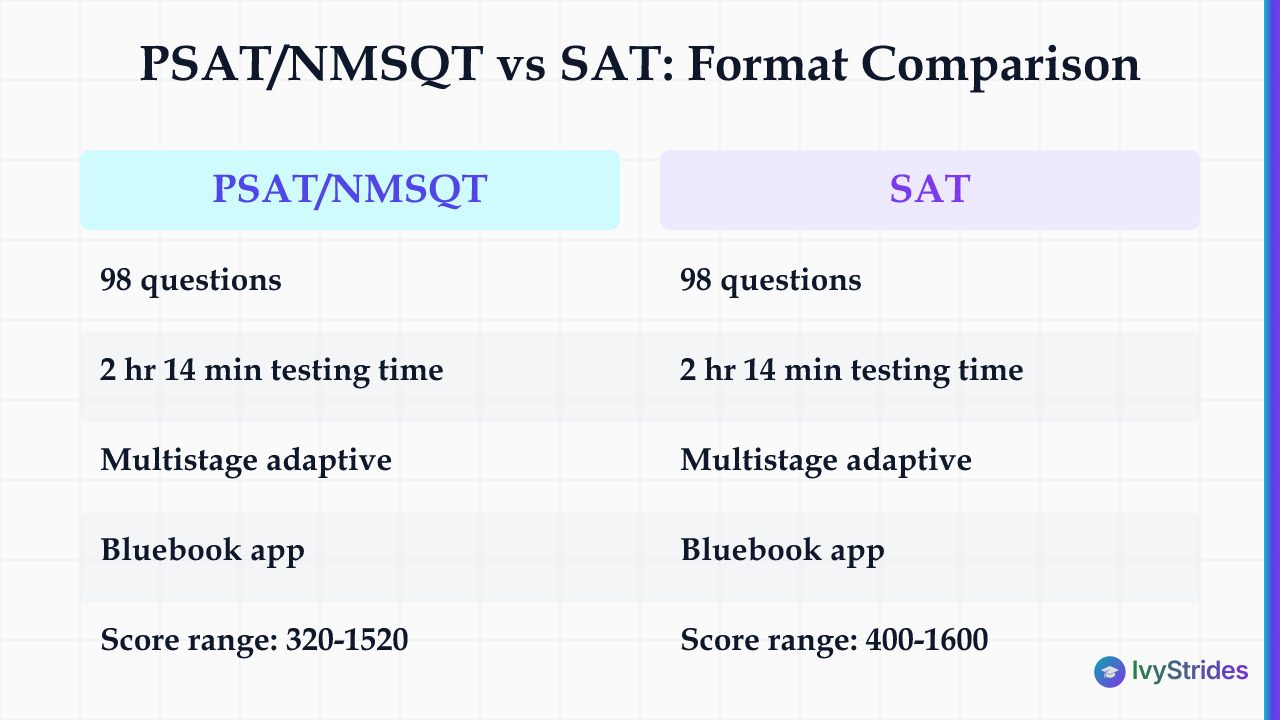
The PSAT/NMSQT is structured similarly to the SAT and measures the same knowledge and skills, College Board says, which is why every grade benefits, National Merit or not. The PSAT/NMSQT has 98 questions in 2 hours and 14 minutes of testing time: Reading and Writing is 54 questions in 64 minutes, split into two 27-question modules, and Math is 44 questions in 70 minutes, split into two 22-question modules (College Board).
The SAT also has 98 questions in 2 hours and 14 minutes, so the PSAT is not a detour from SAT prep. Both tests are multistage adaptive by module: how you do on Module 1 routes you to a more difficult or less difficult Module 2, and both run on College Board's Bluebook app. Understanding how the PSAT's two-module adaptive structure works section by section helps with pacing on test day.
| Feature | PSAT/NMSQT | SAT |
| Total questions | 98 | 98 |
| Testing time | 2 hr 14 min | 2 hr 14 min |
| Sections | 2 | 2 |
| Structure | Multistage adaptive | Multistage adaptive |
| Platform | Bluebook | Bluebook |
| Total score range | 320 to 1520 | 400 to 1600 |
Source: College Board.
One real difference: the score range. The PSAT/NMSQT reports 320 to 1520 and the SAT 400 to 1600. The SAT Suite uses a common score scale, so a 500 in Math on the PSAT/NMSQT would be expected to be a 500 on the SAT taken that same day.
Because of that common score scale, no fixed number of points turns a PSAT score into an SAT score. What raises your SAT score is growth between the two tests. College Board says the tests measure the same skills and knowledge in grade-appropriate ways, which shapes the answer to whether the PSAT is harder than the SAT. Each module also contains two pretest questions that do not count toward your score.
What Your PSAT Score Report Actually Tells You (and How to Use It)
Your PSAT score report works as a diagnostic. On the PSAT/NMSQT and PSAT 10 it reports each section on a 160 to 760 scale (120 to 720 on the PSAT 8/9), and it shows eight Knowledge and Skills domain progress bars: four for Reading and Writing (Information and Ideas, Craft and Structure, Expression of Ideas, Standard English Conventions) and four for Math (Algebra, Advanced Math, Problem-Solving and Data Analysis, Geometry and Trigonometry).
The SAT tests those same eight domains, so the score report matters now rather than later: it shows which ones to focus on before you book an SAT date. Walking through how to read your PSAT score report's domain progress bars turns that picture into a study order.
-
Find your weakest bar. Mark the one or two domains sitting lowest.
-
Match it to a section target. Decide whether Reading and Writing or Math is costing you more points toward your goal.
-
Build the plan around it. Spend your first study block on the lowest bar.
If you want structure as you prepare to take the PSAT, IvyStrides offers live online PSAT prep for grades 8 to 11, with a diagnostic and progress reports in the group cohort and a custom study roadmap in the 1-on-1 track. National Merit-aware coaching keeps the Merit bands in view for 10th and 11th graders.
College Board's 2024-25 PSAT/NMSQT mean is 950, and its benchmarks for being on track to be college ready are 430 in Reading and Writing and 480 in Math for 10th grade, and 460 and 510 for 11th. Comparing your score with those numbers and with what a good PSAT score looks like by grade helps you set a realistic target.
Your domain bars then carry straight into turning your PSAT result into an SAT study plan. An 11th grader can take the SAT in the spring to measure that progress.
FAQ: Taking the PSAT
What are the benefits of taking a PSAT?
The PSAT/NMSQT is the test juniors take to enter the National Merit Scholarship Program. Every version gives you timed practice on Bluebook and a score report with eight domain progress bars that show where to focus, at a list price of $18 or less.
How much does it cost to take the PSAT?
College Board lists the price at $18 per student for the PSAT/NMSQT and PSAT 10 in 2026-27, and $14 for the PSAT 8/9. Some districts and schools cover all or part of it, and some add an administrative fee, so ask your counselor. Registration goes through your school, not College Board.
Is the PSAT similar to the SAT?
Yes, though they are not identical. Both run on Bluebook with the same two-section, multistage adaptive format, the SAT Suite common scale, and 98 questions in 2 hours 14 minutes. The clearest difference is the score range: 320 to 1520 on the PSAT/NMSQT, 400 to 1600 on the SAT.
Do colleges care about PSAT?
College Board says colleges won't receive your actual PSAT/NMSQT scores, and it never sends PSAT 10 or PSAT 8/9 scores to colleges. National Merit recognition does reach them: NMSC sends Semifinalists' names to regionally accredited four-year U.S. colleges and universities. For most students, the PSAT's value is diagnostic rather than admissions-facing.
Your Next Step With the PSAT
Juniors have the most riding on the PSAT, but a freshman or sophomore gains a scored rehearsal in the format they will meet on the SAT.
- Ask your counselor which PSAT your school offers next and when.
- If you are a sophomore or freshman, note the spring 2027 window, March 1 to April 30, 2027.
- When your score report arrives, start with the lowest of the eight domain bars.
- If you missed the fall 2026 test as a junior because of illness, an emergency, or another extenuating circumstance, write to NMSC by April 1, 2027.

Hemant is a seasoned entrepreneur, investor, and growth strategist with deep ground in education and technology-driven learning. His core training is in Mathematics and Physics — he authored Physics for IB Diploma: Ultimate Revision Guide, recognized as a top student resource.