
What SAT Score Do I Need for College? A Clear Guide for Students and Parents
On this page
- What SAT Score Is Good Enough for College, by Tier
- How to Find the SAT Score Your Specific College Expects
- Is the SAT Necessary for College, and When Does Test-Optional Change the Math
- What to Do When Your SAT Score Falls Below Your Target School's Range
- FAQ: SAT Score Targets for College
- Is an SAT necessary for college?
- Is a 1200 on the SAT good or bad?
- What SAT score is good enough for an Ivy League school?
- What is a good average SAT score for a high school student?
- Your Next Step on an SAT Score Target
The SAT score you need is set by each college on your list, and a practical floor is that school's 25th-percentile score. The SAT is a digital exam scored on a 400 to 1600 scale, and your target is a per-school number, not a national one. At or above a school's 25th percentile, your score is in line with the students that school enrolls.
Each college publishes that range in Section C of its Common Data Set, and the federal NCES College Navigator lists test score percentiles on each school's profile. The harder question is what to do when your score sits below that floor, which is where the retake-or-withhold decision starts.

What SAT Score Is Good Enough for College, by Tier
A good SAT score for college depends on the school you are aiming at. The SAT reports a total from 400 to 1600, with two sections scored 200 to 800 each: Reading and Writing, and Math (College Board). The class of 2026 mean total score was 1045 (College Board 2026 SAT Suite Annual Report), so a 1060, the 56th percentile among recent SAT takers, already sits above the average.
But "above average" and "good enough for this school" are different questions. Each college has its own middle-50% range, the band from the 25th percentile to the 75th percentile of enrolled first-year students who sent a score.
| College Tier | Example Schools | Published Middle-50% SAT Range | 25th-Percentile Floor |
| Open-access | Community and many regional publics | Often not required | No published floor |
| Broad-access | Large state universities | Set by each school; read Section C | Each school's own figure |
| Selective | Flagship state, strong privates | Set by each school; read Section C | Each school's own figure |
| Highly selective | Low-admit-rate national universities | Set by each school; read Section C | Each school's own figure |
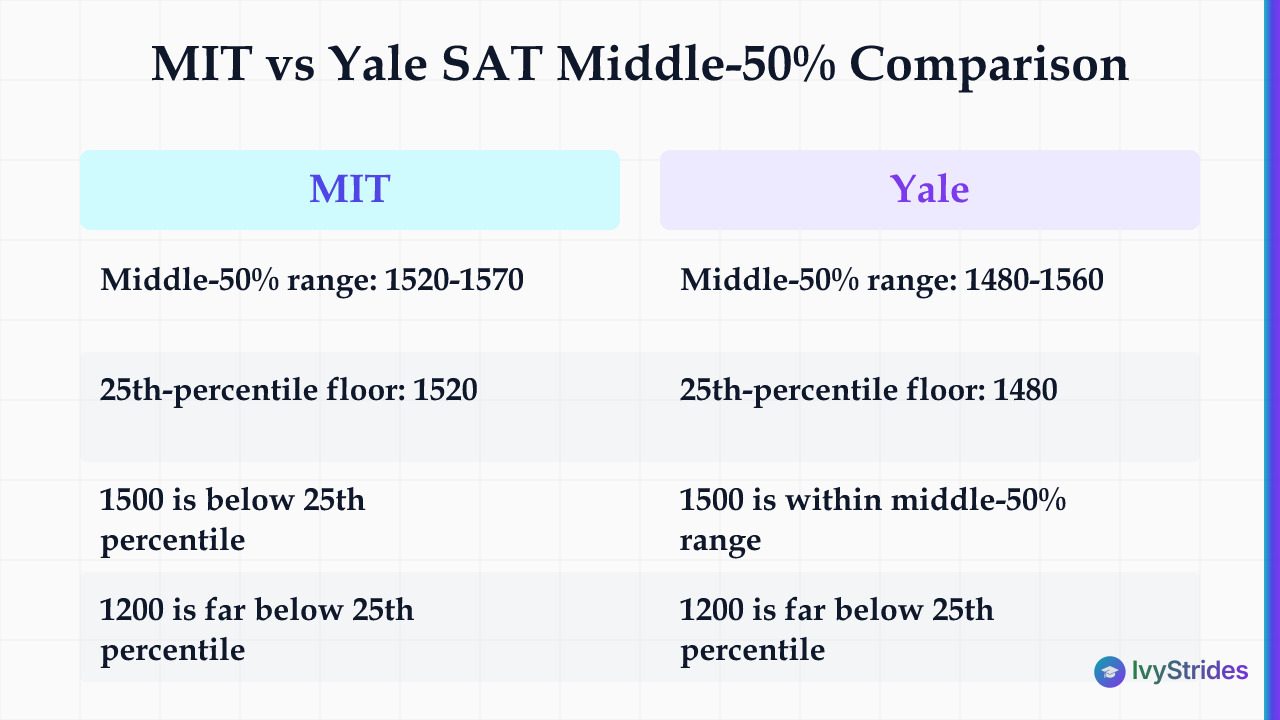
| Most selective | MIT, Yale | MIT 1520 to 1570; Yale 1480 to 1560 | 1520 at MIT; 1480 at Yale |
The MIT and Yale figures come from each school's 2025-26 Common Data Set and describe first-year students who enrolled in fall 2025 and submitted an SAT score. The tiers only sort a college list, so read every other school's exact range in its own Common Data Set.
Read the floor, not the ceiling. At MIT the middle-50% runs 1520 to 1570, and at Yale 1480 to 1560. A 1500 lands at the 97th percentile of recent SAT takers, yet sits below MIT's 25th percentile. That gap is exactly why a national percentile cannot answer "is my score good enough for this school."
Knowing what counts as a good SAT score nationally by percentile tells you where you stand among all test takers, which is useful context but not a college's answer. Reading your own score report accurately matters just as much, so understanding how the SAT is scored on the 400-1600 scale lets you separate your two section scores before you compare either one to a college.
So is a 1200 good or bad? It sits at the 75th percentile of recent SAT takers, well above the average test taker. It is still far below the 25th percentile at MIT and Yale.
How to Find the SAT Score Your Specific College Expects
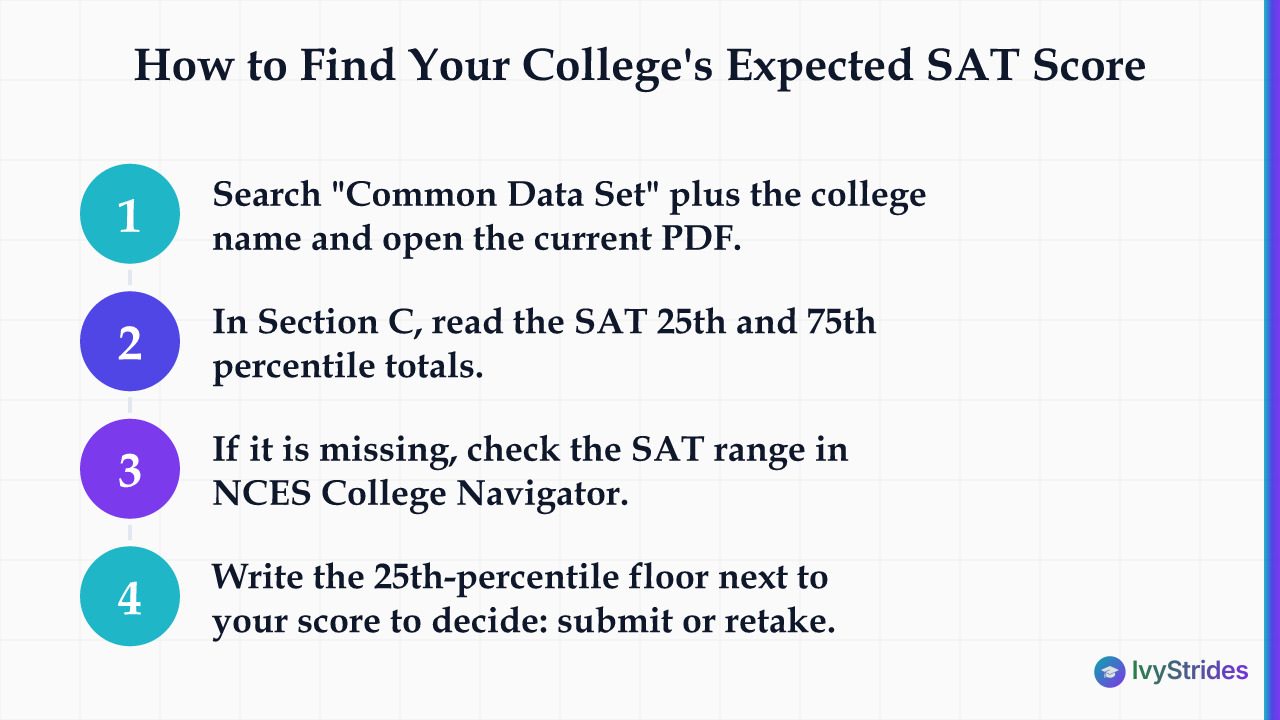
The SAT score a specific college expects lives in Section C of that school's Common Data Set, which lists the 25th and 75th percentile SAT scores of enrolled first-year students who submitted a score. That percentile band, not a tier label, is the number you compare your score against. The federal NCES College Navigator is a second place to look.
Because a tier only sorts your list, the exact number takes a three-step lookup for each college on it.
-
Search "Common Data Set" plus the college name, open the current PDF, and scroll to Section C. Read the SAT 25th and 75th percentile totals, and the section ranges if listed.
-
If you cannot find it, open NCES College Navigator, search the school, and read the SAT range under admissions.
-
Write the 25th-percentile floor next to your own total. At or above it, the score is worth submitting. Below it, you have a retake decision.
For parents: IvyStrides shares admissions timelines and counseling guidance on LinkedIn. Follow along for the questions families ask most.
Superscoring changes the math. When a college superscores, it combines your best Reading and Writing and your best Math from separate sittings. A strong section from an earlier test still counts, so checking how superscoring affects which sitting to send on each school's testing policy page can save a retake you assumed was wasted.
Timing matters too. SAT scores typically post online 2 to 4 weeks after test day, so count back from each application deadline. The December 5, 2026 SAT has a late registration deadline of November 24, 2026, and the March 6, 2027 SAT has a registration deadline of February 19, 2027 (College Board). Whether a sitting still fits your calendar depends on which SAT test dates and registration deadlines for 2026-27 remain open before your application is due.
Is the SAT Necessary for College, and When Does Test-Optional Change the Math
The SAT is not necessary at every college, but some selective schools require it. Test policies vary by school and by entry year, so the only reliable answer comes from each target school's admissions page. MIT and Yale, for example, both require the SAT or ACT for fall 2027 entry, as do several other highly selective schools.
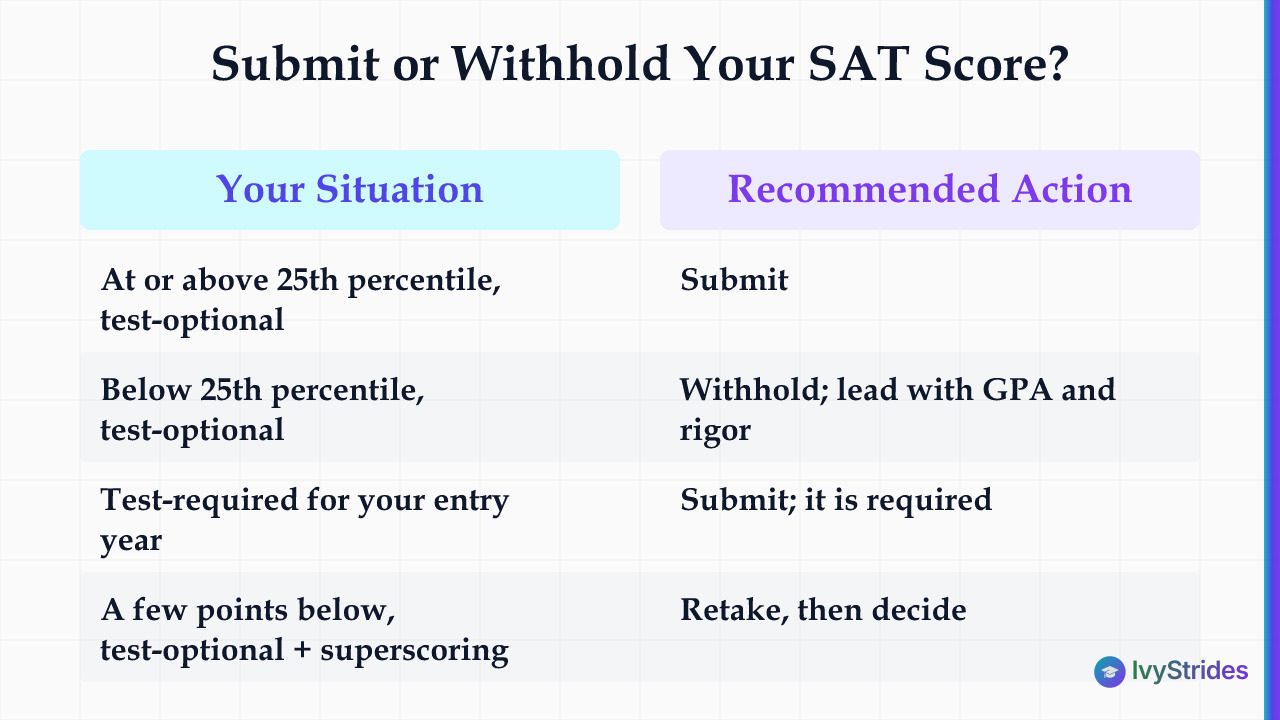
Once you have each school's policy for the year you will enroll, the submit-or-withhold call turns on one comparison: your score against that school's 25th-percentile floor. A requirement announced for a later entry year does not apply to an earlier one.
| Your Score vs. School's 25th Percentile | School Policy | Recommended Action |
| At or above the floor | Test-optional | Submit |
| Below the floor | Test-optional | Withhold; lead with GPA and rigor |
| Any score | Test-required for your entry year | Submit; it is required |
| Within a few points below | Test-optional, superscoring | Retake, then decide |
Below the floor at a test-optional school, a score may not help. A number beneath the 25th percentile sits under at least three quarters of the enrolled students who sent a score, so whether submitting a 1400 SAT helps or hurts at test-optional schools depends entirely on where 1400 lands for that one college, not on a national sense of "good."
Withholding is not the same as having nothing to show. At test-optional schools the transcript and course rigor do more of the work when no score is attached, though how scores and course rigor combine in holistic admissions review differs by institution. Admissions stays holistic: the score is one signal among GPA, essays, and activities, never the whole case.
What to Do When Your SAT Score Falls Below Your Target School's Range
A score below your target school's 25th-percentile floor leaves three honest options: retake, recalibrate the list, or withhold the score where the school allows it. The right one depends on which section is dragging your total and how much calendar you have left before your application deadline.
Start with the section split, because a 1240 made of a 680 Reading and Writing and a 560 Math is a very different prep job than the reverse. The Reading and Writing section runs 54 questions in 64 minutes; Math runs 44 questions in 70 minutes (College Board). A useful first step is to open each school's Common Data Set and mark its 25th-percentile section scores beside your own.
When one section is the bottleneck, the retake plan should start there. IvyStrides' 1-on-1 SAT prep opens with a diagnostic test and a custom roadmap that is re-evaluated weekly, and each of its 10 Bluebook-style adaptive mocks is followed by a tutor review session.
- Identify which section sits furthest below the floor; that section leads your plan.
- Check the SAT Reading and Writing benchmark of 480 as a floor for readiness, not an admissions target.
- Count the weeks to your deadline against typical score release of 2 to 4 weeks.
- Pick a sitting whose registration deadline has not passed: the 2027 weekend dates are March 6, May 1, and June 5, 2027.
- Confirm whether each school superscores before assuming a retake is needed.
- If no sitting fits the deadline, recalibrate the list toward schools whose floor you clear.
Recalibrating is not settling. A retake that cannot land before your deadline is not the end of the list. Rebuild it around schools whose 25th-percentile floor you already clear, the same exercise as working out which colleges accept a 1300 SAT score.
If merit aid is part of your college plan, a retake can matter for aid too, because how SAT scores unlock merit scholarship thresholds is a separate question from clearing an admissions floor. Submission is its own decision, and whether to submit SAT scores under a test-optional policy is settled school by school once your scores are in.
FAQ: SAT Score Targets for College
Is an SAT necessary for college?
Not at every college. Many schools stay test-optional, meaning you can apply without a score. Others require the SAT or ACT: MIT and Yale both do for fall 2027 entry. Check the policy for your entry year on each target school's admissions page, since policies vary by school and year.
Is a 1200 on the SAT good or bad?
A 1200 sits at the 75th percentile of recent SAT takers, above the class of 2026 mean of 1045. It falls below the 25th-percentile floor at the most selective schools, such as MIT and Yale, where enrolled ranges start far higher.
What SAT score is good enough for an Ivy League school?
It depends on the school. In their 2025-26 Common Data Sets, Yale reports a middle-50% SAT range of 1480 to 1560 and Dartmouth 1440 to 1550 for enrolled first-year students who submitted scores. A score at or above a school's 75th percentile sits in the top quarter of those students, but admissions there stay holistic: GPA, rigor, essays, and activities all weigh in.
What is a good average SAT score for a high school student?
The class of 2026 mean total score was 1045, per College Board's 2026 SAT Suite Annual Report. A 1060 clears that average. What counts as good, though, is the 25th-percentile floor at each school on your list, not the national mean.
Your Next Step on an SAT Score Target
Your SAT target is not one number. It is a short list of 25th-percentile floors, one per college, and a clear read on whether you clear each one.
- Pull the Common Data Set or NCES College Navigator entry for every target school.
- Write the 25th-percentile floor beside your own total and section scores.
- Mark each school: clear, close, or below.
- For "close" schools, confirm superscoring and check remaining test dates.
- For "below" schools, decide between a retake and recalibrating the list before your deadline.
Daily SAT and ACT prep on YouTube: short strategy videos from IvyStrides. Subscribe to IvyStrides on YouTube.

Hemant is a seasoned entrepreneur, investor, and growth strategist with deep ground in education and technology-driven learning. His core training is in Mathematics and Physics — he authored Physics for IB Diploma: Ultimate Revision Guide, recognized as a top student resource.