
SAT Math Formulas You Need to Know: The Complete 2026-27 Guide for Students and Parents
On this page
- Which SAT Math Formulas Does the Test Actually Give You?
- SAT Math Formulas by Domain: What to Memorize in Each Area
- The SAT Math Formulas Students Miss Most Often (and Why They Cost Points)
- How to Build Your SAT Math Formula Study Plan Before Test Day
- FAQ: SAT Math Formulas and the Reference Sheet
- Does the SAT give me formulas?
- Does the SAT give you the 30-60-90 triangle formula?
- How many questions can I get wrong and still score 750 on SAT Math?
- Do I need to memorize geometry formulas if the reference sheet has them?
- Your Next Step on SAT Math Formulas
The Digital SAT gives you a geometry-only reference sheet throughout both Math modules: area and volume formulas, the Pythagorean theorem, and the special right triangle ratios. Everything else, all algebra, quadratic, statistics, exponential, and trigonometry formulas, you memorize.
The Math section runs 44 questions in 70 minutes across two adaptive modules, per College Board's Digital SAT structure page. Because the sheet stops at basic geometry, the formulas behind most Math questions are the ones you must know cold.
Which SAT Math Formulas Does the Test Actually Give You?
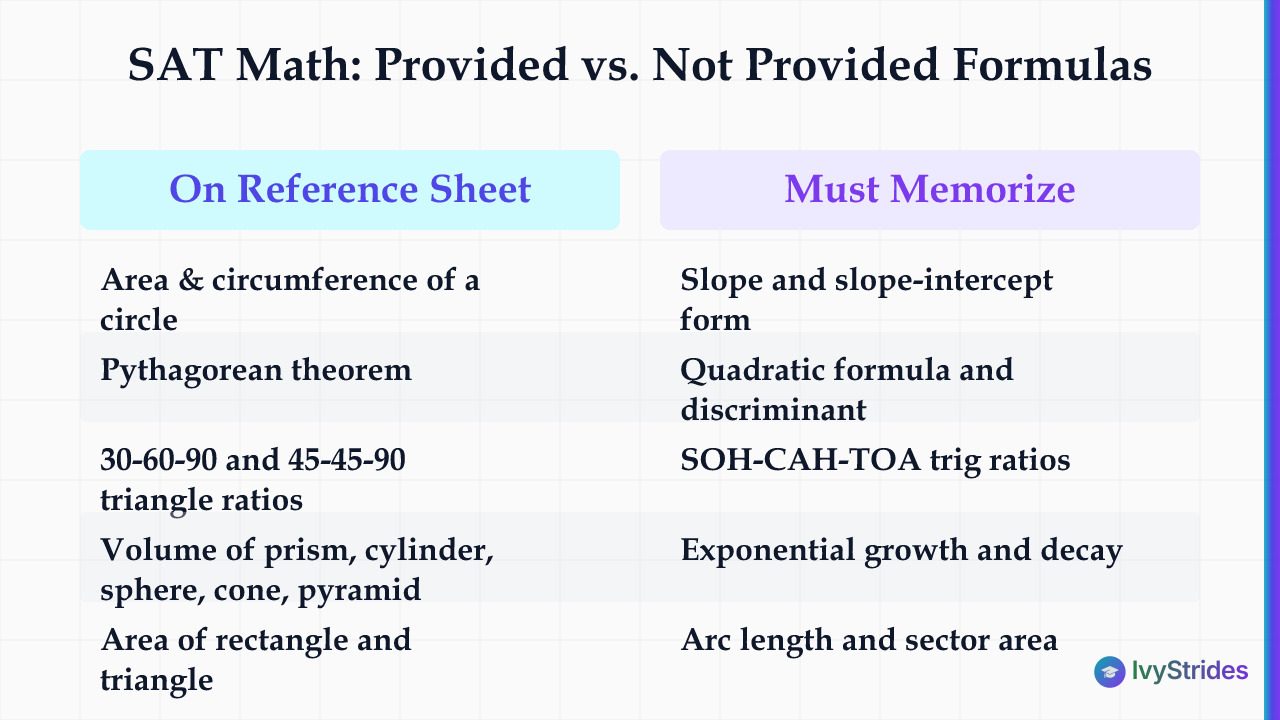
The SAT reference sheet is geometry-only. Open throughout each Math module in Bluebook, it covers the area and circumference of a circle, the area of a rectangle and a triangle, the Pythagorean theorem, the 30-60-90 and 45-45-90 special right triangles, and the volume of a rectangular prism, cylinder, sphere, cone, and pyramid. It also states that a circle has 360 degrees or 2π radians of arc and that a triangle's angles sum to 180 degrees, per College Board's Digital SAT Suite assessment framework.
What the sheet leaves out: any Algebra domain formula, the quadratic formula, any statistics formula, exponential growth and decay, or any trigonometric ratio. Walk in expecting slope or the circle equation to be printed somewhere, and you lose points you can control.
College Board builds the Desmos calculator into Bluebook for the whole Math section, but on most Algebra problems a memorized formula is still faster than graphing.
| Formula / Concept | Provided on Reference Sheet? | Domain |
| Area and circumference of a circle | Yes | Geometry and Trigonometry |
| Area of a rectangle, area of a triangle | Yes | Geometry and Trigonometry |
| Pythagorean theorem | Yes | Geometry and Trigonometry |
| 30-60-90 triangle ratio | Yes | Geometry and Trigonometry |
| 45-45-90 triangle ratio | Yes | Geometry and Trigonometry |
| Volume of rectangular prism, cylinder, sphere, cone, pyramid | Yes | Geometry and Trigonometry |
| Slope and slope-intercept form | No | Algebra |
| Distance formula | No | Geometry and Trigonometry |
| Quadratic formula and discriminant | No | Advanced Math |
| Exponential growth and decay | No | Advanced Math |
| Circle equation | No | Geometry and Trigonometry |
| Percent change, mean, probability | No | Problem-Solving and Data Analysis |
| SOH-CAH-TOA trig ratios | No | Geometry and Trigonometry |
| Arc length and sector area | No | Geometry and Trigonometry |
One structural point to hold onto. The Math section is adaptive by module, so your Module 1 performance sets whether Module 2 is easier or harder. Careless formula errors in Module 1 can route you to the lower-difficulty Module 2, which is why understanding Digital SAT scoring across its two adaptive modules matters before you set a target.
College Board tests arc length and sector area under circles but never prints them, so pair the sheet with the SAT geometry formulas you must memorize.
SAT Math Formulas by Domain: What to Memorize in Each Area
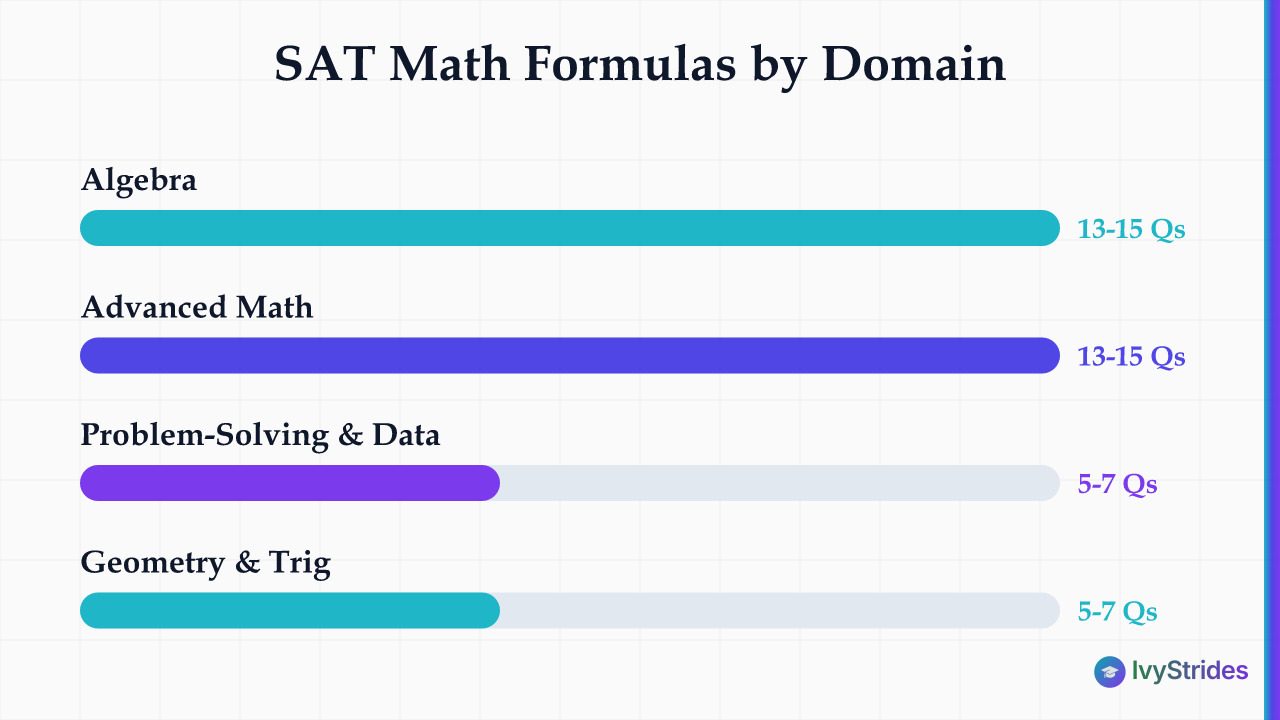
The four SAT Math content domains organize every must-memorize formula: Algebra, Advanced Math, Problem-Solving and Data Analysis, and Geometry and Trigonometry. College Board's Math section overview lists 13 to 15 questions each for Algebra and Advanced Math and 5 to 7 each for the other two, so Algebra and Advanced Math formulas earn your attention first.
Algebra and Advanced Math do the heavy lifting. The Algebra domain runs on linear relationships: slope, slope-intercept form, point-slope form, standard form, and solving systems by substitution or elimination. The Advanced Math domain holds the quadratic formula, the discriminant, vertex form, exponential growth and decay, and your exponent rules. The circle equation and the distance formula sit in Geometry and Trigonometry, under circles.
Problem-Solving and Data Analysis formulas are short and easy to underrate. Percent change, mean, probability, and unit rate aren't provided, and they feel too simple to review.
| Domain (approx. share) | Formula / Concept | When It Appears |
| Algebra (13 to 15 questions) | Slope: m = (y2 − y1)/(x2 − x1) | Linear graphs, rate problems |
| Algebra | Slope-intercept: y = mx + b | Line equations |
| Advanced Math (13 to 15 questions) | Quadratic formula | Solving non-factorable quadratics |
| Advanced Math | Discriminant: b² − 4ac | Counting real roots |
| Advanced Math | Vertex form: y = a(x − h)² + k | Parabola vertex questions |
| Advanced Math | Exponential: y = a(1 ± r)^t | Growth and decay word problems |
| Problem-Solving and Data Analysis | Percent change: ((new − old)/old) × 100 | Percent word problems |
| Problem-Solving and Data Analysis | Mean: sum ÷ count | Data and statistics sets |
| Geometry and Trigonometry | SOH-CAH-TOA | Right-triangle trig |
| Geometry and Trigonometry | Circle equation: (x − h)² + (y − k)² = r² | Circles in the xy-plane |
| Geometry and Trigonometry | Distance formula | Circle and coordinate problems |
| Geometry and Trigonometry | Arc length, sector area | Circle sector questions |
For parents: IvyStrides shares admissions timelines and counseling guidance on LinkedIn. Follow along for the questions families ask most.
A formula only earns points once you can match it to the SAT Math question types grouped by domain.
The SAT Math Formulas Students Miss Most Often (and Why They Cost Points)
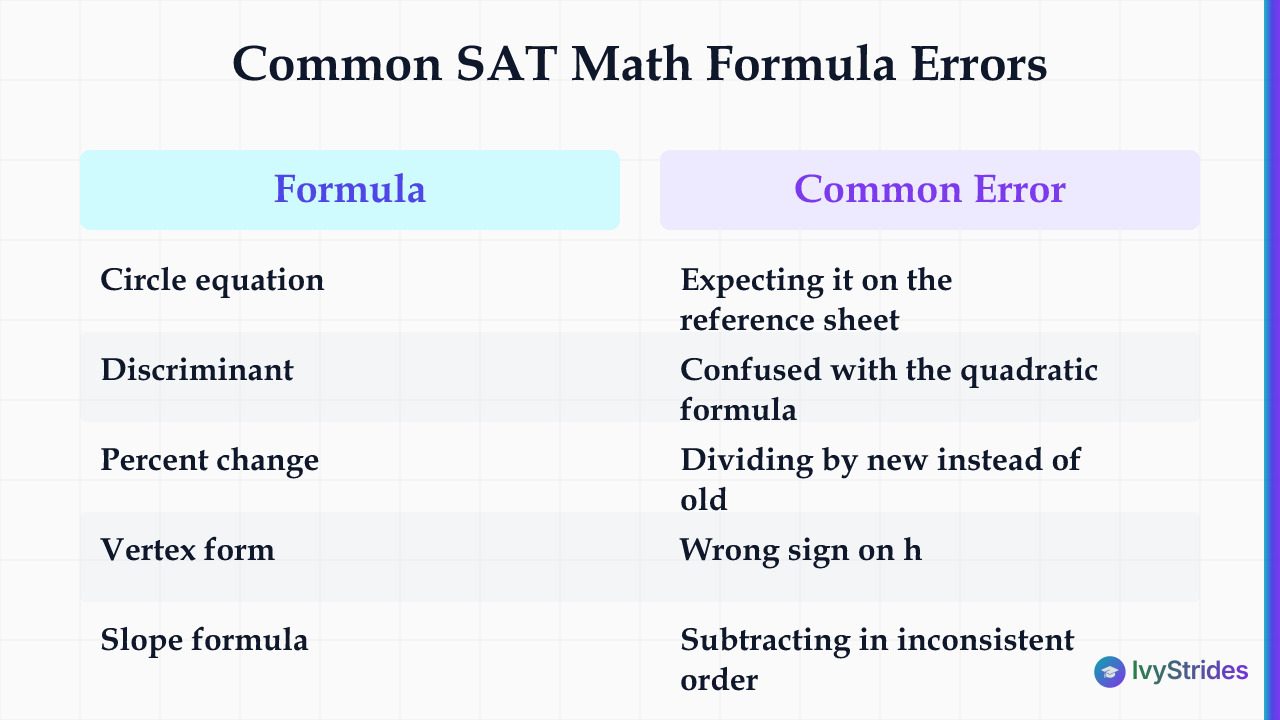
The SAT Math formulas that cost points are rarely the hardest ones. A student can know the quadratic formula cold and still blank on the circle equation, or apply percent change in the wrong direction. Each of these traps sits in a formula the reference sheet never prints.
Start with the circle equation. Students expect (x − h)² + (y − k)² = r² to be printed, but it never is, and College Board's framework lists writing a circle's equation in the xy-plane as a tested skill. The discriminant is the next trap, because it is easy to conflate with the quadratic formula: b² − 4ac tells you how many real roots exist, positive for two, zero for one, negative for none.
Three more recur. Students confuse exponential growth, y = a(1 ± r)^t, with linear growth. On percent change they divide by the new value instead of the old. And on vertex form, y = a(x − h)² + k, they forget the sign flips, reading the vertex as (−h, k) instead of (h, k).
| Formula | Common Error | Domain |
| Circle equation | Expecting it on the reference sheet | Geometry and Trigonometry |
| Discriminant | Confused with the quadratic formula | Advanced Math |
| Exponential growth/decay | Treated as linear | Advanced Math |
| Percent change | Dividing by new instead of old | Problem-Solving and Data Analysis |
| Complementary angle: sin x = cos(90 − x) | Never memorized | Geometry and Trigonometry |
| Vertex form | Wrong sign on h | Advanced Math |
| Slope formula | Subtracting in inconsistent order | Algebra |
A formula list has one limit: it can't tell you which of these is costing you points, because the gap is specific to your error pattern. For students who want that diagnosis done with a tutor, IvyStrides' SAT 1-on-1 prep begins with a diagnostic test and a custom roadmap re-evaluated weekly, and each Bluebook-style adaptive mock is followed by a tutor review.
College Board's published Math timing, 70 minutes for 44 questions, works out to about 95 seconds per question, so recall speed matters as much as accuracy.
How to Build Your SAT Math Formula Study Plan Before Test Day
Start your SAT Math formula study with a timed diagnostic, not a formula list. A full-length official Bluebook practice test shows which domain is actually costing points, so you drill the formulas that matter rather than the ones you already know.
Work it in sequence, spacing your drills over several days rather than one cram session, and let your SAT Math prep plan order the domains by where you lose the most points.
Anchor the plan to a real test date. Scores typically arrive 2 to 4 weeks after test day, so a specific date gives you a hard deadline and a retake window.
| Step | Action | When |
| 1 | Take a timed Bluebook diagnostic | 2 hours 14 minutes of testing |
| 2 | Rank the four domains by point loss | Once the test is scored |
| 3 | Drill weakest domain's formulas, spaced | Over several days |
| 4 | Apply under timed practice | Mixed question sets |
| 5 | Re-test and re-rank | 2 hours 14 minutes of testing |
At step four, use the most accurate SAT practice tests you can find. Spring 2027 SAT weekend dates fall on March 6, May 1, and June 5, per College Board's dates and deadlines page.
Formula recall is the floor, not the ceiling. If the obvious gaps are closed and your score still won't move, you are facing an SAT score plateau.
FAQ: SAT Math Formulas and the Reference Sheet
Does the SAT give me formulas?
Yes, but only geometry formulas. The Digital SAT makes a reference sheet available throughout both Math modules, covering area, volume, the Pythagorean theorem, and the special right triangle ratios. Algebra, quadratic, statistics, exponential, and trigonometry formulas are not provided, so you memorize them.
Does the SAT give you the 30-60-90 triangle formula?
Yes. Both the 30-60-90 and 45-45-90 special right triangle ratios appear on the SAT reference sheet. You don't have to memorize the side ratios, but you do need to apply them quickly under time pressure.
How many questions can I get wrong and still score 750 on SAT Math?
College Board does not publish a fixed number. Its scoring explanation says scores reflect which questions you answer correctly and their difficulty, so two students with the same number correct can earn different section scores. A scored Bluebook practice test is the closest official check on where you stand.
Do I need to memorize geometry formulas if the reference sheet has them?
For the formulas printed on the sheet, no. But several geometry formulas aren't provided: the circle equation (x − h)² + (y − k)² = r², arc length, sector area, and the trig ratios (SOH-CAH-TOA) all require memorizing.
Your Next Step on SAT Math Formulas
Turn what you now know into action:
- Stop memorizing what the geometry-only reference sheet already prints.
- Memorize the Algebra and Advanced Math formulas first; those two domains hold the most questions.
- Drill the common trap formulas, starting with the circle equation and the discriminant.
- Take a timed Bluebook diagnostic, rank your four domains, and drill the weakest one before your test date.
Watch the method, then try it: IvyStrides explains SAT and ACT question types on YouTube.

Hemant is a seasoned entrepreneur, investor, and growth strategist with deep ground in education and technology-driven learning. His core training is in Mathematics and Physics — he authored Physics for IB Diploma: Ultimate Revision Guide, recognized as a top student resource.