
How Is the ACT Scored? Section Scores, Composite, and 2026-27 Ranks at a Glance
On this page
- How ACT Section Scores Are Built from Raw Answers
- How the ACT Composite Score Is Calculated from Three Sections
- What Is a Good ACT Score for College Admissions in 2026
- What the ACT Score Report Shows Beyond the Composite
- FAQ: ACT Scores and What They Mean
- Is a 36 on the ACT a 100%?
- Is 22 out of 36 good on ACT?
- Is 27 out of 36 a good ACT score?
- Is a 25 a bad ACT score?
- Your Next Step on ACT Scoring
The ACT is a college admissions test that scores English, Math, Reading, and the optional Science section on a 1 to 36 scale. Your Composite is the average of English, Math, and Reading only, rounded to the nearest whole number. Science and Writing stay optional and never touch the Composite. Correct answers count; wrong answers carry no penalty. On ACT's 2026-27 national ranks, the mean Composite is 19.1.
The sections below follow that path in order: raw answers become scaled section scores, three of those become your Composite, and the Composite gets a national rank you can set beside each college's published range.

How ACT Section Scores Are Built from Raw Answers
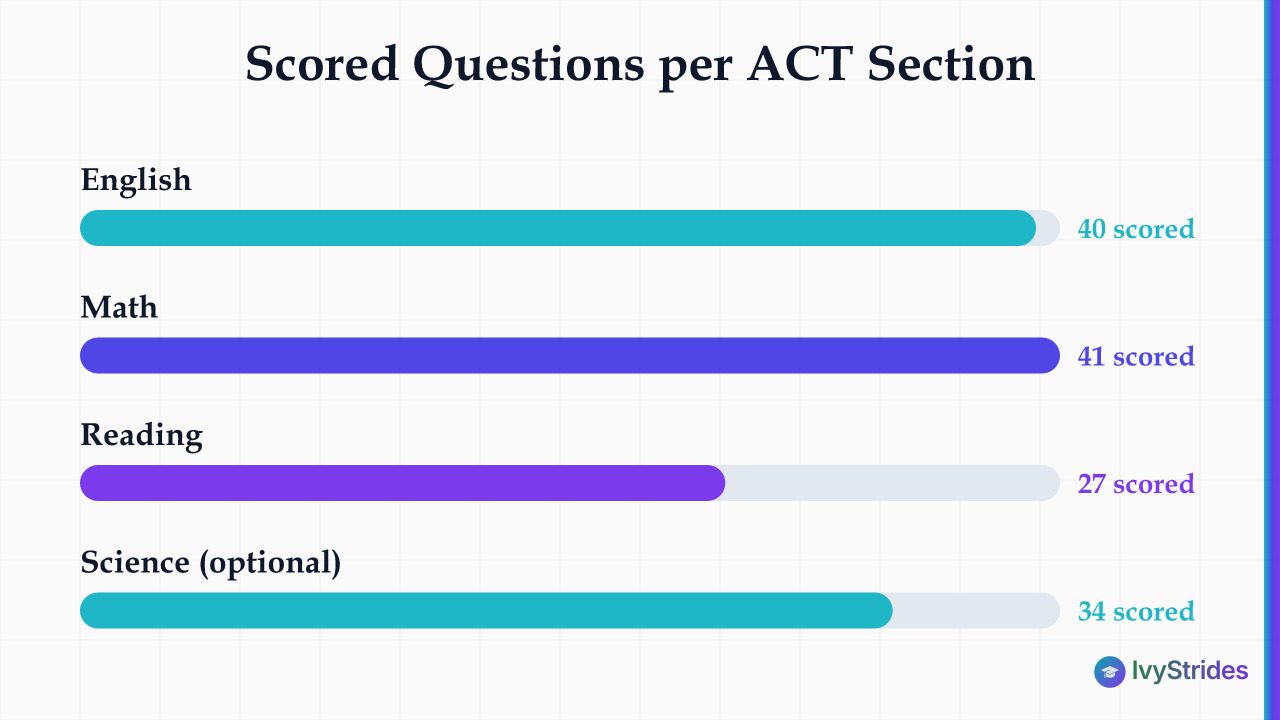
Your ACT raw score is nothing more than a count of correct answers. The ACT applies no penalty for a wrong or blank answer, so guessing never costs you. ACT then converts each raw score to a 1-36 scale score through equating, the process that gives a score the same meaning on every test form and test date.
Not every question you answer counts. Each multiple-choice section mixes in field-test questions, items ACT is trying out for future tests; they do not count toward your score, and you will not know which ones they are on test day. On the enhanced ACT, only 40 of the 50 English questions count toward your score; the other 10 are field-test items.
The scored counts, section by section. The table below shows the question counts and timing ACT publishes on its exam sections and structure page, with a core total added. Enhanced ACT Math questions also offer four answer choices instead of five.
| Section | Total Questions | Scored Questions | Time (minutes) | Counts Toward Composite? |
| English | 50 | 40 | 35 | Yes |
| Math | 45 | 41 | 50 | Yes |
| Reading | 36 | 27 | 40 | Yes |
| Science (optional) | 40 | 34 | 40 | No |
| Core total | 131 | 108 | 125 | Yes |
Reading carries the largest unscored share of any section: ACT's published counts give it 27 scored questions plus 9 field-test items, so 25% (9 of 36) of the section carries no weight. IvyStrides' analysis of the section table adds the core test up to 125 minutes for 131 questions, about 57 seconds per question.
How the ACT Composite Score Is Calculated from Three Sections
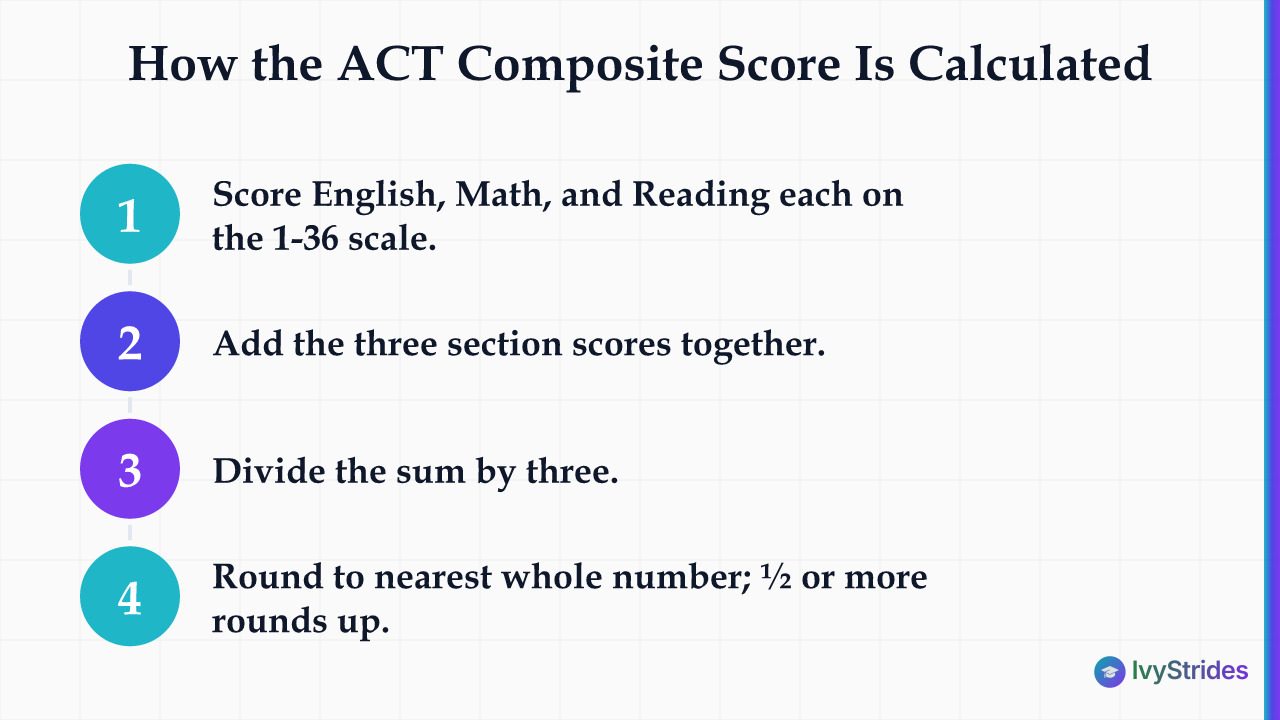
Three section scores build your ACT Composite: English, Math, and Reading, averaged and rounded to the nearest whole number. Science and Writing never enter the arithmetic, so your Composite rests on three numbers, each on the 1-36 scale, and nothing else.
ACT rounds fractions of one-half or more up and smaller fractions down. With three whole-number scores, the average always lands on a whole number, a third, or two-thirds: English 28, Math 27, and Reading 28 average 27 and two-thirds and round up to a 28, while 28, 27, and 27 round down to a 27. One point in one section can therefore move the Composite, which is why working out your Composite from your own section scores is worth doing before you plan a retake.
The Composite build, in four steps:
-
Score English, Math, and Reading each on the 1-36 scale.
-
Add the three section scores together.
-
Divide the sum by three.
-
Round to the nearest whole number; a fraction of one-half or more rounds up.
ACT Writing stays separate on a 2 to 12 scale and does not affect the Composite. Science earns its own 1-36 score.
College admissions insights on LinkedIn: follow IvyStrides for application guidance and counseling updates.
If you test more than once, ACT automatically builds a Superscore: the average of your best English, Math, and Reading scores across test dates. Any ACT taken since September 2016 counts, and since 2025 the Superscore, like the Composite, leaves Science out. Because only your best score in each section counts, a retake cannot pull a Superscore down, so the decision to retake the ACT comes down to whether one section has clear room to rise and whether your colleges accept Superscores.
What Is a Good ACT Score for College Admissions in 2026

Photo by Andy Barbour on Pexels
A good ACT score is one that reaches your target school's published range, and that depends entirely on where you apply. On ACT's 2026-27 national ranks, used for tests taken from September 2026 through August 2027, a Composite of 22 sits at the 72nd national percentile, above the national mean of 19.1. A 25 lands at the 83rd and a 27 at the 89th. A national rank is the percentage of test takers who earned your score or lower.
So "is 22 out of 36 good on ACT?" has no single answer: a 22 beats the national mean, yet highly selective colleges publish ranges that start well above it. The table maps Composites to 2026-27 national ranks, with ACT's own 90th-percentile benchmark marked.
| Composite | National Percentile Rank | Admissions Context |
| 36 | 100 | The highest possible score |
| 33 | 98 | In ACT's 90th-and-above group, its benchmark for more selective colleges |
| 30 | 94 | In ACT's 90th-and-above group, its benchmark for more selective colleges |
| 28 | 91 | The lowest Composite in that 90th-and-above group |
| 27 | 89 | One point below that group |
| 25 | 83 | Well above the 19.1 national mean |
| 22 | 72 | Above the 19.1 national mean |
| 20 | 63 | Just above the 19.1 national mean |
| 19 | 58 | Just below the 19.1 national mean |
A national rank tells you where you stand among recent test takers, but colleges compare you with their own students. Colleges report the 25th-to-75th percentile ACT range of enrolled students who sent scores, and the published ACT ranges at selective colleges are the benchmark to set your Composite beside. Some colleges also tie automatic merit awards to a minimum Composite, so the ACT cutoffs behind merit scholarships belong in that comparison too.
Two caveats. Test-optional policies vary by school and year, so check each college's policy for fall 2027 entry before you decide whether to submit. And admissions decisions rest on the full application, not the Composite alone. College Board's list of colleges that currently or soon will require the SAT or ACT names 21 private colleges alongside 42 public colleges, and warns the list changes frequently.
A Composite gap is usually a section-score gap in disguise. English and Reading at 26 with Math at 22 still round to a 25 Composite, and in that profile the room to move sits in Math, so targeted Math work makes more sense than a broad review of all three sections.
What the ACT Score Report Shows Beyond the Composite
Your ACT score report carries more than the Composite: your section scores, a Science score and a STEM score if you took Science, and a Writing score and an ELA score if you took Writing. Those extra numbers show where your profile is strong and where it is thin.
The STEM score is the average of your Math and Science scores; the ELA score is the average of your English, Reading, and Writing scores. Neither feeds the Composite. The table below sorts what appears on the report.
| Score Type | Scale | What It Measures | Affects Composite? |
| Composite | 1-36 | Average of English, Math, Reading | - |
| Section scores | 1-36 | Each tested subject | Yes (E, M, R) |
| Science | 1-36 | Optional science reasoning | No |
| Writing | 2-12 | Optional essay | No |
| STEM | 1-36 | Average of Math and Science | No |
| ELA | 1-36 | Average of English, Reading, Writing | No |
Sending the scores. Your ACT test fee includes score reports for you, your high school, and up to four colleges if you list their codes when you register; each additional score report costs $20. Once you have tested more than once, you can send your Superscore or the scores from one specific test date. Some colleges let you self-report your Composite before official scores arrive while others require an official send, so sort out when to self-report versus send official ACT scores before each application goes in.
Your section scores are also where a prep plan starts. IvyStrides' one-on-one ACT tutoring begins with a diagnostic test and a custom ACT study roadmap, and the diagnostic sets the section emphasis of the live sessions with an expert instructor.
FAQ: ACT Scores and What They Mean
Is a 36 on the ACT a 100%?
No. A 36 is the highest possible ACT score and carries a national rank of 100 on ACT's 2026-27 table, but it is a scale score, not a percent-correct grade. ACT converts your count of correct answers to the 1-36 scale, and the field-test questions you answer never count at all. The 36 means no test taker in the comparison group scored higher.
Is 22 out of 36 good on ACT?
A Composite of 22 sits at the 72nd national percentile on ACT's 2026-27 ranks and above the national mean of 19.1, so it is higher than most recent test takers' scores. Whether it is good for you depends on your colleges: highly selective universities publish ACT ranges that start well above 22.
Is 27 out of 36 a good ACT score?
A 27 sits at the 89th national percentile on ACT's 2026-27 ranks, a strong national position one point below 28, the lowest Composite in ACT's 90th-and-above group. Whether it is good enough depends on your target school's published 25th-75th percentile range; at a college whose range starts above 27, it falls below that range.
Is a 25 a bad ACT score?
No. A 25 sits at the 83rd national percentile on ACT's 2026-27 ranks, well above the national mean of 19.1. How it reads to a college depends on that college's published range for enrolled students: below a range that starts above 25, inside or above a range that starts lower.
Your Next Step on ACT Scoring
You now have the full pipeline: raw answers to section scores to a rounded Composite, plus the percentile context to judge whether that number clears your target range.
- Find your Composite, then identify the one section scoring lowest.
- Match your Composite to each target school's published 25th-75th percentile band.
- Confirm each school's testing policy for fall 2027 entry before deciding whether to submit.
- Decide whether a retake, with superscoring in mind, fits before your next application deadline; national ACT dates still open include December 12, 2026 (late registration only, through November 29; the November 9 regular deadline has passed), February 27, 2027 (regular registration deadline January 22), and April 10, 2027 (regular deadline March 5).
Daily SAT and ACT prep on YouTube: short strategy videos from IvyStrides. Subscribe to IvyStrides on YouTube.

Hemant is a seasoned entrepreneur, investor, and growth strategist with deep ground in education and technology-driven learning. His core training is in Mathematics and Physics — he authored Physics for IB Diploma: Ultimate Revision Guide, recognized as a top student resource.