
How Should Your USC Supplemental Essay Handle a Second-Choice Major?
On this page
- What Does the USC Supplemental Essay Actually Ask About Your Majors?
- How to Frame Your Second-Choice Major Without Weakening Your Application
- Do the USC Short-Answer Questions Matter as Much as the Required Essay?
- What USC's Recommendation and Essay Together Need to Show
- FAQ: USC Supplemental Essays and the Second-Choice Major
- Does USC need supplemental essays?
- Are there supplemental essays for USC?
- How to do USC supplemental essays?
- Do USC's short answer questions really matter in the supplemental essay?
- Your Next Step on the USC Supplement
USC's required supplemental essay asks how you plan to pursue your academic interests and why at USC, in 250 words or fewer, and its published prompt invites you to address your first- and second-choice majors. The second choice is optional, and USC's guidance on selecting a major says it sometimes admits students to their second choice. If you list one, the essay is where you explain why.
That prompt wording comes from USC's own admission blog guidance, which dates from 2022, and USC's admission office restated the 250-word limit in August 2025. Before you quote any exact short-answer wording, open the live Common App to verify current prompts; third-party sources often carry prompts from an older cycle.
What Does the USC Supplemental Essay Actually Ask About Your Majors?
The USC required supplemental essay is a single response of up to 250 words that asks how you will pursue your academic interests and why at USC, and the published prompt invites you to address your first- and second-choice majors. You submit it through the Common App, which serves more than 1,200 member colleges. USC rates the application essay a Very Important factor in its Common Data Set 2025-26.
So the prompt does two jobs at once: your academic interests and your school-specific fit, with room for your major choices, all in 250 words.
Two choice fields, one narrative. On the application you pick a first-choice major and, if you want one, a second-choice major. If you list both, the essay is where you make them read like parts of one mind, not a hedge.
USC is test-optional for fall 2027 applicants, and applicants who choose not to submit SAT or ACT scores are not penalized or put at a disadvantage, per USC's test-optional FAQ.
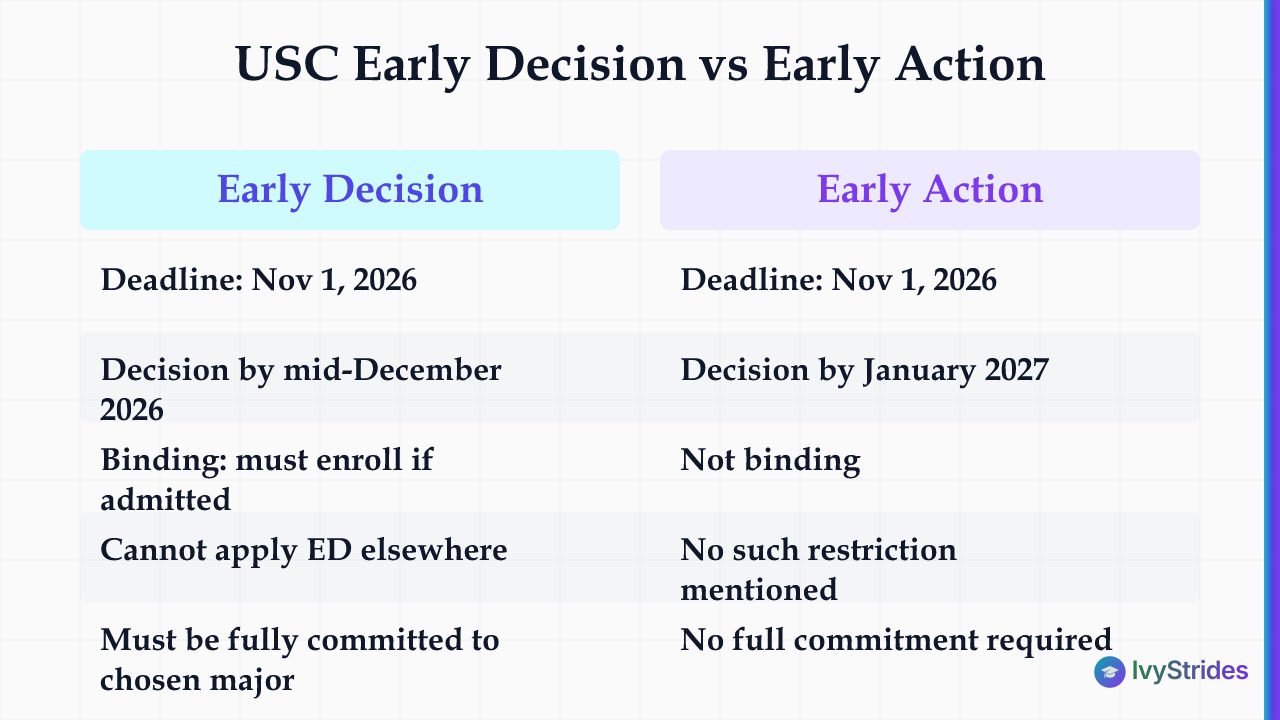
If you are weighing ED or EA by Nov 1, the essay is the same either way, but USC's deadline FAQ says to apply ED only if you are fully committed to the major chosen on your application. USC expects to admit ED applicants to their first-choice major, and one offered a different major is not bound by ED.
ED commits you to enroll if admitted, before you can compare other offers, so settle whether USC Early Decision fits your plan before the deadline. Your major choice also has to survive the revision window you actually get, which depends on where USC's Nov 1 and Jan 10 dates fall against your other college application deadlines for fall 2027.
| Plan | Deadline | Decision by | Binding? |
| Early Decision | Nov 1, 2026 | Mid-December 2026 | Yes |
| Early Action | Nov 1, 2026 | January 2027 | No |
| Regular Decision | Jan 10, 2027 | By April 1, 2027 | No |
Deadlines come from USC's provost ED announcement and the Dornsife apply page. ED applicants may not apply ED anywhere else. Dance, Music, and Dramatic Arts majors cannot apply ED or EA and have a Dec 1 Regular Decision deadline, and the World Bachelor in Business program accepts applications only by the Nov 1 deadline, per USC's first-year application page. Cinematic Arts and Art and Design, both portfolio programs, list Nov 1 for ED and EA.
How to Frame Your Second-Choice Major Without Weakening Your Application
If you list a second-choice major, it works best in your USC essay when it reads as a genuine extension of the same intellectual appetite. USC says it wants essays that sound like you, in the way you actually think and write, and it asks for your own words, not AI-generated text. The same page says USC looks for your potential to make an impact, such as a willingness to go beyond the requirements and to explore ideas.
USC says it asks for major choices to help it understand an applicant's interests, preparation, and goals, so a thoughtful second choice can show intellectual curiosity rather than doubt. USC reads applications through holistic review by people, not formulas, and character and personal qualities are a Very Important factor.
The USC prompt is a compressed version of the why this major essay, and the same principle applies: specificity about the discipline beats enthusiasm about the career.
| Scenario | How it can read | How to frame it |
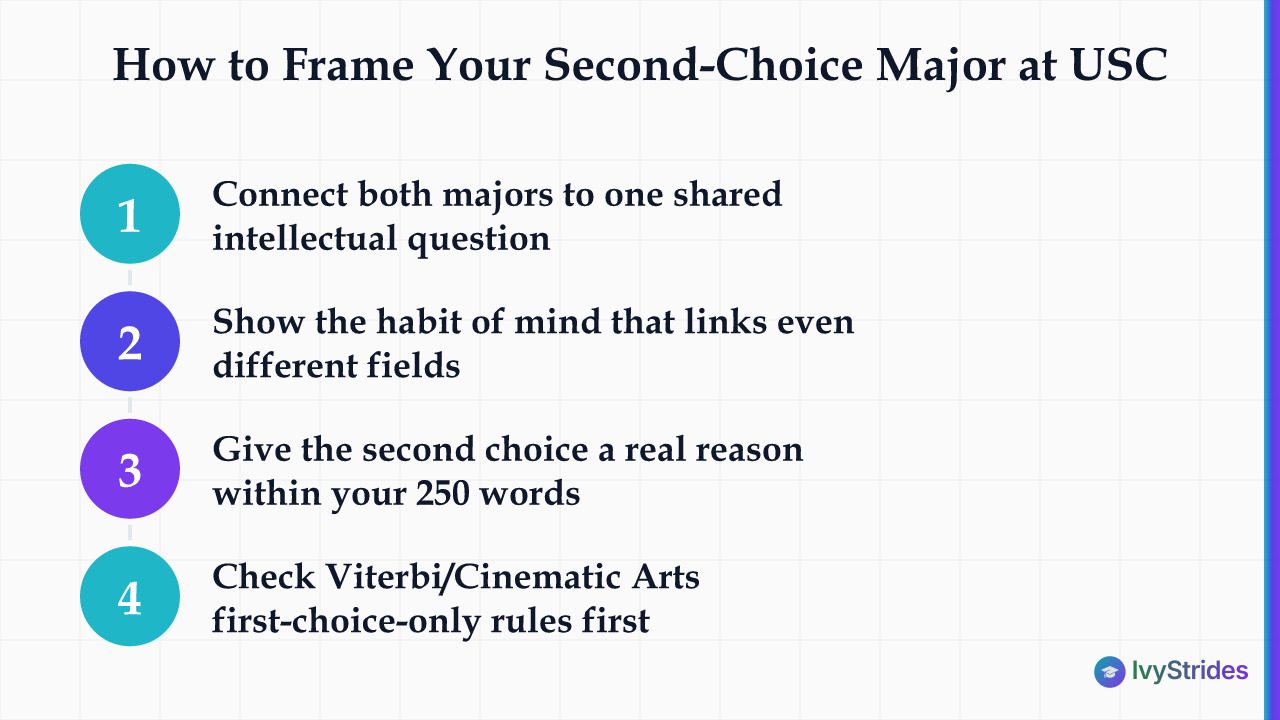
| Related second choice | One coherent intellectual thread | Name the shared question both majors answer |
| Genuinely different second choice | Range, if you connect them | Show the habit of mind that links them |
| Afterthought second choice | Padding or indecision | Rewrite; give it a real reason |
Give the second choice a real reason. If you list one, spend enough of your 250 words to show why it belongs, since USC says it sometimes admits students to their second-choice major.
In IvyStrides' admissions essay coaching, a USC supplement draft is checked against the criteria USC publishes, including a stated reason for each major choice.
One caveat for engineers. USC's Viterbi School considers your first-choice major only for admission, and it calls at least one year of calculus important preparation. If Viterbi is your first choice, let the essay carry your engineering case first. USC's School of Cinematic Arts has a similar rule: Film & TV Production and Animation and Digital Arts must be listed as first-choice majors.
Do the USC Short-Answer Questions Matter as Much as the Required Essay?
It depends on which questions you mean. USC's one required short answer is the 250-word essay itself and should get the most revision time, while USC's post on the Quick Takes says the admission team does not make decisions based on Quick Take responses. USC conducts holistic review by people, not formulas, weighing qualitative and quantitative factors together, and it rates character and personal qualities a Very Important factor in its Common Data Set 2025-26.
Some majors may add their own short-answer questions, which appear in the Common App after you select that major. USC's page on what it looks for in applicants says your activities list, essay, and USC short answers together paint a picture of how you might contribute to the community.
USC's Common Data Set lists the interview and the applicant's level of interest as Not Considered, and the Office of Admission does not interview or track demonstrated interest, though some schools, such as Cinematic Arts, add an interview or assessment. USC says it wants your interest in USC and your intended majors in the short answer instead, so your writing does the work.
The exact 2026-27 wording was not found on a USC page, so do not trust a third-party prompt list; read USC's current questions in the live Common App before you draft. USC's short answers are also one slice of the supplemental workload your whole list creates, so plan how many supplemental essays you will write across your full list before you budget revision hours.
Before you submit, verify these:
-
The required essay runs at or under 250 words and gives a reason for each major you list.
-
Both major choices connect to one clear academic interest.
-
The "why USC" line points to something specific, not a ranking.
-
The voice sounds like you, not AI-generated text.
-
Quick Takes and any major-specific questions are complete and match the live Common App prompts.
-
Viterbi applicants have made the first-choice case first.
What USC's Recommendation and Essay Together Need to Show
USC's required essay and its one required recommendation should reinforce the same character and intellectual-curiosity signals, because the CDS rates both Very Important. USC requires one letter, the Teacher/Counselor Report, from either your school counselor or a teacher; some programs require more, while Viterbi wants only that one report. USC says the letter reflects your values and personal characteristics and the contributions you might make in the classroom and community.
Because both documents speak to the same qualities, they work best when they agree. The essay claims curiosity and the potential to make an impact; the recommender should be someone who has watched you act on it. USC's first-year profile reports 10,006 admits from 79,331 fall 2026 applicants, a 12.6% admit rate.
| Very Important factor | Primary document | What USC readers look for |
| Application essay | Common App essay and USC short answer | Coherent major narrative, genuine voice |
| Character/personal qualities | Essays, activities list, recommendation | Involvement, leadership, achievements |
| Recommendations | Teacher/Counselor Report | Values and contributions, in and out of class |
| Rigor of secondary school record | Transcript, counselor report | Most rigorous program available to you, in your school's context |
| Academic GPA | Transcript | How the GPA was earned, not just the number |
Protect the voice. USC asks for your own words, so feedback should sharpen the writing without flattening it. Aim for college essay feedback that protects your voice rather than rewrites that erase it. Picking the recommender is strategic too, because the right letter echoes, not contradicts, your essay's character signals; weigh who should write your recommendation letters with that fit in mind.
Remember the honest limit: a strong essay does not guarantee admission. USC weighs the full application, and outcomes turn on far more than 250 words.
FAQ: USC Supplemental Essays and the Second-Choice Major
Does USC need supplemental essays?
Yes. USC's supplement is one required short answer of up to 250 words on your academic interests and why USC, where you can address your first- and second-choice majors, plus Quick Takes. Some majors add questions or materials such as portfolios or auditions; check the live Common App for current prompts.
Are there supplemental essays for USC?
Yes. The USC Common App supplement includes one required essay of up to 250 words, a Quick Takes section, and, for some majors, extra questions or materials. The required essay matters most, since USC says it does not make decisions based on Quick Take responses.
How to do USC supplemental essays?
Start with the required essay: explain your academic interests, why you want to pursue them at USC specifically, and your reason for each major you list, in 250 words or fewer. USC wants the essay to sound like you, not AI-generated text. Then complete the Quick Takes and any major-specific questions in the live Common App by your deadline: Nov 1 for ED or EA, Jan 10 for Regular Decision, or Dec 1, the only deadline for Dance, Music, and Dramatic Arts.
Do USC's short answer questions really matter in the supplemental essay?
It depends on which ones. USC's one required short answer is the 250-word essay itself and deserves the most revision time, while USC has said it does not make decisions based on Quick Take responses.
Your Next Step on the USC Supplement
The second-choice major is optional, and USC may admit you to it, so list one only if you would be glad to study it. Write both choices so they answer one question, keep the voice your own, and align the essay with the recommendation your file will carry.
- Open the live Common App and read USC's current short answer, Quick Takes, and any major-specific prompts.
- Draft the 250-word essay with a specific reason for each major.
- Pick a recommender whose letter will echo your essay's character signals.
- Submit by Nov 1 for ED or EA, or by Jan 10 for Regular Decision; Dance, Music, and Dramatic Arts applicants have one deadline, Dec 1.

Rajesh is a technology leader, entrepreneur, and angel investor with 28+ years in Business & Technology Leadership and Product & Solution Engineering. He is passionate about education, mentoring, and driving digital transformation.