
Will a Stanford Interview Help? Many Admitted Students Never Had One
On this page
- Does Getting a Stanford Interview Mean Anything for Your Admission Odds?
- Stanford Interview Timeline: REA Window vs RD Window
- What Stanford Alumni Interviewers Actually Ask
- How to Prepare for a Stanford Alumni Interview
- FAQ: Stanford Interviews and Admission Odds
- Does everyone get an interview at Stanford?
- Is getting a Stanford interview a good sign?
- What questions do Stanford alumni interviewers ask?
- What should I wear to a Stanford alumni interview?
- Your Next Step on the Stanford Interview
The Stanford undergraduate interview is optional, alumni-led, and not offered to every applicant. Invitations depend on whether trained alumni volunteers are available near your high school, and many applicants never receive one. Declining or missing one carries no penalty.
Those terms come straight from Stanford's official interview page. If you do get one, it typically lasts about 40 minutes and works as a two-way exchange: you learn about Stanford while the admission office learns about you. The harder question, the one filling Reddit threads every November, is whether a silent inbox means Stanford has already passed on you. It hasn't, and the reason sits in how Stanford assigns the interviews.
Does Getting a Stanford Interview Mean Anything for Your Admission Odds?
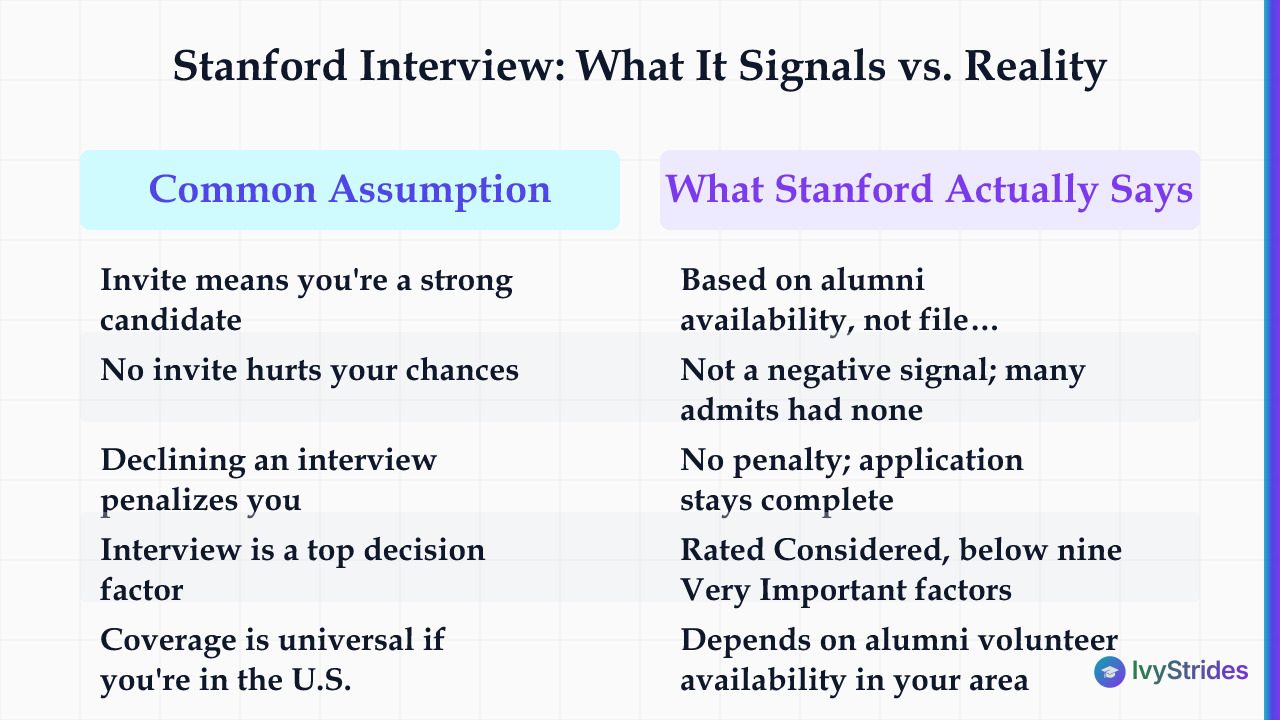
The Stanford alumni interview runs on geographic availability, not application strength. Interviewers come from Stanford's Outreach Volunteer Alumni Link (OVAL) interview program, in which alumni who live in interview areas register as volunteers and complete a required interview training workshop. Stanford extends invitations according to alumni availability in your high school area, so if no volunteer is free near you, no invitation goes out. That absence does not count against you when admissions officers read your file.
Complete without one. Stanford states plainly that the application is complete without an interview and that declining one carries no penalty. So an invitation is not a pre-selection signal, and a missing one is not a rejection signal. Stanford notes that many applicants who do not have interviews are admitted.
Coverage is wide, not universal. Stanford's interview areas cover all 50 states, Washington, D.C., Puerto Rico, and the U.S. Virgin Islands, plus a published list of international locations that includes India, the United Kingdom, and Canada. Even inside those areas, an invitation depends on alumni availability. Possibility, not promise.
Where does the interview actually sit in the decision? It is one input into a holistic review that weighs nine Very Important factors together, but it is not one of the nine. Stanford's 2025-2026 Common Data Set, section C7, rates the interview as Considered, two tiers below the Very Important rating it gives factors such as course rigor, test scores, essays, and recommendations.
| Factor | What Stanford Says |
| Interview assignment | Alumni availability near you, not file strength |
| If you decline | No penalty; application stays complete |
| If you get no invite | Not a negative signal; many admits had none |
| Coverage | All 50 states, D.C., Puerto Rico, the U.S. Virgin Islands, and listed international locations |
| Weight | Rated Considered in CDS C7, below the nine Very Important factors |
| Test policy | SAT or ACT required for fall 2027 entry |
Source: Stanford Undergraduate Admissions, interview.html; Stanford OVAL interview program; Common Data Set 2025-2026 (C7, C8).
Stanford requires the SAT or ACT for the 2026-27 cycle (fall 2027 entry), so your self-reported scores already sit in the file that your interviewer's report joins. Treat the interview as a supporting voice in that file, not as the file's verdict.
Stanford Interview Timeline: REA Window vs RD Window
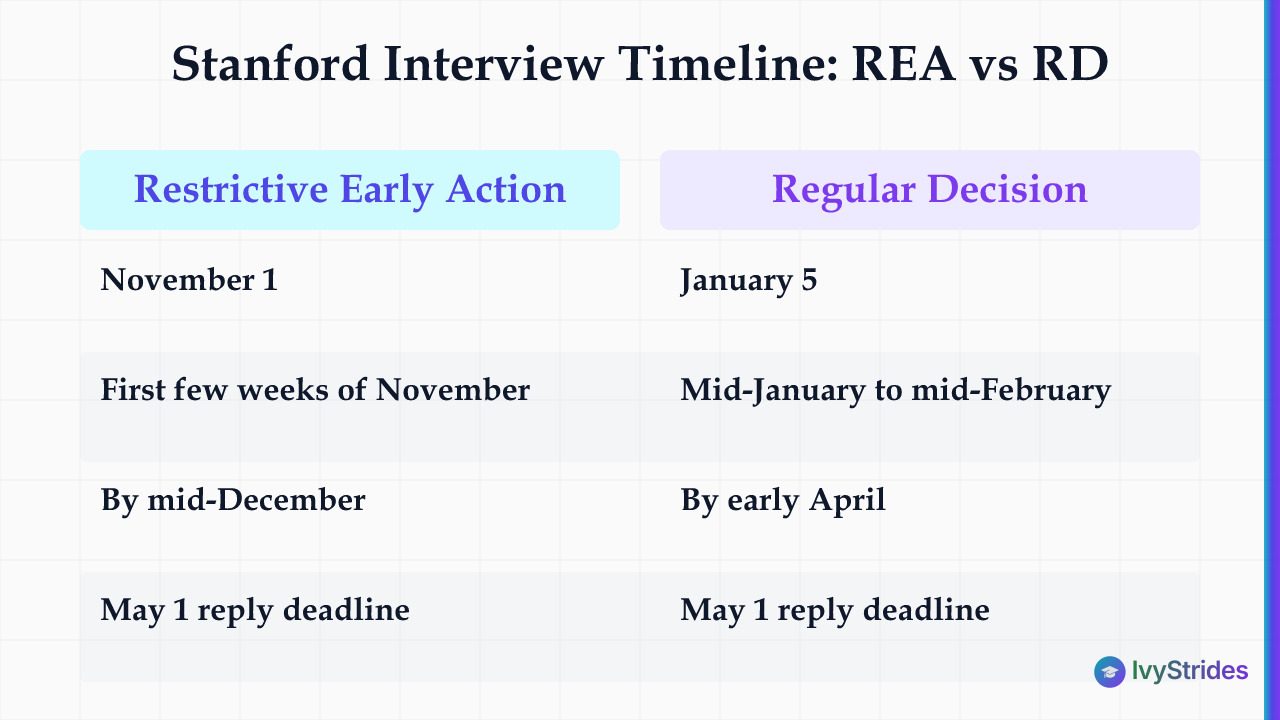
Stanford's interview windows track its two application rounds, and each opens after that round's application deadline.
Restrictive Early Action (REA) is due November 1 (October 15 with an arts portfolio), and decisions arrive by mid-December. Regular Decision (RD) is due January 5, or December 5 for applicants adding an arts portfolio, with decisions by early April. Admitted students in both rounds reply by May 1. REA interviews take place during the first few weeks of November, and RD interviews run from mid-January to mid-February.
| Round | Application Deadline | Interview Window | Decision Date |
| Restrictive Early Action | November 1 | First few weeks of November | By mid-December |
| Regular Decision | January 5 | Mid-January to mid-February | By early April |
Source: Stanford Undergraduate Admissions, apply/first-year/ (deadlines and decisions) and interview.html (interview windows).
Format is flexible. Depending on the location and the interviewer's preference, you meet in person at a public place such as a coffee shop, food court, or library, or by video on Zoom, Google Meet, Microsoft Teams, or FaceTime. Interviews are not offered on the Stanford campus. On scores, Stanford accepts superscores for both the SAT and ACT.
If you are applying REA, your application, including your self-reported SAT or ACT scores, is due November 1, just before the interview window opens. Stanford's Restrictive Early Action rules for private colleges also bar you from applying early to other private US colleges, apart from narrow exceptions such as a non-binding early plan required for a scholarship, so during the November interview window Stanford is usually your only early private-college application.
Score logistics run on a separate track: Stanford reviews the results you self-report in the application, and sending official SAT scores to Stanford becomes a requirement only if you are admitted and choose to enroll. Coordinating test dates with your essay drafts and recommendation requests is the kind of sequencing a college counselor maps out in the fall of senior year.
What Stanford Alumni Interviewers Actually Ask
Stanford alumni interviewers have no set list of questions they are required to ask, so each interview is its own conversation. Stanford's own preparation advice points to three areas: experiences and goals you would like to share, your academic interests and extracurricular involvements, and questions to ask your interviewer. Those areas line up with Stanford's published values, so once you know the values, the conversation stops feeling like a mystery.
Daily SAT and ACT prep on YouTube: short strategy videos from IvyStrides. Subscribe to IvyStrides on YouTube.
Intellectual Vitality is the anchor. In this named part of its holistic review, Stanford describes its students as brimming with curiosity, openness, and imagination, and says it hopes to envision how your energy, curiosity, and optimism would make a mark on Stanford and the world. That is why a résumé recital misses the point, and why it helps to think out loud about something you find genuinely interesting.
On activities, Stanford values depth over breadth. It says exceptional depth in one or two activities may show your passion more than minimal participation in five or six clubs, and that work or family responsibilities are as important as any other activity. So come ready to talk in detail about the one or two things you spend real time on. Stanford also reads achievements in the context of your background and educational pathway.
Your application already seeds this conversation. Stanford's five short questions, each 3 to 50 words, ask about society's most significant challenge, how you spent your last two summers, a historical moment you wish you had witnessed, one activity, job, or family responsibility, and five things important to you. The same interests you named in the five short questions and three essays Stanford requires are the ones you draw on live, so your answers should feel consistent.
- Re-read your own activities list and essays before the interview
- Pick one or two commitments you can talk about for five minutes without notes
- Prepare one intellectual interest you can explain from curiosity, not credentials
- Have a specific reason you want Stanford, beyond ranking
- Prepare two or three real questions for the interviewer
- Leave résumés, transcripts, and test scores at home; interviewers cannot view or accept them
- Confirm the format, in person or video, and the time
Stanford's OVAL program calls the interview a casual, comfortable conversation, and the admission office says no formal preparation is needed. The mechanics of pacing, listening, and asking good questions carry over from how to prepare for a college interview at any selective school.
How to Prepare for a Stanford Alumni Interview
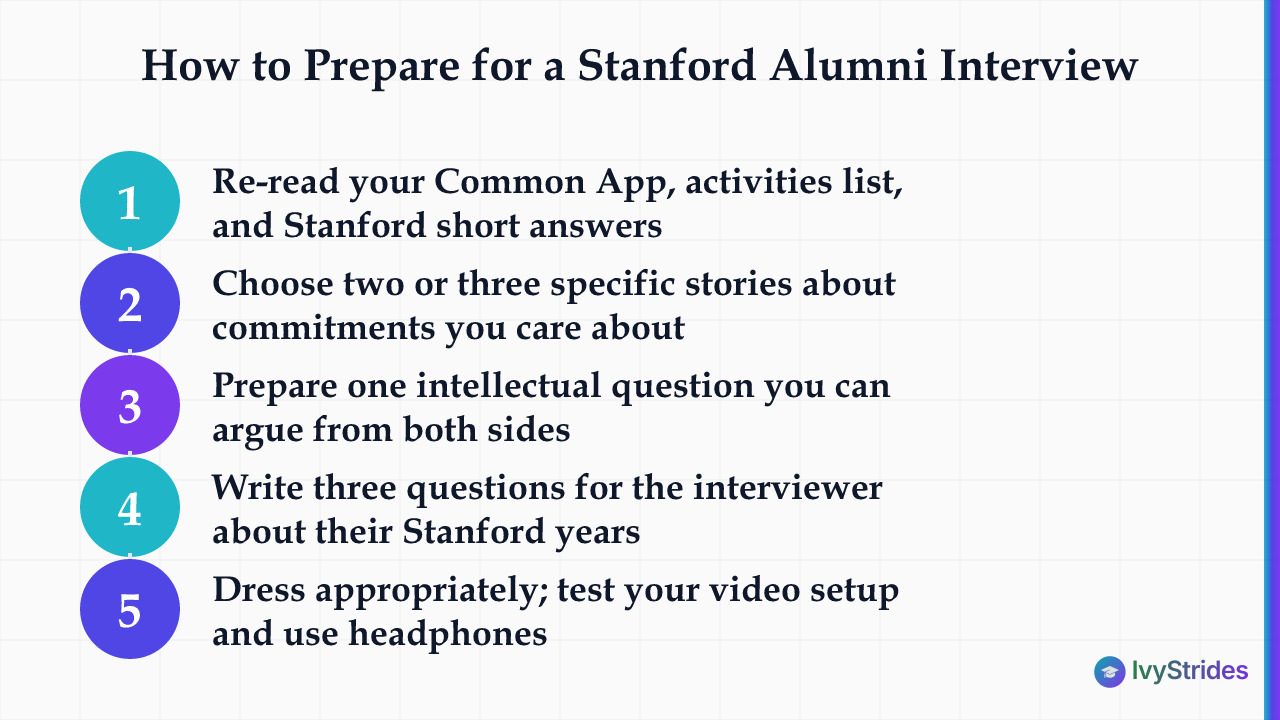
Preparing for a Stanford alumni interview means knowing your stories, not memorizing scripts. With no set question list, a memorized answer rarely fits the question you are actually asked.
Start with your own file. Your Stanford short answers and essays already put your deepest commitments into words, so re-read them first and use them as notes for the conversation.
Prepare questions too: your interviewer is an alumni volunteer who can share stories about their own Stanford experience.
-
Re-read your Common App, activities list, and Stanford short answers
-
Choose two or three specific stories about commitments you care about
-
Prepare one intellectual question you would happily argue both sides of
-
Write three questions for the interviewer about their Stanford years
-
Dress in typical high school attire, and for video, test your setup and use headphones
Schools weigh interviews differently, so understanding how college interviews fit into holistic review at selective schools helps you calibrate how much time to invest.
IvyStrides counselors prepare students for a Stanford interview by working from the essays and activities list already submitted and helping each student choose two or three stories to tell in their own words. For a student juggling a live file and an imminent interview, building a Stanford application strategy across grades 11 and 12 brings essays, scores, and interview prep into one plan.
The stake before you: REA closes November 1, and no interview can make up for an application that is not finished by then.
FAQ: Stanford Interviews and Admission Odds
Does everyone get an interview at Stanford?
No. Stanford extends invitations according to alumni availability in your high school area, and only applicants whose high school is in a listed interview area can be invited. If no trained alumni volunteer is free near you, you will not get an invitation. Stanford says not receiving one will not count against you, and many applicants without interviews are admitted.
Is getting a Stanford interview a good sign?
Not necessarily. Because alumni availability drives assignment rather than application strength, an invitation does not mean Stanford leans toward admitting you. Many admitted students never had an interview. Stanford's Common Data Set rates the interview as Considered, below its nine Very Important factors, so it serves as one input in a holistic review, not a pre-selection signal.
What questions do Stanford alumni interviewers ask?
There is no set list of questions that interviewers are required to ask, so each conversation differs. Stanford suggests thinking ahead about experiences and goals you want to share, your academic interests and extracurricular involvements, and questions for your interviewer, who can share stories about their own Stanford experience.
What should I wear to a Stanford alumni interview?
Stanford says you are welcome to dress in typical high school attire. The interview is meant to be an informal conversation, not a formal job interview, so there is no need to dress up. For a video interview, Stanford suggests headphones to minimize audio feedback.
Your Next Step on the Stanford Interview
An interview invitation is good news about alumni staffing near you, not a verdict on your application. Spend your energy where the nine Very Important factors actually live: your record, your essays, and the one or two activities that show real depth.
- If invited, pick two commitments you can discuss without notes
- Re-read your own essays and short answers before the conversation
- Submit your application and self-reported scores by your round's deadline
- If no invitation arrives, remember that your application is complete without one
College admissions insights on LinkedIn: follow IvyStrides for application guidance and counseling updates.

Hemant is a seasoned entrepreneur, investor, and growth strategist with deep ground in education and technology-driven learning. His core training is in Mathematics and Physics — he authored Physics for IB Diploma: Ultimate Revision Guide, recognized as a top student resource.