
Stanford Supplemental Essays: Plan the Five Short Questions and Three Essays as One Set
On this page
- What Stanford's Eight Supplemental Prompts Are for 2026-27
- What Each Stanford Supplemental Prompt Is Designed to Reveal
- How to Plan the Stanford Supplemental Set Without Repeating Yourself
- Stanford Supplemental Essay Deadlines and What Else the Application Requires
- FAQ: Stanford Supplemental Essays for 2026-27
- Does Stanford require supplemental essays?
- What are the topics for the Stanford supplemental essays for 2026-27?
- How do I write effective supplemental essays for Stanford University?
- How many supplemental essays does Stanford require?
- Your Next Step on the Stanford Supplemental Set
Stanford requires eight written responses for 2026-27: five short questions of 3 to 50 words each and three essays of 100 to 250 words each, all submitted through the Common App. The three essays ask about what excites you about learning, a note to your future roommate, and your contribution to Stanford. Stanford reviews each piece of an application as part of an integrated whole.
That full-set reading is the reason planning matters as much as writing. Stanford publishes its prompts, word limits, and application requirements on its admissions pages, which this article cites throughout. The harder problem is distributing your material across eight responses so none of them repeats another.

What Stanford's Eight Supplemental Prompts Are for 2026-27
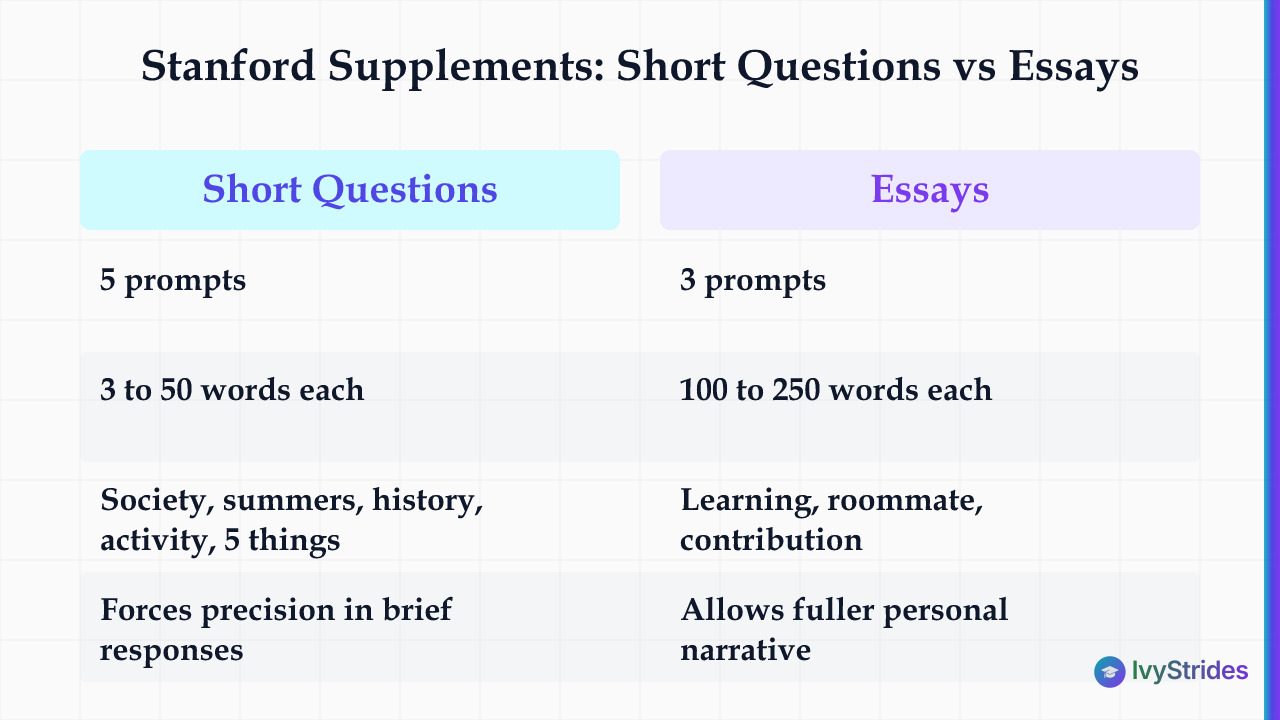
Stanford's eight supplemental prompts split into two types: five short questions capped at 50 words and three essays running 100 to 250 words, all delivered through the Common App. First-year applicants submit these responses alongside the Common App personal statement. Stanford retained the three essay prompts it had posted in the 2025-26 cycle.
Because Stanford rates the application essay "Very Important" alongside GPA, test scores, and extracurriculars in its Common Data Set, the eight supplemental responses are not a formality; they are one of the primary levers an applicant controls. Stanford also requires a test score for fall 2027 entry, accepting both the SAT and ACT with superscoring, so the essays share the file with a scored component admissions also rates "Very Important".
The short questions are not throwaways. The 3-to-50-word range forces precision, and Stanford says its questions help it get to know you as a friend, future roommate, and classmate. Supplements add up quickly across a college list, so weigh how many supplemental responses a full college list demands before you build a schedule around these eight.
Stanford opens the application and the Stanford Questions in early August each year. Here is the full set at a glance.
| Type | Prompt topic (paraphrased) | Word limit |
| Short question | Society's most significant challenge | 3 to 50 words |
| Short question | How you spent your last two summers | 3 to 50 words |
| Short question | A historical moment you wish you'd seen | 3 to 50 words |
| Short question | Brief elaboration on one activity, job, or family responsibility | 3 to 50 words |
| Short question | Five things that matter to you | 3 to 50 words |
| Essay | An idea or experience that makes you excited about learning | 100 to 250 words |
| Essay | A note to your future roommate | 100 to 250 words |
| Essay | The distinctive contribution you would make at Stanford | 100 to 250 words |
What Each Stanford Supplemental Prompt Is Designed to Reveal

Photo by PNW Production on Pexels
Stanford's holistic admission page explains what it looks for under headings such as Context, Extracurricular Activities, and Intellectual Vitality. The essay on what excites you about learning sits closest to Intellectual Vitality, where Stanford describes students brimming with curiosity, openness, and imagination. The roommate essay asks for a note that helps your future roommate, and Stanford, get to know you.
The short questions are another place to show curiosity, in far fewer words. The short question on one activity, job, or family responsibility is the clearest place to show depth: Stanford says exceptional depth in one or two activities may demonstrate your passion more than minimal participation in five or six clubs, and work or family responsibilities are as important as any other activity. Use this space to write about a single activity in depth, not to list five.
Concrete, scene-based writing lets your voice come through. That is the show-not-tell technique that separates a real voice from a generic one. Treat the 50-word cap on the short questions as a precision tool rather than a constraint, or the answers go vague.
Face outward where the prompt asks what you add to the community, not what the community gives you. The prompt asks which of your experiences, interests, and character traits would help you make a distinctive contribution, so tie each one to what it would add at Stanford. Stanford also reviews achievements in context, including your background, educational pathway, and work and family responsibilities, so relevant context belongs in your answers.
| Prompt (paraphrased) | What it can show | Common mistake to avoid |
| Societal challenge | Intellectual curiosity | A "safe" global issue with no personal stake |
| Two summers | Context and initiative | Listing camps, not showing what you did |
| Historical moment | Imagination | A famous event with no angle |
| One activity, job, or family role | Depth over breadth | Trying to cover three activities |
| Five things | Character and voice | Generic items anyone could list |
How to Plan the Stanford Supplemental Set Without Repeating Yourself

Planning the Stanford supplemental set starts with a material inventory, not a draft. List your strongest stories, traits, and commitments first, then assign each to the single prompt it serves best, before you write a word. Stanford applicants apply to the university as a whole, not to a specific major, so the set has to argue for you as a whole person, which makes overlap the enemy.
The three essays in particular risk overlapping with the Common App personal statement unless you map both pieces before drafting either one. Avoid using an essay to retell a formative experience your Common App personal statement already carries. Keep that experience in one place, and let each essay show a different, smaller side of you.
Run an overlap check. Lay all nine pieces side by side, the personal statement plus eight Stanford responses, and mark the central story or trait each one carries. Any story that appears twice gets reassigned to the prompt it serves best.
Overlap is easiest to fix at the planning stage, where you map material to prompts before writing. A coach who reviews your map against Stanford's stated criteria can name the gaps before a draft commits you to a direction, which is what IvyStrides builds its essay coaching for selective-school supplements to do.
Once the Stanford set is planned, the same inventory map speeds up the work for other schools, where adapting material across applications without losing specificity saves you from starting each supplement from scratch. Work through this before drafting:
-
Inventory your strongest material: stories, traits, commitments, context.
-
Name the central story or trait in your Common App personal statement.
-
Assign each inventory item to the one prompt it serves best.
-
Flag any item assigned to two prompts and reassign it.
-
Confirm the contribution-focused essay faces outward, toward campus.
-
Confirm each short question adds something the essays do not.
-
Check that one coherent portrait, not one repeated story, emerges across all nine pieces.
Stanford Supplemental Essay Deadlines and What Else the Application Requires
Stanford's supplemental essay deadlines follow two rounds: Restrictive Early Action (REA) falls on November 1 and Regular Decision (RD) on January 5. REA applicants plan and draft all eight responses between the early-August opening and November 1, or October 15 if they submit an Optional Arts Portfolio.
REA carries a real restriction. If you apply REA, you may not apply early (EA, REA, ED, or Early Notification) to any other private college. The exceptions Stanford lists are non-binding early plans at public universities, non-binding rolling admission, non-binding plans at non-U.S. schools, military academies, and non-binding early plans a college requires for scholarship or special academic program consideration. Stanford releases REA decisions by mid-December and RD decisions by early April, and admitted students in both rounds reply by May 1.
Beyond the eight Stanford Questions, Stanford requires the Common App, the application fee or a fee waiver request, an SAT or ACT score, the School Report with a counselor letter, transcripts, a midyear transcript by February 15, and two teacher recommendations from academic subjects. You self-report scores and send official ones only if you are admitted and choose to enroll, and Stanford accepts superscores for both the SAT and ACT.
Building a writing schedule around the November 1 REA deadline means mapping your supplemental drafts against every other application component due at the same time. Students managing deadlines at several colleges can work with a counselor who sequences the components and guards the February 15 midyear transcript deadline. The alumni interview is optional and depends on alumni availability and on your high school being in one of Stanford's interview areas, which include India, the United Kingdom, and Canada; the application is complete without one and declining carries no penalty.
One caveat worth stating plainly. A strong supplemental set does not decide admission. Stanford reads the full application, and the essays are one weighted part of a holistic file. Stanford confirms its test requirement for fall 2027 entry; future cycles may differ.
| Round | Common App deadline | Common App deadline with arts portfolio | Decision released | Reply date |
| REA | November 1 | October 15 (portfolio materials October 20) | By mid-December | May 1 |
| RD | January 5 | December 5 (portfolio materials December 10) | By early April | May 1 |
FAQ: Stanford Supplemental Essays for 2026-27
Does Stanford require supplemental essays?
Yes. None are optional, and you cannot submit a complete first-year application without them.
What are the topics for the Stanford supplemental essays for 2026-27?
The five short questions cover society's most significant challenge, how you spent your last two summers, a historical moment you wish you had witnessed, a brief elaboration on one activity, job, or family responsibility, and five things that are important to you. The three essays, 100 to 250 words each, cover what excites you about learning, a note to your future roommate, and your contribution to Stanford. Stanford retained the three essay prompts from the 2025-26 cycle.
How do I write effective supplemental essays for Stanford University?
Plan the full set before drafting any single response. Map your strongest material to each of the eight prompts, check for overlap with your Common App personal statement, and make sure each response adds something the others do not. Check the three essays against the personal statement first, since they are the longest pieces. Stanford reviews each piece of the application as part of an integrated whole, so aim for one coherent portrait rather than eight disconnected answers.
How many supplemental essays does Stanford require?
Stanford requires eight written responses in total: five short questions capped at 50 words each and three essays of 100 to 250 words each. All eight are required for every first-year applicant, and none are optional.
Your Next Step on the Stanford Supplemental Set
The work before the writing is a planning problem: deciding what each of the eight responses adds that the other seven do not. Get that map right and the drafts come faster, because every prompt already has its own job.
- Build your material inventory and name the story your personal statement carries.
- Assign each item to one prompt, then run an overlap check across all nine pieces.
- Confirm the contribution essay ties your traits to Stanford and the essay on learning shows real curiosity.
- Set your draft schedule against the November 1 REA or January 5 RD deadline.

Hemant is a seasoned entrepreneur, investor, and growth strategist with deep ground in education and technology-driven learning. His core training is in Mathematics and Physics — he authored Physics for IB Diploma: Ultimate Revision Guide, recognized as a top student resource.