
Should You Take the SAT in Junior or Senior Year? How to Plan Both Sittings
On this page
- When Should You Take the SAT the First Time in High School?
- Should You Take the SAT in Junior Year, Senior Year, or Both?
- Which SAT Dates in Junior and Senior Year Actually Work for Your Timeline?
- What to Do With Your SAT Score After Junior Year
- FAQ: SAT Timing in Junior and Senior Year
- Are you supposed to take the SAT in junior year?
- Should my 11th grader take the SAT this year?
- Is a 1200 SAT score good for a junior?
- If you take the SAT multiple times, which score do colleges see?
- Your Next Step on SAT Timing
Take the SAT for the first time in junior year, ideally spring (March, May, or June), then retake in senior fall. The SAT is a 2-hour-14-minute digital exam scored on a 400 to 1600 scale. College Board recommends taking it at least twice, in the spring of junior year and the fall of senior year.
Why spring of junior year? Scores are typically available online 2 to 4 weeks after the test, so a spring first attempt gives you a score report to work from over the summer and still leaves senior fall for a second sitting before early application deadlines.

When Should You Take the SAT the First Time in High School?

Photo by cottonbro studio on Pexels
Junior year, in spring, is the standard first sitting for the Digital SAT. The Digital SAT is scored on a 400 to 1600 scale across two sections, Reading and Writing and Math, delivered in adaptive modules. College Board's advice holds even for a student who will test only once: take it in the spring of junior year.
The junior-year spring weekend dates are March 6, May 1, and June 5, 2027. If your school offers SAT School Day, the spring 2027 in-school window runs March 1 to April 30, 2027, and your school or district handles registration. College Board posts a score release date for each weekend test, and even June 5 scores arrive on June 21, 2027, well before senior fall. That report shows your section scores and your performance in each content area, so you know whether to retake and where to focus.
The first sitting is a diagnostic, not a verdict. A junior-year score shows where you stand, with senior fall still ahead for a second try at the weaker section. Before you register, learn how the Digital SAT is scored across its two adaptive sections: in each section, your work in the first module decides whether the second module is easier or harder.
Test-optional policies vary by school and year, so even if your target college does not require a score, a strong junior-year result gives you the choice to submit rather than leaving the decision to chance.
| SAT Date | Test Day | Scores Released (College Board) |
| March 6, 2027 | Saturday | March 19, 2027 |
| May 1, 2027 | Saturday | May 14, 2027 |
| June 5, 2027 | Saturday | June 21, 2027 |
Should You Take the SAT in Junior Year, Senior Year, or Both?
Both. The junior-then-senior sequence is the default because it banks an early score and keeps a retake in reserve. A senior-year-only plan gives up that reserve, which is why going first in 12th grade is the high-risk path for Early Decision applicants.
College Board notes that many schools superscore, combining your highest section scores even when they come from different test dates, so at those colleges a junior and a senior sitting let your best Reading and Writing and best Math scores count together. Two sittings is the floor, not the ceiling, so settle how many total SAT sittings make sense once superscoring is in play before you lock a plan.
The senior-only trap is a timing trap. A student who waits until senior fall for a first attempt leaves little room to recover from a bad day. Senior year is also dense with applications, essays, and coursework, and senior-year grades still count with colleges, so a solid SAT score banked before senior fall begins leaves more of that year for your classes.
Superscoring is each college's own policy, so confirm it on every school's admissions website before you plan around it. Test-optional policies, too, shift from year to year (FairTest).
| Scenario | Biggest Risk | Best Fit For |
| Junior year only | No senior-fall retake to lift a weak section | Students happy with a strong spring score |
| Senior year only | Little time to retake before early deadlines | Late starters with no spring option |
| Both years | Two prep cycles to manage | Most applicants, especially ED candidates |
Which SAT Dates in Junior and Senior Year Actually Work for Your Timeline?
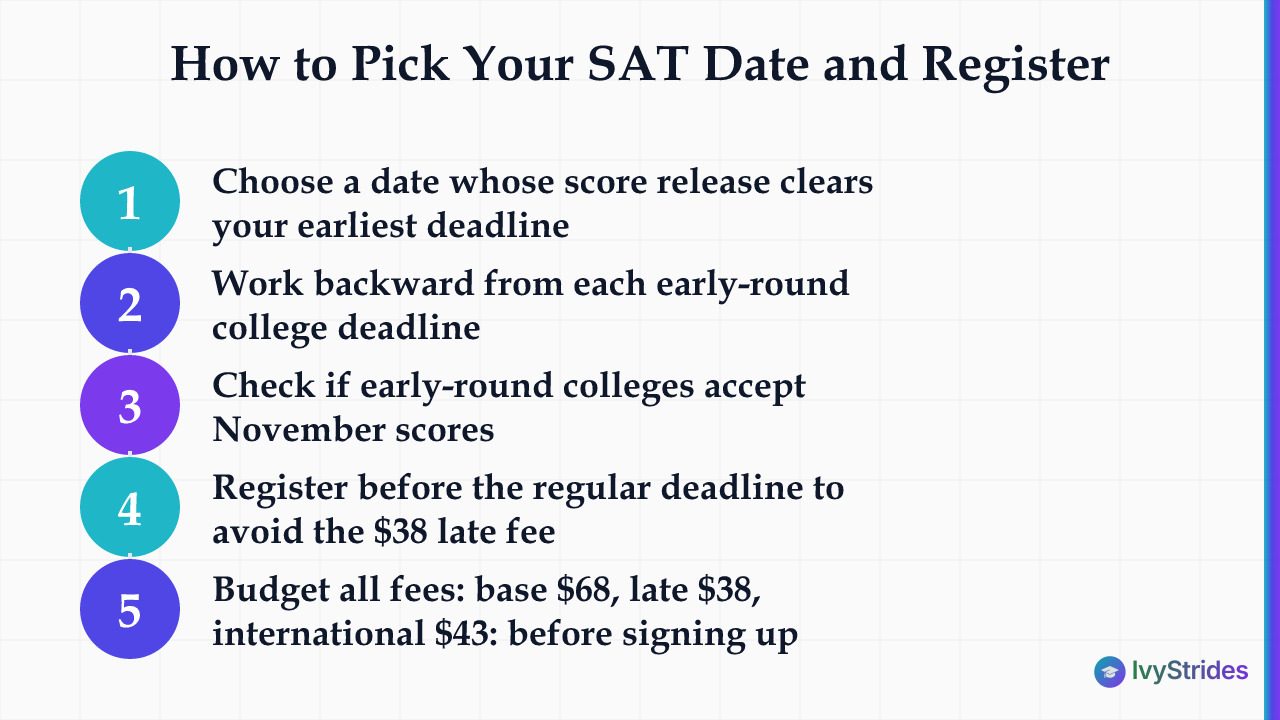
Pick a date by its score-release window, not its season. SAT scores are typically available online 2 to 4 weeks after the test (College Board), so the date you choose either clears your earliest application deadline or misses it.
For juniors in the class of 2028, the March 6, May 1, and June 5, 2027 dates are the first-sitting windows, and the senior-year retake falls in fall 2027. College Board lists its anticipated fall 2027 weekend dates as August 28, September 18, October 9, November 6, and December 4, 2027. Seniors in the class of 2027 still have the December 5, 2026 SAT, with a registration deadline of November 20, 2026 and scores released December 18, 2026, which can serve Regular Decision at colleges that accept December scores.
Register before the regular deadline. The SAT registration fee is $68, and under College Board's fees through June 2027, registering after the regular deadline adds a $38 late registration fee. Students testing outside the United States also pay a $43 international fee. Each test date has its own deadline, so put the 2026-27 SAT test dates and registration cutoffs on your calendar once you choose a sitting. Budgeting the full set of SAT fees before you sign up keeps a late charge from catching you off guard.
Work backward from each early deadline. Scores from the anticipated November 6, 2027 SAT would typically arrive between November 20 and December 4, 2027, after any deadline that falls in early November, so ask each early-round college whether it accepts November scores.
Get your Daily IV Dose on Instagram: quick study tips and test-day advice for high school students. Follow @ivy.strides.
| SAT Date | On College Board's Calendar | Best For |
| December 5, 2026 | Scheduled; scores released December 18, 2026 | Class of 2027, Regular Decision |
| August 28, 2027 | Anticipated | Class of 2028 senior retake |
| September 18, 2027 | Anticipated | Senior retake |
| October 9, 2027 | Anticipated | Last senior retake before November |
| November 6, 2027 | Anticipated | Retake if early-round colleges accept November scores |
| December 4, 2027 | Anticipated | Regular Decision retake |
What to Do With Your SAT Score After Junior Year
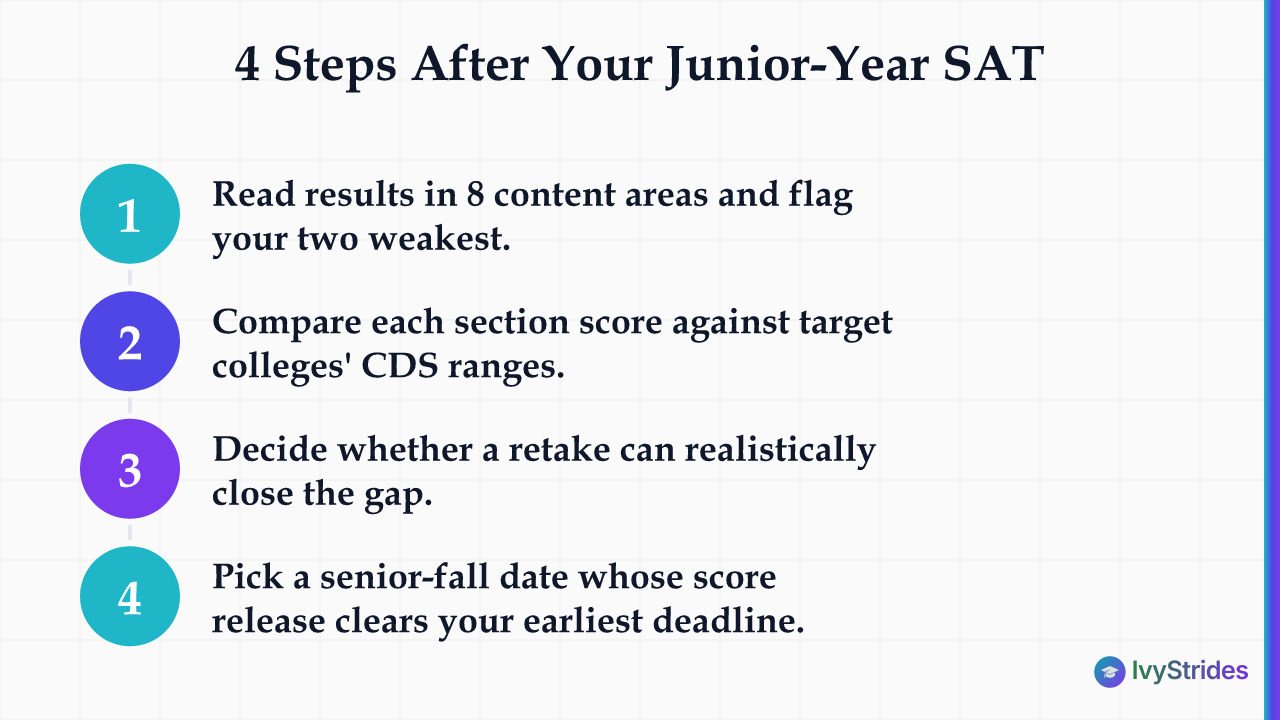
Read the score report, decide on a retake, then register. The Digital SAT score report shows your two section scores on the 200 to 800 scale, your total on the 400 to 1600 scale, and a graphic of your performance on each of the eight content areas the test measures, four in Reading and Writing and four in Math. That breakdown, more than the total alone, tells you which section to prioritize.
Is a junior-year 1200 good enough? In College Board's 2026 SAT Suite of Assessments Annual Report, the 75th percentile total score for the class of 2026 was 1220, counting each student's most recent score, so a 1200 on a first attempt sits just below the top quarter of that class. Whether it clears your target colleges' ranges is a separate question.
Your online score report also shows whether you met each section's College and Career Readiness benchmark: 480 for Reading and Writing and 530 for Math. If your 1200 splits unevenly, start the retake plan with the weaker section. The same call comes up higher on the scale, and whether a 1300 SAT score is worth retaking depends on the colleges on your list.
Which score do colleges see? Mostly, you decide. College Board's Score Choice lets you choose which test dates to send, though some colleges and scholarship programs require all your scores, and colleges that superscore combine your highest section scores across the dates you send. Turning the report into a focused plan means working through how to review your SAT practice test mistakes to target the right domains rather than re-studying everything.
A junior who has not tested yet can get an early read on focus areas before March. IvyStrides' SAT Winter Batch starts with a full digital SAT diagnostic and a one-on-one review, then runs small-cohort live online classes timed to the March 6, 2027 SAT from November 28, 2026, with two live sessions a week and Bluebook-style adaptive practice tests. If you would rather prepare on your own, start by learning how to study for the SAT from a blank schedule.
After your junior-year SAT, four steps before you register for a retake:
-
Read your results in the eight content areas and flag your two weakest.
-
Compare each section score against your target colleges' Common Data Set ranges.
-
Decide whether a retake can realistically close the gap.
-
Pick a senior-fall date whose score release clears your earliest deadline.
FAQ: SAT Timing in Junior and Senior Year
Are you supposed to take the SAT in junior year?
Yes. Junior year is the standard first sitting. College Board recommends taking the SAT at least twice, in the spring of junior year and the fall of senior year, and the spring 2027 weekend dates are March 6, May 1, and June 5. That gives you a score report to act on and time to retake before Early Decision deadlines in senior fall.
Should my 11th grader take the SAT this year?
Yes, 11th grade is the right time for a first sitting. The spring 2027 dates leave the summer and College Board's anticipated fall 2027 dates open for a targeted retake if needed. Waiting until 12th grade removes that buffer and puts pressure on a single score before Early Decision deadlines.
Is a 1200 SAT score good for a junior?
A 1200 sits just below the 75th percentile total score of 1220 that College Board reported for the class of 2026, a solid foundation. Whether it's enough depends on your target colleges' ranges. The key point: a junior-year 1200 leaves time to retake before applications are due. Check each school's Common Data Set for its middle-50% SAT range.
If you take the SAT multiple times, which score do colleges see?
Through College Board's Score Choice, you choose which test dates to send, though some colleges and scholarship programs require all your scores. Colleges that superscore take your highest section scores across the dates you send and combine them, and College Board notes that many schools do. Always confirm each college's superscore policy on its admissions website.
Your Next Step on SAT Timing
The decision comes down to one sequence: sit the SAT first in junior spring, read the score report, then plan a senior-fall retake that clears your earliest deadline. Here is what to do now:
- If you're in 11th grade, register for a March, May, or June 2027 date.
- If you're in 10th grade, plan your first sitting for the spring of junior year.
- If you're already a senior, the December 5, 2026 SAT is your last 2026 date; register by November 20, 2026, and check that each college accepts December scores.
- Confirm each target college's test-optional and superscore policy on its admissions website.
- Register before the regular deadline to avoid the $38 late fee.
Daily SAT and ACT prep on YouTube: short strategy videos from IvyStrides. Subscribe to IvyStrides on YouTube.

Hemant is a seasoned entrepreneur, investor, and growth strategist with deep ground in education and technology-driven learning. His core training is in Mathematics and Physics — he authored Physics for IB Diploma: Ultimate Revision Guide, recognized as a top student resource.