
How to Study for the SAT in 2026: A Step-by-Step Guide That Actually Works
On this page
- The Short Answer: How to Study for the SAT (Start Here)
- Step 1: Take a Full-Length Diagnostic Test Before You Study Anything Else
- Step 2: Set a Realistic Target Score Based on Your College List
- How Long Should You Study for the SAT? Timelines by Score Goal
- Step 3: Build Your SAT Study Plan Around Your Weak Question Types
- How to Study for SAT Math: The Section Most Students Underestimate
- How to Study for SAT Reading and Writing: What the Digital Format Changed
- The Best Free and Paid SAT Study Resources in 2026
- The Week Before the SAT: What to Do (and What to Stop Doing)
- Is a 1400 SAT Better Than a 31 ACT? (And How to Decide Which Test to Take)
- Frequently Asked Questions About Studying for the SAT
- Is getting a 1200 on the SAT hard?
- What score is roughly 70% correct on the SAT?
- Is 1500 SAT top 1%?
- Can I study for the SAT in one month?
- How do I start studying for the SAT if I've never taken it before?
- Is a 1400 SAT or a 31 ACT better?
- How many times can I take the SAT?
- The Real Next Step
To study for the Digital SAT in 2026, take a full-length official practice test in the College Board Bluebook app first, identify your weakest question types in Reading and Writing and in Math from the score report, then build a targeted study schedule around those gaps and retest every three to four weeks. Students who follow this diagnostic-first sequence typically see roughly 100 to 200 point gains over about 8 to 16 weeks of focused prep.
Those hours assume real, timed practice with official College Board materials, not skimming a prep book on the couch. The rest of this guide breaks down each step, gives realistic timelines for 1200, 1400, and 1500 targets, and shows where free official resources are enough and where 1-on-1 section-specialist coaching accelerates results.

The Short Answer: How to Study for the SAT (Start Here)
The Digital SAT is scored on a 400 to 1600 scale across two sections: Reading and Writing (200 to 800) and Math (200 to 800). It runs 2 hours and 14 minutes total, is delivered entirely through the College Board Bluebook app, and uses an adaptive two-module structure per section: your performance on Module 1 routes you to an easier or harder Module 2, which sets your score ceiling (College Board).
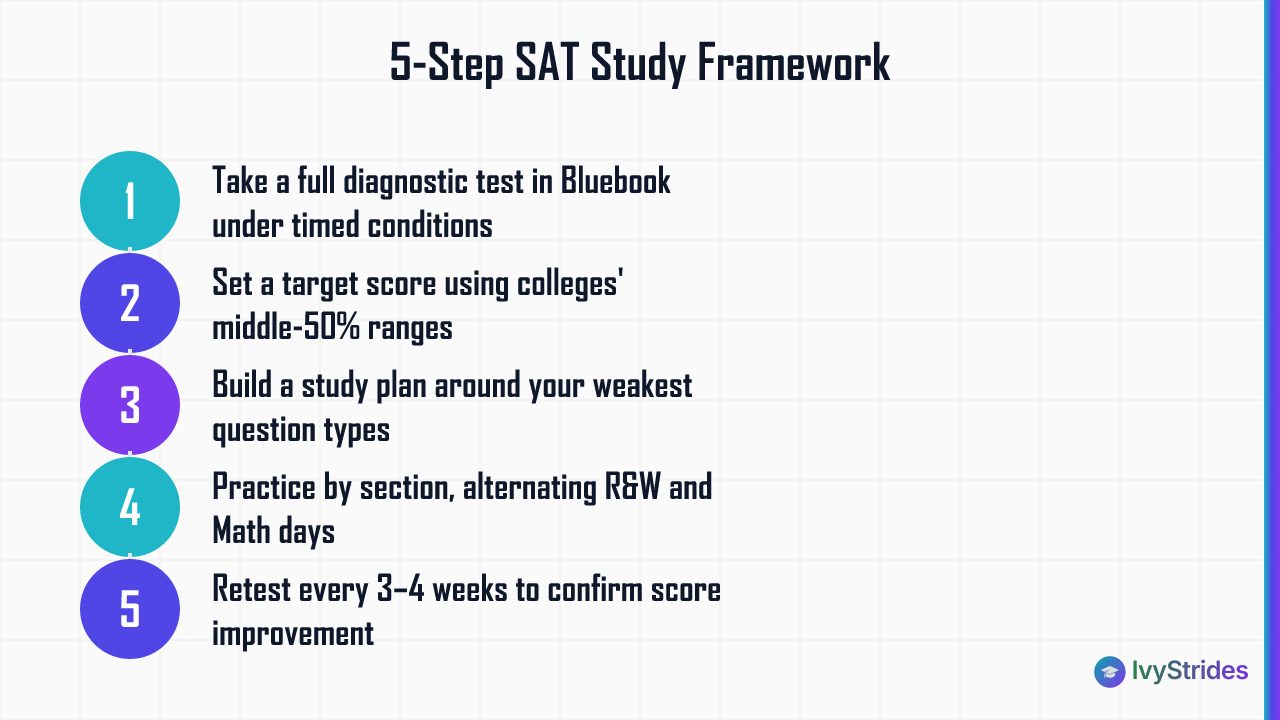
Here's the five-step framework:
-
Take a diagnostic full-length practice test in Bluebook under real timed conditions.
-
Set a target score based on the middle-50% range at the colleges on your list.
-
Build a study plan around your weakest question types, not your weakest section.
-
Practice by section with official materials, alternating Reading and Writing and Math days.
-
Retest every three to four weeks to confirm the score is actually moving.
That's it. The rest of this article expands each step with specifics. For a broader reference, see the official SAT study guide 2026.
Step 1: Take a Full-Length Diagnostic Test Before You Study Anything Else
You can't build a study plan without a real baseline. Reading a prep book without knowing your score is like training for a marathon without knowing your current mile time.
Download the Bluebook app free from the College Board Digital SAT site, pick one of the official full-length practice tests, and take it in one sitting with the timer running. No phone. No snacks stretched into 15-minute breaks. No restarts. The score you get is your real starting point.
Your diagnostic and every subsequent full-length practice test should come from official sources; see our guide to the best SAT practice tests and how to use them.
How to read the score report. The Bluebook score report breaks your performance down by skill domain, not just by section. In R&W you'll see performance across Information and Ideas, Craft and Structure, Expression of Ideas, and Standard English Conventions. In Math you'll see Algebra, Advanced Math, Problem-Solving and Data Analysis, and Geometry and Trigonometry. This is the map you study from. Look for the domain where you're missing roughly 40% or more of questions. That's where the fastest points live.
If you have PSAT scores, they're the most accurate diagnostic you already have. Our PSAT-to-SAT conversion guide shows how to translate that data into an SAT study plan.
In our coaching, a common pattern in first-test diagnostics: students who score around 1100 to 1200 typically have Math as their lower section, with Algebra and Advanced Math as the primary gaps. Knowing that on day one saves weeks of misdirected effort. If you need a second practice attempt after your diagnostic, our library of official SAT practice tests is where to go next.
Step 2: Set a Realistic Target Score Based on Your College List
Your target score isn't a wish. It comes from the middle-50% SAT range at the schools you actually want to apply to, published in each school's Common Data Set.
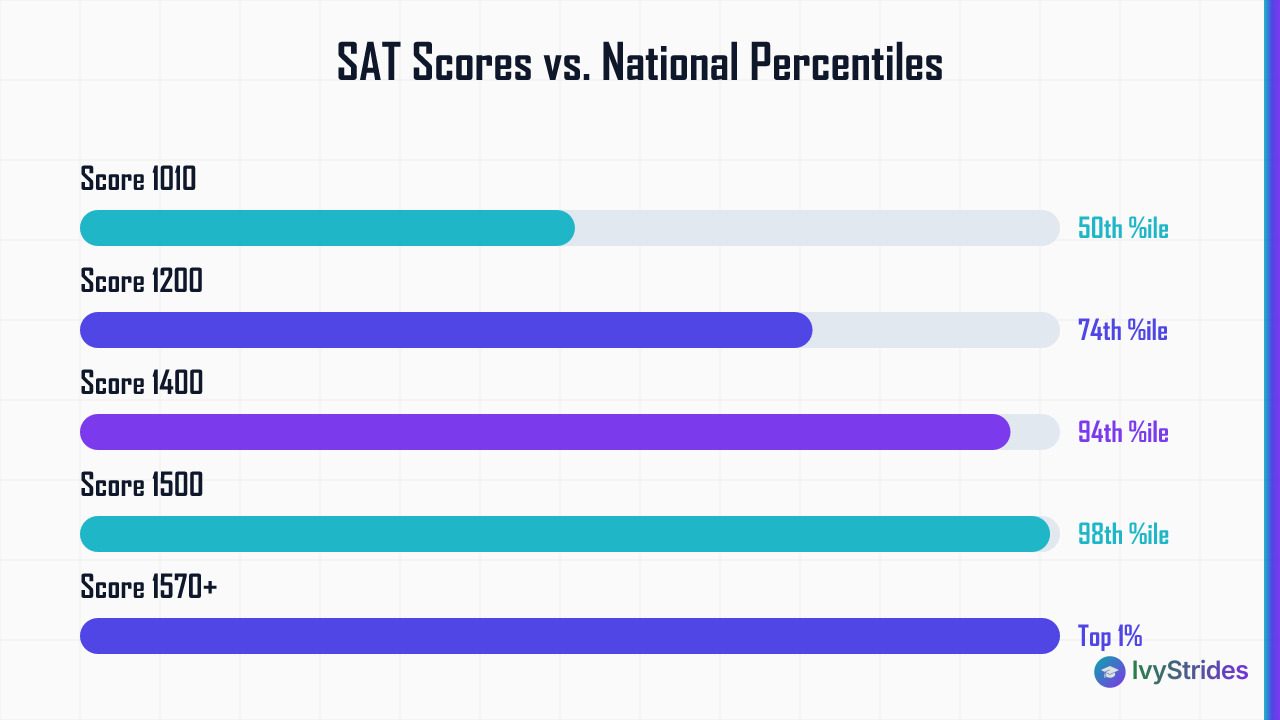
Here's roughly how SAT scores map to national percentiles, based on recent College Board score distributions:
- 1010 is around the 50th percentile (national average).
- 1200 is around the 74th percentile.
- 1400 is around the 94th to 95th percentile.
- 1500 is around the 98th percentile.
- 1570 and above is roughly the top 1% nationally.
Typical middle-50% ranges look approximately like this: selective state flagships 1200 to 1350, highly selective private schools 1450 to 1550, Ivy-level schools 1500 to 1580. Once you have a diagnostic score, use the SAT score scale and percentiles guide to understand what percentile you're at and what your target score means for your college list. For context on what different score bands mean for admissions, see what is a good SAT score 2026.
A realistic score delta. In our coaching with students starting in the 1100 to 1200 range, students who complete a full structured program typically reach the 1300 to 1400 band, with 200+ point gains as the typical outcome for students completing the IvyStrides 1-on-1 SAT program. Larger jumps happen, but they require the full timeline and consistent weekly hours. If you have four weeks and a 1050 baseline, targeting 1500 isn't a plan; it's a fantasy.
One caveat worth stating clearly: test-optional policies vary by school and year. Check FairTest for the current list before you decide a strong score is optional at your target schools. Admissions decisions also depend on the full application, not test scores alone.
How Long Should You Study for the SAT? Timelines by Score Goal
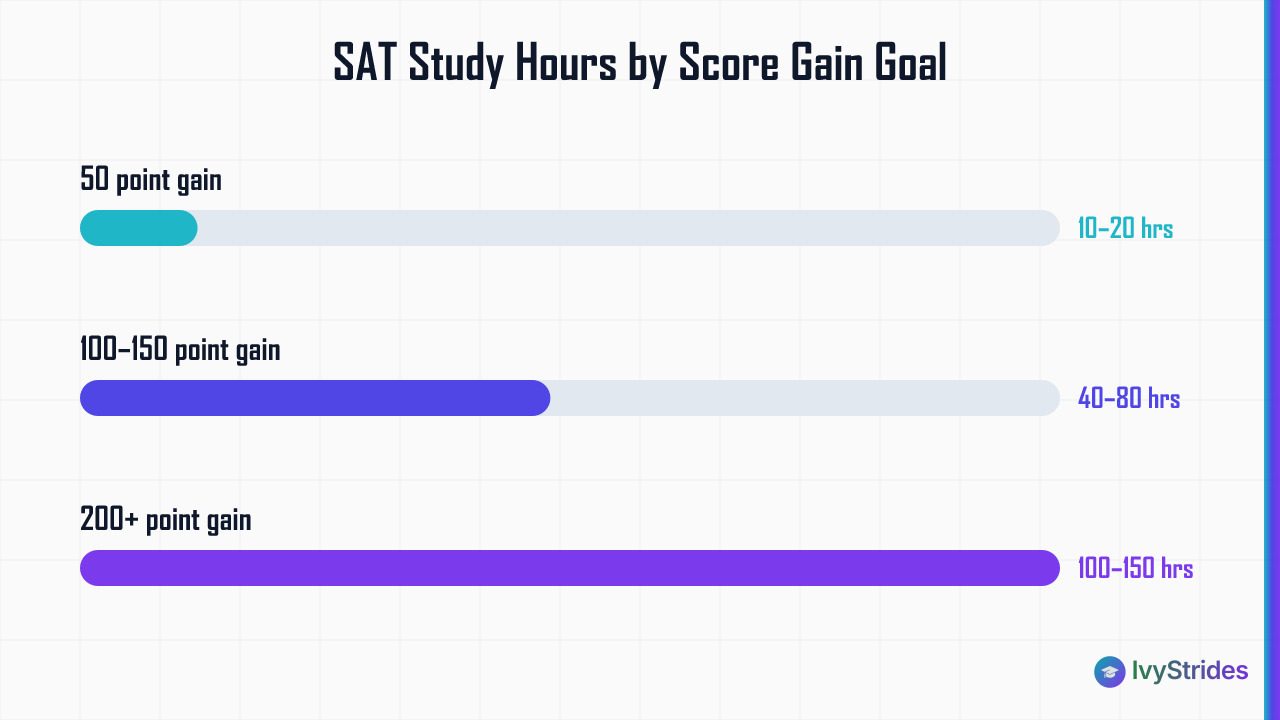
Study hours should scale with your target score delta. Here's the range that typically holds up across student cohorts:
- 50 point gain: roughly 10 to 20 focused hours.
- 100 to 150 point gain: roughly 40 to 80 hours over about 4 to 8 weeks.
- 200+ point gain: roughly 100 to 150 hours over about 3 to 6 months.
One-week plan (how to study for the SAT in a week). You won't remake your score in seven days, but a roughly 30 to 70 point gain is realistic if you focus. Take one timed practice section per day. Review every error the same evening. Drill only your two or three highest-frequency weak question types, usually Standard English Conventions in R&W and Algebra basics in Math. Don't open a new content area.
One-month plan (how to study for the SAT in a month). Two full-length practice tests spaced two weeks apart. Targeted drills five days per week, roughly 60 to 90 minutes per session. Alternate R&W days and Math days. Save the last three days for review only, no new content.
Three-month plan. Diagnostic in week 1. Content study and targeted drills weeks 2 through 8. Two retests in weeks 9 and 11. Final polish and light review in week 12. This is the timeline where, in our coaching, 200+ point gains show up most consistently, because there's enough runway for spaced retesting to lock in gains.
For a week-by-week breakdown of exactly what to study and when, see our full SAT study plan guide. If you've already taken the SAT once and are planning a retake, the strategy shifts; our how to improve your SAT score on a retake playbook covers what changes.
Step 3: Build Your SAT Study Plan Around Your Weak Question Types
Most students study the SAT like it's a subject. It isn't. It's a test of specific, repeating question types, and your point-recovery potential is uneven across them.
Prioritize by miss rate. Rank your question-type miss rates from your diagnostic report. Anything you miss roughly 40% or more of the time is your first target. Only after that rate drops below about 20% do you move to the next weakest type. This sequence sounds obvious. Most self-studying students still do the opposite, drilling everything evenly.
Weekly schedule structure. A workable rhythm is two days of R&W drills, two days of Math drills, and one day for either a full timed section or a full practice test. Rest days matter; fatigue caps retention.
Spaced retesting. After you study a question type, retest it about 3 to 5 days later with fresh questions. If your miss rate has dropped, you can move on. If not, the material hasn't stuck. This is the difference between recognition (I've seen this before) and mastery (I can solve this cold). It's the mechanism behind the IvyStrides diagnostic-first, targeted-weakness, spaced-retesting methodology.
For a downloadable framework you can adapt, see the sat study guide pdf. Before you drill Math practice sets, review the complete list of SAT Math topics for 2026 so you know which content areas carry the most questions.
How to Study for SAT Math: The Section Most Students Underestimate
SAT Math has roughly 44 questions across two adaptive modules, per the College Board. Here's the part most students miss: two content domains carry about 70% of the weight. Algebra (linear equations, systems, inequalities) and Advanced Math (quadratics, functions, nonlinear equations) together make up most of the section. If your Math score is under 700, this is where you invest first.
Learn Desmos before test day. The Bluebook app includes a built-in Desmos graphing calculator available on every Math question. Students who practice with Desmos consistently save roughly 30 to 60 seconds per graphing question. Students who first meet Desmos on test day lose those seconds and often more, because they attempt algebra by hand when a two-second graph would settle it. In our coaching, this is the single most common preventable time loss on Module 2 Math. For practice-friendly walkthroughs, see our digital sat calculator guide.
Problem-Solving and Data Analysis (ratios, percentages, statistics, two-way tables) is the third-largest domain and often the fastest to improve. The math itself isn't hard; the questions test whether you can read the setup carefully.
Geometry and Trigonometry is the smallest domain, but the SAT reference sheet only gives you some formulas. Know which are provided and which you must memorize; our SAT geometry formulas breakdown covers that split.
If your diagnostic shows Math as the weaker section and self-study isn't moving it, an Online SAT Math tutor working 1-on-1 with you on your specific weak domains typically closes the gap faster than group instruction.
How to Study for SAT Reading and Writing: What the Digital Format Changed
The Digital SAT R&W section looks nothing like the old paper SAT. Instead of long passages with 10 questions each, you now get short discrete passages, usually one to five sentences, with one question per passage (College Board). This changes everything about how to study.
The four question-type categories:
- Information and Ideas: main idea, detail, inference, data interpretation from small graphs and tables.
- Craft and Structure: word in context, text structure, cross-text connections. The answer is always supported by explicit text evidence.
- Expression of Ideas: transitions, rhetorical synthesis, sentence combining.
- Standard English Conventions: punctuation (commas, semicolons, colons), sentence boundaries, subject-verb agreement, modifier placement.
Standard English Conventions is where most students find the fastest gains. The rules are finite and learnable within roughly two to three weeks of focused study. In our coaching, this is consistently the domain where scores move first.
Read the question before the passage. Honestly, the most common R&W error we see is spending too long on the passage text before knowing what the question is asking. The passages are short. Go to the question stem first, then read the passage with a specific target in mind. This one habit is worth roughly 20 to 50 points for most students.
For students whose R&W scores have plateaued, see why your SAT reading score is not improving. To keep a running log of your error patterns (the highest-use habit in R&W prep), use our free sat mistake tracker.
The Best Free and Paid SAT Study Resources in 2026
Here's the honest breakdown of what to use and when.
Genuinely free and sufficient for many students:
- College Board Bluebook app: the official Digital SAT platform, contains full-length official practice tests, required for test day. Available at satsuite.collegeboard.org.
- Official College Board personalized practice: the practice tool linked to your College Board account, which uses your PSAT and SAT scores to generate targeted skill recommendations.
- IvyStrides free sat mistake tracker and downloadable resources: an error log we built because most students skip this step and lose weeks to repeating the same mistakes.
When free is enough. You're self-directed. You have three or more months. You're targeting a 50 to 100 point improvement from a mid-range baseline. Your diagnostic shows evenly distributed weaknesses that basic drilling can close.
When paid prep helps. You have specific skill gaps that self-study hasn't closed after four to six weeks. You're targeting 1450+ from a baseline below 1300. You have fewer than eight weeks. You've taken the SAT once already without hitting your target.
In our coaching, students who combine official Bluebook practice tests with targeted 1-on-1 section-specialist work close skill gaps faster than students using generic prep courses, because the coach only spends time on the question types your diagnostic actually flagged. If that fits your situation, our 1-on-1 SAT prep pairs you with an R&W specialist or Math specialist depending on where your gap is. No program guarantees a specific score; results depend on starting point, hours invested, and consistency.
The Week Before the SAT: What to Do (and What to Stop Doing)
The week before the test isn't the time for heroics. It's the time to protect the score you've built.
Days 7 to 4. One timed practice section per day. Review errors only. No new content, no new question types.
Days 3 to 2. Light review of your personal error log. No full-length tests. Confirm your admission ticket, acceptable photo ID, and test center location.
Day before. No studying. Charge the device you'll use for Bluebook. Pack your admission ticket, ID, an approved snack, and water. Sleep on your normal schedule; don't force early bedtime.
Morning of. Eat a real breakfast with protein. Arrive 30 minutes early. Bring water and a snack for the 10-minute break between R&W and Math.
What to stop. Don't take a full-length practice test the day before. In our coaching, students who do this frequently report fatigue affecting their Module 2 performance on test day. Don't start a new content area in the final week. Don't stay up past midnight cramming grammar rules.
For students with fewer than two weeks before test day, our last-minute SAT tips article covers what to prioritize and what to skip. If test anxiety is the issue, see our strategies to overcome SAT anxiety.
Is a 1400 SAT Better Than a 31 ACT? (And How to Decide Which Test to Take)
Neither is better. A 1400 SAT and a 31 ACT are roughly concordant, both placing you at approximately the 94th to 95th percentile nationally. Colleges accept both equally and don't weight one over the other in admissions.
The right answer: submit whichever score is higher relative to your target schools' admitted-student ranges. If you haven't taken either test, take a full-length official practice test for each, one weekend apart, and compare percentiles. The test where you score higher is your test.
A few real differences to know:
- The ACT includes a Science section that tests data interpretation and experimental reasoning, not biology or chemistry content (ACT, Inc.). The Digital SAT does not.
- The Digital SAT uses adaptive modules where Module 2 difficulty is set by Module 1 performance. The ACT is linear.
- The ACT runs faster per question. Students who work quickly under pressure sometimes prefer it. Students who read carefully and want the flexibility of an adaptive format usually prefer the SAT.
For a fuller breakdown, see our ACT vs. SAT comparison.
Frequently Asked Questions About Studying for the SAT
Is getting a 1200 on the SAT hard?
A 1200 sits at approximately the 74th percentile, so it's above the national average but not highly selective. For most students starting at 1000 to 1050, reaching 1200 typically requires roughly 40 to 60 hours of focused, targeted practice over about 6 to 10 weeks. It's a realistic goal if you commit to consistent weekly hours and address your specific weak question types instead of studying everything evenly. For more on how this score fits into admissions, see is 1300 a good SAT score.
What score is roughly 70% correct on the SAT?
The Digital SAT isn't scored as a simple percentage. It uses scaled scoring, where raw performance is converted based on question difficulty and adaptive module routing. Answering about 70% of questions correctly typically produces a scaled score in the 1100 to 1200 range, though the exact conversion varies by test form. The College Board publishes official score distributions at satsuite.collegeboard.org.
Is 1500 SAT top 1%?
No. A 1500 is approximately the 98th percentile. Top 1% nationally is roughly 1570 or higher. A 1500 is still an outstanding score, competitive at nearly every highly selective college, and falls within the middle-50% range at many Ivy-level schools. Admissions depend on the full application, not test scores alone.
Can I study for the SAT in one month?
Yes. A roughly 50 to 150 point improvement is realistic in 30 days with a structured plan. Take a diagnostic in the first three days, spend the middle weeks drilling your weakest question types, and fit in two full-length timed practice tests spaced about two weeks apart. Students who try to review all content equally in one month typically see smaller gains than those who narrow ruthlessly to their highest-impact gaps.
How do I start studying for the SAT if I've never taken it before?
Download the Bluebook app, take one full-length official practice test under timed conditions, and read your score report by question type. That single step tells you more about where to focus your study time than any prep book introduction. From there, build a weekly schedule targeting your two or three weakest question-type categories before expanding.
Is a 1400 SAT or a 31 ACT better?
They're roughly concordant, both at approximately the 94th to 95th percentile. Colleges accept them equally. Submit whichever is higher relative to your target school's admitted-student range. If you haven't taken both, take a full practice test for each and compare percentiles before committing.
How many times can I take the SAT?
There's no strict limit set by College Board. Most students take it two or three times. For a fuller answer, see how many times can you take the SAT. You can also check current SAT test dates 2026 to plan your sittings.
The Real Next Step
Studying for the SAT isn't about willpower or hours logged. It's about whether the hours you spend are aimed at the right question types. A student with a specific 60-hour plan built from a real diagnostic will outperform a student with a vague 200-hour plan built from a prep book introduction, every time.
Take the diagnostic. Read the score report by question type. Then either build the plan yourself using this guide, or bring your diagnostic to a coach who can accelerate the process. That's the methodology we use in 1-on-1 SAT prep. You can also meet the section-specialist SAT coaches who work with students at each score band.

Award-winning author (South Asian Book Award) and graduate of BITS Pilani and UCLA Luskin School of Public Affairs. Brings a published writer's eye to Common App essays and grammatical precision to SAT and ACT R&W instruction.