
How to Prep for SAT Math and Hit Your Target Score (2026 Game Plan)
On this page
- What the Digital SAT Math Section Actually Looks Like in 2026
- The Four SAT Math Domains You Need to Know (2026 Syllabus)
- How the Two-Module Adaptive Format Changes Your Strategy
- Why Your SAT Math Score Is Not Improving (And What to Fix First)
- What Is a Good SAT Math Score? Score Benchmarks by College Tier
- How Long Should You Study for SAT Math? Realistic Timelines by Score Band
- The Best Way to Prepare for SAT Math: A Step-by-Step Framework
- Is It Realistic to Score 800 on SAT Math?
- When to Consider 1-on-1 SAT Math Coaching
- FAQ
- Is a 490 on SAT Math a good score?
- How hard is it to get a 1200 on the SAT?
- Can I prepare for SAT Math from scratch in a short time?
- What is the best free resource for SAT Math practice?
- Does the Desmos calculator help on every SAT Math question?
- How many times should I take the SAT before applying to college?
To prep for SAT Math in 2026, start with a full-length Digital SAT practice test to identify which of the four domains (Algebra, Advanced Math, Problem-Solving and Data Analysis, or Geometry and Trigonometry) is costing you the most points. Then work targeted practice by domain, use the integrated Desmos graphing calculator strategically, and retest on a spaced schedule to confirm retention. The Math section has 44 questions across two adaptive modules in 70 minutes, per the College Board's SAT Suite documentation. Most students working roughly 6-8 hours per week see a 50-100 point Math gain in about 6-8 weeks; a 150-200 point gain typically takes 12-16 weeks of structured prep.
The real question is not "what should I study" in the abstract. It's which two domains are eating your score right now, and in what order to attack them. The sections below map that out, starting with what the test actually looks like in 2026.

What the Digital SAT Math Section Actually Looks Like in 2026
The Digital SAT Math section is 44 questions in 70 minutes, split into two modules of roughly 22 questions each, per the College Board. Module 1 is fixed difficulty for every test-taker. Module 2 is adaptive: the Bluebook app routes you to either a harder or easier Module 2 based on how you performed in Module 1. Math is scored on a 200-800 scale, and Math plus Reading & Writing combine to form the 400-1600 composite.
The integrated Desmos graphing calculator is available for all 44 questions. As of 2026, the embedded calculator window is resizable. A reference sheet with common area, volume, and right-triangle formulas is provided on-screen for every Math question. Not every formula you need is on that sheet, but the essentials are.
The four content domains, per College Board's assessment framework, are:
- Algebra: roughly 35% of Math questions
- Advanced Math: roughly 35%
- Problem-Solving and Data Analysis: roughly 15%
- Geometry and Trigonometry: roughly 15%
If you're wondering where the pacing pressure comes from, our guide to how many questions are on the SAT breaks down the full section-by-section count. For the mechanics of how routing between Module 1 and Module 2 actually works, our SAT adaptive testing explainer covers the algorithm.
The Four SAT Math Domains You Need to Know (2026 Syllabus)
Every question on the Digital SAT Math section belongs to one of four domains, and the College Board publishes exactly what each covers. Knowing the labels is not enough. You need to know what a typical question in each domain looks like so you can spot your weak points on a diagnostic.
Algebra is the largest single domain. Expect linear equations in one and two variables, systems of two linear equations, linear inequalities, and linear function interpretation in context. A representative question: solve a system of two linear equations and identify the value of one variable, or interpret the slope of a line describing a real-world rate.
Advanced Math covers nonlinear functions, quadratics, polynomials, exponential functions, and equivalent expressions. Typical question: given f(x) = x² - 5x + 6, find the sum of the roots, or determine the vertex of a parabola from its equation. Advanced Math is heavily represented in the hard Module 2, so students targeting 700+ Math need to be fluent here.
Problem-Solving and Data Analysis is the context-and-numbers domain: ratios, rates, percentages, unit conversion, probability, one- and two-variable statistics, and reading data from two-way tables, scatterplots, and bar charts. Word-problem heavy. Because many of these questions are phrased as short scenarios, our 7-step SAT word problems method gives a repeatable translation process to convert English into equations.
Geometry and Trigonometry covers area and volume, angle relationships, right triangles, trigonometric ratios (sin, cos, tan), and circles in the coordinate plane. The reference sheet handles most volume and area formulas, but circle equations, special right triangles beyond the 30-60-90 and 45-45-90, and specific arc/sector relationships are not on it. Our SAT geometry formulas guide lists exactly which ones to memorize.
For a complete breakdown of every concept tested by domain, including difficulty ratings and which topics appear most often in hard Module 2, see our full SAT math topics guide. Because Algebra is the single largest domain, our deep-dive on SAT algebra questions walks through the most common question types and fast-solving patterns.
How the Two-Module Adaptive Format Changes Your Strategy
Here's the part most students miss. Because Module 2 difficulty is routed by Module 1 performance, accuracy in Module 1 matters more than speed. A student who rushes through Module 1 to bank extra time for Module 2, then misses six questions on careless arithmetic, will be routed to the easier Module 2. That easier Module 2 typically caps your Math score below roughly 700, no matter how flawlessly you answer it.
You cannot see the routing decision during the test. There's no on-screen signal telling you which Module 2 you landed in. So the strategic conclusion is simple: treat Module 1 as the higher-stakes module. Slow down enough to eliminate careless errors, verify with Desmos where useful, and only push pace if you're finishing with five-plus minutes left and are consistently accurate.
When Desmos actually helps. Graphing y = x² - 5x + 6 to see the roots at x = 2 and x = 3 is faster than factoring by hand, especially under pressure. Entering a system like y = 2x + 1 and y = -x + 7 as two lines and reading off the intersection point (2, 5) is nearly instant. For probability tables or verifying that your algebraic answer matches a scatterplot's trend, Desmos removes ambiguity.
When Desmos slows you down. Simple linear equations like 3x + 7 = 22, one-step percentage problems, and questions where the answer is obviously derivable from the equation structure. Reaching for Desmos here costs roughly 20-40 seconds you don't have. In our coaching, students who use Desmos selectively on the right question types gain both accuracy and time; students who reach for it on every question often run short on time in Module 2.
The 2026 update lets you resize the embedded calculator so it doesn't obscure the question text, a small but real improvement. For a fuller walkthrough of when to open the calculator, see our digital SAT calculator guide.
Why Your SAT Math Score Is Not Improving (And What to Fix First)

Photo by RDNE Stock project on Pexels
Look, if your score is stuck, the problem is almost never "I need to do more practice questions." It's that you're practicing the wrong questions. In our coaching with students in the 600-700 Math band, the most common pattern is spending prep time on Algebra (already solid) while Advanced Math and Problem-Solving and Data Analysis questions account for roughly 60-70% of the missed points on a diagnostic.
Four failure modes we see repeatedly:
-
Studying without a diagnostic. You cannot prioritize domains you haven't measured. Doing 200 random practice questions without an error log tells you you're busy. It doesn't tell you you're improving.
-
Repeating practice questions without error analysis. Getting a question wrong, checking the answer key, thinking "oh right, I knew that," and moving on. That's not learning; that's confirmation. The fix is to write down why you missed it: content gap, careless error, misread, or pacing.
-
Confusing pacing problems with content gaps. If you get a question right when you have unlimited time but miss it under 90 seconds, that's a fluency issue, not a knowledge issue. Different fix. Drill the question type for speed, don't re-learn the concept.
-
Not distinguishing careless errors from real gaps. A right-approach-wrong-arithmetic miss is not the same as a wrong-approach miss. In our coaching, students at the 720+ band lose most of their remaining points to careless errors, not to unknown content. The prep changes accordingly.
The methodology we use is diagnostic first, targeted weakness work second, spaced retesting third. That means: full-length official practice test, domain-level error log, focused practice on the two weakest domains, then a fresh full-length retest 2-3 weeks later to confirm the fix stuck. A simple sat mistake tracker is enough to run this cycle on your own, and it costs nothing. Pair that with our official SAT practice tests library for full-length simulations.
What Is a Good SAT Math Score? Score Benchmarks by College Tier
Before you build a study plan, pick a real target. "Higher" is not a target. A specific score, tied to your college list, is.
SAT Math is scored 200-800. The national average sits in roughly the 520-530 range, based on College Board's most recent score distribution data. Here's how common benchmarks map to approximate percentiles, per College Board's published percentile tables:
- 490 Math: around the 40th percentile. Below the national average, not competitive for selective colleges, but a clear starting point with substantial room to gain.
- 600 Math: around the 73rd percentile. Above average; competitive for many mid-tier public flagships.
- 700 Math: around the 93rd percentile. Competitive for many top-50 schools.
- 750 Math: around the 96th percentile. In range for most Ivies and highly selective privates on the Math side.
- 800 Math: around the 99th percentile. Required to reach the 75th-percentile Math mark at a handful of STEM-focused schools like MIT and Caltech.
A 1200 composite (roughly 600 per section) is approximately the 74th percentile nationally, a reasonable mid-range target for students currently scoring 1000-1100.
Percentile figures are approximate; verify the current year's table at satsuite.collegeboard.org before finalizing a target. If you're unsure whether your current Math score is competitive for your target schools, our guide to what counts as a good SAT score 2026 maps score ranges to college tiers with percentile data.
Caveat on test-optional. Many selective schools remain test-optional or test-flexible for 2026 applicants, but policies vary by school and by year. The FairTest tracker maintains the current list. If a school is test-optional, a strong SAT Math score still helps: submitting a 750+ Math is a positive signal, and not submitting when your score is well below the school's middle 50% is often the right call. Admissions outcomes depend on the full application, not test scores alone.
For students aiming at the ceiling, our perfect SAT score breakdown covers what near-perfect prep actually looks like.
How Long Should You Study for SAT Math? Realistic Timelines by Score Band
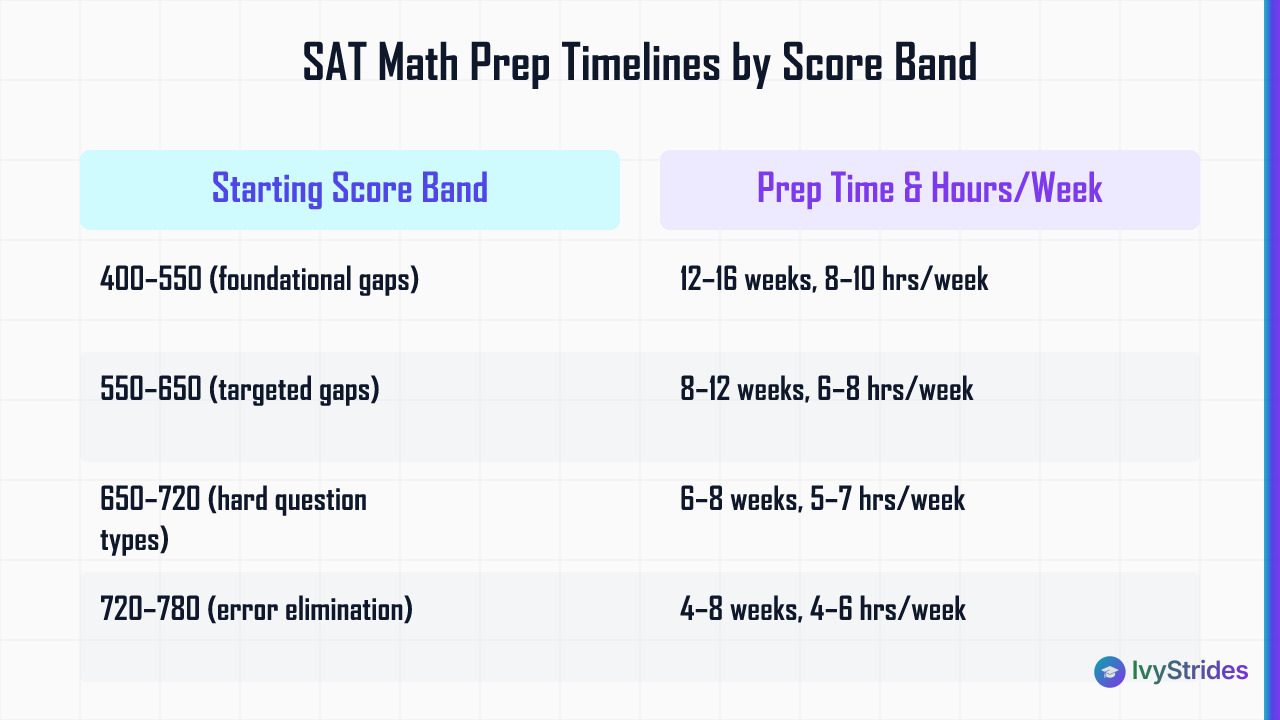
Weekly hours matter more than calendar weeks. A student doing 3 hours a week for 20 weeks will typically gain less than a student doing 8 hours a week for 8 weeks, even though the second student put in fewer total hours. Consistency and density beat scatter.
Honest timelines by starting Math score, framed as typical for students completing structured prep:
- 400-550 band: roughly 12-16 weeks at about 8-10 hours per week. Foundational gaps in Algebra and early Advanced Math; typical gain 100-200+ points.
- 550-650 band: roughly 8-12 weeks at 6-8 hours per week. Targeted work on Advanced Math and Problem-Solving and Data Analysis; typical gain 60-120 points.
- 650-720 band: roughly 6-8 weeks at 5-7 hours per week. Focus on hard Module 2 question types and Desmos fluency; typical gain 40-80 points.
- 720-780 band: roughly 4-8 weeks at 4-6 hours per week. Near-perfect accuracy on Algebra and Advanced Math; error elimination is the main lever.
- 780-800 band: roughly 4-6 weeks at 4-5 hours per week. Zero careless errors, mastery of hardest Advanced Math and Geometry questions.
In our coaching with students in the 600-650 Math band, 6-8 hours of targeted weekly prep typically produces a 60-100 point Math gain across about 8 weeks. That's a domain-specific pattern, not a promise. Your gain depends on how honestly you diagnose and how consistently you retest.
Spaced retesting roughly every 2-3 weeks is non-negotiable. Without it, you can't distinguish real gains from lucky guesses. Every retest is a fresh, timed, full-length official practice test in the Bluebook app.
If you have roughly a month before your test date, our 30-Day SAT Study Plan maps out daily tasks for each week of prep. In the final 72 hours, your prep shifts from content review to logistics and mindset; our last minute SAT tips article covers exactly what to do in that window. And on test morning itself, a short SAT test day checklist prevents avoidable mistakes with the Bluebook setup.
The Best Way to Prepare for SAT Math: A Step-by-Step Framework
Here's the seven-step framework we run with every SAT student. It's simple. Skipping steps is where most students go wrong.
Step 1: Take a full-length official Digital SAT practice test. Use the Bluebook app or a College Board official paper test. Timed, single sitting, no interruptions. This is your baseline.
Step 2: Score by domain, not just overall. A 620 Math score is a starting number. A 620 Math where you missed 4 Algebra, 8 Advanced Math, 3 PSDA, and 2 Geometry questions is a study plan. Identify the two domains costing you the most points.
Step 3: Study the highest-impact domain first. If Advanced Math is your biggest gap and Algebra is second, spend roughly the first 2-3 weeks on Advanced Math question types (quadratics, polynomials, exponentials), then move to Algebra. Do not rotate randomly across all four domains.
Step 4: Use Desmos intentionally. Practice with the calculator open, but force yourself to solve algebraically first on 3x + 7 = 22-style questions. Reserve Desmos for graphing quadratics, systems, and verification.
Step 5: Retest after roughly 2-3 weeks. Fresh full-length official test, timed, Bluebook. Compare domain-level errors. If Advanced Math errors dropped from 8 to 3, the targeted work stuck. If not, diagnose why (content vs. pacing vs. careless) before repeating the cycle.
Step 6: Repeat the error-log and targeted-practice cycle. Move to the next weakest domain. Keep the mistake tracker running.
Step 7: Simulate test conditions in the final 2 weeks. Full-length tests, in Bluebook, at the same time of day as your real test. This trains endurance and calibrates pacing.
Free resources that work. College Board offers official full-length Digital SAT practice tests via the Bluebook app, and there are official free study resources at satsuite.collegeboard.org. These cover the full SAT math topics syllabus and are the right starting point for any self-directed student.
When free prep hits its ceiling. Self-directed prep works well from roughly 400 to about 700 for most disciplined students. Above 700, the last 50-100 points typically come from personalized error analysis that generic platforms can't provide, because the errors are subtle and individual. In our coaching, students who skip the diagnostic step and go straight to random practice questions typically plateau around 4-6 weeks in without a clear path forward. That's the moment to consider structured coaching. For an overview of how we structure that, see our SAT prep overview. For section-specialist Math work specifically, our online SAT math tutor page covers the model.
Is It Realistic to Score 800 on SAT Math?
Short answer: yes, but only if you understand what 800-level prep actually requires.
800 SAT Math is approximately the 99th percentile. It requires near-perfect accuracy across both modules, including the hardest Advanced Math and Geometry questions in the hard Module 2 routing. There's essentially no margin for careless error. On a 44-question section, missing even 1-2 questions can drop you below 780.
What we see at the 750-780 level, in our coaching with students moving toward 800, is that the primary work is error elimination, not new content learning. These students already know the math. The gap is in careless arithmetic, misreading word problems, and skipping Desmos verification on complex quadratics they could have caught. The prep looks like near-daily short sessions of 8-12 hard Module 2 questions, timed, with rigorous post-mortem on every miss.
Do you actually need 800? Honestly, probably not. Most competitive schools have 75th-percentile Math scores in the 750-780 range. Chasing 800 for its own sake, when 770 opens the same admissions doors, is a poor use of prep hours. But if you're targeting MIT, Caltech, or similar STEM-focused schools where the 75th-percentile Math sits at 800, the 780-800 range is where you need to be. See our MIT SAT requirements breakdown for the specifics.
Reaching 800 requires consistent near-perfect performance under timed conditions. That's not a plateau every student can reach regardless of effort. Set the target based on your college list, not on perfection for its own sake.
When to Consider 1-on-1 SAT Math Coaching
Not every student needs coaching. If you're disciplined, your score is moving, and your diagnostics show clean progress roughly every 2-3 weeks, keep going with self-directed prep.
Coaching is the right call when three signals appear together:
-
Your score has plateaued across two full practice tests despite consistent study.
-
The same domain errors keep repeating on your mistake tracker, even after targeted practice.
-
Your pacing isn't improving, or you're finishing modules with time to spare but still missing questions.
A section-specialist SAT Math coach is different from a generalist tutor. Our SAT Math coaches work exclusively on SAT Math, not on Reading & Writing and not on other tests. That means deeper knowledge of specific question types, faster diagnosis of the exact fluency gap, and drills calibrated to your current score band. In our coaching, students who come in after a self-directed plateau typically have a specific, addressable domain gap that a diagnostic reveals within the first session, usually one they hadn't seen on their own error log because they weren't categorizing errors by mechanism.
For students completing the IvyStrides 1-on-1 SAT prep program, a 200+ point composite improvement is typical when starting below 1300. Have a fixed test date coming up? Our SAT winter batch enrollment offers structured cohort timing.
The lowest-commitment starting point is a free SAT consultation, where a specialist reviews your diagnostic and tells you honestly whether coaching would move your score meaningfully or whether self-directed prep is the right path. You can also meet our SAT Math coaches to see who you'd work with.
FAQ
Is a 490 on SAT Math a good score?
A 490 Math score is below the national average of roughly 520-530 and falls around the 40th percentile. It's not competitive for selective colleges, but it's a clear, addressable starting point. Students at 490 typically have foundational gaps in Algebra and early Advanced Math that a diagnostic identifies quickly. A structured 12-16 week prep plan at about 8-10 hours per week can realistically move this score into the 600-650 range.
How hard is it to get a 1200 on the SAT?
A 1200 composite (roughly 600 per section) sits around the 74th percentile nationally, so it's above average but not highly selective. For a student currently scoring 1000-1100, reaching 1200 typically takes about 8-12 weeks of targeted prep at 6-8 hours per week. The Math gain usually comes from closing Advanced Math and Problem-Solving gaps identified on a diagnostic, not from grinding through Algebra you already know.
Can I prepare for SAT Math from scratch in a short time?
Yes, but the realistic gain depends on your starting point and available weeks. A student with solid school-level Algebra and some exposure to quadratics can make meaningful progress in roughly 6-8 weeks. A student with significant foundational gaps needs about 12-16 weeks for a substantial improvement. Either way, starting with a full-length diagnostic is the non-negotiable first step. Prep time spent on topics you've already mastered is wasted.
What is the best free resource for SAT Math practice?
College Board publishes official full-length Digital SAT practice tests through the Bluebook app and offers free preparation materials directly at satsuite.collegeboard.org. These map to the four tested domains and are the right starting materials for any self-directed student before investing in paid prep. Pair them with a mistake tracker to convert practice into real domain-level progress.
Does the Desmos calculator help on every SAT Math question?
No. Desmos is most useful for graphing systems of equations, finding quadratic roots visually, and verifying answers on data analysis questions. For straightforward linear equations or simple arithmetic, opening Desmos takes more time than solving by hand. In our coaching, students who use Desmos selectively on the right question types gain both accuracy and time; students who reach for it on every question often run short on time in Module 2.
How many times should I take the SAT before applying to college?
Most students benefit from two to three sittings, with focused prep between each. Many colleges superscore, meaning they take the highest section scores across all sittings, which makes strategic retaking worthwhile. A common pattern is: take one test to establish a real baseline, prep for about 8-12 weeks, retake, then decide based on that result whether a third sitting is worth it.
The core move is simple: diagnose first, prioritize the two highest-impact domains, use Desmos surgically, and retest roughly every 2-3 weeks to confirm gains. That's what separates students whose scores climb steadily from students who put in hours and plateau.

Two decades teaching quantitative and verbal aptitude on standardized tests. Rare dual expertise across Math and Verbal — particularly effective for students with gaps on both sides. Senior AP Mentor for our Calculus and English tracks.