
SAT Fees 2026–27: Complete Cost Breakdown, Waivers & How to Save
On this page
- What Does the SAT Cost in 2026–27: The Complete SAT Fee Schedule
- SAT Fee Waivers: Who Qualifies and What Benefits Come With Them
- Not Sure Where Your Score Stands or What Prep You Actually Need?
- How to Keep Your Total SAT Cost Low: Practical Saving Strategies
- Is a 1200 a Good SAT Score, and When Does a Retake Make Financial Sense
- Ready to Make Every SAT Registration Count?
- FAQ: SAT Fees and Costs
- How much does it cost to take the SAT?
- Should I retake the SAT if I got a 1500?
- Can I give my SAT fee waiver to someone else?
- Is the SAT fee the same in Texas as in other U.S. states?
- Your Next Step on SAT Costs
The SAT registration fee is $68 for students testing in the United States. International students pay $68 plus a $43 regional surcharge, for a total of $111 before any local taxes or test-center fees. Four score reports are included at no extra charge when you register, and students who qualify for a fee waiver take the SAT for free. Additional fees apply for late registration, test-center changes, and score reports sent after registration.
Every figure here comes from the College Board's official SAT fee schedule, verified as of this article's publication date. Because College Board refreshes its schedule periodically, confirm the current number on their site before you click "pay." What follows is the full breakdown, who qualifies for a waiver, and where you can spend less.
What Does the SAT Cost in 2026–27: The Complete SAT Fee Schedule

The SAT base registration fee is $68 for U.S. students, and that single charge covers one test date plus four score reports sent to colleges at registration. College Board administers the SAT and sets every fee below. The base number is where most families stop reading, and it's exactly where budget surprises begin, because the add-ons stack fast.
Here's what the fee buys. You're paying to sit the Digital SAT: 98 questions across 2 hours 14 minutes, split into a Reading and Writing section (54 questions, 64 minutes, two adaptive modules) and a Math section (44 questions, 70 minutes), per the College Board. Scores land on the 400–1600 scale. The fee is identical whether you score 900 or 1550.
| Fee Type | Amount | Notes |
| Base registration (U.S.) | $68 | Covers one test date; four score reports included |
| International regional surcharge | +$43 | Added to base; total $111 before local fees |
| Late registration surcharge | Verify current amount on College Board | Applies after the standard deadline |
| Test-center or test-date change | $34 | Free with a fee waiver |
| Late cancellation | $44 | If cancelled by Thursday 11:59 p.m. ET before test day |
| Additional score report (each) | Verify current amount on College Board | Beyond the four free reports |
| Rush score report | Verify current amount on College Board | Faster delivery, higher cost |
| Four score reports at registration | $0 | Only when designated during registration |
| Fee waiver (eligible U.S. students) | $0 | Eliminates the $68 base fee |
Two figures deserve a flag. Some competitor sites still list an older late-registration surcharge and a lower change fee long after College Board updates them. The change fee is $34 and the late cancellation fee is $44 per College Board's current schedule, but confirm the late-registration surcharge and per-report figures directly on the source before you register.
If your plans change after you register, our full SAT cancellation fee guide walks through the refund rules. Students testing outside the U.S. face a mandatory $43 regional surcharge; our dedicated SAT registration fee for international students guide covers country-specific totals and payment options.
SAT Fee Waivers: Who Qualifies and What Benefits Come With Them
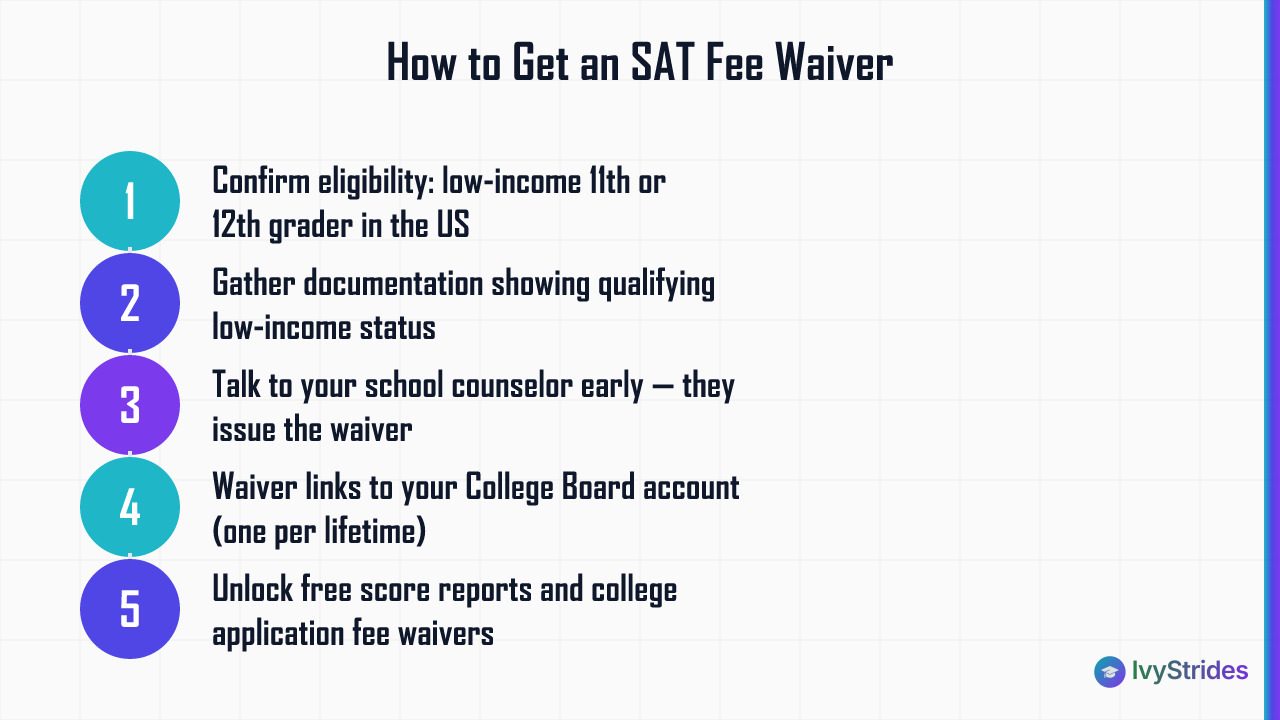
An SAT fee waiver eliminates the $68 base registration fee for eligible low-income 11th- and 12th-graders in the United States. It's not a discount code you find online. Your school counselor issues it, it ties to your College Board account, and you get one per lifetime. International students are not eligible.
Eligibility runs on documented low-income indicators. If any of the following describes your situation, you likely qualify, though your counselor makes the final call with College Board.
- Enrolled in the National School Lunch Program (free or reduced-price lunch)
- Family income falls within the USDA Income Eligibility Guidelines
- Enrolled in a program that aids low-income families, such as SNAP or TANF
- Living in federally subsidized public housing, a foster home, or homeless
- A ward of the state or an orphan
- Enrolled in a program that serves low-income students, such as a federal TRIO program
The waiver does more than zero out the $68. It unlocks free additional score reports beyond the standard four, and it triggers college application fee waivers that both the Common App and the Coalition App honor. That last piece matters more than the test fee itself. Application fees at selective schools often run $70 to $90 each, so a student applying to eight colleges can save several hundred dollars. Full details sit on College Board's fee waivers page.
One clarification we hear confused often: the SAT fee waiver has nothing to do with National Merit. The National Merit Scholarship Corporation screens on the PSAT/NMSQT Selection Index, not on SAT fees. Different test, different pathway.
To apply, talk to your school counselor early. Before you commit, it's also worth confirming whether your target schools even weight scores; our guide on what is test-optional and should you submit SAT scores explains how those policies interact with a strong score strategy. Once you've tested, our SAT scores explained breakdown shows what your number means.
Not Sure Where Your Score Stands or What Prep You Actually Need?
In a free 15-minute call, an IvyStrides coach will review your current score, identify your highest-leverage gaps, and recommend a realistic plan, whether that is 1-on-1 prep, a test pack, or a targeted study schedule. Students and parents are both welcome to join.
How to Keep Your Total SAT Cost Low: Practical Saving Strategies
Keeping your total SAT cost low comes down to three moves: designate your free score reports at registration, prep with free official materials before you pay, and don't register for a retake you don't need. Each one saves real money.
Look, the four free reports are the most-missed saving in the whole process. They're free only when you designate the schools during registration. In our coaching, many students arrive not knowing this and end up paying per-report fees for colleges they'd planned to apply to all along. If you know four target schools now, name them at checkout.
For prep, the official Bluebook app gives you full-length Digital SAT practice tests at no cost and covers the adaptive module format you'll see on test day. There's no reason to pay for a diagnostic before you've used the official one.
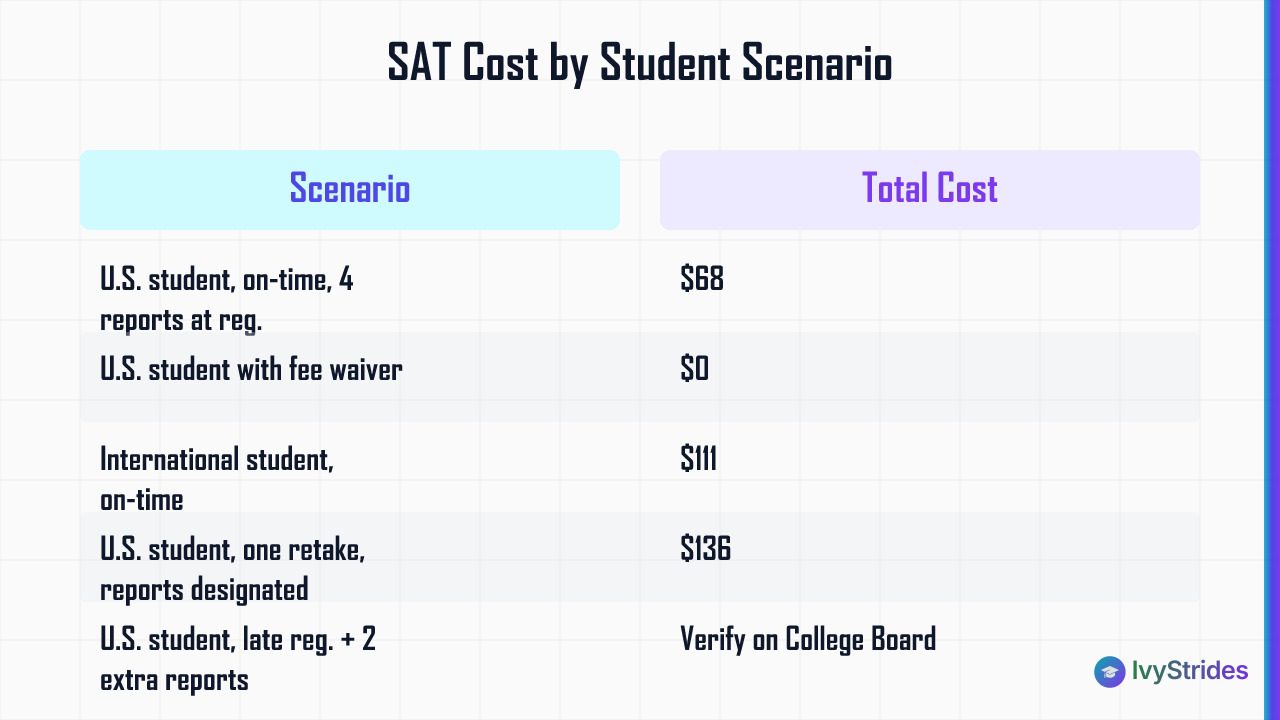
Which brings up the retake question. A retake costs another $68, and the bigger cost is the roughly 60 to 80 prep hours behind it. In our coaching, students who complete a full diagnostic before registering usually avoid at least one unnecessary retake. The scenarios below show what families actually pay.
| Scenario | Fees Paid | Total Cost |
| U.S. student, on-time, 4 reports at registration | $68 | $68 |
| U.S. student with fee waiver | $0 | $0 |
| International student, on-time | $68 + $43 | $111 |
| U.S. student, one retake, reports designated both times | $68 × 2 | $136 |
| U.S. student, late registration + 2 extra reports | $68 + surcharges | Verify on College Board |
Registration is only one line in the total investment. Tutoring and materials add to the budget, and our SAT tutoring cost guide breaks down what families typically spend. To build a study plan around the free official tests, start with our review of the most accurate SAT practice tests and our official SAT study guide 2026.
Is a 1200 a Good SAT Score, and When Does a Retake Make Financial Sense
A 1200 SAT score sits at around the 75th percentile, meaning you scored higher than roughly three-quarters of test-takers, per College Board's score-meaning data. The national average is around 1050. So yes, 1200 is a solid, above-average score. Whether it justifies another $68 depends on the gap between your score and your target schools' ranges.
A retake is really an ROI question. A student at 1200 aiming for programs whose admitted students cluster near 1400 has a clear case: 200 points can change the shortlist. Here's the part most students miss at the top of the scale. A student at 1500 chasing 1520 is spending $68 and dozens of hours for a delta most colleges won't notice. The table below maps current scores to the retake decision.
| Current Score | Approximate Percentile | Retake Worth It? | Typical Next Step |
| Below 1050 | Below ~50th | Usually yes | Diagnostic, then targeted prep |
| 1200 | ~75th | Yes, if targeting 1350+ | Section-specialist coaching |
| 1350 | ~90th | Maybe | Confirm target-school ranges |
| 1500 | ~98th | Rarely | Only for top-10 schools or scholarships |
| 1550+ | ~99th+ | No | Shift hours to essays and APs |
Two caveats hold across every row. Admissions outcomes depend on the full application, not scores alone, and test-optional policies vary by school and year. A retake only makes sense once you've confirmed a score will actually move your candidacy. In our coaching, students who run a diagnostic before deciding avoid paying for a test date that won't change their outcome.
For the top-of-scale decision specifically, see our take on whether is 1500 a good SAT score for Ivy League admission. On the broader weighting question, read how much does the SAT matter for college admission in 2026. When a retake is justified, our guide on how to improve your SAT score lays out the method.
Ready to Make Every SAT Registration Count?
A diagnostic-driven prep plan means you register when you are ready, not just when the calendar says so. Book a free 15-minute strategy call and leave with a clear score target, a realistic timeline, and a plan that fits your budget. Bring a parent; the call is built for both of you.
FAQ: SAT Fees and Costs
How much does it cost to take the SAT?
The SAT costs $68 for U.S. students. International students pay $111, which is the $68 base plus a $43 regional surcharge, before any local taxes. Students with a fee waiver pay nothing. Add-on charges apply for late registration, test-center changes, and score reports sent beyond the four included at registration.
Should I retake the SAT if I got a 1500?
For most students, no. A 1500 is a strong score at the vast majority of colleges. Consider a retake only if you're targeting top-10 schools where the middle 50% of admitted students reaches 1570 or above, or if a named merit scholarship sets a higher cutoff. The $68 retake fee matters far less than the roughly 60 to 80 prep hours you'd redirect from essays or AP exams.
Can I give my SAT fee waiver to someone else?
No. A school counselor issues each SAT fee waiver to a specific student, and it ties to that student's College Board account. You can't transfer, share, or reuse it more than once per lifetime.
Is the SAT fee the same in Texas as in other U.S. states?
Yes. The $68 base registration fee is identical across all U.S. states, including Texas. There's no state-specific surcharge for domestic test-takers, and late registration and other add-on fees are the same nationwide.
Your Next Step on SAT Costs
You now know the real total: $68 in the U.S., $111 internationally, $0 with a waiver, plus whatever add-ons your situation triggers. The number that surprises families isn't the base fee; it's the score reports and retakes they didn't plan for. Get ahead of both before you register.
- Confirm your exact total on College Board's current fee schedule, including any late surcharge, before you pay.
- Ask your school counselor about a fee waiver if any low-income indicator applies to you.
- Designate your four free score reports at registration, not after.
- Run a full official Bluebook diagnostic before deciding whether a retake is worth the cost.
For more on how we build diagnostic-driven plans, read about IvyStrides.