
Do You Need an ACT Tutor Near You? When In-Person Still Wins

On this page
- When an In-Person ACT Tutor Near You Is the Right Call
- How Much Does ACT Tutoring Cost in 2026?
- Is ACT Tutoring Worth the Cost for Your Score Goal?
- What to Look for in a Private ACT Tutor, Local or Online
- FAQ: ACT Tutoring Costs and Worth
- How much do ACT tutors cost?
- Is ACT tutoring worth it?
- What is the average price for a private tutor?
- How can I improve my ACT score quickly?
- Your Next Step on the ACT Tutor Decision
An in-person ACT tutor near you is worth seeking when you need structured accountability, have a specific section score dragging your Composite down, and a test date within 8 to 12 weeks. An ACT tutor is a coach who works section by section to raise your Composite. For most students, a qualified online tutor delivers the same targeted prep with more flexibility.
Format matters less than the tutor's section expertise and your commitment to the work. That's the real decision hiding under the "near me" search, and this page walks you through it: when local wins, what tutoring costs in 2026, whether it's worth it for your goal, and how to vet anyone you hire.
When an In-Person ACT Tutor Near You Is the Right Call
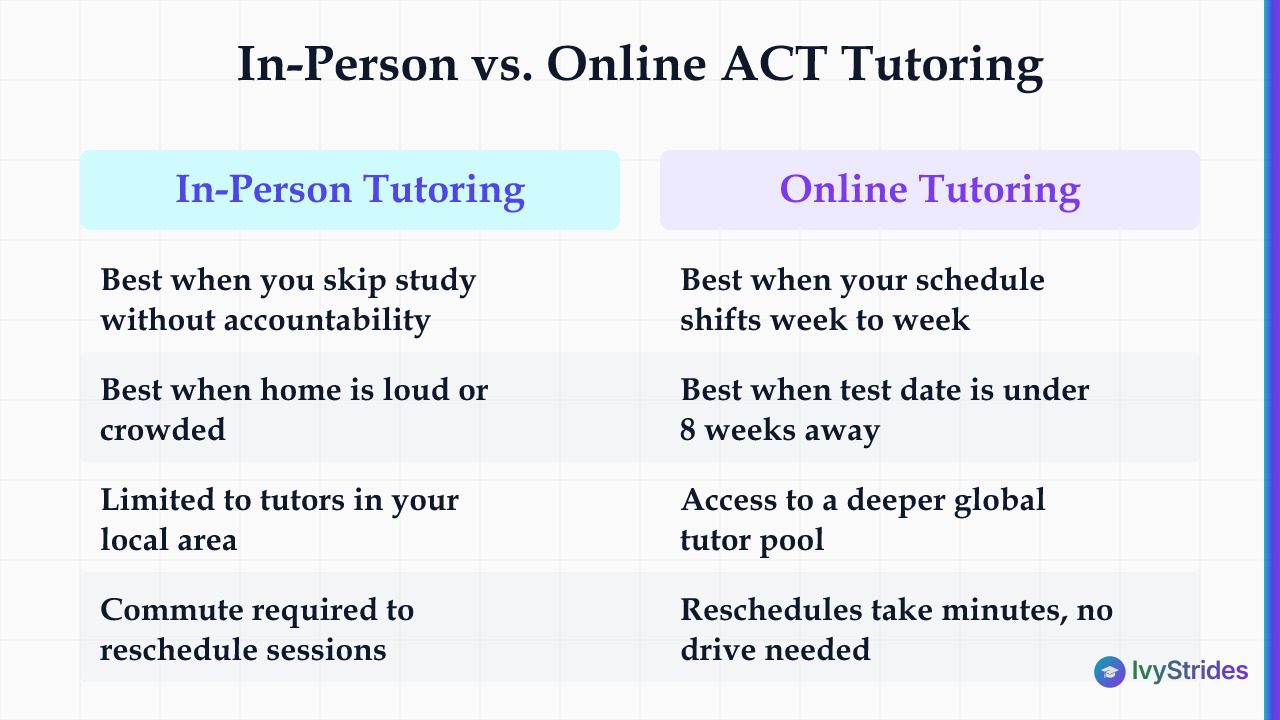
An in-person ACT tutor near you wins in three specific situations: when you need someone in the room to hold you accountable, when distractions at home sink every online session, and when you learn faster reading handwritten work on Math problems than watching a screen share. Outside those cases, online ACT tutoring covers the same ground.
The enhanced ACT rewards the same section-specific prep either way. Its core (English, Math, and Reading) runs 131 questions in 125 minutes, which averages about 57 seconds per question. ACT, Inc. publishes the 125 minutes and the 131-question count separately; IvyStrides calculates that 57-second average. A tutor's job is to make that pace automatic, and pacing drills work over video just as well as across a table.
Geography sets your deadline, not your tutor. Your nearest upcoming test date sets the outer boundary of your prep window; the full 2026-27 schedule with registration deadlines is in our ACT test dates and registration deadlines guide. ACT offers seven national test dates in 2026-27. Three anchor most junior-year plans now: October 17, 2026 (the regular deadline passed September 11; late registration, with the $42 fee, closes September 29), December 12, 2026 (register by November 6), and February 27, 2027 (register by January 22).
| Situation | Better Format | Why |
| You skip solo study without a set time | In-person | A booked room forces the hour |
| Home is loud or crowded | In-person | A neutral space cuts distraction |
| You want a specialist not in your town | Online | The global tutor pool is deeper |
| Your schedule shifts week to week | Online | Reschedules take minutes, not a drive |
| One section is dragging your Composite | Either | Section fit beats format |
| Test date is under 8 weeks away | Online | You start this week, no commute |
How Much Does ACT Tutoring Cost in 2026?
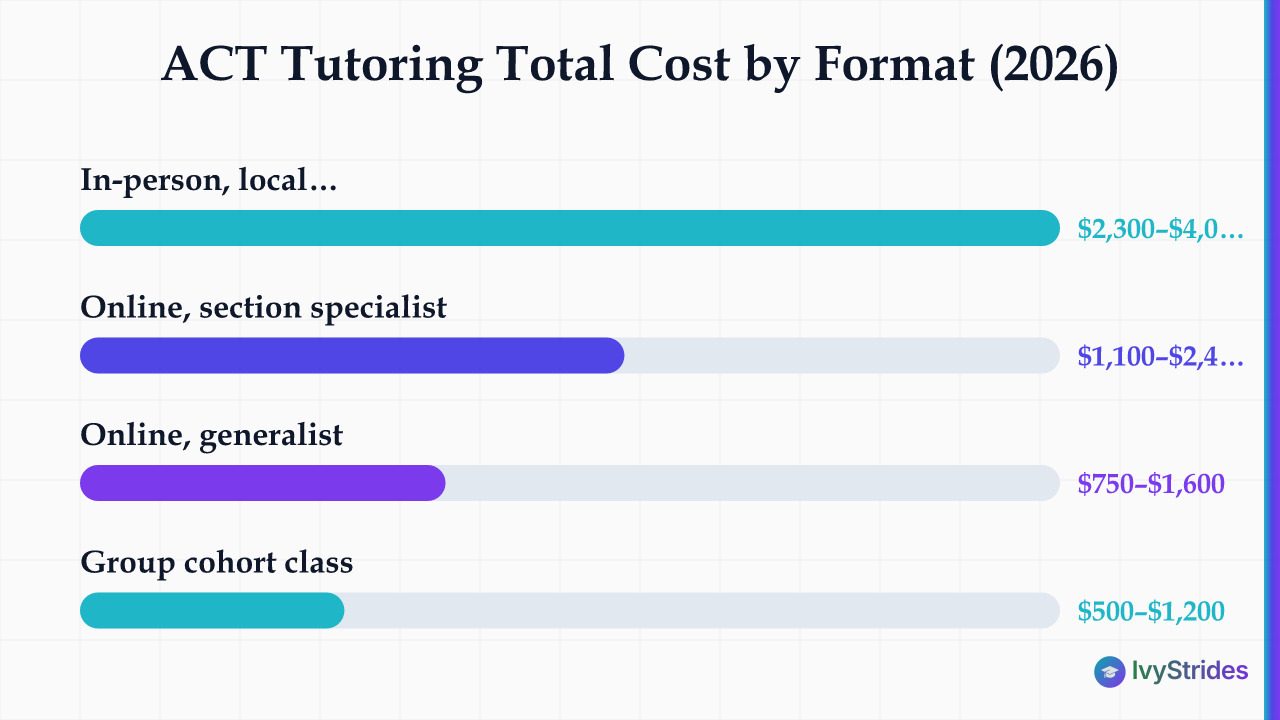
Private ACT tutoring in 2026 typically runs $50 to $200 per hour, and format drives most of that spread. Online ACT tutoring usually lands lower, around $60 to $120 an hour, while a local in-person specialist can reach $150 to $200. A realistic engagement that moves your Composite runs roughly 15 to 25 hours of targeted work, so plan for about $900 to $3,000 total.
That's the tutoring line, and the test itself is separate. ACT base registration is $70 for the core English, Math, and Reading test. Adding both optional sections brings it to $100, with the Science add-on at $5 and Writing at $25. Miss the regular deadline and late registration adds $42, the cheapest mistake to avoid on this whole list.
| Tutoring Format | Typical Hourly Rate | Typical Total | Best For |
| Online, section specialist | $75 to $120 | $1,100 to $2,400 | Most students |
| Online, generalist | $50 to $80 | $750 to $1,600 | Small, single-section gaps |
| In-person, local specialist | $150 to $200 | $2,300 to $4,000 | Accountability-driven learners |
| Group cohort class | $40 to $70 per session | $500 to $1,200 | Broad review on a budget |
For a full cost breakdown including late fees, score report fees, and how to reduce total spend, see our ACT tutoring cost guide. If registration cost itself is the barrier, our ACT fee waivers breakdown covers who qualifies.
Is ACT Tutoring Worth the Cost for Your Score Goal?
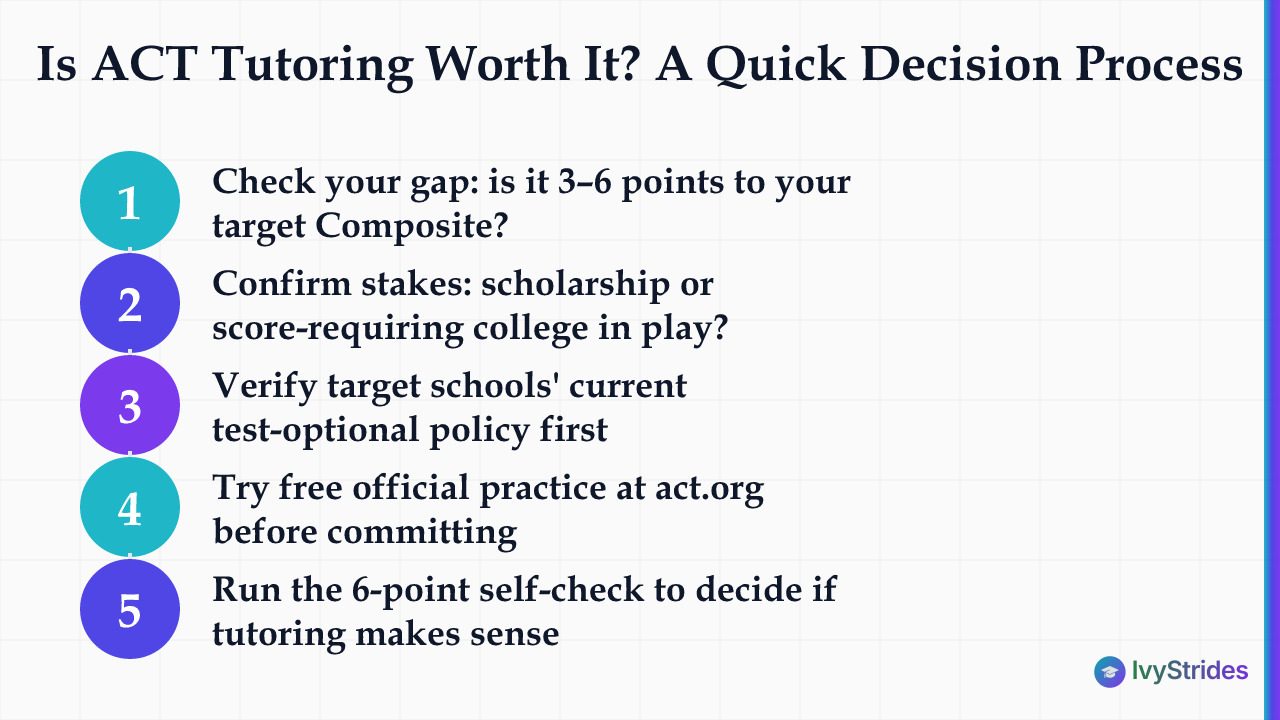
ACT tutoring is worth the cost when the gap between your current and target Composite is 3 to 6 points and something concrete rides on closing it, a merit scholarship threshold or a college that still requires scores. Below a 2-point gap, disciplined self-study with official practice often gets you there. The stakes decide, not the format.
Know what the Composite is first. Your ACT Composite is the average of English, Math, and Reading, rounded to the nearest whole number, on a 1 to 36 scale. Science and Writing are scored separately and sit outside the Composite. So a tutor who "improves your Science reasoning" hasn't moved the number colleges quote unless one of your three core section scores climbed too.
Does paid help actually work? Research published in ERIC by Moore (2019) found that students who worked with a private tutor improved their ACT retest scores. That's improvement, not a promised point total. How far your Composite moves depends on your starting point, the hours you invest and your consistency, not on the tutoring format alone.
Weigh test-optional carefully. Test-optional policies vary by school and year, so a strong score still matters at many colleges. College Board's own list names 21 private and 42 public colleges that currently or soon will require SAT or ACT scores, some starting with Fall 2027 entry, and the list changes often. Before you spend on tutoring, confirm your target schools' current policy.
Run this quick self-check before you commit:
- Your gap to your target Composite is 3 or more points
- A merit scholarship or a score-requiring college is in play
- One or two sections, not all four, are pulling the number down
- You have 8 or more weeks before your chosen test date
- Free official practice at act.org hasn't moved your score alone
- You'll commit to consistent weekly hours, not a cram weekend
If you're unsure how far you can climb, see how much you can realistically improve your ACT score by starting score band. And if you haven't settled on the ACT yet, the format differences covered in our ACT vs SAT comparison can help you choose before you invest in tutoring.
What to Look for in a Private ACT Tutor, Local or Online
A qualified private ACT tutor knows one section cold, opens with a real diagnostic assessment, and can name the specific question types costing you points. Whether that tutor sits in your town or on a screen matters far less than whether they specialize. The single biggest predictor of a wasted engagement is a generalist reviewing everything evenly.
Section fit is the whole game, because each section runs on its own clock. The enhanced ACT English section is 50 questions in 35 minutes, 40 of them scored; Math is 45 questions in 50 minutes, 41 scored, with four answer choices instead of five; Reading is 36 questions in 40 minutes, 27 scored; and optional Science is 40 questions in 40 minutes, 34 scored and outside the Composite. A tutor who can't name your bottleneck can't fix it.
Reading pacing is the usual culprit. In our coaching with students in the 24-28 Composite band, Reading pacing is the most common bottleneck. Reading gives you 36 questions in 40 minutes, about 67 seconds each (IvyStrides' arithmetic from ACT's published format), and because nine of the 36 are unlabelled field-test items, you have to pace for all of them. Students who haven't practiced under that constraint often run out of time on the last passage, so start with a full diagnostic and target your weakest section first.
| Criterion | Green Flag | Red Flag |
| Section focus | Specializes in your weak section | Teaches all four the same way |
| First session | Opens with a full diagnostic | Jumps straight to worksheets |
| Method | Retesting on a spaced schedule | No plan to remeasure |
| Track record | Cites typical gains by band | Promises a guaranteed number |
| Section format | Knows current question counts | Quotes legacy 75-question English |
| Homework | Assigns targeted weakness work | Hands out generic packets |
This is exactly how IvyStrides 1-on-1 ACT prep is built: a diagnostic-first plan, a section-specialist coach matched to your weakest section, then targeted weakness work and spaced retesting to lock the gain in. You can meet our ACT coaches by section to see the match. Once you've picked a format, a structured week-by-week plan is what turns sessions into points; our ACT prep in 2 months plan maps exactly that.
FAQ: ACT Tutoring Costs and Worth
How much do ACT tutors cost?
Private ACT tutors typically charge $50 to $200 per hour depending on format and expertise. Online tutors often run $60 to $120 an hour; local in-person specialists can reach $150 to $200. A realistic 4-point Composite gain usually requires 15 to 25 hours of targeted work, putting total spend in the $900 to $3,000 range. ACT registration itself starts at $70 for the core test.
Is ACT tutoring worth it?
For students with a 3 to 6 point gap between their current and target Composite, tutoring is typically worth it, especially when a merit scholarship threshold or a score-required college is in play. Research published in ERIC by Moore (2019) found that working with a private tutor improved ACT retest scores. Free resources alone rarely close a gap that large within a single test cycle.
What is the average price for a private tutor?
For ACT-specific prep, average private tutor rates in 2026 run about $75 to $130 per hour online and $100 to $175 in person. Rates vary by section specialization, track record, and location. Generalist tutors cost less but usually produce smaller gains than tutors who specialize in the exact section dragging your Composite down.
How can I improve my ACT score quickly?
The fastest gains come from identifying the one or two sections pulling your Composite down, then drilling those sections' specific question types. In our coaching, students who start with a full diagnostic and focus on their weakest section first gain 2 to 3 Composite points faster than those reviewing everything evenly. With 8 to 12 weeks of consistent work, a 4-point gain is realistic.
Your Next Step on the ACT Tutor Decision
The "near me" search is really a question about fit and stakes, not maps. Decide the format on your learning style and schedule, then judge any tutor on section expertise and a real diagnostic.
- Pin down your current Composite and your target, section by section
- Pick a format: in-person if you need the room, online if you need the reach
- Vet at least one tutor against the green-flag list above
- Register for your nearest ACT date before the regular deadline passes

Award-winning author (South Asian Book Award) and graduate of BITS Pilani and UCLA Luskin School of Public Affairs. Brings a published writer's eye to Common App essays and grammatical precision to SAT and ACT R&W instruction.