
SAT Geometry Formulas You Actually Need to Memorize (2026)
On this page
- What the Digital SAT Geometry Reference Sheet Actually Gives You
- SAT Geometry Formulas You Must Memorize (Not on the Reference Sheet)
- Not sure which of these formula gaps is costing you the most points?
- How to Use SAT Geometry Formulas Efficiently on Test Day
- SAT Math Score Context: What 450, 600, and 700+ Mean for Geometry
- Ready to turn formula knowledge into real score gains?
- Frequently Asked Questions: SAT Geometry Formulas You Actually Need to Memorize
- Do they give you geometry formulas on the SAT?
- Is a 450 on SAT Math bad?
- How rare is an 800 on SAT Math?
- What formulas are not given on the SAT that I still need to know?
- Your Next Step on SAT Geometry
The Digital SAT gives you a built-in reference sheet with 12 geometry formulas and 2 angle facts: area and circumference of a circle, area of triangles and rectangles, the Pythagorean theorem, both special right triangle ratios, and volume formulas for boxes, cylinders, spheres, cones, and pyramids. You don't memorize those. What you do memorize: arc length, sector area, the equation of a circle, the distance and midpoint formulas, and basic trigonometric identities. Those appear on real test questions and are absent from the sheet.
That split is the whole game. The formulas the College Board hands you are the low-difficulty ones; the ones it withholds are where students in active prep quietly lose points. The rest of this article gives you both lists, a memorization method, and score-band context.
What the Digital SAT Geometry Reference Sheet Actually Gives You
The Digital SAT reference sheet is a fixed panel of 12 formulas and 2 geometric facts, identical on every test form, reachable through a button in the Bluebook app during the Math section. What you see in practice is exactly what you see on test day.
Geometry and trigonometry is one of four content domains on the Digital SAT Math section; for a full breakdown of every domain and question type, see our sat math topics guide. Here's the part most students miss: the sheet lists both special right triangle ratios, so 30-60-90 and 45-45-90 are given, not memorized.
| Formula or Fact | What It Covers | Memorize It? |
| A = πr² | Area of a circle | No, given |
| C = 2πr | Circumference of a circle | No, given |
| A = ℓw | Area of a rectangle | No, given |
| A = ½bh | Area of a triangle | No, given |
| a² + b² = c² | Pythagorean theorem | No, given |
| 30-60-90 ratio 1 : √3 : 2 | Special right triangle | No, given |
| 45-45-90 ratio 1 : 1 : √2 | Special right triangle | No, given |
| V = ℓwh | Volume of a rectangular prism | No, given |
| V = πr²h | Volume of a cylinder | No, given |
| V = 4/3 πr³ | Volume of a sphere | No, given |
| V = 1/3 πr²h | Volume of a cone | No, given |
| V = 1/3 ℓwh | Volume of a pyramid | No, given |
| Sum of angles in a triangle = 180° | Angle fact | No, given |
| Degrees in a circle = 360° | Angle fact | No, given |
A free walkthrough of the sheet lives on the College Board's official practice platform. Bookmark it, then stop studying those 14 lines. For how these questions feed your section score, see how the Digital SAT is scored.
SAT Geometry Formulas You Must Memorize (Not on the Reference Sheet)

Photo by https://kaboompics.com/ on Pexels
The formulas that cost points are the ones the reference sheet leaves out, and about ten are worth committing to memory. These all sit inside the geometry and trigonometry domain and appear on real Digital SAT forms, per the College Board's Math content specifications. None show up when you tap the reference button.
In our coaching with students scoring in the 550-650 Math band, arc length and the equation of a circle are the two most commonly missed formula-dependent question types. Both, along with trig identities like the complementary angle rule and the Pythagorean identity, appear most often in Module 2 when the adaptive algorithm routes you to the difficult path after a strong Module 1.
| Formula | Category | When It Appears | Difficulty |
| Arc length = (θ/360) × 2πr | Circles | Module 1 and 2 | Medium-hard |
| Sector area = (θ/360) × πr² | Circles | Module 1 and 2 | Medium-hard |
| (x−h)² + (y−k)² = r² | Equation of a circle | Both; harder in Module 2 | Hard |
| d = √((x₂−x₁)² + (y₂−y₁)²) | Coordinate geometry | Any module | Medium |
| Midpoint = ((x₁+x₂)/2, (y₁+y₂)/2) | Coordinate geometry | Any module | Easy-medium |
| m = (y₂−y₁)/(x₂−x₁) | Coordinate geometry | Any module | Easy-medium |
| SOH-CAH-TOA | Trigonometry | Any module | Medium |
| sin(x) = cos(90−x) | Trig identity | Hard Module 2 | Hard |
| sin²(x) + cos²(x) = 1 | Trig identity | Hard Module 2 | Hard |
| Exterior angle = sum of two non-adjacent interior angles | Lines and angles | Any module | Medium |
Notice the pattern. Coordinate geometry and circles carry the heaviest memorization load, and both reward you for knowing the formula cold. The distance formula is just the Pythagorean theorem applied to two points, and the slope formula rebuilds from rise over run, but rebuilding costs seconds you don't have at about 82 seconds per question.
Once you know which formulas to memorize, the next step is a practice plan; our sat math prep guide walks through the diagnostic-to-target-score process.
Not sure which of these formula gaps is costing you the most points?
A free 15-minute strategy call with an IvyStrides SAT Math coach gives you a diagnostic snapshot of your geometry weak spots and a targeted plan to close them before your test date. Students and parents are both welcome.
How to Use SAT Geometry Formulas Efficiently on Test Day
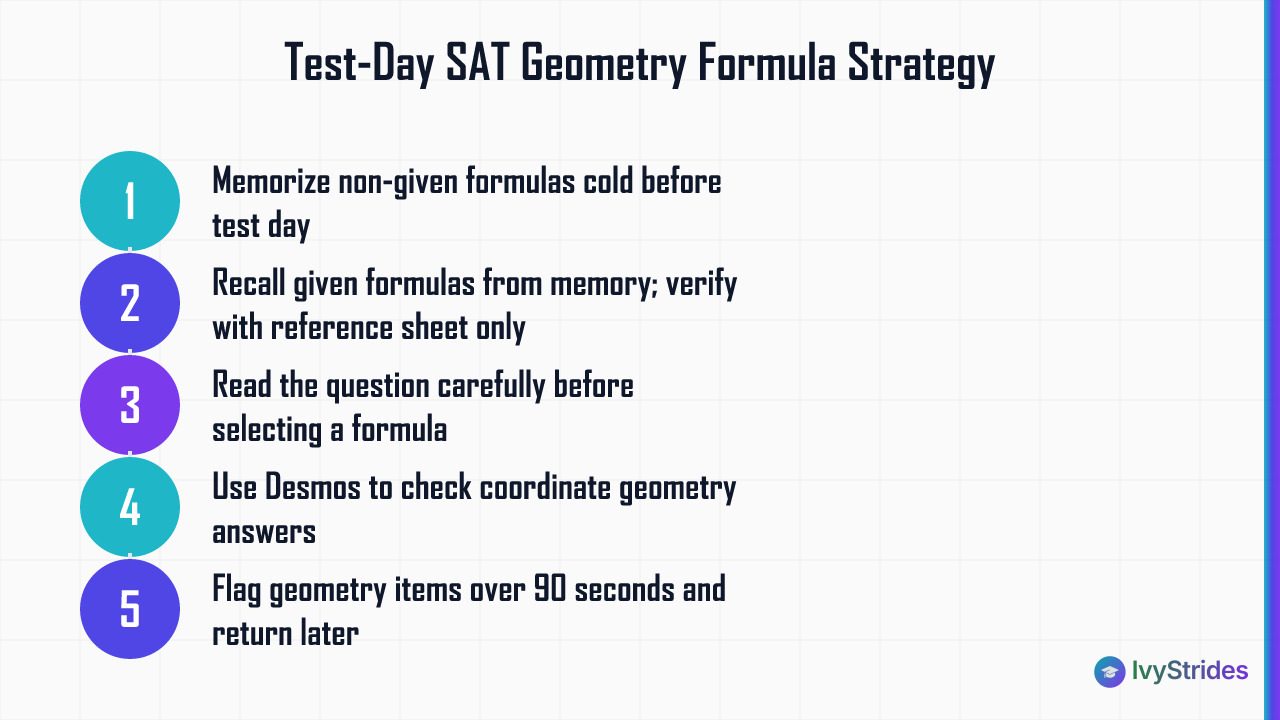
Efficient test-day formula use means knowing which formulas live in your head and which live one click away in Bluebook, then never confusing the two. The Math section runs 44 questions in 70 minutes, about 82 seconds per question, per the College Board's format specs. Opening the reference sheet mid-problem costs roughly 10 to 15 seconds each time.
The rule is simple. Memorize the non-given formulas first, because you can't look those up. Then drill the given formulas until recall is automatic, so you're not tapping the button for πr². In our coaching, students who have the reference-sheet formulas automatic rather than merely available save around 3 to 5 minutes across the Math section, and that time flows straight into the harder reasoning questions.
The Desmos calculator is built into the Math section throughout, and it's your fastest check on coordinate geometry. Plot two points, read the distance, confirm your formula work in seconds.
Test-Day Geometry Formula Checklist
- Confirm the non-given formulas are memorized cold before test day, not the morning of.
- Recall the given formulas from memory first; open the reference sheet only to verify.
- Read what the question asks, arc length or sector area, before choosing a formula.
- Use Desmos to check any coordinate geometry answer you have time to verify.
- Sketch the figure when the question gives coordinates but no picture.
- Flag and skip any geometry item eating more than 90 seconds, then return.
- After the test, log every geometry miss by formula type.
Logging every miss by formula type is the fastest way to find your personal gap; the sat error log template turns that pattern into a drill list. For official geometry sets to drill against, our roundup of which SAT practice test is the most accurate points you to real forms. Building a schedule around your test date? Our sat study plan spreads formula work across a 6-week to 6-month timeline.
SAT Math Score Context: What 450, 600, and 700+ Mean for Geometry
Your SAT Math score band, on the 200 to 800 scale, tells you how much geometry work you need, because the questions you see scale with the difficulty path the adaptive algorithm routes you to. A 450 sees mostly basic-area and Pythagorean questions; a 700 sees the equation of a circle and trig identities in a hard Module 2.
The national average SAT Math score sits around 520, per College Board score data. A 450 falls below that, roughly the 35th to 38th percentile, so geometry gaps there are usually one of several content issues. An 800 is approximately the 99th percentile, meaning near-perfect accuracy including every hard geometry item.
| Score Band | Geometry You Will See | Formula Priority | Point Recovery from Formula Work |
| 400-500 | Basic area, perimeter, Pythagorean theorem | Reference-sheet formulas usually enough | Modest; content gaps are broader |
| 500-650 | Arc length, sector area, coordinate geometry | Non-given formulas become critical | 15-25 points, in our coaching |
| 650-800 | Equation of a circle, trig identities, multi-step | Full memorization plus reasoning fluency | Smaller; reasoning speed dominates |
In our coaching with students in the 550-650 band, geometry and trigonometry formula gaps account for roughly 15 to 25 points of recoverable score. Wondering whether your Math score is competitive for your target schools? Our what is a good SAT score guide covers percentiles and benchmarks across the range. One caveat: a strong Math score helps, but admissions depend on the full application, and test-optional policies vary by school and year.
Ready to turn formula knowledge into real score gains?
IvyStrides sat 1-on-1 prep coaches work with students at every band, starting from a diagnostic test to find exactly where your points are going. Book a free 15-minute call and leave with a concrete next step, whether you're the student mapping your own plan or a parent weighing a coach.
Frequently Asked Questions: SAT Geometry Formulas You Actually Need to Memorize
Do they give you geometry formulas on the SAT?
Yes. The Digital SAT includes a built-in reference sheet with 12 geometry formulas and 2 angle facts, reachable through a button in the Bluebook app during the Math section. Several formulas that show up on real questions, though, are missing from it: arc length, sector area, the equation of a circle, and the distance formula all have to be memorized separately.
Is a 450 on SAT Math bad?
A 450 sits below the roughly 520 national average and lands around the 35th to 38th percentile, per College Board data. It's not disqualifying, but it points to real content gaps across geometry, algebra, and data analysis. In our coaching, students in this band typically recover 80 to 120 points within about 8 to 12 weeks of diagnostic-driven work.
How rare is an 800 on SAT Math?
An 800 is approximately the 99th percentile, so around 1 in 100 test-takers reaches it. At that level you need to answer nearly every question correctly, including the hardest Module 2 geometry and trigonometry items. Getting there takes fast, accurate multi-step reasoning, not just formula recall.
What formulas are not given on the SAT that I still need to know?
The ones absent from the reference sheet but tested regularly are arc length, sector area, the equation of a circle, the distance formula, the midpoint formula, the slope formula, SOH-CAH-TOA, the complementary angle identity sin(x) = cos(90−x), and the Pythagorean identity sin²(x) + cos²(x) = 1. Expect them most in the harder adaptive Module 2.
Your Next Step on SAT Geometry
You now have both lists: the 14 items the Digital SAT hands you and the ten it doesn't. The gap between them is where 30 minutes of targeted memorization turns into recovered points. To learn more about how we structure score-band coaching, see the IvyStrides about page. You can also meet the tutors who specialize in SAT Math.
Do these three things this week:
- Memorize the ten non-given formulas cold, starting with arc length, sector area, and the equation of a circle.
- Run two timed geometry drill sets using official Bluebook practice, about 10 questions each.
- Log every miss by formula type so your next study block targets your real gap.
Content current as of 2026 and reflects the Digital SAT format in place since the March 2024 rollout. Percentile and score figures are drawn from College Board's published data; question counts per form are representative and can vary slightly.

Two decades teaching quantitative and verbal aptitude on standardized tests. Rare dual expertise across Math and Verbal — particularly effective for students with gaps on both sides. Senior AP Mentor for our Calculus and English tracks.