
SAT Fees for International Students? Your Full 2026 Cost Breakdown (Plus Ways to Save)
On this page
- The 2026 SAT Fee Table for International Students: Every Number in One Place
- Why International Students Cannot Get an SAT Fee Waiver (And What to Do Instead)
- Additional SAT Fees International Students Often Miss
- How to Register for the SAT as an International Student (and Avoid Costly Mistakes)
- What SAT Score Should International Students Actually Target?
- How to Spend Less on the SAT Without Cutting Corners
- How Much Does It Cost to Retake the SAT as an International Student?
- Is the SAT Worth the Cost for International Students?
- FAQ
- Can international students get an SAT fee waiver?
- How much does the SAT cost in India, the UK, and other countries?
- What is the SAT late registration fee for international students?
- Is a 1300 a good SAT score for international students?
- Is a 1450 a good SAT score for international students?
- Are there any ways to get help paying for the SAT as an international student?
- Making Every Attempt Count
International students pay $111 to register for the SAT in 2026: a $68 base registration fee plus a $43 international testing fee applied to every student sitting the exam outside the United States and its territories. That $111 covers one test date at one approved international test center. Add-ons like late registration ($38), test-center changes ($34), and score sends ($15 per college after your free sends) can push a single attempt past $200. Fee waivers aren't available to students testing internationally. Every figure here traces back to the College Board official international fee page and reflects the current published schedule for the 2025-26 testing year.
The harder question, how to keep your total spend from ballooning across multiple attempts, is where the next section starts.
The 2026 SAT Fee Table for International Students: Every Number in One Place
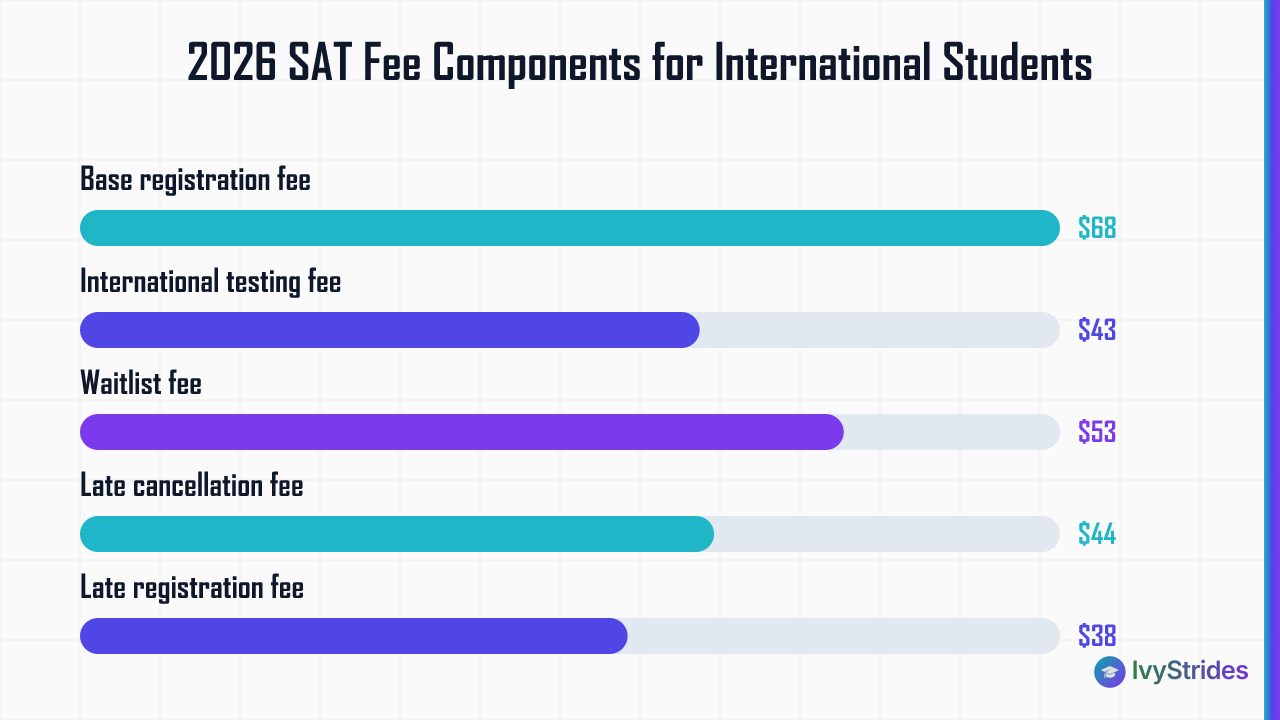
Here's the full picture.
| Fee | Amount (USD) | When it applies |
| Base registration fee | $68 | Every SAT registration, worldwide |
| International testing fee | $43 | Any test center outside the US, US territories, or Canada |
| Baseline total (international) | $111 | Standard registration, on time |
| Late registration | $38 | Registering after the standard deadline |
| Test-center change | $34 | Switching your assigned test center |
| Late cancellation | $44 | Cancelling after the cancellation deadline |
| Waitlist | $53 | Testing on a waitlist basis (if seats open) |
| Additional score report | $15 per recipient | Sending scores to colleges beyond your 4 free sends |
| Rush score report | $31 per recipient | Expediting a score send |
| Official source | n/a | College Board international fee page |
The $111 baseline is a floor, not a ceiling. Some international test centers add a local administrative fee on top of the College Board charges, disclosed at the specific center's listing. For a step-by-step walkthrough of the registration workflow itself, see our SAT exam registration guide.
Source: College Board's official SAT registration and fees pages. Fees reflect the current published schedule; College Board updates fee tables annually, so verify at registration.
Why International Students Cannot Get an SAT Fee Waiver (And What to Do Instead)
Short answer: no. Per College Board policy, SAT fee waivers are available only to eligible students who reside and test in the United States or a US territory. Foreign nationals studying in the US may qualify if they meet both residency and financial eligibility requirements. Students testing at an international center outside the US aren't eligible, regardless of financial need.
That's the honest answer. The follow-up frustration is legitimate: international students already pay a roughly $43 surcharge that US peers don't, and they can't access the waiver US peers can.
Here's what you can control:
- Register on time. Skipping the late fee saves roughly $38 per attempt. Across three sittings, that alone is $114.
- Designate score recipients at registration. You get 4 free sends within 9 days of your test date. Using them saves $15 per college.
- Cut retakes with real prep, not more attempts. Every avoided sitting saves at least $111. This is the largest lever most families miss.
- Check local subsidies. Some national scholarship bodies, embassies, or high schools in specific countries offer testing subsidies. Your school counselor is the best source; IvyStrides can't verify country-by-country availability.
If your plans shift after you've paid, know the cancellation calendar so you don't lose roughly $44 unnecessarily; our how to cancel SAT registration post walks through the deadlines.
Before you register, our free SAT resources page is a useful place to scope your baseline without spending anything.
Additional SAT Fees International Students Often Miss
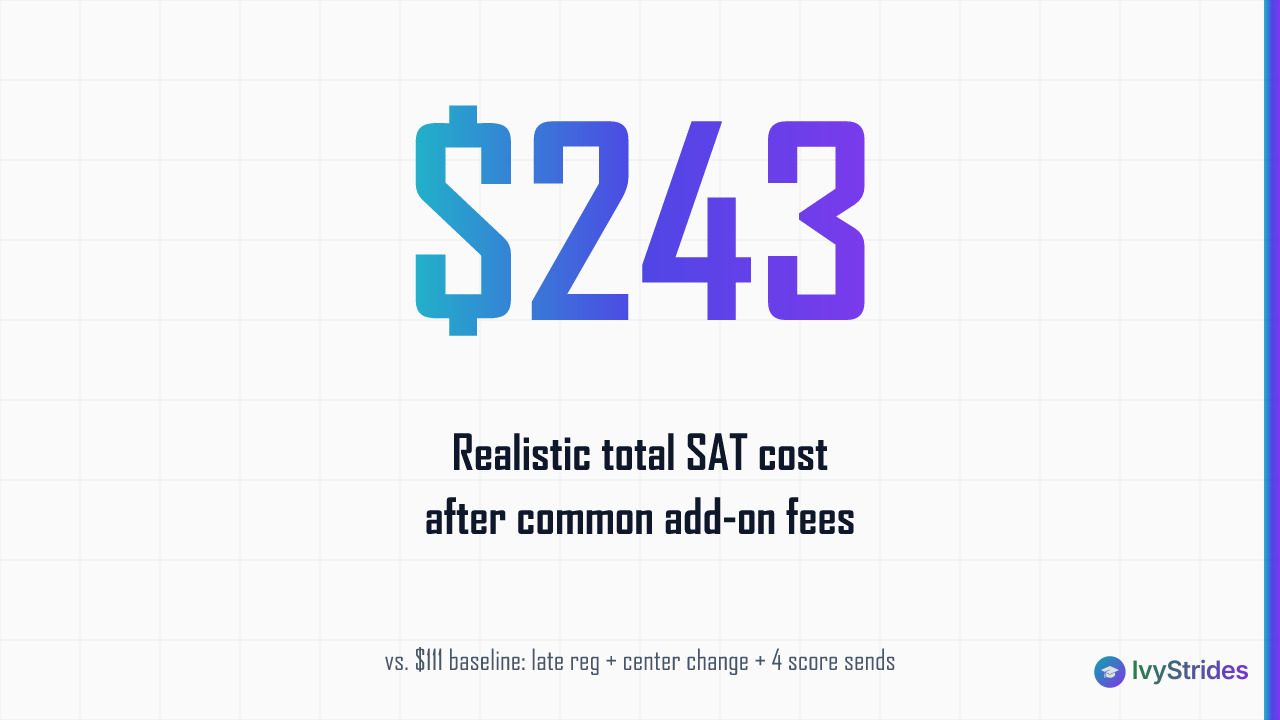
If your plans change after registration, understanding the cancellation and refund rules can save you the $44 late-cancel fee. It's one of a handful of costs that quietly turn a $111 registration into something closer to $250.
Look at a realistic scenario. A student registers late (roughly $38), realizes their assigned center is two hours away and switches ($34), sits the exam, then decides after the fact to send scores to four colleges they didn't designate at registration (4 × $15 = $60). Total: $111 + $38 + $34 + $60 = $243. Same test, same score, more than double the baseline.
The line items to watch:
- Late registration ($38). Triggered the moment you miss the standard deadline. Register early. This is the easiest fee to avoid.
- Test-center change ($34). Triggered if you change your assigned center after registering. Verify seat availability and distance before you confirm.
- Late cancellation ($44). Triggered if you cancel after the cancellation window closes. If life changes, cancel promptly.
- Waitlist ($53). Triggered if you register through the waitlist after the late deadline. Painful, and avoidable by registering on time.
- Score sends ($15 per college). After your 4 free sends, every additional college costs $15. Plan your college list before test day. Our how to send SAT scores guide covers the mechanics.
- Rush score reports ($31 per recipient). Only relevant near application deadlines.
- Local center administrative fees. Vary by country and center. Disclosed at the specific center's listing.
- Payment method costs. College Board accepts major credit and debit cards. If you pay in a non-USD currency, expect a foreign transaction fee from your card issuer on top of the College Board charge.
Sending scores adds $15 per recipient after your free sends are used, so building your college list before test day is one of the highest-value moves you can make. If your prep plan is still fuzzy at this stage, our SAT prep overview walks through how a diagnostic-first approach reduces total spend.
How to Register for the SAT as an International Student (and Avoid Costly Mistakes)
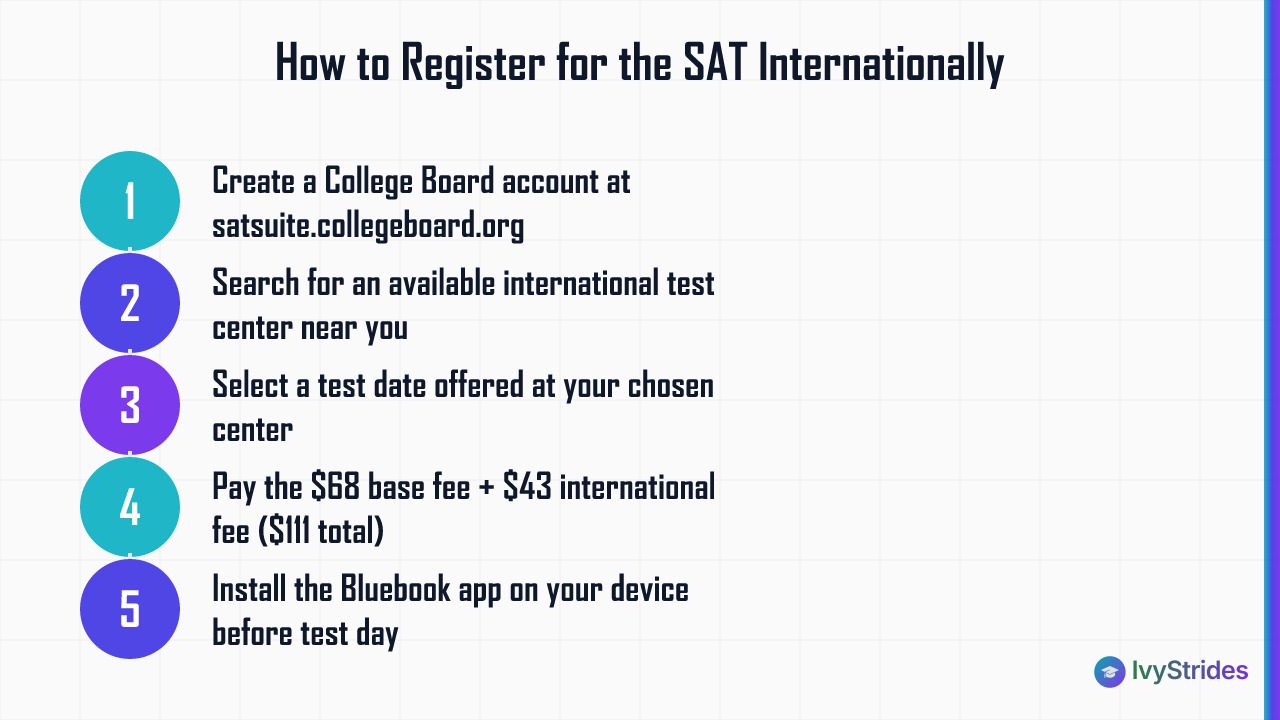
Before you pay the fees, you need to know how SAT registration works for international students, including test-center selection and the Bluebook app requirement.
The workflow, in order:
-
Create a College Board account at satsuite.collegeboard.org. You'll use the same account to view scores and send them later.
-
Search for an international test center. Availability varies widely by country. High-demand markets, including India, China, South Korea, UAE, and Nigeria, fill fast, sometimes within days of a new date opening.
-
Select a test date. International test dates are a subset of US dates. Confirm your chosen date is offered at your target center.
-
Pay the $68 base fee plus $43 international fee ($111 total).
-
Install the Bluebook app on your testing device before test day. The Digital SAT is delivered through Bluebook on a laptop or tablet you bring (or the center provides). No app, no test.
The Digital SAT has been fully digital since March 2024, delivered as two adaptive sections (Reading and Writing, then Math), each split into two adaptive modules. Your Module 2 difficulty is set by your Module 1 performance. Every authorized international test center supports this format via Bluebook.
Two mistakes that quietly cost money:
- Waiting until the late deadline. Popular international centers close well before the late deadline. You then pay $38 late plus risk the $53 waitlist fee for a seat that never opens.
- Choosing a distant center to grab any seat. Then paying $34 to move later. If your first-choice center is full, our what to do if SAT test centers are full post covers the sequence to follow.
The single best hedge against both problems is registering as soon as the window opens for your target date.
What SAT Score Should International Students Actually Target?
Knowing what score you need helps you decide how many attempts to budget for, which directly affects how much you spend in total.
A rough map of the score landscape for international applicants to US universities:
- 1300: above the US national average but below the median at most selective universities. A workable starting point, not a final destination for students targeting top-50 schools.
- 1400-1450: competitive at a wide range of strong US universities and often at or just below the median at flagship state schools.
- 1500+: within the middle-50% range at highly selective universities.
- 1550+: at or above the median for the most selective schools in the country.
For concrete benchmarks, the middle-50% SAT composite range at MIT is roughly 1520-1580 and at UPenn roughly 1500-1560, per each school's most recent Common Data Set. Our deeper dives on MIT SAT requirements and UPenn SAT Requirements 2026: Score Range, Tips and Strategy break down what those numbers mean for an international applicant's overall profile.
Test-optional policies vary by school and year, so confirm each target college's current policy before deciding whether to submit. Test-optional isn't test-blind: at most schools that still accept scores, a strong SAT is rarely a negative and often a meaningful positive.
The link to cost: in our coaching with students at the 1200-1350 band, a diagnostic-driven plan typically produces gains of roughly 150-200+ points across a few months of focused work. A student who reaches their target on attempt two rather than attempt four saves $222 in registration fees alone, before score sends. For a broader look at how scoring works, see our guide to the SAT score scale and percentiles.
How to Spend Less on the SAT Without Cutting Corners
Reducing the number of retakes you need is the most reliable way to lower your total SAT spend, which is why starting with a diagnostic test and a targeted study plan matters before you register.
The concrete moves, in order of impact:
-
Take a full-length diagnostic before your first registration. If you're roughly 200 points below your target with three months to go, you're not ready. Registering anyway means paying $111 for a rehearsal you could have done at home.
-
Register on time. Save $38 per attempt.
-
Plan your college list before test day. Use all 4 free score sends. Save $60 per attempt if you'd otherwise send to four colleges post-test.
-
Use official Digital SAT practice. College Board's Bluebook app includes free full-length adaptive practice tests written by the exam authors. Start there. Supplement with our SAT practice tests library and structured plan.
-
Follow a real study plan instead of drifting. Our 30-Day SAT Study Plan 2026 to Boost Your SAT Score Fast is designed for students in the final month before test day.
-
Get section-specialist help where you're weakest. Most students plateau because they practice everything and target nothing. Our 1-on-1 SAT prep pairs students with a Reading & Writing specialist and a Math specialist rather than a single generalist tutor.
The math: two retakes avoided by real prep saves at least roughly $222 in registration fees, before you count score sends and late fees. For most families, targeted prep pays for a meaningful chunk of itself in reduced testing costs alone, and the admissions upside sits on top of that.
How Much Does It Cost to Retake the SAT as an International Student?
Each retake costs the same $111 baseline: $68 base plus $43 international, per College Board's fee schedule. College Board doesn't cap the number of times you can sit the SAT, so retake economics matter.
Three-attempt math for a typical international student:
- 3 registrations at $111 each = $333, per College Board's official fee schedule
- Plus $15 per college for any sends beyond the 4 free per test date
- Plus any late fees, center changes, or waitlist fees
Most selective US universities superscore the SAT, meaning they combine your best Reading and Writing score and best Math score across sittings. Two focused attempts, each targeting one section for improvement, often outperform three unfocused ones both on final score and on total cost.
In our coaching, students who complete a diagnostic-driven plan before their first attempt typically reach their target score in one or two attempts rather than three or four. That's a pattern, not a promise. For the broader picture on retake timing and strategy, see our how many times can you take the SAT guide. For the on-your-own study path, the official SAT study guide 2026 walks through the core content.
Is the SAT Worth the Cost for International Students?
Honestly, for most international applicants to US universities, yes. Here's the case, weighted.
Even under test-optional policies, many US universities still review submitted SAT scores from international applicants, and a strong score can offset weaker elements elsewhere in an application. A 1450+ from an applicant in a country where grade inflation or curriculum differences make transcripts harder to interpret is a clean, calibrated signal admissions officers trust.
Additional angles:
- Merit scholarships often require or strongly prefer a submitted score. Some universities publish minimum SAT thresholds for automatic merit awards.
- Non-US universities also review SAT scores. Bocconi, IE, SSE, and select programs in the UK and Asia accept or require the SAT.
- ROI framing. A total SAT spend of $111 to roughly $333 across one to three attempts is a small fraction of the total cost of a US college application cycle. If a competitive score lifts your admit probability or unlocks scholarship consideration, the fee math isn't close.
The caveats are real. Test-optional policies vary by school and year; always verify at FairTest and the college's own admissions page before deciding whether to submit. No score guarantees admission anywhere; the full application still matters. If you're weighing the SAT against the ACT before committing, our ACT vs SAT: which test to choose breakdown covers the decision framework.
The clean way to decide is a diagnostic, a target-score conversation, and an honest look at your college list. That's exactly what a Free SAT consultation delivers.
FAQ
Can international students get an SAT fee waiver?
No. College Board fee waivers are available only to eligible students who reside and test in the United States or US territories. Students testing at international test centers outside the US aren't eligible, regardless of financial need. Foreign nationals studying in the US may qualify if they meet the residency and financial eligibility criteria. The most reliable cost-reduction path for international students is registering before the standard deadline (saves $38), designating all 4 free score sends at registration (saves up to $60), and reducing retakes through structured prep.
How much does the SAT cost in India, the UK, and other countries?
The College Board charges the same $68 base fee plus $43 international fee ($111 total) regardless of country, per the official international fee page. Some local test centers add a small administrative fee, disclosed at the specific center's listing during registration. Check your target center's page on the College Board site for any center-specific surcharge before you confirm.
What is the SAT late registration fee for international students?
The late registration fee is roughly $38, bringing your total to $149 if you register after the standard deadline. There's also a $53 waitlist fee if you attempt to register after the late deadline and a seat opens up. Registering as soon as your target date opens is the simplest way to avoid both charges.
Is a 1300 a good SAT score for international students?
A 1300 is above the US national average but below the median at most selective universities. For context, MIT's middle-50% composite range runs roughly 1520-1580. A 1300 is a reasonable starting point rather than a target. In our coaching with students at the 1200-1300 band, a diagnostic-driven plan typically produces gains into the 1400-1500 range across a few months of focused work. Where you should land depends on your target college list.
Is a 1450 a good SAT score for international students?
Yes. A 1450 is competitive at a wide range of strong US universities and is respected by UK and select European universities that consider SAT results. It sits below the median at the most selective schools (Harvard, MIT, Princeton, Stanford), where middle-50% ranges typically start around 1500. If your list is heavy on top-10 schools, aim for 1500-1550. Test-optional policies vary by school and year, so confirm each college's current policy before deciding to submit.
Are there any ways to get help paying for the SAT as an international student?
College Board fee waivers aren't available internationally. Some national governments, local scholarship programs, or school systems in specific countries offer subsidies for standardized testing; check with your school counselor or local education ministry. The most reliable lever for most families is reducing retakes through structured preparation.
Making Every Attempt Count
The full 2026 SAT budget for an international student sits anywhere between $111 for a single clean sitting and $400+ across three attempts with late fees, center changes, and post-test score sends layered on. The difference isn't luck; it's planning. Register early, designate score sends at registration, take a real diagnostic before you pay, and put the prep work in before your first attempt rather than between attempts two and three. To see who works with students at each score band, meet the IvyStrides team. For more on our methodology, read about IvyStrides.

Award-winning author (South Asian Book Award) and graduate of BITS Pilani and UCLA Luskin School of Public Affairs. Brings a published writer's eye to Common App essays and grammatical precision to SAT and ACT R&W instruction.