
Most Tested SAT Grammar Rules: The Complete 2027 Guide for Students and Parents
On this page
- What the SAT Actually Tests in Its Grammar Questions
- The Most Tested SAT Grammar Rules, From College Board's Skill List
- Why Students Keep Missing SAT Grammar Questions (and the Pattern Behind It)
- How to Practice SAT Grammar Rules Efficiently Before Test Day
- FAQ: Most Tested SAT Grammar Rules
- What are some important grammar rules to remember for the SAT?
- Is a 700 on SAT Reading and Writing a good score?
- How do I improve my SAT grammar score?
- What grammar rules should I focus on for SAT Reading and Writing?
- Your Next Step on SAT Grammar
The most tested SAT grammar rules are the ones College Board lists in its Standard English Conventions domain: sentence boundaries and punctuation, subject-verb agreement, pronoun-antecedent agreement, verb tense and form, modifier placement, and plurals and possessives. Standard English Conventions is the question domain inside the Reading and Writing section that checks these rules, and College Board's assessment framework puts it at approximately 26% of operational questions (11–15 questions).
Those rule types run across both modules of the Reading and Writing section, which College Board builds as 54 questions in 64 minutes. Here's the distinction that trips most students up: the SAT does not ask you to name a rule. It asks you to pick the version of a sentence that obeys it, which is a different skill.
What the SAT Actually Tests in Its Grammar Questions
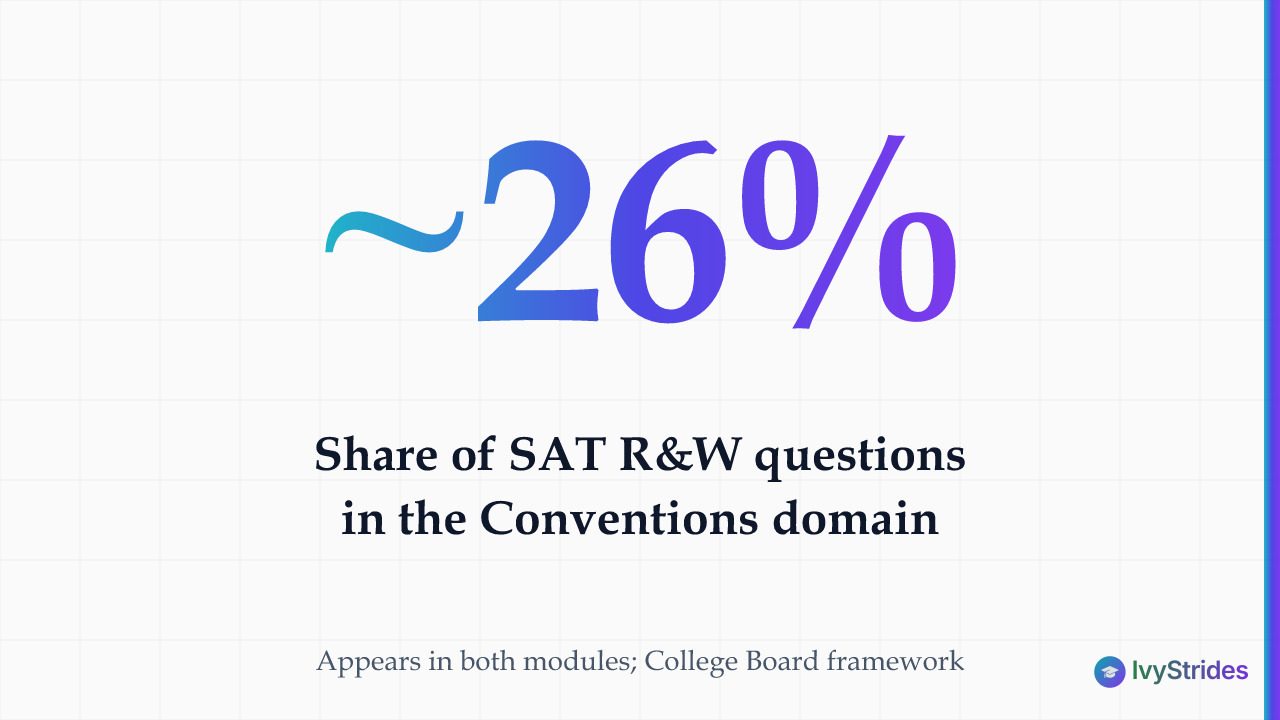
SAT Standard English Conventions is one of four content domains inside the Reading and Writing section, and it tests sentence structure, usage, and punctuation. The other three domains (Information and Ideas, Craft and Structure, Expression of Ideas) show up in the breakdown of all four Reading and Writing content domains. A conventions question gives you a short text, often one or two sentences, with one blank, then four answer choices that differ only in punctuation or word form.
Scored grammar questions count toward your Reading and Writing section score, which College Board reports on a 200-800 scale and adds to your Math score to produce the 400-1600 total. The College and Career Readiness benchmark for Reading and Writing is 480.
Pace matters here. College Board's assessment framework gives students an average of 1.19 minutes per Reading and Writing question, so a student who stops to parse a long modifier falls behind. The section is also adaptive by module: your performance on Module 1 routes you to a higher- or lower-difficulty Module 2, so early accuracy on these questions shapes the rest of the section.
| Feature | Detail |
| Questions | 54 |
| Time | 64 minutes |
| Modules | Two 32-minute modules |
| Average time | 1.19 minutes per question |
| Adaptive | Module 2 difficulty set by Module 1 |
| Score scale | 200-800 (feeds the 400-1600 total) |
| Conventions domain | Approximately 26% of operational questions; appears in both modules |
The Most Tested SAT Grammar Rules, From College Board's Skill List
College Board does not publish how often each individual rule appears, so this list follows the official skill descriptions rather than a frequency count. The framework splits the domain into two testing points: Boundaries, which covers punctuation that joins or separates clauses and sentences, and Form, Structure, and Sense, which covers usage such as agreement, verb tense, modifiers, and possessives.
Punctuation and sentence boundaries. A semicolon joins two independent clauses without a conjunction, exactly as a period would. A colon introduces a list or explanation, but only after an independent clause. A comma plus a FANBOYS conjunction (for, and, nor, but, or, yet, so) joins two independent clauses. The classic error is the comma splice: two full sentences joined by a comma alone. Some questions test the reverse: a lone comma never separates a subject from its verb.
Subject-verb agreement. Singular subjects take singular verbs; plural subjects take plural verbs. The SAT buries the test by dropping a prepositional phrase between the subject and the verb: "The box of old photographs (was/were) heavy." Strip "of old photographs" and the answer is obvious.
Pronoun-antecedent agreement. A pronoun must match its antecedent in number. The usual trap is a group noun or a distant antecedent: "The committee published (its/their) findings." The committee is one body, so "its" is correct.
Verb tense and form. The verb must fit the time frame the passage sets, and every sentence needs a finite main verb. A gerund, participle, or infinitive cannot carry a sentence on its own.
Modifier placement. An introductory modifier must describe the subject of the main clause. A dangling modifier has no logical subject in the sentence at all.
Plurals and possessives. Choose among singular, plural, and possessive nouns, and between possessive determiners (its, their, your) and contractions (it's, they're, you're). Read "it's" as "it is" or "it has"; if neither fits, you need "its."
Each punctuation sub-rule rewards worked repetition, so the punctuation and grammar rules that earn points on the SAT set out the comma, semicolon and colon rules with a worked example.
| Grammar Rule | What the SAT Tests | Quick Signal to Look For |
| Punctuation | Semicolons, colons, commas with FANBOYS | Answer choices differ only in the mark |
| Subject-verb agreement | Verb matching a disguised subject | A phrase sits between subject and verb |
| Pronoun-antecedent agreement | Pronoun matching its noun in number | A group noun, or a pronoun far from its noun |
| Verb tense and form | Tense, and a finite main verb | Choices mix -ing, -ed and to forms |
| Modifier placement | Introductory phrase and subject match | Sentence opens with an -ing or -ed phrase |
| Plurals and possessives | Plural vs. possessive, its vs. it's | Choices differ only by an apostrophe |
This video shows how to tell plural nouns from possessives using apostrophe rules, with examples like girls uniforms.

More videos like this one: follow IvyStrides on YouTube for daily SAT and ACT preparation tips.
Why Students Keep Missing SAT Grammar Questions (and the Pattern Behind It)
Students miss SAT grammar questions because the rule is hidden behind a predictable disguise, not because the rule is obscure. The rules from the list above get re-dressed in three recurring costumes.
The intervening phrase. The SAT separates a subject from its verb with a long phrase, usually a prepositional phrase: "A collection of rare manuscripts (is/are) displayed downstairs." The ear wants "manuscripts are." The subject is "collection," so the verb is "is."
Watch how ignoring a prepositional phrase reveals the true singular subject and the correct verb form.

The mismatched opener. A sentence begins with a participial phrase whose subject never shows up: "Having studied for weeks, the exam felt easy." The exam did not study. This is a dangling modifier, and the fix names who studied right after the comma.
The missing main verb. A long sentence piles up participles and never delivers a finite verb: "The new telescope, built over a decade, capturing its first images." Nothing in that sentence is a main verb. "Captured" fixes it.
When you log a wrong answer, write down the disguise behind it, "subject hidden by a long phrase," not just the rule name. Logging the specific disguise pattern behind each recurring SAT error is what breaks the loop. Reviewing wrong answers by error type rather than by question number is an easy step to skip; working through practice test mistakes by category is where the pattern becomes visible.
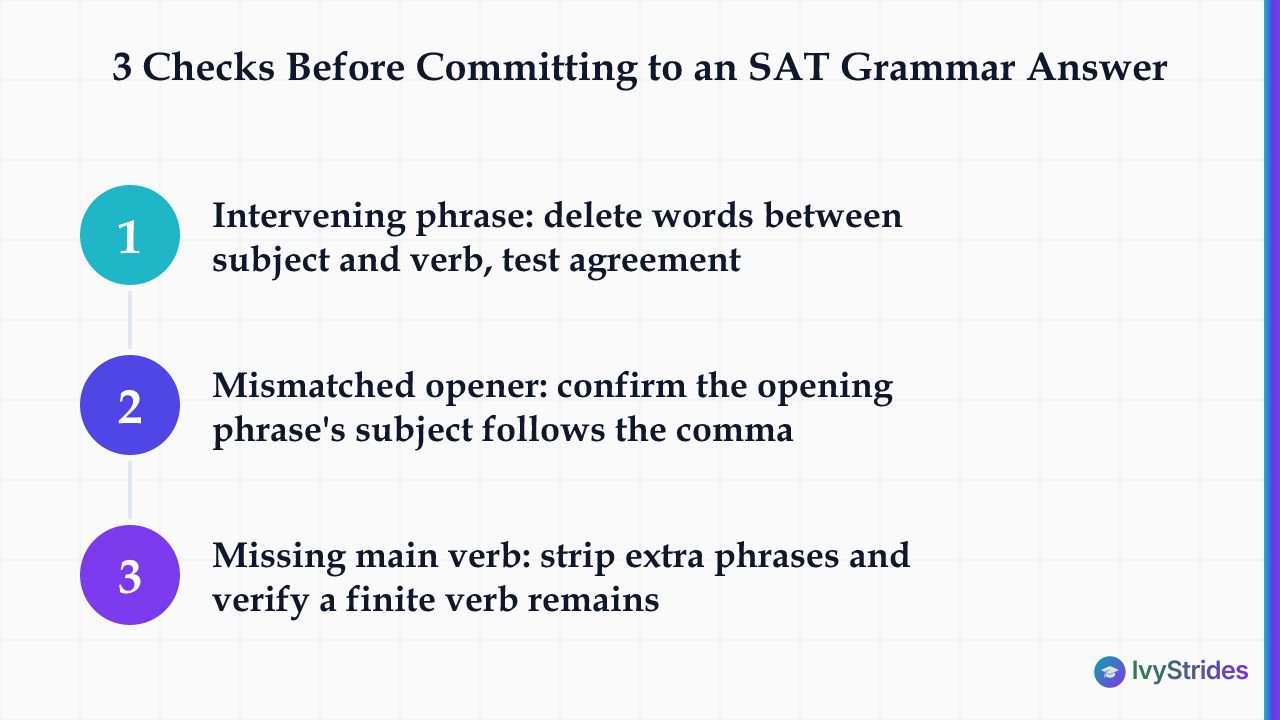
Three things to check before you commit to an answer:
-
Intervening phrase. Delete everything between subject and verb, then test agreement.
-
Mismatched opener. Name the subject the opening phrase describes, and confirm it follows the comma.
-
Missing main verb. Strip the extra phrases and confirm a finite verb is left.
How to Practice SAT Grammar Rules Efficiently Before Test Day
The efficient way to practice SAT grammar rules is to find your own weakest rule first, then drill it. College Board offers free full-length practice tests in the Bluebook app, and its Student Question Bank lets you build specific skills with targeted questions.
Take a timed Bluebook Reading and Writing module and tag every grammar question by rule. Rank the rules by your personal miss rate. Study your top two rules with a worked example. Then re-test on those rule types at your next study session, while the fix is fresh.
| Step | Action | What You Get |
| 1 | Take a timed Bluebook R&W module, tag by rule | A list of misses sorted by rule |
| 2 | Rank rules by your own miss rate | Your top two rules |
| 3 | Study the top two rules with a worked example | One clear example per rule in your log |
| 4 | Re-test on those rule types in the Student Question Bank | A check that the fix held |
How do you know a rule you are studying still appears on the current Digital SAT? Check it against College Board's skill list and practice with official questions, not an old print book. Possessives versus contractions (its/it's, their/they're) are on that list; commonly confused words like affect/effect are not. Choosing accurate SAT practice tests built around the adaptive module structure keeps your drilling honest.
Map the sequence to a real date. December 5, 2026 is the last SAT weekend date this year, and both its registration deadlines (November 20, late November 24) have passed, so a plan made now points to March 6, May 1, or June 5, 2027. Registration for March 6 closes February 19, 2027. Anchoring your practice sequence to a specific test date is the difference between a plan and a wish.
If you want a tutor to set the practice order, IvyStrides' SAT 1-on-1 prep built around a diagnostic test and custom roadmap sets your focus areas from that diagnostic and re-evaluates them weekly. Each of its 10 Bluebook-style adaptive mocks is followed by a tutor review session. If transitions keep catching you out, that is a separate pattern worth understanding why transitions questions keep going wrong.
FAQ: Most Tested SAT Grammar Rules
What are some important grammar rules to remember for the SAT?
College Board's Standard English Conventions skills cover sentence boundaries (semicolons, colons, commas with coordinating conjunctions), subject-verb agreement, pronoun-antecedent agreement, verb tense and form, modifier placement, and plurals and possessives. Study the ones you miss most first.
Is a 700 on SAT Reading and Writing a good score?
A 700 on Reading and Writing is well above the College and Career Readiness benchmark of 480 on the 200-800 section scale. Whether it is strong enough depends on your college list, so compare it with each school's published score range.
How do I improve my SAT grammar score?
Tag every wrong answer on a timed Bluebook module by grammar rule, study your top two rules with worked examples, then retest on those types at your next session. Repeat the cycle so your time goes to the rules actually costing you points.
What grammar rules should I focus on for SAT Reading and Writing?
Start with boundaries (semicolons, colons, and commas with FANBOYS), then subject-verb agreement with intervening phrases, then pronoun-antecedent agreement, then verb forms, modifiers, and possessives. Reorder that list by your own miss rate.
Your Next Step on SAT Grammar
You now know which rules the SAT's conventions questions test and how the SAT disguises them. The point of this article is priority: study the rules you miss most, not every rule equally.
- Tag each miss on one timed Bluebook Reading and Writing module by rule, and start with your top two.
- Keep an error log by disguise pattern, not just by rule name.
A strong Reading and Writing score is one component of a full application. Test-optional policies vary by school and by year, so confirm each college's current requirement before you set your target.
For parents: IvyStrides shares admissions timelines and counseling guidance on LinkedIn. Follow along for the questions families ask most.

Hemant is a seasoned entrepreneur, investor, and growth strategist with deep ground in education and technology-driven learning. His core training is in Mathematics and Physics — he authored Physics for IB Diploma: Ultimate Revision Guide, recognized as a top student resource.