
How to Get Into MIT: Character Tops Its List, Above Grades and Scores

On this page
- Why MIT Says the Match Matters More Than Your Numbers
- The Qualities MIT Names on Its Own Admissions Page
- What MIT's Application Actually Requires for Fall 2027
- How to Build an MIT Application File That Shows What MIT Looks For
- FAQ: Getting Into MIT
- What are the steps involved in the MIT admission process?
- Does MIT require interviews?
- Can I get into MIT with a 1490 SAT?
- Is MIT an Ivy League school?
- Your Next Step Toward an MIT Application
MIT is test-required for fall 2027 entry: every first-year applicant must submit an SAT or ACT score. MIT first-year admission is a holistic review run through MIT's own application portal, and its admissions page says the match between applicant and Institute matters most, above any single number.
Strong grades and scores show you are prepared; MIT says the match is what decides.
Why MIT Says the Match Matters More Than Your Numbers
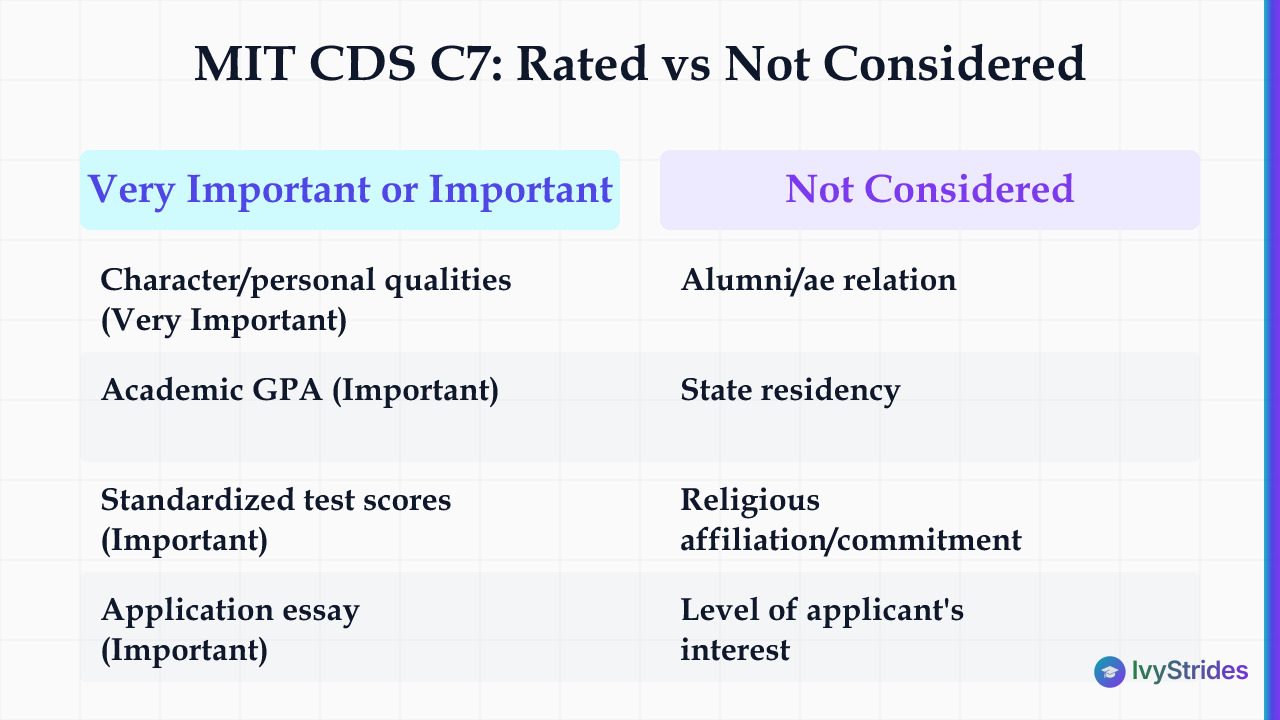
MIT admissions does not pick the highest-scoring applicants; it picks applicants who fit MIT's mission and culture. For the Class of 2029, MIT admitted 1,334 of 29,281 first-year applicants, about 4.6 percent. A seat turns on more than metrics.
MIT says so directly. Grades and scores show academic preparedness, but it's really the match between the applicant and the Institute that drives selection. The mission it wants you to match: using science, technology, and other scholarship to make the world better.
That framing shapes how MIT rates factors in its Common Data Set. In section C7 of the 2025-26 Common Data Set, MIT rates Character/personal qualities as its only Very Important factor. Grades, test scores, and essays sit one tier lower, and MIT marks four familiar admissions levers Not Considered.
| Factor | MIT Rating (CDS C7) |
| Character/personal qualities | Very Important |
| Academic GPA | Important |
| Standardized test scores | Important |
| Application essay | Important |
| Interview | Important |
| Alumni/ae relation | Not Considered |
| State residency | Not Considered |
| Religious affiliation/commitment | Not Considered |
| Level of applicant's interest | Not Considered |
Source: MIT Common Data Set 2025-26, section C7 (ir.mit.edu). MIT's C7 table lists each factor individually; IvyStrides compiled the ratings into this summary.
Read the Not Considered column twice. Demonstrated interest, legacy, and state residency count for nothing, so a student who spends energy emailing admissions for "interest points" wastes it here. The energy that counts goes into the file itself.
The Qualities MIT Names on Its Own Admissions Page
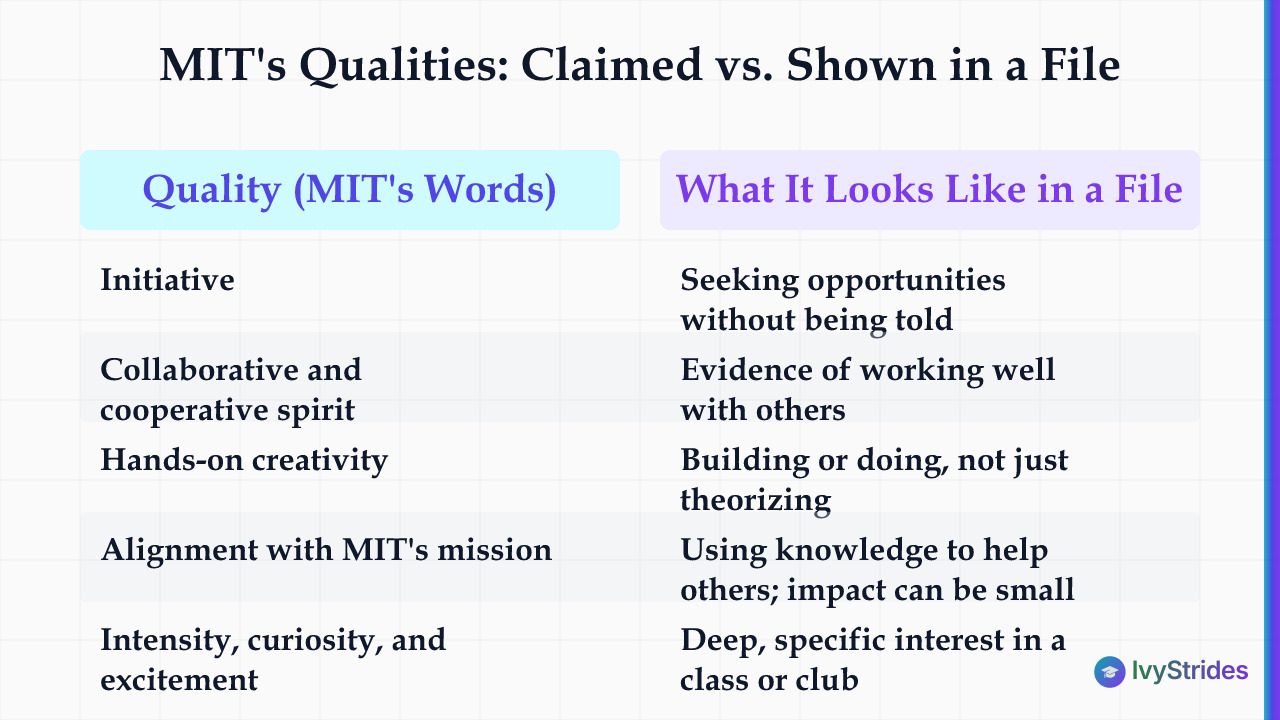
MIT names the qualities it looks for, and they map onto character, not GPA. Your essays, activities, and recommendations are where they have to show.
The qualities on MIT's page, and what each looks like when a file shows it rather than claims it:
| Quality (MIT's words) | What It Looks Like in an Application |
| Alignment with MIT's mission | Using what you know to help others; impact can be small |
| Collaborative and cooperative spirit | Evidence you work well with others, not only alone |
| Initiative | Seeking out opportunities without waiting to be told |
| Risk-taking | Trying hard things and recovering when they fail |
| Hands-on creativity | Building or doing, not just theorizing (Mind and Hand) |
| Intensity, curiosity, and excitement | Deep, specific interest in a class, club, or community |
| The ability to prioritize balance | Making time for rest and interests outside academics |
Impact can be ordinary. MIT's page offers the example that tutoring a single kid in math changes the world. You do not need a founded nonprofit. You need evidence you acted.
On collaboration, MIT means it literally. MIT designs many problem sets for groups, and cross-department labs are common, so the page warns that students who always prefer working alone may not be happy there. A file that reads as a lone genius is a fit problem.
Hands-on creativity traces to the motto. Mind and Hand means MIT wants applicants excited to actually do something about problems, not only think about them.
Here's the part most students miss. You can recite these qualities and still submit a file that shows none of them, because the student wrote the activities and essays to sound impressive rather than to surface a trait. The four-activity limit forces the choice, which is why how you write each activity description against the trait it proves matters more when you only get four slots.
What MIT's Application Actually Requires for Fall 2027
MIT's first-year application runs entirely through MIT's own application portal, not the Common App. That difference matters, because the portal carries its own essays, its own four-activity limit, and its own test-reporting flow. Here is every component for the 2026-27 cycle.
| Component | Required or Optional | Key Detail |
| SAT or ACT | Required | ACT Writing/Science and SAT Essay not required |
| Four short-answer essays | Required | About 100-200 words each |
| Four short responses | Required | 40-50 words each |
| Activities | Required | Four activities maximum |
| Self-reported coursework | US students only | International students use transcript |
| Two teacher letters | Required | One math/science, one humanities/social science/language recommended |
| Counselor letter | Optional | School profile and supplemental letter also optional |
| Educational Counselor interview | Offered where available | Waived with no adverse effect if unavailable |
| Creative portfolio (SlideRoom) | Optional | For researchers, performing artists, visual artists, and makers |
| FUN form | EA admitted or deferred; all RA applicants | February Updates and Notes, with midyear grades |
Scores are required, with no cutoff. MIT requires the SAT or ACT, accepts both paper and digital SAT, superscores, and says it has no cutoff or recommended score. For the full score-range picture and superscore policy, see our MIT SAT requirements guide. You must take the tests before November 30 for Early Action and before December 31 for Regular Action.
Coursework is read by subject. Students in US school systems fill in a self-reported coursework form so MIT sees grades by subject in one format; it does not replace your official transcript, and international-school students skip it. To judge your course load, see how many AP courses top colleges expect against what your school offered.
The deadlines, and the quirk that helps you. MIT's Early Action deadline is November 1 with decisions mid-December; Regular Action is January 4 with decisions mid-March. EA is non-restrictive, meaning you may apply EA to MIT and apply early elsewhere too. MIT's CDS confirms there is no Early Decision. You may apply only once per entry year, EA or RA, not both.
The two required teacher letters carry subject guidance: MIT recommends one from a math or science teacher and one from a humanities, social science, or language teacher. The optional Research Supplement wants a questionnaire, an abstract or poster, and a letter from your research mentor.
How to Build an MIT Application File That Shows What MIT Looks For
Building an MIT file means auditing every component against the qualities MIT names, then revising the weakest evidence first. Teacher letters, four essays, and four activities each carry those signals, so work in sequence, starting with the essays.
Anchor on the field-of-study prompt. MIT's four short-answer essays run about 100-200 words each. The first asks what field of study appeals to you most and what led to the interest; the others ask how you did something different in your education, what problems you'd want to tackle, and how you handled an unexpected challenge. In our view, that first prompt is where depth of interest shows most, so draft it first and let it set the voice.
Treat the short responses as personality windows. The four 40-50 word responses ask what you do just for fun, someone you admire, a topic you could talk about for hours, and whether you're a generalist or a specialist. In our coaching, a common first-draft mistake is listing achievements rather than revealing personality, and the word limit punishes that instinct immediately.
Use the four-activity limit as a filter. MIT lets you list only four activities, far fewer than the Common App's ten, so choose the four that collectively cover the most traits, not the four with the most prestige. One can show collaboration, one initiative, one hands-on building, one depth.
Brief your recommenders. We recommend sharing the qualities MIT names with your teachers before the letter is written, so a letter can speak to initiative or risk-taking directly rather than offer generic academic praise.
Mapping these criteria against a real profile, from course rigor to activity depth to essay angle, is the work of our college counseling for grades 11 and 12.
| Step | Action |
| 1 | Draft the field-of-study essay first; it sets your voice |
| 2 | Write each short response to reveal personality, not achievement |
| 3 | Pick four activities that cover the most traits across them |
| 4 | Share MIT's named qualities with both recommenders |
| 5 | Choose EA (Nov 1) or RA (Jan 4); you may apply only once a year |
| 6 | Keep senior-year grades up; the FUN form reports them |
Senior-year grades still count after you apply. Everyone admitted or deferred in Early Action, and every Regular Action applicant, submits a February Updates and Notes form with midyear grades, so how admissions offices read a grade drop on your transcript is worth understanding before you coast.
FAQ: Getting Into MIT
What are the steps involved in the MIT admission process?
You apply through MIT's own portal, not the Common App. You submit SAT or ACT scores, write four short-answer essays and four short responses, list up to four activities, and provide two teacher letters. You choose Early Action (November 1) or Regular Action (January 4). After applying, MIT may offer an alumni interview.
Does MIT require interviews?
No. MIT does not require an interview, but it offers one with an alumni Educational Counselor where available. If MIT cannot offer one, it waives the interview with no adverse effect. MIT's Common Data Set rates the interview as Important, so accept the invitation if you receive one.
Can I get into MIT with a 1490 SAT?
A 1490 is a composite score. MIT's published admissions statistics for the Class of 2029 report section score ranges for admitted students, not a composite range: SAT Math 780-800 and Reading and Writing 740-780. MIT says it has no cutoff and reads scores in context, alongside the rest of your file.
Is MIT an Ivy League school?
No. The Ivy League is an athletic conference of eight specific universities, and MIT is not one of them. MIT is an independent research university in Cambridge, Massachusetts. People often group it with those schools for its selectivity, but it has no formal affiliation.
Your Next Step Toward an MIT Application
MIT reads for character and fit first, then uses grades and scores to confirm you can handle the work. Aim for a file where four essays, four activities, and two letters each show a quality MIT names, not just a line of achievement.
Before November 1, do these:
- Take the SAT or ACT before November 30 for Early Action, and self-report every sitting
- Draft the field-of-study essay, then the three other short-answer prompts
- Rewrite your four short responses to reveal who you are
- Choose four activities that cover the widest set of MIT's qualities
- Brief both teacher recommenders on the qualities MIT names
- Decide between non-restrictive Early Action and Regular Action

Rajesh is a technology leader, entrepreneur, and angel investor with 28+ years in Business & Technology Leadership and Product & Solution Engineering. He is passionate about education, mentoring, and driving digital transformation.