
How to Get Into Harvard When No Single Factor Outranks the Rest

On this page
- What Harvard's Academic Benchmarks Actually Look Like
- How Harvard Weighs Activities, Character, and What You Would Add
- How Harvard's Supplement and Essays Fit Into the Review
- What Harvard's Application Process Requires Before You Submit
- FAQ: Harvard Admissions for the 2026-27 Cycle
- Is it hard to get into Harvard?
- What GPA do you need to get into Harvard?
- What are Harvard's top majors?
- Can I get into Harvard as an international student?
- Your Next Step Toward a Harvard Application
Getting into Harvard takes a strong academic record, SAT or ACT scores, essays, and meaningful activities, reviewed together with no single factor decisive. Harvard College is test-required for fall 2027 entry. Its fall 2025 class posted middle-50% SAT section scores of 720-770 (Reading and Writing) and 730-790 (Math), with a 4.22 average GPA.
Those figures come from Harvard's Common Data Set 2025-26, published by its Office of Institutional Research and Analytics. The harder question isn't the numbers. It's how the essays, activities, and testing fit into one file the committee reads as a whole, and what you do before the November 1 or January 1 deadline.
What Harvard's Academic Benchmarks Actually Look Like
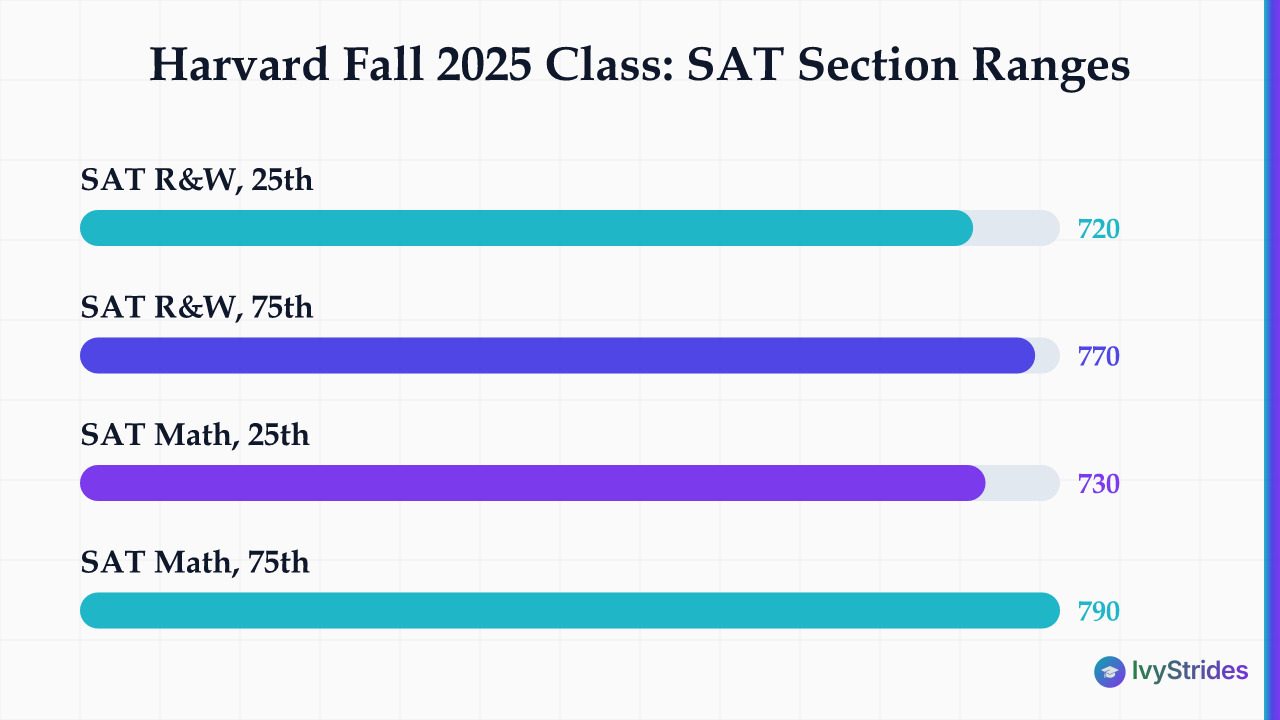
Harvard College admissions rests on academic strength first, and for the 2026-27 cycle the SAT or ACT is required, so your test plan carries real weight. The testing FAQ confirms the requirement for fall 2027 entry.
The benchmarks below describe enrolled students who submitted a score, not admitted students. Harvard reports each SAT section separately, and adding section percentiles together does not produce a total-score range, so read each section on its own.
| Metric | 25th Percentile | 50th Percentile | 75th Percentile | Notes |
| SAT Reading and Writing | 720 | 750 | 770 | 79% submitted an SAT |
| SAT Math | 730 | 770 | 790 | Sections reported separately |
| ACT Composite | 33 | 35 | 35 | 27% submitted an ACT |
| Average GPA | N/A | 4.22 | N/A | 99.10% submitted a GPA |
Source: Harvard CDS 2025-26, C9 and C12.
Notice the ACT composite 50th percentile is 35, not 36. Even at Harvard, a perfect composite is not the median.
The GPA figure needs context. Harvard states no minimum GPA and does not say whether the 4.22 is weighted, so what the 4.22 average leaves out matters more than the number itself. Course rigor sits alongside it.
Course load Harvard names. Its guide to preparing for college recommends four years of English, four years of a single foreign language, history for at least two and preferably three years, four years of math, and four years of science (physics, chemistry, biology, preferably one advanced course).
If your SAT score sits near the low end of those section ranges, whether a 1540 holds up at Harvard, Yale, and Princeton puts your number in context. If a section is pulling you below the range, our 1-on-1 SAT program starts from a timed diagnostic and targets that section before the November 1 deadline.
International applicants. The SAT or ACT is still required. In genuine access cases only, where a student cannot pay for or reach a test, Harvard's supplement and testing FAQ let AP results, IB scores, or GCSE/A-Level results stand in. They are not interchangeable substitutes.
How Harvard Weighs Activities, Character, and What You Would Add
Harvard admissions weighs far more than grades and scores, and it says so plainly: "there is no formula" for admission. Alongside academics, the admissions FAQ names community involvement, leadership and distinction in activities, and personal qualities and character.
| Factor | What Harvard Says | Application Implication |
| Activities | Quality matters more than quantity | Depth in a few, not a long list |
| Jobs and family | Can show underlying character | Count them; describe the responsibility |
| Contribution | "Special talents or excellences of all kinds" | Show what you'd add to the community |
| Engagement | Willingness to respectfully engage differing ideas | The disagreement short answer tests this |
| Use of resources | Looks for students who use its full breadth | Name specific Harvard opportunities |
| Demonstrated interest | Not considered | Skip visits-as-strategy; they don't count |
Source: Harvard admissions FAQ, first-year applicants page, application tips guide, and 2026-27 supplement.
Quality over quantity is not a slogan here. Harvard's application tips guide says a commitment to excellence in any activity, including jobs and family responsibilities, can show character. One deep commitment reads stronger than ten shallow memberships.
Demonstrated interest is off the table. The 2026-27 supplement states Harvard does not consider it, and the CDS rates it Not Considered. Campus visits and emails to admissions will not tip a decision. Spend that energy on the essays.
The other Ivies share Harvard's whole-person review but split on testing, demonstrated interest, and early plans, so where the Ivies split on testing and early plans is worth mapping school by school.
How Harvard's Supplement and Essays Fit Into the Review
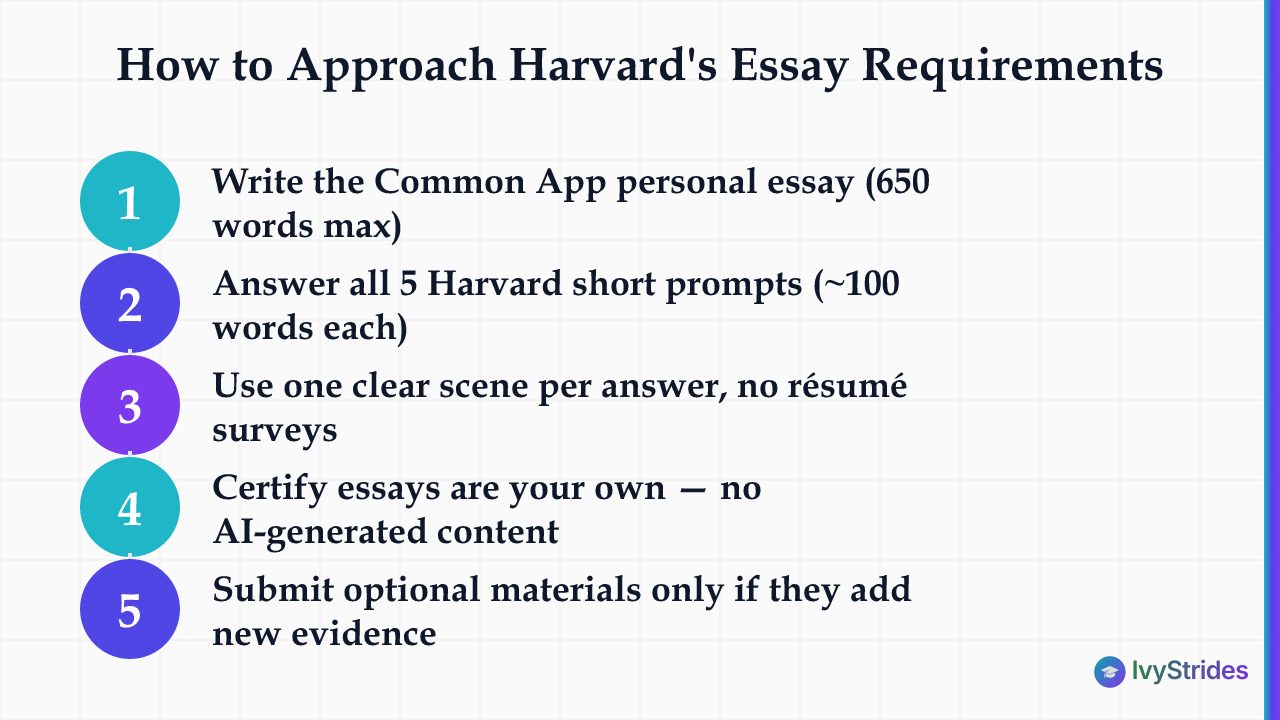
Harvard's 2026-27 supplement asks for five required short answers, each 150 words maximum, and Harvard says about 100 words is enough for each. That sits alongside the Common App personal essay, capped at 650 words across seven prompts unchanged for 2026-27. These essays are where the whole-person review from the section above gets its evidence.
| Prompt | Topic | Word Limit | What It Tests |
| 1 | How your life experiences will let you contribute to Harvard | 150 | Perspective and contribution |
| 2 | A time you strongly disagreed with someone about an idea or issue | 150 | Respectful engagement |
| 3 | Activities, work, travel, or family responsibilities that shaped you | 150 | Commitment and character |
| 4 | How you hope to use your Harvard education in the future | 150 | Direction and purpose |
| 5 | Top 3 things your roommates might like to know about you | 150 | Personality and voice |
Source: Harvard College 2026-27 supplement, which says each question can be answered in about 100 words.
Each short answer is capped at 150 words, and that length rewards one specific scene over a survey of your résumé. In our essay coaching, the Harvard short answers that land best treat the limit as a discipline: one clear scene, one honest reflection, no throat-clearing. The same discipline drives supplemental essays that get read closely.
The AI and authenticity rule is explicit. The supplement says you may get human or technological help, but you may not submit substantive content generated by other sources, and you must certify the essays are your own work. Draft in your own voice from the first line.
No admission by major. Harvard does not admit applicants to particular programs. You list up to three fields of interest out of 50 concentrations and rate how definite your plans are. A niche interest will not price you out of a spot.
Optional materials stay optional. Portfolio pieces, research papers, and creative writing can go through the portal or Slideroom, but Harvard calls them "neither expected nor required." Send them only if they add something the file does not already show.
Making the 650-word personal statement do work the supplement cannot is its own skill, covered in how to use the Common App essay word limit. For structured help drafting all five short answers plus the personal statement, our college admissions counseling program maps the full essay set to one narrative.
What Harvard's Application Process Requires Before You Submit
Harvard's application process runs on two rounds with firm dates and one significant restriction. Restrictive Early Action (REA) closes November 1 with decisions in mid-December; Regular Decision closes January 1 with decisions at the end of March. Because the essays above take real time, the round you choose shapes your whole fall.
| Round | Deadline | Decision | Key Restriction |
| Restrictive Early Action | November 1 | Mid-December | No other private early apps |
| Regular Decision | January 1 | Late March | Full flexibility |
Source: Harvard first-year applicants page and 2026-27 supplement.
What REA restricts. If you apply REA, you may not apply early to any other private college (ED, EA, or REA) or to a binding early program at a public university. You may still apply early to any public university, military academy, or university outside the United States under a non-binding program, and to other colleges' Regular Decision or Early Decision II rounds.
In our coaching, students who map the REA restriction by September of senior year have more room to weigh Harvard REA against another school's binding ED, and how binding and non-binding early rounds differ frames that choice.
Required materials. Harvard's application requirements page lists a Secondary School Report with counselor letter and transcript, two teacher recommendations from different academic subjects, a Midyear Report, and a Final Report. The supplement also asks about school disciplinary history. Give your recommenders weeks, not days; asking teachers the right way makes a stronger letter more likely.
Scores and interviews. You submit the SAT or ACT, and sending SAT scores to Harvard walks through the codes and timing. Alumni interviews are assigned at Harvard's discretion, cannot be requested, and may be by video, phone, or in person. Missing one is not a negative, and an application is complete without it.
FAQ: Harvard Admissions for the 2026-27 Cycle
Is it hard to get into Harvard?
Yes. Harvard is among the most selective colleges in the United States. Its fall 2025 entering class posted middle-50% SAT section scores of 720-770 (Reading and Writing) and 730-790 (Math) and an average GPA of 4.22, per the CDS 2025-26. A strong academic record is necessary but not sufficient, since Harvard reviews the full application with no formula.
What GPA do you need to get into Harvard?
Harvard does not publish a minimum GPA. The CDS 2025-26 reports an average of 4.22 for the fall 2025 entering class, with 99.10% of students submitting a GPA. Harvard does not confirm whether that figure is weighted. Course rigor counts alongside the number, so a demanding schedule with a slightly lower GPA can read stronger than an easy one with a higher GPA.
What are Harvard's top majors?
There is no admission by major at Harvard. In the supplement you list up to three fields of interest out of 50 concentrations and rate how definite your plans are.
Can I get into Harvard as an international student?
Yes. Harvard reviews international applicants through the same whole-person process. The SAT or ACT is required. Students who genuinely cannot access those tests may, in exceptional cases, substitute AP results, IB scores, or GCSE/A-Level results.
Your Next Step Toward a Harvard Application
Harvard reads the file as a whole, so the smartest move is to find the weakest part of yours and fix it while there is still time before the deadline.
- Line up your GPA, SAT or ACT score, and AP rigor against the CDS 2025-26 benchmarks above.
- Pick your round: REA by November 1, or RD by January 1, and map the REA restriction if you are weighing another early school.
- Draft the five short answers early, one scene each, in your own voice.
- Ask two teachers in different academic subjects for recommendations now, not in October.
- Confirm Harvard's testing policy on its admissions site, since policies change each cycle.

Two decades teaching quantitative and verbal aptitude on standardized tests. Rare dual expertise across Math and Verbal — particularly effective for students with gaps on both sides. Senior AP Mentor for our Calculus and English tracks.