
Is It Too Late to Apply to College? What Seniors Can Still Do This Cycle
On this page
- Is It Too Late to Apply to College for Fall 2027?
- Which College Application Deadlines Are Still Open for Fall 2027
- What Happens When You Apply Late to a College
- What a Late College Application Actually Looks Like: Essays, Scores, and Next Steps
- FAQ: Late College Application Deadlines and Options
- How late is too late for college applications?
- Can I still apply for a college after the deadline?
- What happens if you apply late to a college?
- Do any colleges accept late applications?
- Your Next Step on a Late College Application
For most seniors, it is not too late to apply right now and still start college this cycle. A college application deadline is the date by which you must submit your application materials, as Common App defines it, and in November most seniors still have Regular Decision deadlines ahead. Common App's 2026-27 deadlines grid lists January 1, 2027 for Harvard and Princeton and January 15, 2027 for Purdue and Tulane.
Rolling admissions, later deadlines, open admissions colleges and spring semester entry add more room after that. The reassurance has limits worth naming early, though: admissions outcomes depend on the full application, not timing alone, and at some colleges merit aid consideration closes before admission does.

Is It Too Late to Apply to College for Fall 2027?

Photo by RDNE Stock project on Pexels
No, it is not too late to apply to college for fall 2027 for most seniors asking in the fall. The Regular Decision deadline that fuels this anxiety is one admission plan among several. Which path fits depends on the plan each college uses and the start term you will accept, not on a single universal cutoff.
Rolling admissions is the key term. Common App defines rolling admission as a decision plan that lets students submit an application at any time throughout the year, with colleges reviewing applications as they receive them. The University of Pittsburgh says it has no set deadline for first-year applicants and makes decisions throughout the year. Rolling does not always mean open-ended, though: Michigan State reviews Regular Decision files on a rolling basis, and its final deadline is April 1, 2027.
Three other routes stay open past early January. Some colleges set a later Regular Decision deadline: Hampton University's is March 1, 2027 for fall 2027. Open admission, in the NCES definition, is a policy whereby the school will accept any student who applies, and College Navigator lists Santa Monica College with one. Spring semester entry is a separate start term you pick in each college's Common App questions, and Michigan State notes that admission to other semesters may be limited or not available at all.
| Admission Plan | What It Means | Fall 2027 Example |
| Regular Decision | Apply by a specific date, decision within a stated period | Harvard: January 1, 2027 |
| Later Regular Decision | The same plan with a later fixed date | Hampton University: March 1, 2027 |
| Rolling admission | Apply any time; the college reviews files as they arrive | University of Pittsburgh: no set deadline |
| Open admission | The school accepts any student who applies | Santa Monica College |
| Spring semester entry | A later start term, set by each college | Michigan State: may be limited or not available |
The Common App alone connects you to more than 1,200 member colleges, each with its own plans and dates. A passed early date does not always close the whole college: Harvard's Restrictive Early Action date was November 1, and its Regular Decision deadline is January 1, 2027. Which plan a missed date belonged to matters, because binding and nonbinding rounds differ in what they ask of you and when they close.
Which College Application Deadlines Are Still Open for Fall 2027
College application deadlines still open for fall 2027 include Regular Decision dates from January 1, 2027 onward, later dates such as Hampton University's March 1, and rolling plans such as Pittsburgh's. Your job is to find the schools that fit your profile and confirm each one's current status before you apply.
Two official tools do most of the finding. Common App's 2026-27 deadlines and requirements grid lists each member's early, Regular Decision or rolling dates; Common App's college search filters by traits such as HBCU status, test-optional or flexible policy and no application fee. The federal NCES College Navigator shows a college's application fee and admissions figures, and it marks colleges with an open admission policy.
Merit aid is the real cost of waiting. Purdue lists November 1 as its merit scholarship consideration deadline, ahead of its January 15 Regular Decision date, and Michigan State says regular and rolling applicants are still considered for any remaining awards. A binding round also removes your ability to compare aid offers: Common App notes that a student admitted early decision must withdraw other applications, so weigh a second binding round such as ED II against the aid you need.
| Month | Fall 2027 Example | Plan |
| December 2026 | Pittsburgh: December 1 for automatic academic scholarship consideration | Rolling |
| January 2027 | Harvard and Princeton: January 1; Purdue and Tulane: January 15 | Regular Decision |
| February 2027 | Michigan State: February 1 priority date | Regular Decision, rolling review |
| March 2027 | Hampton University: March 1 | Regular Decision |
| April 2027 | Michigan State: April 1 final deadline | Regular Decision, rolling review |
One factor stays live even now: senior year grades. Colleges marked in the grid as requiring Common App's Mid Year Report receive a form that usually summarizes your academic performance through the middle of your final year, so how senior year grades factor into a late review matters as much in February as it did in September.
What Happens When You Apply Late to a College
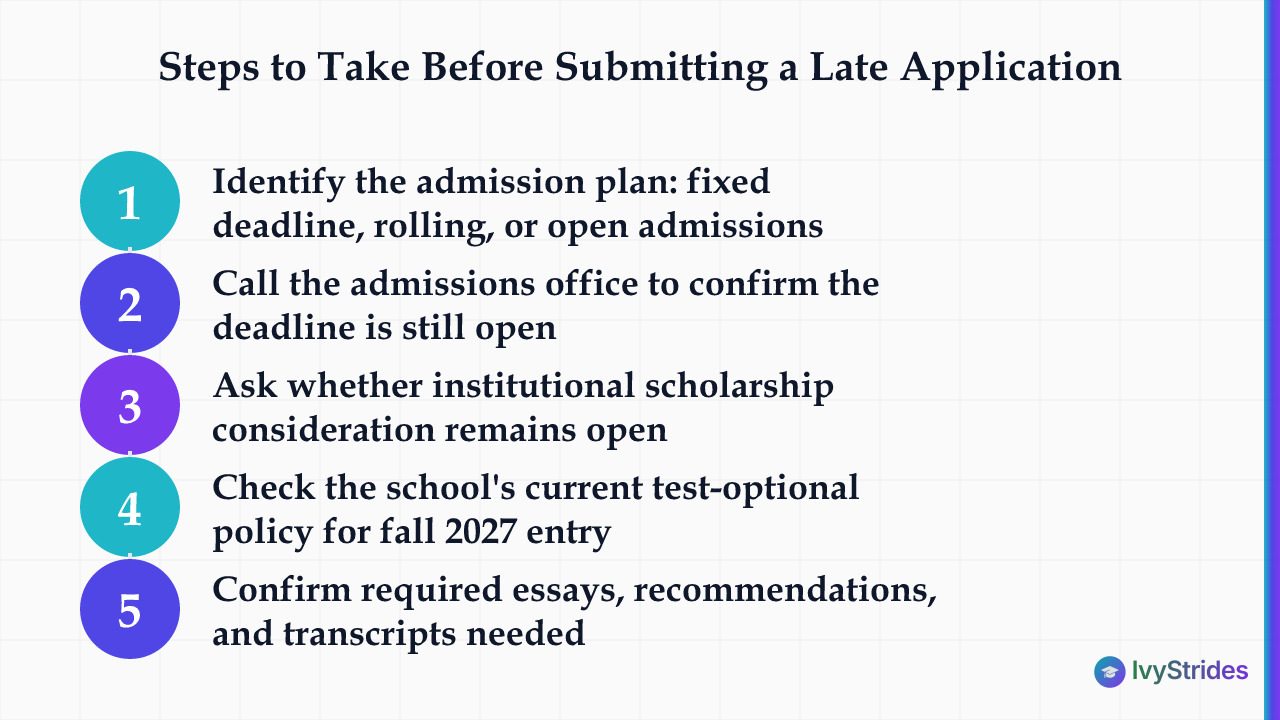
Applying late to a college leads to one of three situations, depending on the plan the school uses. A late application is not automatically rejected everywhere.
Fixed deadline. Under Regular Decision you apply by a specific date, and each college decides whether it will read a file that arrives later. Rolling admissions. The college reviews files as it receives them, so there is no single cutoff, though a final date can still apply, as Michigan State's April 1 deadline shows. Open admissions. The school accepts any student who applies, so ask for its last date for the term you want. Call the admissions office and ask plainly which one applies.
Daily SAT and ACT prep on YouTube: short strategy videos from IvyStrides. Subscribe to IvyStrides on YouTube.
Merit aid is where late timing bites hardest. At Pittsburgh, which has no set admission deadline, first-year students who complete and submit an application and all required materials by December 1 are automatically considered for its academic scholarships. Say so when you call: ask whether both admission and scholarship consideration remain open.
Test scores sit alongside this decision. Some colleges, Harvard among them, require the SAT or ACT; elsewhere, whether to send a score turns on each school's policy for fall 2027 entry. Test-optional policies vary by school and year, per FairTest, and a strong score can still help a late file where a school considers scores at all.
Before you submit a late application, confirm:
- The admission plan: ask the admissions office whether the date is firm or the college reviews files on a rolling basis
- Whether institutional scholarship consideration is still open
- The school's current test-optional policy for fall 2027 entry
- Whether a mid-year transcript, Common App's Mid Year Report, is required
- Which supplemental essays, if any, the school still requires
- Which recommendations the school requires, as the Common App grid lists by college
What a Late College Application Actually Looks Like: Essays, Scores, and Next Steps

Photo by KATRIN BOLOVTSOVA on Pexels
A late college application carries the same components as an on-time one: the personal essay where the college requires it, any supplemental essays, a transcript, recommendations, and test scores where the school asks for or considers them. The quality bar does not drop because the deadline is close. What changes is the order you tackle them in when time is short.
The personal statement comes first because it is the one piece you control entirely. Common App's seven essay prompts are unchanged for 2026-27, and the personal essay has a 650-word maximum. You can submit the same essay to any Common App college, which is why writing a college essay when you are short on time deserves more of your attention than chasing one more school.
Supplemental essays come next and vary by school, so check each portal. Scores follow, where the school considers them. Your counselor sends the transcript once you request it, and recommendation requirements differ by college, so give your counselor and teachers as much notice as the calendar allows.
-
Shortlist two to four rolling or later-deadline schools that fit your profile
-
Call each admissions office to confirm the deadline and aid status
-
Draft the Common App personal statement within 650 words
-
Complete any supplemental essays each school still requires
-
Request your transcript and recommendations, and send scores if you are submitting them
If you want guided help sequencing it, IvyStrides' college counseling for grades 11 and 12 starts seniors at the college list and runs to the deposit decision, with regular-round applications completed and submitted from December and a per-school submission audit among its written deliverables. If you are the first in your family to apply, the steps are the same, and first-generation college applicants can also ask each college about fee waivers, alongside Common App's own waiver in the Profile section.
FAQ: Late College Application Deadlines and Options
How late is too late for college applications?
It depends on the plan. Regular Decision has a fixed date, such as January 1, 2027 at Harvard or March 1, 2027 at Hampton University. Rolling colleges review files as they arrive, though some still set a final date, such as April 1, 2027 at Michigan State. Open admissions colleges accept any student who applies.
Can I still apply for a college after the deadline?
Sometimes. Each college decides whether to read a file that arrives after its stated date, so call the admissions office and ask directly. At a rolling college such as the University of Pittsburgh, which has no set first-year deadline, the question is whether seats and scholarship consideration remain.
What happens if you apply late to a college?
At a college with a fixed deadline, the admissions office may not read a late file at all. At a rolling or later-deadline college, the office can still review it, but scholarship dates can pass first: Purdue's merit scholarship consideration deadline was November 1, ahead of its January 15 Regular Decision date. Admission turns on the full application, not timing alone.
Do any colleges accept late applications?
Yes. Common App's 2026-27 grid lists rolling plans at colleges such as Arizona State, Iowa State and the University of Pittsburgh, and Hampton University, an HBCU, keeps Regular Decision open until March 1, 2027. NCES College Navigator marks colleges with an open admission policy, so confirm each college's current status before you apply.
Your Next Step on a Late College Application
The admissions cycle is not closed for most seniors, but each college sets its own dates. Treat the weeks before January 1 as triage: find schools that fit, confirm their dates, and submit complete, well-written applications, starting with any scholarship date that comes first.
- Put any scholarship date that comes first, such as Pittsburgh's December 1, ahead of the January deadlines
- Confirm each school's SAT or ACT policy, then decide whether to send scores you have
- Ask your counselor which colleges need the Mid Year Report, and request recommendations early
College admissions insights on LinkedIn: follow IvyStrides for application guidance and counseling updates.

Hemant is a seasoned entrepreneur, investor, and growth strategist with deep ground in education and technology-driven learning. His core training is in Mathematics and Physics — he authored Physics for IB Diploma: Ultimate Revision Guide, recognized as a top student resource.