
Is a 32 a Good ACT Score? What 30, 32, and 34 Mean for College Admissions

On this page
- What a 32 ACT Score Means: Percentile, Rarity, and National Context
- What Does a 32 ACT Score Actually Get You in College Admissions?
- Is a 32 ACT Enough for the Ivy League and Top-10 Schools?
- Should You Retake the ACT After Scoring a 32? A Score-Band Decision Framework
- Is a 32 ACT Equivalent to a 1450 SAT? Understanding the Concordance
- Will a 32 ACT Score Help You Win Scholarships?
- How a 32 Fits Into Your Broader Admissions Strategy: Scores, APs, and Essays
- FAQ
- Is a 32 ACT good enough for the Ivy League?
- Is a 32 a good first-time ACT score?
- Should I submit a 32 ACT to a school with a median of 34?
- What is a 32 ACT score equivalent to on the SAT?
- How hard is it to go from a 32 to a 34 on the ACT?
- Does a 32 ACT qualify for merit scholarships?
Yes, a 32 is a good ACT score. It places you at roughly the 97th percentile nationally per ACT, Inc., which means you scored higher than about 97 out of every 100 test-takers. A 32 is competitive at the large majority of U.S. colleges, including most highly selective ones. At Ivy League and top-10 universities, where the middle 50% of admitted students typically scores between 34 and 36, a 32 sits below the median. Whether it's good enough comes down to three things: your target schools, your section balance, and whether you have time to retake.
The school-by-school ranges below come from each university's Common Data Set. The harder question, and the one this article answers, is whether the gap between 32 and 34 is worth closing for your specific college list.
What a 32 ACT Score Means: Percentile, Rarity, and National Context
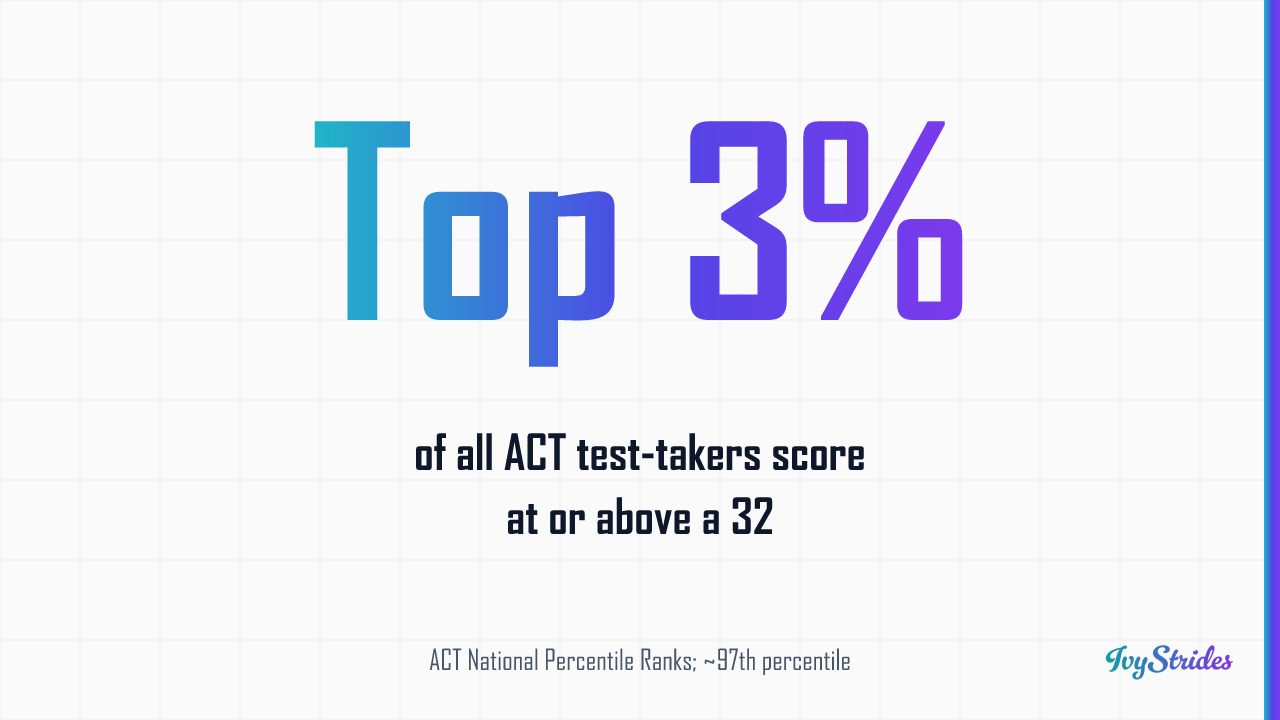
The ACT composite is the rounded average of four section scores, each scaled 1 to 36: English, Math, Reading, and Science. Per ACT's National Profile Report, the national average composite typically hovers around 19 to 20. A 32 typically puts you at roughly the 97th percentile per ACT's published percentile ranks. Fewer than 3% of test-takers in any given year score at or above 32.
Here's the part most students miss. Section balance changes what a "32" actually signals. A balanced 32/32/32/32 looks academically even. A 35 English, 34 Reading, 31 Math, 28 Science also averages to 32, but admissions readers at STEM-heavy programs will spot that 28 Science instantly. So will an algorithm scanning superscores. Two students, same composite, very different applicants.
Before going further, check the current ACT test dates 2026 so any improvement plan aligns with a real registration window.
What Does a 32 ACT Score Actually Get You in College Admissions?

A 32 typically opens the door at hundreds of schools. The cleanest way to evaluate where it lands is to compare your 32 against each target school's 25th-75th percentile ACT range, published annually in the Common Data Set.
Here's the rough map, using recent Common Data Set figures:
- Ivy League and top-10 (Harvard, Yale, Princeton, Columbia, Stanford, MIT): middle 50% ACT range approximately 34-36. A 32 is below the 25th percentile.
- Schools ranked roughly 11-20 (Vanderbilt, Northwestern, Duke, Brown, Cornell): middle 50% range approximately 33-35. A 32 is at or just below the 25th percentile. Should You Apply to Vanderbilt University? frames the rest of a competitive application at that band.
- Schools ranked roughly 20-40 (Rice, WashU, Notre Dame, Dartmouth, Emory): middle 50% range approximately 32-35. A 32 is within the range, often near the 25th percentile. Deciding Whether to Apply to the University of Notre Dame? walks through the academic profile that pairs well at that tier.
- Schools ranked roughly 40-100: middle 50% range typically 28-32. A 32 is at or above the 75th percentile of admitted students.
Same number, very different competitive position depending on the school.
A 32 ACT is a strong academic signal, but admissions officers at elite schools read every application holistically, which means your essays carry real weight alongside your score. Strong AP exam scores in rigorous subjects can reinforce the academic picture a 32 creates, particularly at schools where the 32 sits near the 25th percentile of admitted students. The Should You Apply to Northwestern University in 2026? breakdown shows how AP performance and essays interact with test scores in holistic review.
One caveat. Many schools remain test-optional, and policies shift year to year. FairTest maintains a current tracker; always verify directly on each school's admissions page before you decide whether to submit.
Is a 32 ACT Enough for the Ivy League and Top-10 Schools?
Honestly? It depends on what else you bring.
At Harvard, Yale, Princeton, and Columbia, the most recently reported Common Data Set figures typically place the middle 50% ACT range at roughly 34-36. A 32 typically falls below the 25th percentile, meaning fewer than 25% of admitted students scored at or below 32. That's a real headwind. It's not a fatal one.
Ivy League admissions are holistic. Strong essays, top AP scores, distinctive extracurriculars, and a compelling personal story can all offset a below-median test score. Students do get admitted to T10 schools with a 32. Students with 35s get rejected. Nobody honest in this field promises an Ivy admit based on any single number.
Here's the practical lens. If your composite is 32 and your section breakdown reveals a clear weakness, the marginal-effort math for a retake usually favors the retake. A 32 with a 28 Science is a different problem than a balanced 32, and the first is much more fixable. Apply to Cornell University in 2026: What You Must Know gets into how Cornell weighs section consistency. For students looking at smaller Ivies, Should You Apply to Brown University? Deadlines and Odds 2026 covers Brown's posture on retakes and superscoring.
If 32 is your ceiling after multiple attempts, your essays and AP record carry the application. If you've taken the test once and have time for one more sitting, the next section walks through whether the retake is worth it.
Should You Retake the ACT After Scoring a 32? A Score-Band Decision Framework
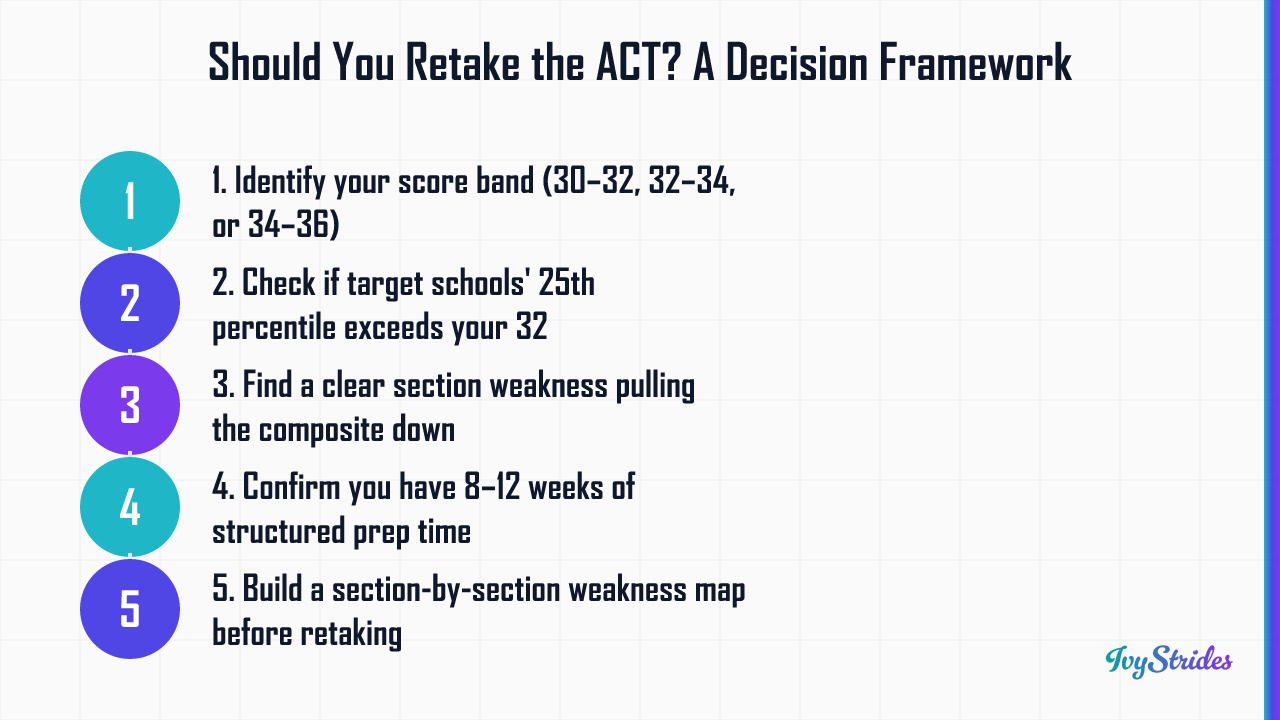
Not all ACT score jumps are equal in difficulty.
- 24 to 30 is a content-gap jump. Students at this band are still missing fundamentals (grammar rules, geometry formulas, passage strategy), and broad remediation moves the score.
- 30 to 32 is an error-reduction jump. The content is mostly known; points are being lost to careless mistakes, pacing, and a handful of question types.
- 32 to 34 is a precision jump. Every section requires sharp work on the hardest question categories and tight pacing control.
- 34 to 36 is the marginal-gains band, where one or two missed questions per section is the entire difference.
In our coaching with students in the 30-32 band, the most common gains come from reducing careless errors in ACT Math and improving pacing on ACT Reading (4 passages in 35 minutes is brutal time pressure). In our coaching with students in the 32-34 band, gains typically require precision work on ACT Science conflicting-viewpoints passages and high-difficulty ACT Math content (trigonometry, advanced functions). The strategy and the time budget look different.
So when should you retake?
Retake if:
- Your target schools' 25th percentile is above 32.
- You have an identifiable section weakness pulling the composite down (especially a sub-30 Science or Math).
- You have at least 8 to 12 weeks of structured prep time before the next sitting.
Don't retake if:
- Your target schools' 75th percentile (per their Common Data Set) typically sits at or below 32. You're already above median.
- Your school list is largely test-optional and your GPA, APs, and essays are stronger signals.
- You have under 6 weeks and no clear weakness to target. A rushed retake often produces the same composite, sometimes lower.
Test-optional policies vary by school and year, so before deciding whether to submit a 32, verify the current policy at each school on your list.
The IvyStrides methodology for retakes is straightforward, calibrated against ACT's official prep guidance: a real baseline practice test, a section-by-section weakness map, section-specialist coaches (one for Math, a different one for Reading and English, a third for Science), and spaced retesting to harden the gains. In our coaching with students completing our 1-on-1 ACT program in the 30-34 band, typical gains land in the 2 to 4 composite point range across 8 to 12 weeks.
A junior we worked with last fall came in with a 32 composite and a 28 Science section that was the obvious drag. Ten weeks of targeted Science work (passage-type drills, data-interpretation pacing) plus Reading pacing work moved the composite to 34. Same student, same brain, different score. The 28 became a 33, and Reading climbed one point on top.
Students who decide a retake is worth it will find a section-by-section roadmap in our guide on how to score 34+ on the ACT. If you have roughly two months before your next test date, our ACT prep in 2 months week-by-week plan maps exactly how to structure that time. When you're ready for a coached path, our 1-on-1 ACT prep program is built around this exact band.
Is a 32 ACT Equivalent to a 1450 SAT? Understanding the Concordance
Roughly yes. Per College Board ACT-SAT concordance tables, a 32 ACT corresponds to approximately a 1450 SAT composite. That's the standard answer, and it's the one colleges treat as equivalent when both scores cross an admissions desk.
But concordance is a statistical approximation built from population-wide distributions. It's not a personal conversion. A student who scored 32 on the ACT won't automatically score 1450 on the SAT. The two tests reward different skill profiles. The ACT Science section has no SAT equivalent. The Digital SAT's adaptive Reading and Writing module is a different beast from ACT English. Math content overlaps but the question styles diverge.
The right move, if you're genuinely deciding between the two tests, is to take a full-length diagnostic of each. Our ACT vs SAT comparison breaks down format, scoring, and which test tends to favor which skill sets. For a diagnostic, our act practice test online library gives you a real timed baseline to compare against an SAT diagnostic.
For most students sitting at 32, the switch isn't worth it. A 32 to 34 ACT path is usually faster than a 1450 to 1500 SAT path, because you already know the test format.
Will a 32 ACT Score Help You Win Scholarships?
Yes, often substantially. Many universities publish ACT cutoffs that trigger automatic merit aid, and those cutoffs typically sit in the 28 to 32 range at schools ranked outside the T20. A 32 frequently lands at or above the top automatic tier.
State flagship universities are the clearest example. Many publish a tiered merit-aid grid keyed directly to ACT composite and GPA. Private schools ranked 30 to 100 often do the same. A 32 will, at many of these schools, qualify for the highest automatic tier or open eligibility for competitive named scholarships that require additional application materials.
One important distinction. The National Merit Scholarship runs through the PSAT/NMSQT Selection Index, not the ACT (see College Board PSAT/NMSQT). Your ACT composite doesn't affect National Merit standing.
Caveat, and it matters: scholarship policies vary by institution and year. Specific dollar amounts shift annually, and some schools have moved away from purely test-based automatic awards. Always check each school's current financial aid page directly. Don't rely on last year's published thresholds.
For students still building their ACT strategy, our ACT prep overview page walks through how the prep paths differ for students targeting scholarship thresholds vs. T20 admissions.
How a 32 Fits Into Your Broader Admissions Strategy: Scores, APs, and Essays
Look, a 32 is one signal. A strong one, but one of several.
At schools where a 32 typically sits below the 25th percentile (T20 and Ivy League) per their Common Data Set, the rest of the academic profile carries more weight, not less. Strong AP scores (4s and 5s) in rigorous subjects, especially in your intended major area, signal academic capability that pure test scores can't fully capture. A student with a 32 ACT and five 5s in challenging APs reads differently than a student with a 32 ACT and no AP record.
If your school doesn't offer the APs you want, our ap courses online can fill the gap. We run per-subject specialist instructors, not generalists, which matters more in AP than it does almost anywhere else.
Essays are the other lever. In our essay coaching, students who pair a strong personal narrative with a competitive-but-not-elite test score have built compelling applications at selective schools. Essays don't compensate for a weak test score in a mechanical sense, but they tell admissions officers something the score cannot: who you are, how you think, what you'd contribute. At T20 schools where the 32 is below median, an exceptional essay is often the difference.
For students who haven't yet decided on a retake, our how to study for the ACT guide covers the diagnostic-first approach we use to determine whether the score is even the right thing to invest in next.
A 32 is a strong score that opens the great majority of selective colleges, qualifies for meaningful merit aid, and signals real academic ability. It is below median at the most elite schools, where the rest of your application (APs, essays, extracurriculars) becomes decisive. Whether to retake is a question of target schools and time, not a referendum on whether 32 is "good."
FAQ
Is a 32 ACT good enough for the Ivy League?
A 32 sits below the 25th percentile of admitted students at most Ivy League schools, where the middle 50% ACT range is typically 34-36 per Common Data Set data. It's not an automatic disqualifier in a holistic process, but students targeting Ivies with a 32 should either pursue a retake or ensure the rest of their application (essays, AP scores, extracurriculars) is exceptionally strong. Admissions outcomes depend on the full application, not test scores alone.
Is a 32 a good first-time ACT score?
Yes, a 32 on a first attempt is an excellent starting point. It places you at approximately the 97th percentile nationally and gives you a clear, achievable improvement target if your schools' medians sit at 34 or higher. In our coaching with students in this band, a focused 8-12 week diagnostic-driven program targeting section-specific weaknesses typically produces gains of 2 to 4 composite points.
Should I submit a 32 ACT to a school with a median of 34?
It depends on the school's current test-optional policy and the strength of the rest of your application. If the school is test-required or test-recommended, submitting a 32 when the median is 34 places you below the middle range of admitted students, which can be a disadvantage. If the school is test-optional and your GPA, APs, and essays are strong, you may choose not to submit. Verify each school's current policy directly; FairTest maintains a tracker at fairtest.org.
What is a 32 ACT score equivalent to on the SAT?
A 32 ACT composite is approximately equivalent to a 1450 SAT composite per College Board concordance tables. This is a statistical approximation built from population distributions, not a guaranteed personal conversion. A student who scored 32 on the ACT should take a full-length SAT practice test before assuming they would score 1450 on the SAT, because section-strength profiles differ between the two exams.
How hard is it to go from a 32 to a 34 on the ACT?
It's achievable but requires precision work rather than broad content review. In our coaching with students in the 32-34 band, gains typically come from mastering high-difficulty ACT Science conflicting-viewpoints passages, tightening pacing on ACT Reading (4 passages in 35 minutes), and eliminating careless errors on advanced ACT Math questions like trigonometry and complex algebra. Students typically see 2 to 4 composite points of gain in this band across 8 to 12 weeks of structured prep.
Does a 32 ACT qualify for merit scholarships?
A 32 strengthens merit aid eligibility at many colleges, particularly schools ranked outside the top 20. Many state flagships and private universities in the 30-100 ranking range publish automatic merit aid cutoffs in the 28-32 range, where a 32 often qualifies for a top or near-top tier. Scholarship policies vary by institution and year, so verify current thresholds directly with each school's financial aid office.

Award-winning author (South Asian Book Award) and graduate of BITS Pilani and UCLA Luskin School of Public Affairs. Brings a published writer's eye to Common App essays and grammatical precision to SAT and ACT R&W instruction.