
ACT Writing Test: How to Score 11+ (Anatomy of a Strong Essay)

On this page
- What ACT Writing Scores Mean: The 2-12 Scale Explained
- What the Four Scoring Domains Actually Measure (And Where Most Students Lose Points)
- Ideas and Analysis (5-6 vs 3-4)
- Development and Support (5-6 vs 3-4)
- Organization (5-6 vs 3-4)
- Language Use and Conventions (5-6 vs 3-4)
- Why Most Students Get Stuck at 7 or 8 (The Exact Gaps We See in Coaching)
- Not Sure Which Domain Is Holding Your Score Back?
- The Essay Blueprint That Earns 5-6 in Every Domain
- Introduction (3-4 sentences)
- Body Paragraph 1: your position with evidence
- Body Paragraph 2: engagement with a contrasting perspective
- Body Paragraph 3: nuanced extension or second supporting argument
- Conclusion (3-4 sentences)
- Is an 11 a Good ACT Writing Score? Percentiles and College Expectations
- How to Practice ACT Writing Effectively Before Test Day
- FAQ
- How are ACT Writing scores calculated?
- Does ACT Writing affect the Composite score?
- How rare is a 12 on ACT Writing?
- Should I retake the ACT just to improve my Writing score?
- Is spelling scored on the ACT Writing test?
- What ACT Writing score should I aim for at selective colleges?
- Ready to Turn Your ACT Writing Score Into a Strength?
To score an 11 on ACT Writing, you need two trained raters to award you an average of 5 to 6 out of 6 across all four domains: Ideas and Analysis, Development and Support, Organization, and Language Use and Conventions. The ACT Writing score runs from 2 to 12 and sits separately from your 1-36 Composite score. The national average lands near 6-7. A score of 11 puts you well above the 99th percentile, and reaching it takes a clear thesis, genuine engagement with the three given perspectives, layered evidence, and controlled prose. Not just clean grammar.
These scoring mechanics come directly from ACT, Inc.'s official Writing Test documentation, cited throughout. The harder question is what raters reward at the 5-6 level versus the 3-4 level, and where most students leak points without knowing it. That's where the next section starts.
What ACT Writing Scores Mean: The 2-12 Scale Explained
The ACT Writing Test is an optional 40-minute essay. Two trained raters each read your essay and assign a score of 1 to 6 in each of the four domains. For each domain, your domain score is the sum of the two raters' scores, so each domain score lands between 2 and 12. Your final ACT Writing score is the average of the four domain scores, rounded to the nearest whole number, producing a single 2-12 result.
That final number is reported separately. It doesn't factor into your 1-36 Composite, which is the average of your English, Math, Reading, and Science section scores. Colleges that require or recommend Writing review it as a distinct data point.
A few benchmarks worth holding in your head:
- National average: approximately 6-7 (per ACT, Inc. aggregate data).
- Score of 9 or higher: roughly 97th percentile or above.
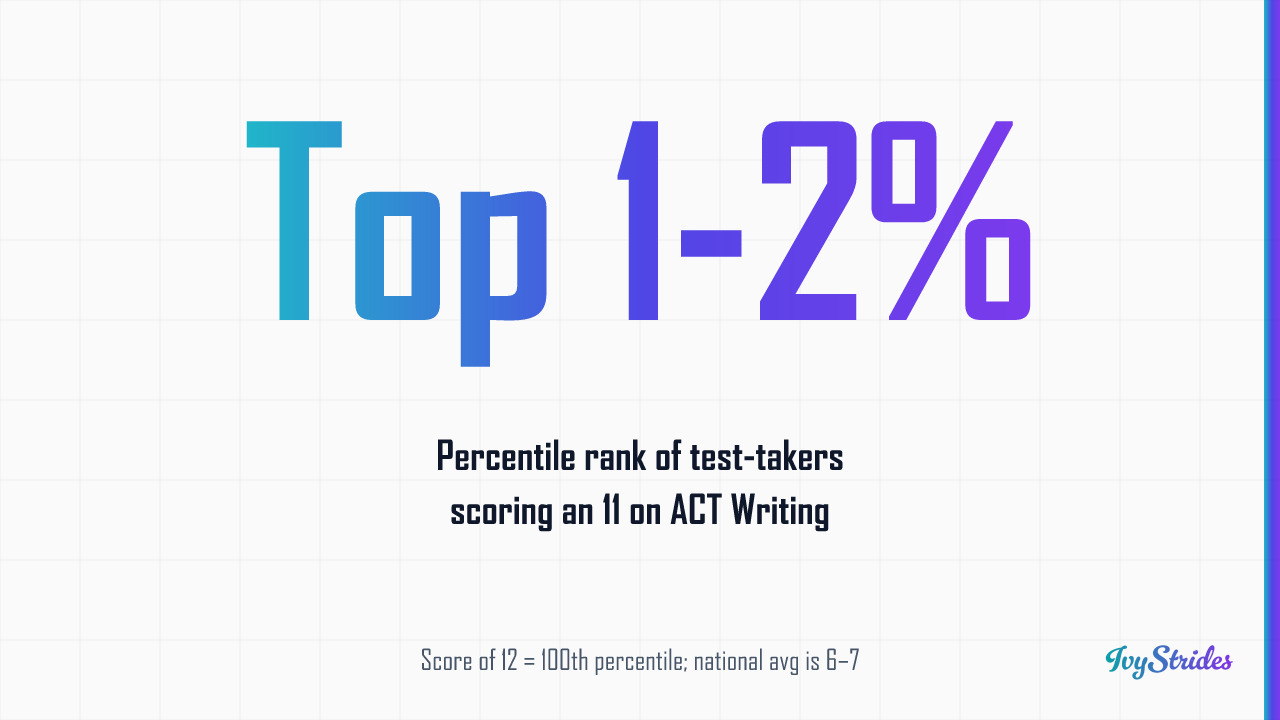
- Score of 11: top 1-2% of all test-takers.
- Score of 12: 100th percentile. Extremely rare. Both raters must award a 6 in all four domains.
When a student tells us they "wrote a solid essay" and scored an 8, that 8 sits right at the national mean. It feels solid because most essays land near that level. The gap from 8 to 11 isn't a matter of polish. It's a structural and analytical jump. If you're still weighing which test to focus on, our breakdown of ACT vs SAT difficulty is the right starting point.
What the Four Scoring Domains Actually Measure (And Where Most Students Lose Points)
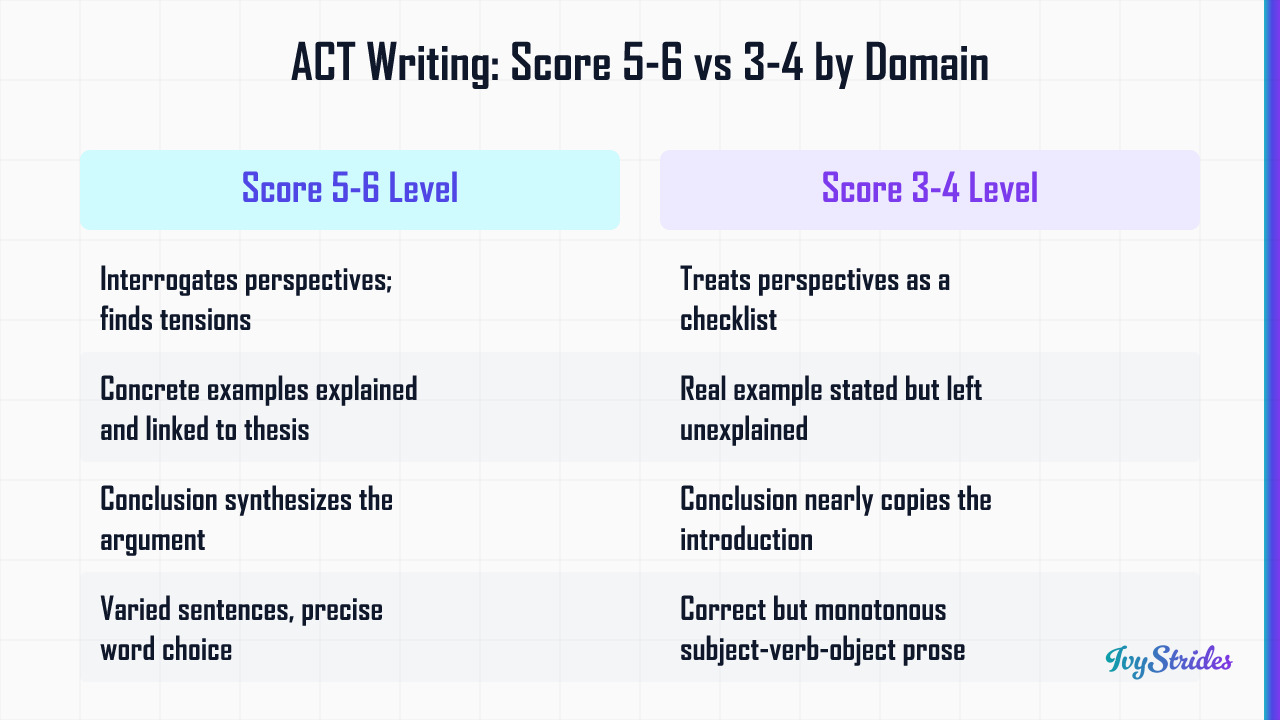
Each domain measures a different thing. Raters are trained to score them independently, which means a single essay can pull a 6 in one domain and a 3 in another. Knowing the difference between a 5-6 and a 3-4 in each domain is the entire game.
Ideas and Analysis (5-6 vs 3-4)
At the 5-6 level, the essay develops a nuanced position and critically engages with at least one of the three given perspectives. The writer doesn't just acknowledge the perspectives; they interrogate them, identifying assumptions, tensions, or implications.
At the 3-4 level, the essay restates the perspectives and stakes out a position, but treats the perspectives as a checklist. Acknowledge perspective 1. Acknowledge perspective 2. Side with one. There's no real analysis of why the perspectives differ or what's at stake.
The analytical reading skills that help you interpret ACT Reading passages, identifying an author's argument and evaluating evidence, are the same skills raters reward in the Ideas and Analysis domain of ACT Writing. If your Reading score is strong, you already have the raw material; you just need to transfer it onto the page.
Development and Support (5-6 vs 3-4)
At the 5-6 level, reasoning is specific and layered. Examples are concrete (a named policy, a real-world case, a precise scenario) and each example is explained: why it matters, what it proves, how it connects back to the thesis.
At the 3-4 level, the student states a claim, gives one example, and moves on. The example is real but unexplained. The reader has to do the connective work.
Organization (5-6 vs 3-4)
At the 5-6 level: clear introduction with thesis, body paragraphs with topic sentences, deliberate transitions between ideas, and a conclusion that synthesizes the argument rather than restates the introduction.
At the 3-4 level: paragraphs exist, but transitions are weak ("Another reason is…", "Also…"), and the conclusion is a near-copy of the introduction. The argument doesn't build; it stacks.
Language Use and Conventions (5-6 vs 3-4)
At the 5-6 level: varied sentence structure, precise word choice, few or no errors in grammar and mechanics. The prose has rhythm. The writer uses subordinate clauses, occasional inversion, and deliberate parallelism.
At the 3-4 level: grammar is often correct, but every sentence follows the same subject-verb-object pattern. Vocabulary is functional but generic. Even error-free, monotonous prose gets capped at 4 here.
Students who've drilled ACT English conventions, particularly usage and mechanics, rhetorical skills, and punctuation rules, tend to score higher in Language Use and Conventions because the same grammatical precision transfers directly to their own prose. For a structured plan that integrates both sections, see how to study for the ACT. For the full picture of how Writing fits with the rest of the exam, see our ACT prep overview.
Why Most Students Get Stuck at 7 or 8 (The Exact Gaps We See in Coaching)
Here's the part most students miss. An essay that scores 7 or 8 isn't a bad essay. It's usually a competent one with two or three specific gaps that cap each domain at 3-4. Fix those gaps and the score moves.
In our coaching with students targeting an 11, the most common gap is in Ideas and Analysis: the essay acknowledges all three perspectives but never takes a clear stance on how they relate to each other. The student treats the three perspectives as separate items to be summarized rather than as competing claims to be weighed against each other. Raters can tell within the first paragraph whether the writer is going to analyze or just describe.
A junior we worked with last fall had this exact issue. Her practice essays were grammatically clean, organized into five paragraphs, and consistently scored 8. The fix wasn't more vocabulary or longer paragraphs. It was teaching her to start body paragraph 2 by taking one perspective seriously before answering it. Her next two practice essays scored 10.
The second pattern: a Development score of 3-4 typically means the student states a claim and gives one example but doesn't explain the significance or connect it back to the thesis. The example is real. The reasoning around it is thin.
Third: Organization scores of 3-4 often reflect a missing or weak conclusion that simply restates the introduction. A strong conclusion synthesizes; it shows how the body paragraphs collectively build a position that wasn't obvious at the start.
Fourth: Language Use scores get capped at 4 when sentence structure is repetitive (subject-verb-object throughout) even if grammar is technically correct. Raters reward prose that sounds like prose, not transcribed speech.
The takeaway: students who score 7-8 overall are typically scoring 3-4 in at least two domains, not 2-3 across all four. The fix is targeted, not wholesale. Identify which two domains are dragging the average, and work on those specifically. To practice under real conditions, use our act practice test online library and grade yourself against the official rubric after each attempt.
Not Sure Which Domain Is Holding Your Score Back?
Book a free 15-minute ACT strategy call. Our coaches will review your current score, identify your weakest domain, and give you a concrete plan to reach 11+.
The Essay Blueprint That Earns 5-6 in Every Domain
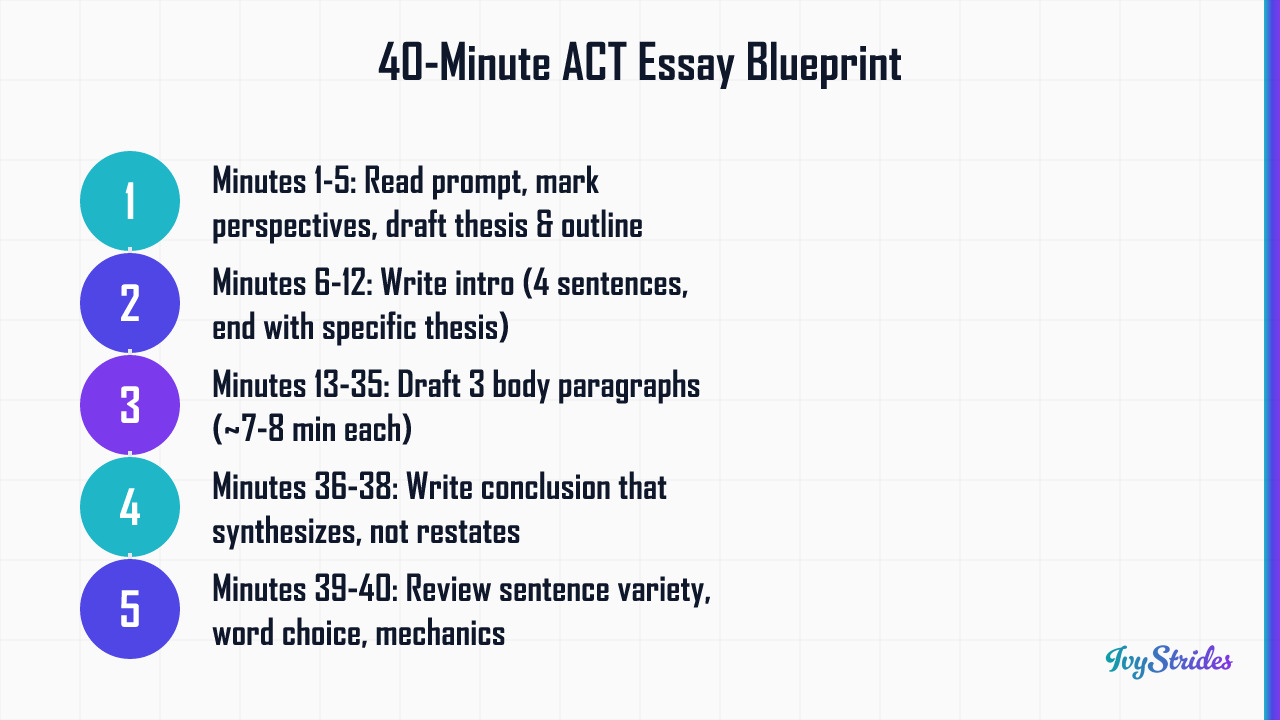
You have 40 minutes. Here's the pacing that consistently produces top-band essays:
- 5 minutes: read the prompt twice, mark up the three perspectives, draft a thesis, and outline body paragraphs.
- 30 minutes: draft. Roughly 7-8 minutes per body paragraph, plus 3-4 minutes for the introduction and 2-3 for the conclusion.
- 5 minutes: review for sentence variety, word-choice upgrades, and mechanical errors.
Target length: approximately 450-550 words. Shorter essays struggle in Development and Support; longer essays start to lose Organization control.
Introduction (3-4 sentences)
- Sentence 1: frame the issue. Don't restate the prompt verbatim; characterize the stakes.
- Sentence 2-3: briefly acknowledge the complexity. Signal that you've read the perspectives.
- Sentence 4: thesis. State your position clearly, and hint at how you'll defend it.
The thesis is the most important sentence in the essay. A generic thesis ("Technology has both benefits and drawbacks") caps Ideas and Analysis at 4. A specific thesis ("While automation displaces certain jobs in the short term, the more consequential effect is the slow reshaping of how we define meaningful work") opens the door to a 5 or 6.
Body Paragraph 1: your position with evidence
Topic sentence stating your main claim. Two pieces of specific evidence or reasoning. One to two sentences explaining significance, connecting the evidence back to the thesis.
Body Paragraph 2: engagement with a contrasting perspective
This is where most 7-8 essays leave points on the table. Introduce one of the three given perspectives that complicates or contrasts your view. Concede what's valid about it. Then explain why your position still holds, or why the contrasting perspective misses something important.
That concession move, taking the opposing view seriously before answering it, is what 5-6 perspective engagement looks like in the Ideas and Analysis domain.
Body Paragraph 3: nuanced extension or second supporting argument
Two options. Either (a) a second independent argument for your position, with fresh evidence; or (b) a nuanced extension that addresses a real-world implication or counterintuitive consequence of your thesis. Option (b) tends to score higher in Ideas and Analysis because it shows the writer thinking forward from the thesis, not just defending it.
Conclusion (3-4 sentences)
Synthesize. Don't restate. A strong conclusion names the tension you identified, gestures at why your position resolves that tension better than the alternatives, and ends with a sentence that reframes the stakes. If your conclusion could be deleted without losing anything, it's not doing its job.
For students who want this structure built into a personalized timeline, our 1-on-1 ACT prep program assigns a section-specialist coach to your weakest domain. If you have a fixed test date in roughly eight weeks, see our ACT prep in 2 months framework for sequencing Writing practice alongside the multiple-choice sections.
Is an 11 a Good ACT Writing Score? Percentiles and College Expectations
Yes. An 11 is in the top 1-2% of all ACT Writing test-takers nationally. A 12 sits at the 100th percentile and is extremely rare. In our coaching experience, students who reach an 11 have already demonstrated the analytical depth and structural control that defines top-tier writing, and the gap between an 11 and a 12 is often a single domain score point from a single rater.
Whether an 11 matters for your application depends on the schools on your list. Some selective colleges require or recommend ACT Writing; many don't consider it at all. The cleanest way to verify is to check each school's admissions page or its Common Data Set directly, since policies change year to year. Test-optional policies at many schools don't automatically extend to the Writing section as a separate decision, so confirm Writing requirements specifically rather than assuming.
If you're still deciding between the ACT and the SAT, note that the SAT does not include an optional essay component as of 2024, making ACT Writing the only standardized essay option for students targeting schools that require a writing score. For a fuller comparison, see is the SAT harder than the ACT.
A quick benchmark frame:
- Score 8: competitive at most schools that review Writing.
- Score 10: strong target for highly selective schools that require or recommend Writing.
- Score 11-12: signals top-tier writing ability; never a liability in admissions.
The Composite still matters more than Writing at almost every school that considers both. If your Composite needs work first, our breakdown of how to score 34+ on the ACT walks through the full-test approach.
How to Practice ACT Writing Effectively Before Test Day
A practice protocol that works:
-
One timed 40-minute essay per week for 4-6 weeks before the test. No exceptions on the timer. The Writing test is as much a pacing exercise as an analytical one.
-
Self-score in each of the four domains using the official ACT rubric available at act.org. Be honest. If you're not sure whether a paragraph is a 4 or a 5, default to 4.
-
Compare your essay to official ACT sample essays at the 4, 5, and 6 score levels. ACT publishes annotated samples for exactly this purpose. Reading a 6-level essay next to your own is the single fastest way to calibrate your self-assessment.
-
Identify the consistently lowest domain across three practice essays. That's your priority for targeted work, not whichever domain felt weakest on the most recent essay.
In our coaching, students who practice with domain-level self-scoring typically improve their Writing score by 2-3 points within 4-6 weeks of structured practice. The students who plateau are almost always the ones who write practice essays but never grade them against the rubric.
To log domain-level errors across essays and track patterns over time, grab our mistake tracker (the same template works for ACT Writing; just relabel the columns to the four domains). If you're targeting specific schools and want to know exactly where the Writing score sits in their review, our piece on Yale ACT code and score requirements shows how to read a school's stated and unstated expectations.
FAQ
How are ACT Writing scores calculated?
Two trained raters each score your essay 1-6 in four domains: Ideas and Analysis, Development and Support, Organization, and Language Use and Conventions. Each domain score is the sum of the two raters' scores (so 2-12 per domain). Your final ACT Writing score is the average of the four domain scores, rounded to the nearest whole number, producing a 2-12 result. Source: ACT, Inc. official scoring documentation.
Does ACT Writing affect the Composite score?
No. The ACT Writing score is reported separately and does not factor into the 1-36 Composite. Your Composite is the average of your four multiple-choice section scores: English, Mathematics, Reading, and Science. Colleges that require or recommend Writing review it as a separate data point alongside your Composite.
How rare is a 12 on ACT Writing?
A perfect 12 requires both raters to award a 6 in all four domains, placing the student at the 100th percentile. It's extremely rare. In our coaching experience, students who reach an 11 already have the analytical depth and structural control that characterizes top-tier writing; the gap to a 12 is often a single domain point from one rater, which is partly outside the writer's control.
Should I retake the ACT just to improve my Writing score?
It depends on whether the colleges on your list require or recommend Writing and how far your current score is from their expectations. If your Composite is already strong and only Writing needs improvement, check each school's admissions page or Common Data Set to confirm whether Writing is required. Retaking the full ACT to improve only one section is a real time investment; talk it through with an ACT coach before committing.
Is spelling scored on the ACT Writing test?
Spelling falls under Language Use and Conventions. Raters evaluate overall control of language, including grammar, punctuation, syntax, and word choice. Occasional spelling errors are unlikely to drop your score significantly on their own, but a pattern of errors that disrupts readability will lower the Language Use and Conventions domain score. Proofread in the final 3-5 minutes.
What ACT Writing score should I aim for at selective colleges?
For highly selective colleges that require or recommend Writing, aim for a 10 or above. An 8 is generally competitive at most schools that review Writing at all. Always verify the specific school's policy directly, since requirements vary by institution and can change year to year. Test-optional policies at many schools don't automatically extend to the Writing section, so confirm before assuming Writing is optional.
Top ACT Writing scores aren't about flowery vocabulary or longer essays. They're about a clear thesis, real engagement with the given perspectives, layered evidence, controlled prose, and a conclusion that synthesizes rather than restates. Build that structure, practice it under a real 40-minute timer, and grade yourself honestly against the official rubric. The score follows.
Ready to Turn Your ACT Writing Score Into a Strength?
Students and parents: book a free 15-minute strategy call with an IvyStrides ACT coach. We'll identify your domain gaps, build a targeted practice plan, and connect your Writing prep to your full ACT and admissions strategy.

Award-winning author (South Asian Book Award) and graduate of BITS Pilani and UCLA Luskin School of Public Affairs. Brings a published writer's eye to Common App essays and grammatical precision to SAT and ACT R&W instruction.