
How to Set a Realistic SAT Score Goal with your Child in 2026: A Step-by-Step Guide That Actually Works

On this page
- Why Setting a Specific SAT Score Goal Matters More Than Just Saying "Do Your Best"
- Step 1: Establish Your Child's SAT Baseline Score Before Setting Any Goal
- Step 2: Research the SAT Score Ranges at Your Child's Target Colleges
- Step 3: Measure the SAT Score Gap and Decide Whether It Is Realistic
- Not Sure If Your Child's SAT Goal Is Realistic? Let's Find Out Together.
- Step 4: Build a Prep Timeline Around Your Child's SAT Target Score
- Step 5: Break the SAT Goal into Section Sub-Goals for Reading and Writing vs. Math
- How to Have the SAT Goal Conversation with Your Child Without Creating Pressure
- What a Realistic SAT Score Goal Looks Like at Each Starting Score Band
- Frequently Asked Questions About Setting a Realistic SAT Score Goal with Your Child
- What percentage of students get a 1600 on the SAT?
- What is a realistic SAT goal for a student, with an example?
- Is the SAT or ACT better for students with ADHD?
- Is it possible to bring a 1230 SAT score up to 1400?
- How do I find the SAT score range for a specific college?
- Should my child aim for the median SAT score at their target school or higher?
- How many practice tests should my child take before setting a final SAT goal?
- Your Next Move
- Your Child Has a Target Score. Now Let's Build the Plan to Reach It.
To set a realistic SAT score goal with your child, start with a full-length official Digital SAT practice test to find a true baseline score. Then look up the middle-50% SAT ranges (25th to 75th percentile) for each college on your child's list using the Common Data Set. Measure the gap between the baseline and the 75th-percentile target. For students completing structured prep, a gain of roughly 100 to 200 points is typical. That gap, divided by realistic weekly study hours, gives you a prep timeline and a defensible target date.
Those inputs (baseline, target-college percentile, gap, and hours) come from the College Board's Digital SAT documentation and each school's published Common Data Set. The rest of this guide walks through the five steps in order, then closes with a score-band reference table and a parent-and-child conversation script.
Why Setting a Specific SAT Score Goal Matters More Than Just Saying "Do Your Best"
A vague goal produces vague prep. "Do your best" tells a 15-year-old nothing about which question types to drill, how many hours to study, or when to register.
An SAT score goal is a planning tool, not a judgment. It's a specific number, on the 400 to 1600 scale, tied to a real test date and a real college list. Without it, families default to two failure modes: over-preparing (six months of unfocused review that burns the student out) or under-preparing (a rushed month before the test with no diagnostic).
Consider a student aiming for "1400" who has never taken a practice test. If their real baseline is 1150, that's a 250-point gap. At roughly 5 hours per week of focused prep, that gap needs closer to 20 weeks of runway, not the 6 weeks the family had loosely planned. A goal without a baseline is a guess.
One caveat before you build the goal. Test-optional policies vary by school and year, so before anchoring your entire strategy on a target score, confirm each of your child's target schools' current policy through FairTest and the do colleges still require the SAT in 2026 breakdown. Even at test-optional schools, a strong score submitted at or above the 75th percentile typically strengthens the application.
Step 1: Establish Your Child's SAT Baseline Score Before Setting Any Goal
Skip this step and every number after it is fiction.
An SAT baseline score is the score your child would earn today, with no prep, on a real Digital SAT under real conditions. The only reliable way to find it is a full-length official practice test administered through the Bluebook app from College Board, the same platform used on test day. Four full-length practice tests are available for free inside Bluebook.
Have your child sit the full test in one session, timed, with the 10-minute break, and no phone. Anything shorter or untimed produces a score that overstates real ability. In our coaching, students who skip the baseline step and set goals from aspirations alone consistently underestimate their gap and run out of prep time before their test date.
The Digital SAT is scored on a 400 to 1600 scale, with two sections weighted equally: Reading and Writing (200 to 800) and Math (200 to 800). Each section is delivered in two modules. Module 1 has a mix of easy, medium, and hard questions. Performance on Module 1 determines whether the student routes to a harder or easier Module 2. Only students who route to the harder Module 2 can access the top of the score range. This adaptive structure matters for goal-setting: a student stuck in the easier Module 2 has a functional section ceiling of roughly 600 to 650, regardless of accuracy.
If your child hasn't taken a Digital SAT practice test yet but has a recent PSAT score, that PSAT can serve as an early baseline proxy. See our guide on how to use your PSAT score to set an SAT goal for the conversion math. For the underlying scoring mechanics, how the Digital SAT is scored walks through Module 1 to Module 2 routing in detail.
Record two numbers from the baseline: the composite (out of 1600) and the two section scores (R&W and Math, each out of 800). You'll need all three for Step 3.
Step 2: Research the SAT Score Ranges at Your Child's Target Colleges
Once you have a baseline, you need a target. That target is not "as high as possible." It's the 75th percentile SAT score at each school on your child's list.
Every US college publishes a Common Data Set (CDS), updated annually. Section C of the CDS lists the 25th and 75th percentile SAT scores for enrolled students who submitted scores. To find any school's CDS, search "Common Data Set [University Name]" in Google. The results usually surface a PDF on the university's institutional research page.
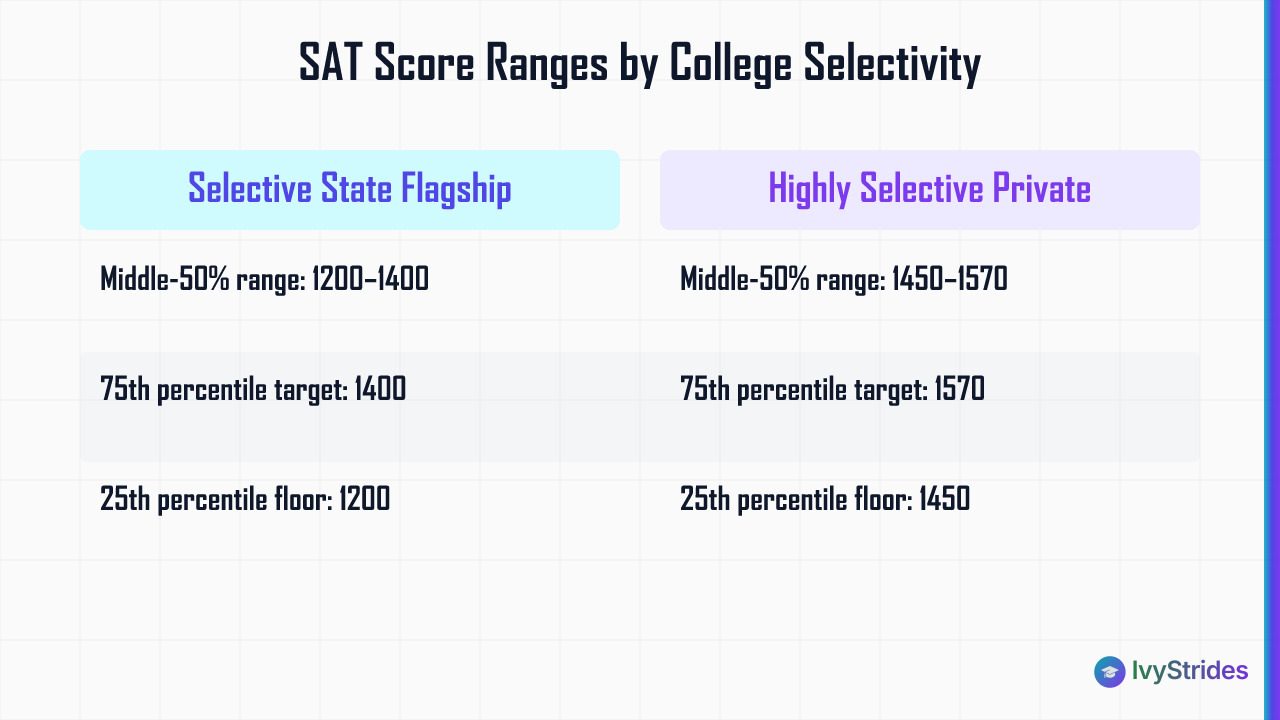
The range between the 25th and 75th percentiles is the school's middle-50% SAT range. Two examples:
| School tier | Sample middle-50% SAT range | 75th percentile target |
| Selective flagship state university | 1200 to 1400 | 1400 |
| Highly selective private research university | 1450 to 1570 | 1570 |
Aim for the 75th percentile, not the median. A score at the 75th percentile places your child above roughly three-quarters of admitted students who submitted scores, which strengthens the application. The median (50th percentile) means half of admitted students scored higher. The 25th percentile is the floor: submitting a score below that number often hurts more than it helps.
Do this for three to five schools on your child's list. Take the highest 75th-percentile target and use that as the working goal. If your child's dream school has a 1530 target and their safety school has a 1350 target, prepping for 1530 covers both.
For a full breakdown of what SAT scores mean at every percentile and selectivity tier, our guide on what is a good SAT score in 2026 covers the national distribution in detail.
One caveat, again: test-optional policies vary by school and year. Confirm each school's current policy via FairTest or the test-optional admissions landscape in 2026 before finalizing the target.
Step 3: Measure the SAT Score Gap and Decide Whether It Is Realistic
Subtract the baseline from the target. That number is the gap.
Baseline 1180. Target 1400. Gap = 220 points.
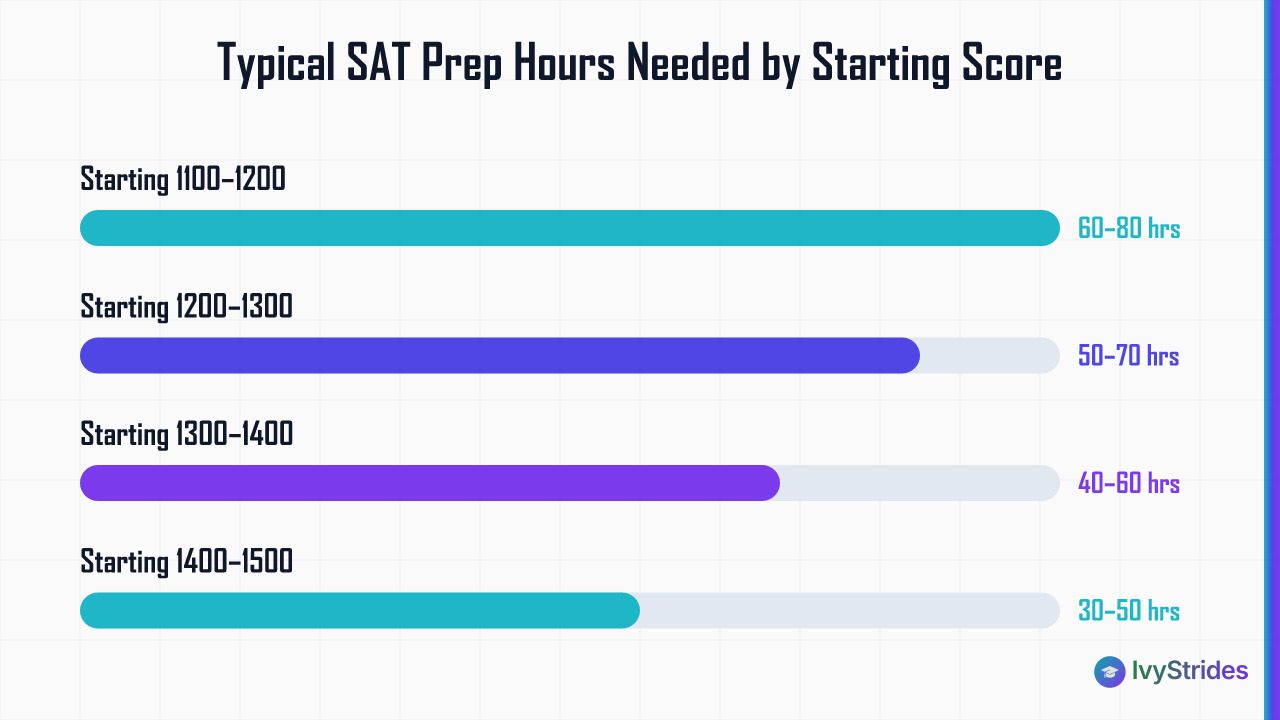
The next question is whether 220 points is closable given your child's timeline and available prep hours. Here are score-band benchmarks, framed as typical outcomes for students completing a structured, diagnostic-driven program:
| Starting composite | Typical realistic target | Typical prep hours needed |
| 1100 to 1200 | 1250 to 1350 | about 60 to 80 hours |
| 1200 to 1300 | 1350 to 1450 | about 50 to 70 hours |
| 1300 to 1400 | 1450 to 1520 | about 40 to 60 hours |
| 1400 to 1500 | 1500 to 1560 | about 30 to 50 hours |
A 200+ point improvement is achievable for students starting below 1300 who complete a full diagnostic-driven program, but it typically requires 80 to 120+ hours. These ranges align with published benchmarks across the tutoring industry, where a 100 to 200 point improvement with structured prep is the widely-cited typical outcome.
Now split the gap by section. If your child scored 620 R&W and 560 Math with a composite target of 1400, that's roughly +80 R&W and +140 Math. The Math gap is nearly twice as large, so the prep plan should be Math-heavy: more time on Algebra, Advanced Math, and Problem-Solving and Data Analysis than on R&W drills.
In our coaching with students in the 1200 to 1300 band, those who identify their weakest question types in Module 1 (for example, Command of Evidence in R&W or Advanced Math in Math) and target those specifically see faster gains than students who review everything.
Once you have a gap number, the next question is whether that gap is closable in your available timeline. Our 200 point SAT improvement guide breaks down exactly what that prep looks like week by week. For students who want a section-specialist coach to run the diagnostic and build the plan, our SAT 1-on-1 prep program pairs each student with a dedicated R&W coach and a dedicated Math coach.
Not Sure If Your Child's SAT Goal Is Realistic? Let's Find Out Together.
In 15 minutes, an IvyStrides coach will review your child's baseline score, map it against your target colleges, and give you a concrete gap number and prep plan. No pressure, no sales pitch. Students and parents both welcome. Book directly here: [CALENDLY_URL]
Step 4: Build a Prep Timeline Around Your Child's SAT Target Score
A gap in points is not a plan. A gap in weeks is.
The Digital SAT is offered roughly seven times per year in the US. College Board publishes the full test date schedule at satsuite.collegeboard.org. Registration deadlines fall about a month before each test date.
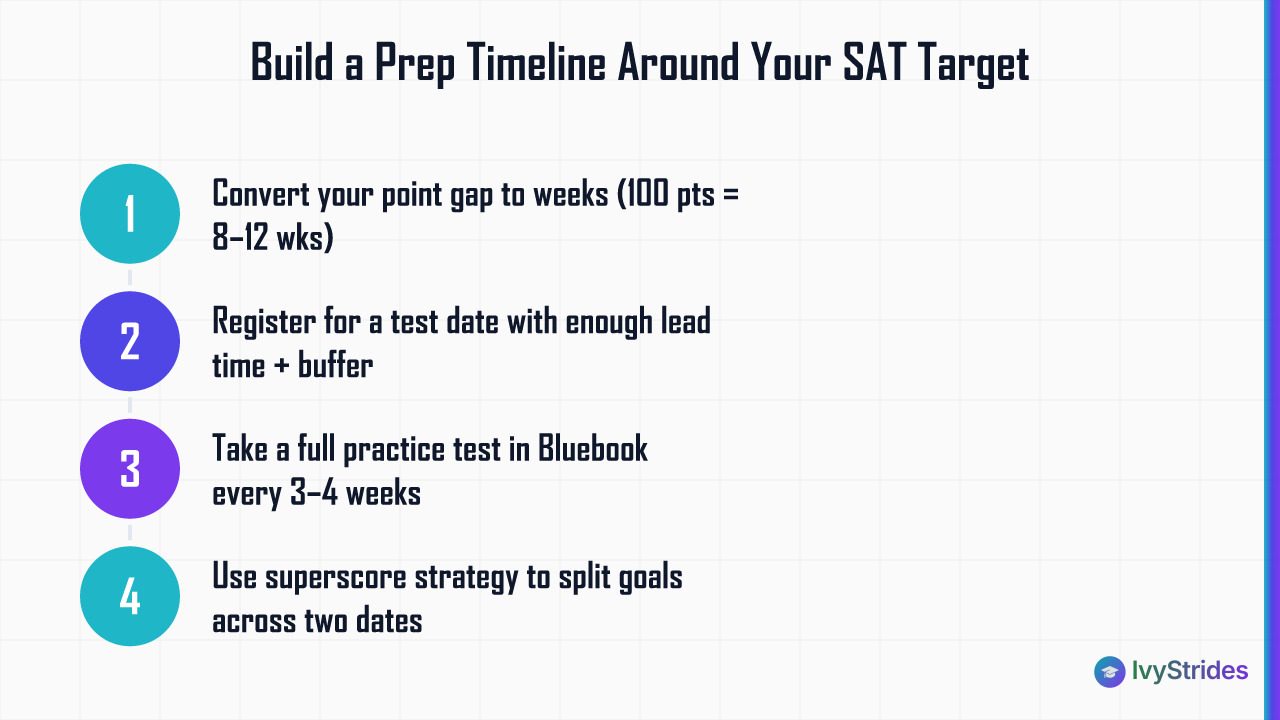
Convert the gap to weeks using a rule of thumb: a 100-point gap typically needs 8 to 12 weeks of consistent prep at 5 to 7 hours per week. A 200-point gap needs roughly 16 to 20 weeks at the same pace. So a student with a 150-point gap should register for a test date at least 14 to 16 weeks out, plus a buffer week or two.
Build in spaced retesting. Roughly every 3 to 4 weeks during prep, sit a full-length practice test in Bluebook, score it, and adjust the plan based on which section moved and which didn't. Students who never re-test between diagnostic and test day arrive on test day with no updated data on their gap.
Superscore policy also changes the math. Most colleges superscore the SAT, meaning they take the highest R&W score and the highest Math score across separate test dates. That lets a student split the goal across two attempts: focus prep on R&W for a fall test date, then shift to Math for a spring date. Confirm each target school's superscore policy on its admissions page; policies vary.
For a customizable week-by-week schedule that turns your gap number into a weekly action plan, our SAT study plan walks through 6-day, 6-week, and 6-month versions. For upcoming test dates and registration windows, see SAT test dates 2026-2027.
Step 5: Break the SAT Goal into Section Sub-Goals for Reading and Writing vs. Math
A 1400 composite goal is really two goals: a Reading and Writing target and a Math target. Treating it as one number wastes prep hours.
The Digital SAT R&W section covers four content domains: Information and Ideas, Craft and Structure, Expression of Ideas, and Standard English Conventions. The Math section covers Algebra, Advanced Math, Problem-Solving and Data Analysis, and Geometry and Trigonometry. Each domain has a specific set of question types that appear in Module 1 and, more heavily weighted, in the harder Module 2.
Take a student scoring 620 R&W and 580 Math with a composite target of 1350. They need +65 in R&W and +85 in Math. That's not "study harder." It's:
- R&W focus: whichever two of the four domains scored lowest on the Bluebook score report (often Craft and Structure and Standard English Conventions).
- Math focus: Advanced Math and Problem-Solving and Data Analysis, which typically carry the heaviest weight in the hard Module 2.
A section-specialist coach knows exactly which question types appear in each Module 2 hard set and can drill those directly. In our coaching, students who work with a dedicated R&W coach and a separate dedicated Math coach (rather than a generalist tutor teaching both) close section gaps faster because each coach lives inside one section every day. This is why the IvyStrides tutors page lists R&W specialists and Math specialists separately. Why the SAT 1-on-1 prep program pairs each student with both.
For students whose gap sits largely on the Math side, SAT Math prep covers the domain-by-domain tactics that move a Math section score.
How to Have the SAT Goal Conversation with Your Child Without Creating Pressure
The hardest step isn't the math. It's the conversation.
Frame the goal as a plan built from data, not as a judgment of your child's ability. Here's a script that works with most 10th and 11th graders:
"Your practice test score is 1180. The three schools you're most excited about have middle-50% SAT ranges of 1300 to 1480. Our working goal is 1380, which is a 200-point improvement. That's a stretch, and it's within the typical range for students who put in about 80 hours of focused prep. Here's what that looks like over 16 weeks. If we start now, you'd sit the real test in mid-May. Does that timeline work with your junior year?"
Notice what that script does. It names the baseline. It anchors the goal to specific colleges rather than abstract prestige. It states the effort honestly (80 hours is not casual). It puts the timeline in the student's hands. And it never mentions intelligence.
In our coaching, students who understand why the goal matters (a specific set of colleges, not a number for its own sake) stay more consistent through a 14 to 18 week prep cycle than students who are told to "just get a high score."
Two things to avoid. First, never compare your child's baseline to a sibling's, a cousin's, or a classmate's. Score-shaming produces test anxiety, and test anxiety suppresses real ability on test day. Our guide on strategies to overcome SAT anxiety covers that failure mode in detail. Second, don't inflate the goal to sound ambitious. A goal 300 points above a realistic target creates a demoralization spiral around week 8, when the practice-test scores aren't moving fast enough.
Setting the goal is step one. Staying involved without adding pressure is harder, and our parent support guide for SAT prep covers exactly how to do that through every phase of prep.
What a Realistic SAT Score Goal Looks Like at Each Starting Score Band
Quick reference. All ranges are typical outcomes for students completing a structured, diagnostic-driven program. Not guarantees.
| Starting composite | Realistic target | Typical prep hours | College tier alignment |
| 900 to 1100 | 1100 to 1250 | 80 to 120 | Broad-access and less-selective four-year colleges |
| 1100 to 1200 | 1250 to 1350 | 60 to 80 | Selective state universities |
| 1200 to 1300 | 1350 to 1450 | 50 to 70 | Competitive private universities and flagship state schools |
| 1300 to 1400 | 1450 to 1520 | 40 to 60 | Highly selective universities |
| 1400 to 1500 | 1500 to 1560 | 30 to 50 | Most selective universities in the country |
A note on 1600. Only a very small share of test-takers earn a perfect score in any given year. A 1600 should not be the default goal for most students. The goal is to be competitive at your child's target schools, not to maximize the number in the abstract.
For a live tool that maps a section-score pair to a composite target, use our SAT score calculator. For broader improvement tactics, how to improve your SAT score in 2026 covers the methodology.
Frequently Asked Questions About Setting a Realistic SAT Score Goal with Your Child
What percentage of students get a 1600 on the SAT?
Only a very small share of SAT test-takers earn a perfect 1600 in any given year. For most students, 1600 is not a useful planning target. A better goal is the 75th percentile SAT score at your specific target colleges, which typically falls between 1350 and 1570 depending on selectivity. Anchoring to a real school's data beats chasing a headline number.
What is a realistic SAT goal for a student, with an example?
A realistic SAT goal is anchored to a baseline score and a specific college target. Example: a student scores 1220 on a full-length Bluebook practice test and wants to apply to a school with a middle-50% range of 1300 to 1460. A realistic target is 1380 to 1400, which is a gain of roughly 160 to 180 points improvement. For students completing a structured 14 to 18 week program, that gap is within the typical range.
Is the SAT or ACT better for students with ADHD?
Neither test is universally better. Both the SAT and ACT offer accommodations including extended time, which must be applied for through the College Board or ACT, Inc. respectively. The right test depends on the individual student's strengths. The SAT's adaptive Digital format and absence of a Science section suits some students; the ACT's consistent pacing and shorter passages suits others. Take a full official practice test of each and compare. Our ACT vs SAT decision guide walks through the trade-offs in detail.
Is it possible to bring a 1230 SAT score up to 1400?
A 170-point improvement from 1230 to 1400 is within the typical range for students completing a structured, diagnostic-driven prep program. In our coaching with students in the 1200 to 1300 band, those who identify their weakest question types and work with a section-specialist coach typically gain 100 to 200 points. Key variables: available prep time (roughly 60 to 80 hours for this gap), consistency, and quality of instruction.
How do I find the SAT score range for a specific college?
Search "Common Data Set [College Name]" in Google. The result is usually a PDF on the college's institutional research page. Look for Section C, which reports the score band for enrolled students who submitted results. Common Data Sets are updated annually, so verify you're reading the most recent version (typically the CDS 2023 to 2024 or 2024 to 2025).
Should my child aim for the median SAT score at their target school or higher?
Aim higher than the median. Targeting the upper end of a school's published band puts your child ahead of most admitted students who submitted scores, which strengthens the application. Sitting at the median means half of admitted students scored higher, which is a weaker position. Submitting a score below the 25th percentile often hurts more than it helps.
How many practice tests should my child take before setting a final SAT goal?
One full-length official practice test in Bluebook is enough to establish a baseline and set the initial goal. After that, one practice test roughly every 3 to 4 weeks during prep serves as a progress checkpoint and lets you adjust the goal or the plan if the student is improving faster or slower than expected. Students who take a practice test only once (at the start) prep blind for months.
Your Next Move
You now have the five-step framework: baseline, target research, gap analysis, timeline, and section sub-goals. The remaining step is turning that framework into a plan your child will actually work through week by week. That's where a section-specialist coach saves months of trial and error. IvyStrides is a global, online 1-on-1 prep academy; you can read more about our approach on the About page or meet the coaching team on the tutors page.
Your Child Has a Target Score. Now Let's Build the Plan to Reach It.
Book a free 15-minute strategy call with an IvyStrides section-specialist coach. We'll confirm the goal, identify the section gaps, and map out a realistic prep timeline, whether that means 1-on-1 coaching, a Test Pack, or a combination of both. Book directly here: [CALENDLY_URL]

Award-winning author (South Asian Book Award) and graduate of BITS Pilani and UCLA Luskin School of Public Affairs. Brings a published writer's eye to Common App essays and grammatical precision to SAT and ACT R&W instruction.