
How to Prepare for the AIME in the Three Months After the AMC
On this page
- What the AIME Format Demands and Why It Is Harder Than the AMC
- What to Study for the AIME: The Four Topic Areas and Where to Start
- Your Three-Month AIME Preparation Schedule, Week by Week
- What Happens After the AIME: USAJMO, USAMO, and What Your Score Signals
- FAQ: AIME Preparation and Qualifying
- How difficult is it to qualify for AIME?
- Is qualifying for AIME impressive?
- Is the AIME test hard?
- What is the qualifying score for AIME?
- Your Next Step Toward a Competitive AIME Score
The 2027 AIME is a 15-question exam taken in two 90-minute parts, with every answer an integer from 0 to 999, and preparing for it after the AMC means working four topic areas in sequence: algebra, geometry, number theory, and combinatorics. Diagnose your weakest area in month one, then move to AIME-level problems and timed simulations.
Those format facts come from the MAA, and the sequence matters because the AIME rewards depth, not speed. Twelve minutes per problem tests whether you can carry a multi-step construction to a clean integer, a different skill from the pattern-spotting that gets you through the AMC.

What the AIME Format Demands and Why It Is Harder Than the AMC
The AIME (American Invitational Mathematics Examination) is the MAA's second-stage competition: 15 questions split into two 90-minute parts, eight problems in the first and seven in the second, with every answer an integer from 0 to 999, no multiple-choice options, and no penalty for a wrong answer (MAA).
For 2026-27 you qualify with a score of 100 or above on the AMC 10 or 85 or above on the AMC 12, now fixed numbers rather than percentages, and you must be 13 or older on the day you take the AIME (MAA). Pearson testing centers will give the AIME as a computer-based exam on February 5 and 6, 2027, with no separate AIME I and AIME II, no make-up dates, and a February 1 registration deadline.
Why the format changes your practice. The AMC gives you five answer choices, so backsolving and estimation win points. The AIME gives you a blank box. You either produce the exact integer or you score nothing on that problem. That constraint means AIME preparation has to build full solutions, not shortcuts to the right letter.
Here is how the three exams compare.
| Exam | Questions | Time | Answer format | Wrong-answer penalty |
| AIME | 15 | Two 90-minute parts | Integer 0 to 999 | None |
| AMC 10/12 | 25 | 75 minutes | 5 choices | None (0 points; a blank earns 1.5) |
| Digital SAT | 98 | 2 hr 14 min | Multiple-choice and student-produced response | None |
Sources: AIME and AMC (MAA); SAT (College Board).
IvyStrides' analysis of the MAA's published format puts the average time per AIME question at 12 minutes, about 11 in part 1 and 13 in part 2, against about 57 seconds per question on the enhanced ACT core and, on the digital SAT, about 71 seconds per Reading and Writing question and about 95 seconds per Math question. That gap is the whole point: a single AIME problem can demand a modular arithmetic argument, a coordinate setup, and a careful final count before you reach the integer.
Reaching the qualifying threshold is itself a real achievement, and how hard it is to qualify for the AIME lays out the exact score mechanics behind it. Which AMC version you sat also sets your route: the AMC 10 path leads to USAJMO eligibility and the AMC 12 path to USAMO, a distinction worth settling before you fix a score target, so weigh choosing between the AMC 10 and AMC 12 early.
What to Study for the AIME: The Four Topic Areas and Where to Start

Photo by RDNE Stock project on Pexels
AIME problems fall into four topic areas: algebra, geometry, number theory, and combinatorics with probability. Because the exam rewards depth rather than speed, your first job isn't to open a textbook; it's to find which of those four is your floor. Attempt three or four problems from each area on a recent AIME paper, untimed, and note exactly where you stall.
A common pattern. Students over-index on algebra, their strongest AMC area, and under-prepare number theory. Rank the four areas by where you lose the most and start theory work there in week one, not with whatever feels comfortable.
| Topic area | Key subtopics | Priority if weak |
| Algebra | Polynomials, sequences, functional equations, inequalities, complex numbers | High, but often strong |
| Geometry | Euclidean, coordinate, trigonometric, 3D | High |
| Number theory | Modular arithmetic, divisibility, Diophantine equations | Highest, commonly weakest |
| Combinatorics and probability | Counting, recursion, expected value, generating functions | High |
Where problems sit. Do not count on one difficulty ladder running from problem 1 to problem 15: for 2027 the MAA says the two parts, eight problems and then seven, will be comparable in difficulty. For a first-time qualifier, the problems you can finish cleanly in each part are the highest-use targets. Lock those down before you sink most of a 90-minute part into one hard problem.
Work from past AIME papers, which share the 15-question, integer-answer format. They were single three-hour sittings, so to rehearse the 2027 split you time each one as two 90-minute blocks, problems 1 to 8 and then 9 to 15, knowing the difficulty may not divide the way the new parts do. Topic work also fits inside a larger contest year, so where each contest lands across the AMC-to-AIME season helps you plan beyond this one sitting.
Your Three-Month AIME Preparation Schedule, Week by Week
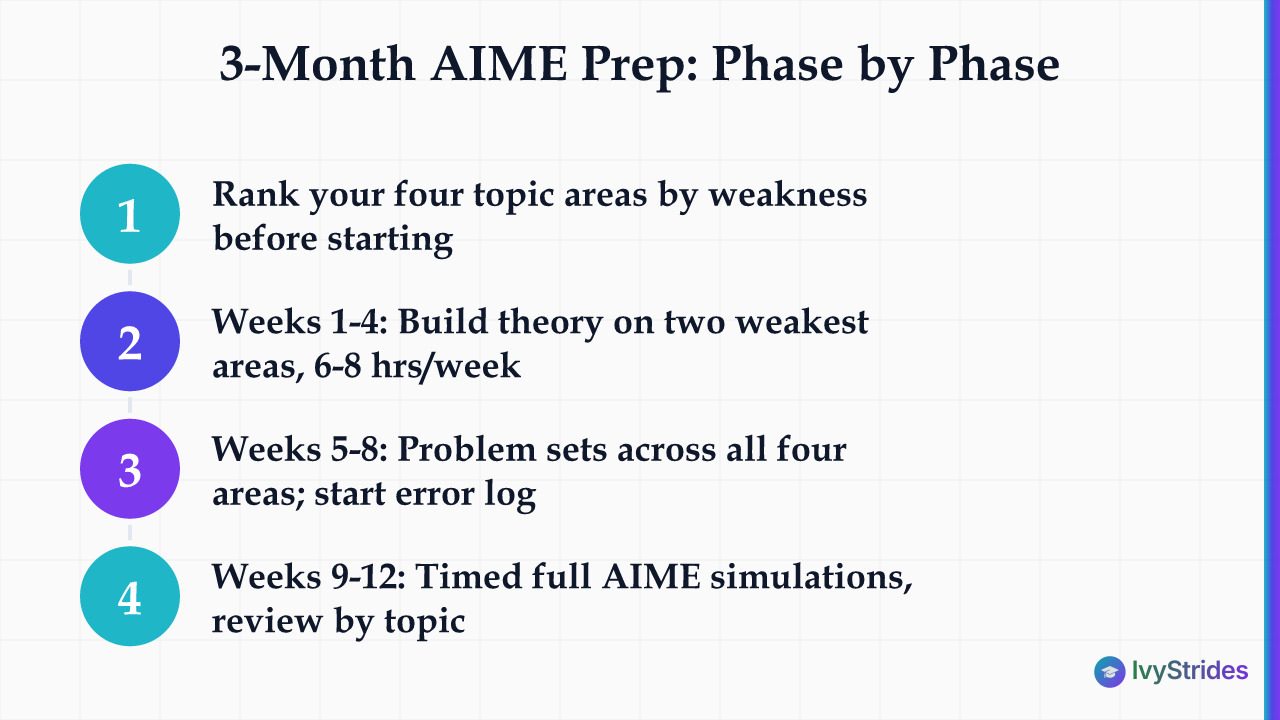
A three-month AIME plan splits into three phases: theory on your two weakest topic areas, targeted problem sets across all four, then timed simulations. Because you already ranked the four areas by weakness, month one starts with purpose rather than a scattered read-through. A common early mistake is attempting random problem sets before diagnosing which area is your floor, so rank first and work the weakest area in week one.
| Phase | Weeks | Focus | Weekly hours | Key milestone |
| Theory | 1–4 | Two weakest areas, problems 1–6 difficulty | About 6–8 | Gaps named and closed |
| Problem sets | 5–8 | All four areas, problems 1–10 difficulty | About 8–10 | Error log live and sorted |
| Simulation | 9–12 | Timed full papers, review by topic | About 8–10 | Three full AIME sittings done |
Month one, weeks 1 to 4. Build theory on your two weakest areas and drill problems 1 through 6. If number theory is your floor, that means modular arithmetic, divisibility rules, and Diophantine equations before anything harder. Keep sessions to roughly 6 to 8 hours a week.
Month two, weeks 5 to 8. Move to problem sets across all four areas at problems 1 through 10 difficulty, and start an error log. For every miss, record the topic, whether it was a conceptual gap or an execution slip, and the resolution. That log tells you where month three has to go.
Month three, weeks 9 to 12. Run timed full-exam simulations on past AIME papers, then review each paper problem by problem against the error log sorted by topic. Since the 2027 AIME runs as two 90-minute parts with no return to part 1 and no calculators, rulers, compasses or formula sheets, rehearse that setup in your early timed sittings.
Whatever plan you follow, end it on at least three timed full-exam simulations in month three, each reviewed problem by problem. If you want that structure without building it yourself, IvyStrides' Math Olympiad and Research program names the two topic areas to tackle first and maps a week-by-week schedule against your AIME date.
What Happens After the AIME: USAJMO, USAMO, and What Your Score Signals
The AIME is a gateway, and your AMC route sets which olympiad you would be invited to: the USAJMO if you came through the AMC 10, the USAMO if you came through the AMC 12 or both, though a ninth or tenth grader from the AMC 12 whose AIME score clears only the USAJMO bar goes to the USAJMO.
For 2027, the MAA says qualification for both olympiads will be primarily based on AIME scores and AMC scores will no longer be a factor (MAA), and it has not published a fixed AIME cutoff. Treat that as a reason to maximize your AIME score, not to aim at a cutoff someone posted last year.
| Route | AMC exam | AIME score needed to advance | Next stage |
| USAJMO | AMC 10 | Primarily AIME score; no fixed cutoff published for 2027 | USAJMO |
| USAMO | AMC 12, or both AMC 10 and AMC 12 | Primarily AIME score; no fixed cutoff published for 2027 | USAMO |
Is qualifying impressive? For a STEM-focused applicant, yes. The MAA invites students who perform exceptionally well on the AMC 10 or AMC 12 to the AIME, so qualifying is a recognized problem-solving signal. That said, admissions outcomes depend on the full application, not any single credential.
The AIME sits inside a wider competition calendar running from the AMC 8 through AMC 10/12, AIME, and USAJMO or USAMO, and knowing where each sits helps you plan a multi-year profile. Selective colleges read competition results as one academic signal among many, a point the best extracurricular activities for the Ivy League puts in context. Students aiming higher often pair a contest record with a project, and a math research topic a high schooler can finish gives a starting framework.
FAQ: AIME Preparation and Qualifying
How difficult is it to qualify for AIME?
For 2026-27 the MAA has fixed the bar at 100 or above on the AMC 10 or 85 or above on the AMC 12, both scored out of 150, and AIME takers must be at least 13 on test day (MAA). The MAA has not published what share of AMC takers that bar will admit.
Is qualifying for AIME impressive?
Yes. AIME qualification is a meaningful academic credential, especially for students applying to STEM-focused programs at selective colleges, because the MAA offers the AIME to students who earn a qualifying score on the AMC 10 or AMC 12. Admissions outcomes depend on the full application, not any single credential, so treat it as one strong signal among many.
Is the AIME test hard?
Yes. The MAA states that AIME questions are more difficult than those on the AMC 10 and AMC 12, and the exam is far harder than the SAT. Its 15 problems require multi-step reasoning across algebra, geometry, number theory, and combinatorics, with no multiple-choice options and no partial credit. In 2027 you also work under a split format: eight problems in the first 90 minutes and seven in the second, with no return to the first part.
What is the qualifying score for AIME?
For 2026-27 the qualifying scores are fixed: 100 or above on the AMC 10A or AMC 10B, or 85 or above on the AMC 12A or AMC 12B (MAA). Students who also meet the MAA's other eligibility rules, including being 13 or older on test day, can take the AIME once, on February 5 or 6, 2027.
Your Next Step Toward a Competitive AIME Score
You have the format, the four topic areas, and a three-month sequence that turns AMC qualification into a plan. The work now is to start diagnosing, not reading.
- Pull a recent past AIME paper and attempt three or four problems in each topic area, untimed.
- Rank the four areas by where you stall and begin theory on the weakest two in week one.
- Open an error log in month two, sorting every miss by topic and by error type.
- Reserve month three for at least three timed full-exam simulations, each reviewed problem by problem.

Rajesh is a technology leader, entrepreneur, and angel investor with 28+ years in Business & Technology Leadership and Product & Solution Engineering. He is passionate about education, mentoring, and driving digital transformation.