
How to Find a Maths Research Topic a High Schooler Can Actually Finish
On this page
- What Makes a High School Maths Research Topic Actually Finishable
- Is This Maths Research Topic Finishable? A 5-Point Check
- Which Maths Research Topic Areas Work Best for High Schoolers
- High School Maths Research Topic Areas: Scope, Skill Level, and Example Questions
- How to Narrow Any Maths Topic Into a Specific Research Question
- From Broad Interest to Specific Research Question: A 4-Step Narrowing Process
- How a Maths Research Project Strengthens a College Application
- How a Maths Research Project Appears Across Your College Application
- FAQ: Maths Research Topics for High School Students
- Which topic is best for research in mathematics?
- What are some good research project topics in mathematics?
- What are some good math project ideas for high school students?
- What are some good research titles for mathematics?
- Your Next Step on a Maths Research Topic
The strongest math research topics for high school students come from four areas: applied statistics and data analysis, combinatorics and graph theory, number theory, and mathematical modelling. A high school maths research topic is a single specific question you answer with your current skills in one semester. Scope decides everything.
That framing comes from how structured programs like the MIT PRIMES High School Research Program define finishable projects: a narrow question, a written output, and a mentor who keeps it on track. A narrow question finished well beats a broad topic abandoned halfway.
What Makes a High School Maths Research Topic Actually Finishable
A finishable maths research topic is one you can scope to a single answerable question, complete with a precalculus or early-calculus background, and finish in a semester to a year with a written output. Most stalled projects fail the first criterion, not the last.
Scope is the difference between a field and a question. "Number theory" is a field you cannot finish. "Do the prime gaps in the first 10,000 primes match the Cramér conjecture predictions?" is a question you can answer in a few months. In our coaching, students who try to research a full field stall within roughly four weeks; students who start with a single dataset or a single conjecture produce a finished paper.
The most common failure mode is choosing something too advanced, not too basic. Students reach for a topic that needs graduate coursework to even read the literature, then quietly abandon it. Match the topic to what you already know: strong algebra, some statistics, maybe early calculus.
A typical high school maths research paper runs roughly 5 to 15 pages over 3 to 6 months, a range synthesised from program parameters at MIT PRIMES and Immerse Education. IvyStrides derives this figure from the inputs cited above. Your output can be a written paper, a poster, or a presentation. A mentor matters here too. Structured programs pair students with a supervisor who validates the question before any work begins, the step self-directed students skip most often.
Is This Maths Research Topic Finishable? A 5-Point Check
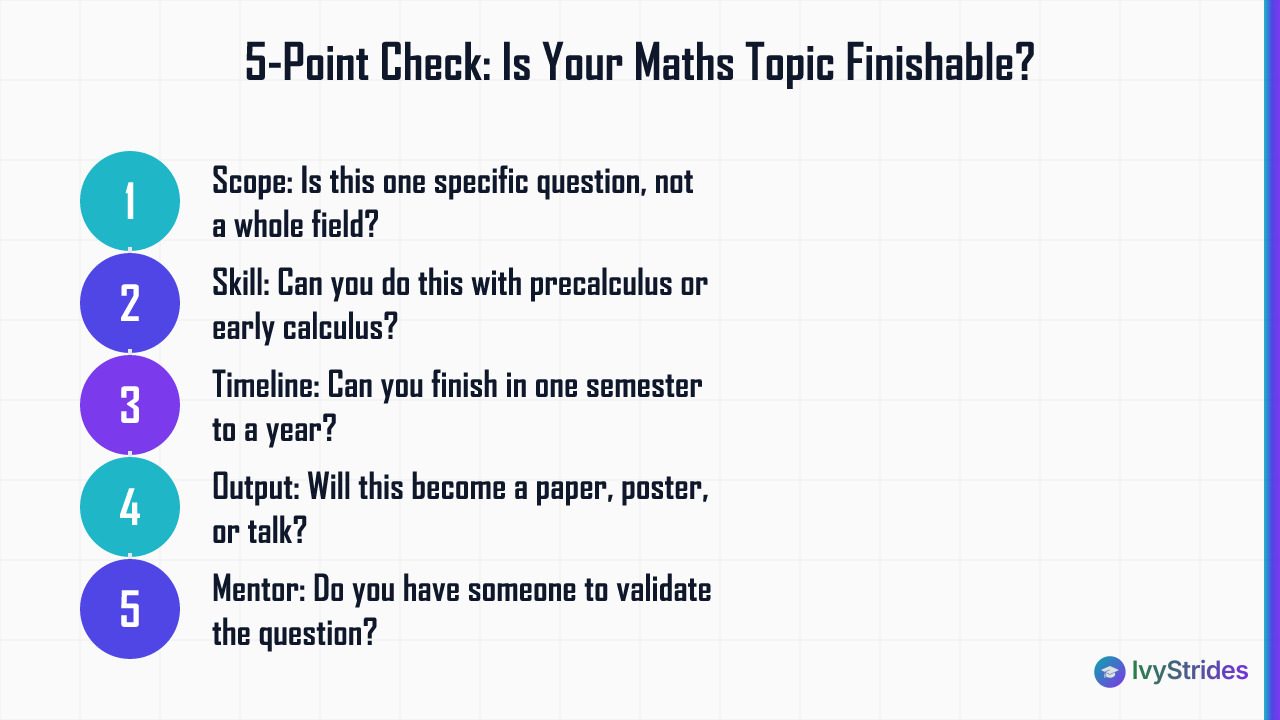
| Criterion | What to Ask |
| Scope | Is this one specific question, not a whole field? |
| Skill | Can I do this with precalculus or early calculus? |
| Timeline | Can I finish in one semester to a year? |
| Output | Will this become a paper, poster, or talk? |
| Mentor | Do I have someone to validate the question? |
Students also weighing research against contests can compare the landscape in our guide to math competitions and summer camps for high schoolers.
Which Maths Research Topic Areas Work Best for High Schoolers
The best maths research topic areas for high schoolers are applied statistics, combinatorics and graph theory, number theory, and mathematical modelling, because each offers open questions accessible without university coursework. Building on the finishability check above, applied statistics and combinatorics are the most accessible entry points; number theory suits students with competition experience.
Students who have worked through AMC 10/12 problem sets in combinatorics or number theory already have the background to turn a competition problem into a research question, because both disciplines reward the same skill: finding structure in an unfamiliar situation. Students still deciding between contests can read AMC 10 or AMC 12 first.
Applied statistics needs only high school statistics and a dataset. Test Benford's Law on economic figures, or model sports outcomes from public tracking data. Combinatorics and graph theory need no calculus at all; graph coloring, Ramsey numbers, and network spread models are rich in questions a motivated student can attempt. Number theory rewards a strong algebra background: modular arithmetic, prime distribution, RSA cryptography. Mathematical modelling applies maths to real systems like epidemiology or ecology, with entry-level projects possible on algebra and statistics alone.
High School Maths Research Topic Areas: Scope, Skill Level, and Example Questions
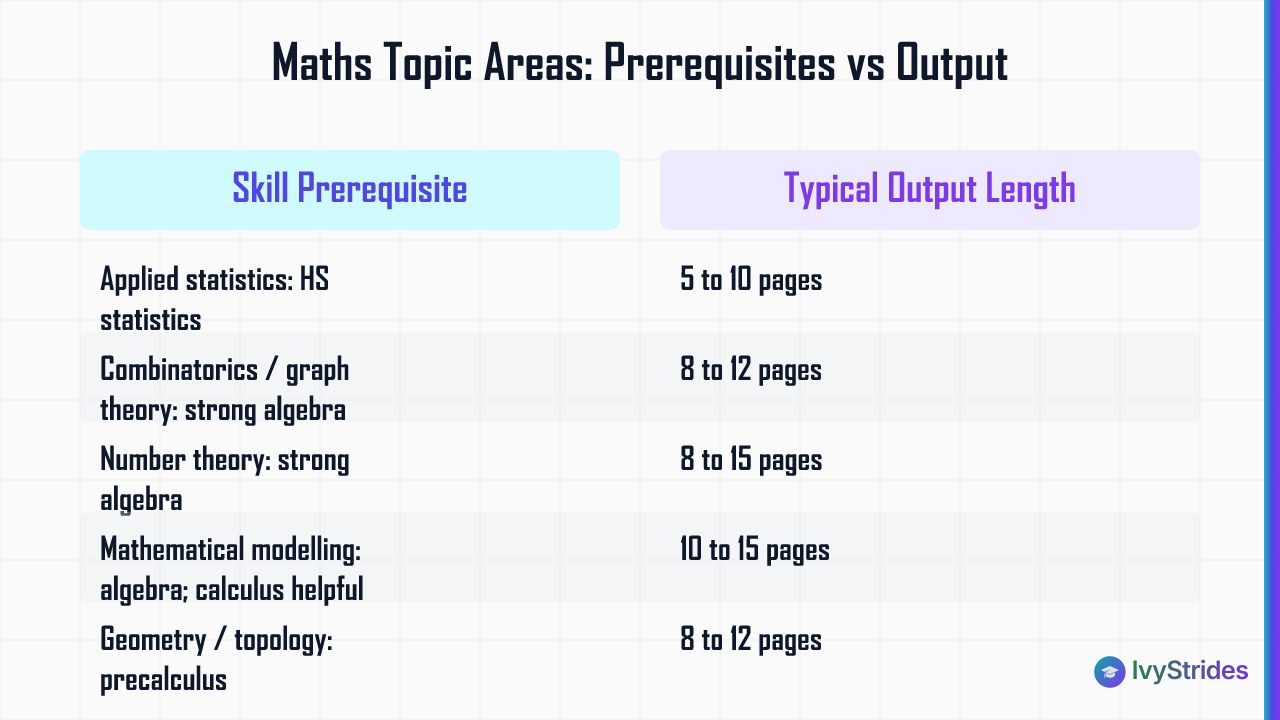
| Topic Area | Skill Prerequisite | Example Research Question | Typical Output |
| Applied statistics | High school statistics | Do World Bank GDP figures follow Benford's Law? | 5 to 10 pages |
| Combinatorics / graph theory | Strong algebra | Can vertex coloring schedule a school timetable? | 8 to 12 pages |
| Number theory | Strong algebra | Do prime gaps below 10,000 fit Cramér's conjecture? | 8 to 15 pages |
| Mathematical modelling | Algebra; calculus helpful | How does an SIR model fit a local outbreak? | 10 to 15 pages |
| Geometry / topology | Precalculus | What symmetries govern a given tiling family? | 8 to 12 pages |
The pattern across applied mathematics research topics holds: the strongest projects pair a concrete phenomenon with a method the student already owns. Our math olympiad and research program covers exactly these areas with structured mentorship.
How to Narrow Any Maths Topic Into a Specific Research Question
Narrowing a maths topic into a research question means moving from field to subfield to a specific phenomenon to a single answerable question, then checking you can answer it with the tools and data you actually have. This step decides whether the topic areas above become finishable projects or quietly die.
Take statistics. Narrow it to Benford's Law. Narrow that to a phenomenon: leading digits in GDP data. Then write the question: "Do the leading digits of World Bank GDP figures follow Benford's Law, and do deviations correlate with political instability indices?" That is a research question. It names a dataset, a method, and a testable claim.
Run two tests on any candidate question. First, the available-tools test: can you answer it with high school maths and free data? World Bank Open Data, the Stanford Network Analysis Project, and public sports-reference archives cover most projects. Second, the original-contribution test: is the answer already sitting in a textbook, or is the question genuinely open? A mentor validates that before you commit months to it.
From Broad Interest to Specific Research Question: A 4-Step Narrowing Process
-
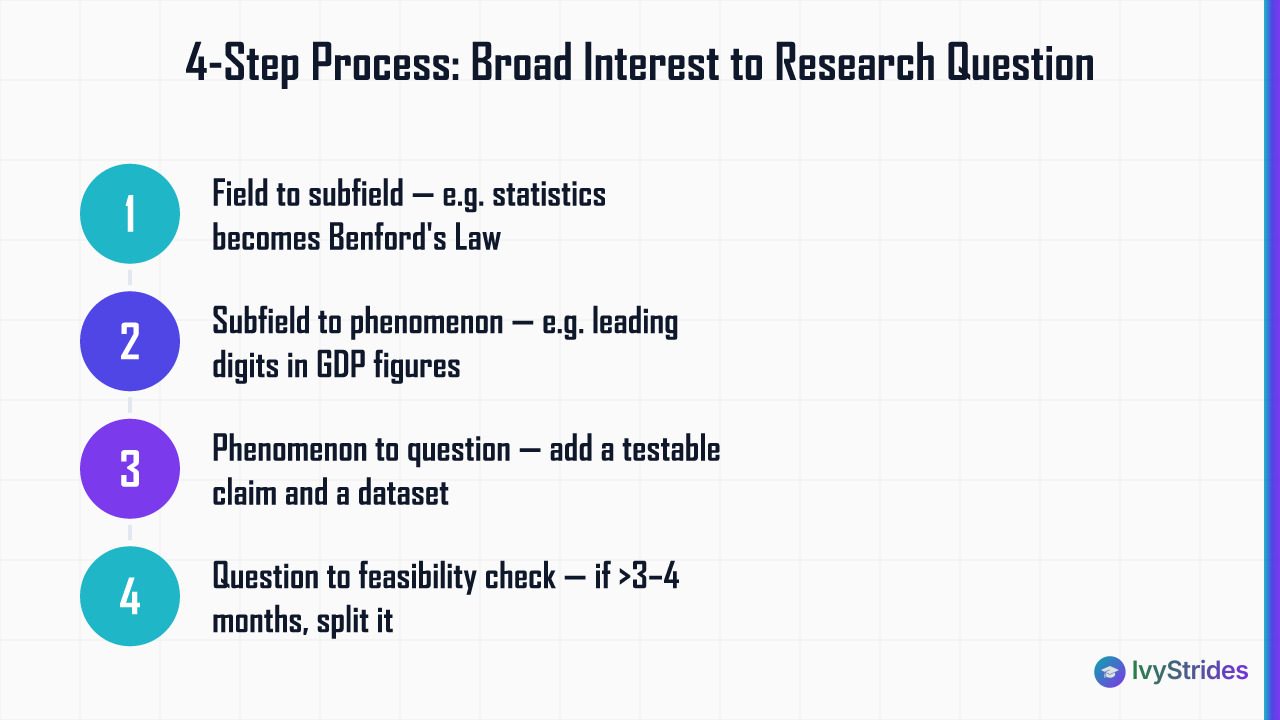
Field to subfield. Statistics becomes Benford's Law.
-
Subfield to phenomenon. Benford's Law becomes leading digits in GDP figures.
-
Phenomenon to question. Add a testable claim and a dataset.
-
Question to feasibility check. If answering it needs more than roughly 3 to 4 months of focused work, split it.
Students who want a finished project to submit somewhere can also scan research competitions for high school students before locking the question.
How a Maths Research Project Strengthens a College Application
A finished maths research project strengthens a college application by functioning as an admissions spike: a sustained, specific intellectual commitment that appears on the activities list, in the Common App additional information section, and often in a personal statement. It signals depth where most applications show breadth.
A completed maths research project, even a modest one with a clear question and a written conclusion, functions as a spike on a college application because it demonstrates sustained intellectual initiative rather than a list of short-term activities. Our full explainer on what is a spike in college admissions develops that argument in detail.
On the activities list, describe the project in 150 characters: "Independent research on Benford's Law in GDP data; wrote 12-pg paper testing digit distributions against instability indices." Concrete verb, concrete output. In the additional information section, a short abstract gives an admissions reader the shape of the work. In an essay, the research process, the false starts, the moment a model finally fit, often becomes a genuine personal statement rather than a list of accomplishments.
One caveat, and it is not optional. A research project can strengthen an application, but college admissions outcomes depend on the full application, not any single element, and no project substitutes for strong grades or scores. Students interested in research across STEM disciplines can explore science competitions and programs alongside maths research to find where their strongest interest lies. Building that overall strategy is the work of college admissions counseling.
How a Maths Research Project Appears Across Your College Application
| Application Section | What to Include | Limit |
| Activities list | Project title, method, output | 150 characters |
| Additional information | Short abstract of the question and finding | ~650 words |
| Personal statement | The process and what it revealed about you | 650 words |
| Interview | One clear sentence on what you found | Spoken |
FAQ: Maths Research Topics for High School Students
Which topic is best for research in mathematics?
For high school students, applied statistics and combinatorics are the most accessible starting points, because both need only algebra and precalculus and offer genuinely open questions. Number theory is a strong third choice if you have competition maths experience. The best topic is the one that matches your current skill level and scopes to a single answerable question.
What are some good research project topics in mathematics?
Strong starting points include testing Benford's Law on a real-world dataset, modelling information spread across a social network graph, analysing prime gap distributions, or building a statistical model for sports outcomes. Each scopes to a 5 to 15 page paper using freely available data and high school maths tools.
What are some good math project ideas for high school students?
Project ideas that work at the high school level include a Benford's Law analysis of a public dataset, a graph-coloring application to a scheduling problem, a modular arithmetic exploration of RSA cryptography, or a mathematical model of a local ecological system. Each produces a concrete, presentable output within one semester.
What are some good research titles for mathematics?
A strong research title names both the phenomenon and the dataset or method. For example: "Do Leading Digits in World Bank GDP Data Follow Benford's Law?" or "Vertex Coloring as a Scheduling Tool: A Graph Theory Application to School Timetabling." Titles that name the question and the method signal a scoped, finishable project.
Your Next Step on a Maths Research Topic
You now have four topic areas, a five-point finishability check, and a four-step process for narrowing a broad interest into one answerable question. The gap between reading this and finishing a paper is a single specific question and someone to validate it.
- Pick one topic area that matches your current maths background.
- Write a one-sentence research question that names a phenomenon, a method, and a dataset.
- Check it against the 5-point finishability list before you commit any time.
- Line up a mentor or program to validate the question before you start writing.

Two decades teaching quantitative and verbal aptitude on standardized tests. Rare dual expertise across Math and Verbal — particularly effective for students with gaps on both sides. Senior AP Mentor for our Calculus and English tracks.