
How Many Points It Takes to Qualify for the AIME, and What Changes After You Do

On this page
- What the AIME Qualifying Score for AMC 10 and AMC 12 Actually Is
- How Hard It Is to Qualify for AIME, and What a Realistic Prep Timeline Looks Like
- AMC 10 or AMC 12: Which Path to AIME Qualification Is Right for You
- What AIME Qualification Actually Signals for College Admissions
- FAQ: AIME Qualifying Scores and What They Mean
- What is the qualifying score for AIME?
- What percentage of people qualify for AIME?
- How difficult is it to qualify for AIME?
- Is AIME qualifier impressive?
- Your Next Step Toward an AIME Qualifier
To qualify for the AIME, score 100 or higher on the AMC 10, or 85 or higher on the AMC 12. The AIME (American Invitational Mathematics Examination) is the second stage of the MAA competition ladder, reached only by clearing these fixed thresholds. Both exams run on a 0-150 scale.
Those thresholds come from the Mathematical Association of America, and they took effect for the 2026-27 school year, replacing the older floating percentage cutoffs. Verify them at maa.org before each cycle, since the MAA reviews the rules annually. The harder question is whether your gap to that number is closable, and that is what the rest of this article settles.
What the AIME Qualifying Score for AMC 10 and AMC 12 Actually Is
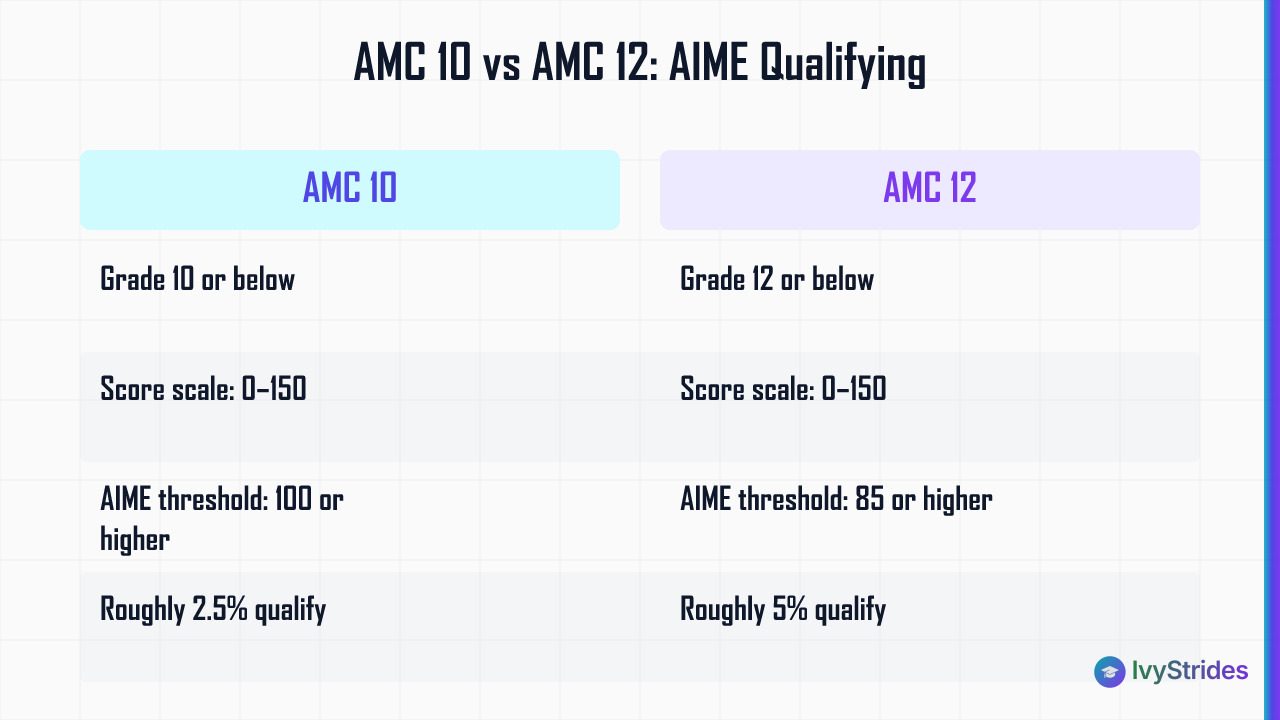
The AIME qualifying score is 100 on the AMC 10 or 85 on the AMC 12. The AMC 10 and AMC 12 are 30-question, 75-minute multiple-choice exams, each scored from 0 to 150, with 6 points per correct answer and 0 for a blank or wrong answer. Clear the threshold on either, and the MAA invites you to sit the AIME.
The 2026-27 change matters. Before this cycle, the MAA qualified a fixed percentage of takers, so the cutoff floated year to year. Now the number is fixed at 100 and 85. You know your target the moment you finish the contest, not weeks later.
Grade eligibility. The AMC 10 is open to students in grade 10 or below. The AMC 12 is open to students in grade 12 or below. A ninth or tenth grader can sit either, which is a real strategic choice covered further down.
If you are in grade 10 or below and deciding which exam to sit, the choice between AMC 10 and AMC 12 affects both your qualifying threshold and your AIME strategy; see our full comparison of AMC 10 or AMC 12.
For the 2025-26 cycle, the two AIME sittings fell on February 5, 2026 (AIME I) and February 11, 2026 (AIME II), per the MAA. You sit one, not both. The AIME itself runs 15 integer-answer questions, answers from 000 to 999, over 3 hours, with no multiple choice and no partial credit.
| Exam | Who Can Sit | Score Scale | AIME Qualifying Threshold | Approx. % Who Qualify |
| AMC 10 | Grade 10 or below | 0-150 | 100 or higher | Roughly 2.5% |
| AMC 12 | Grade 12 or below | 0-150 | 85 or higher | Roughly 5% |
How Hard It Is to Qualify for AIME, and What a Realistic Prep Timeline Looks Like
Qualifying is genuinely selective: roughly 2.5% of AMC 10 takers and roughly 5% of AMC 12 takers clear the threshold in a typical year. The U.S. Department of Education tracks millions of high schoolers nationally, and AMC participants already self-select as strong math students out of that field. So that top slice sits inside an already competitive pool. Across both exams, the qualifying group runs to roughly 7,000 to 10,000 students annually.
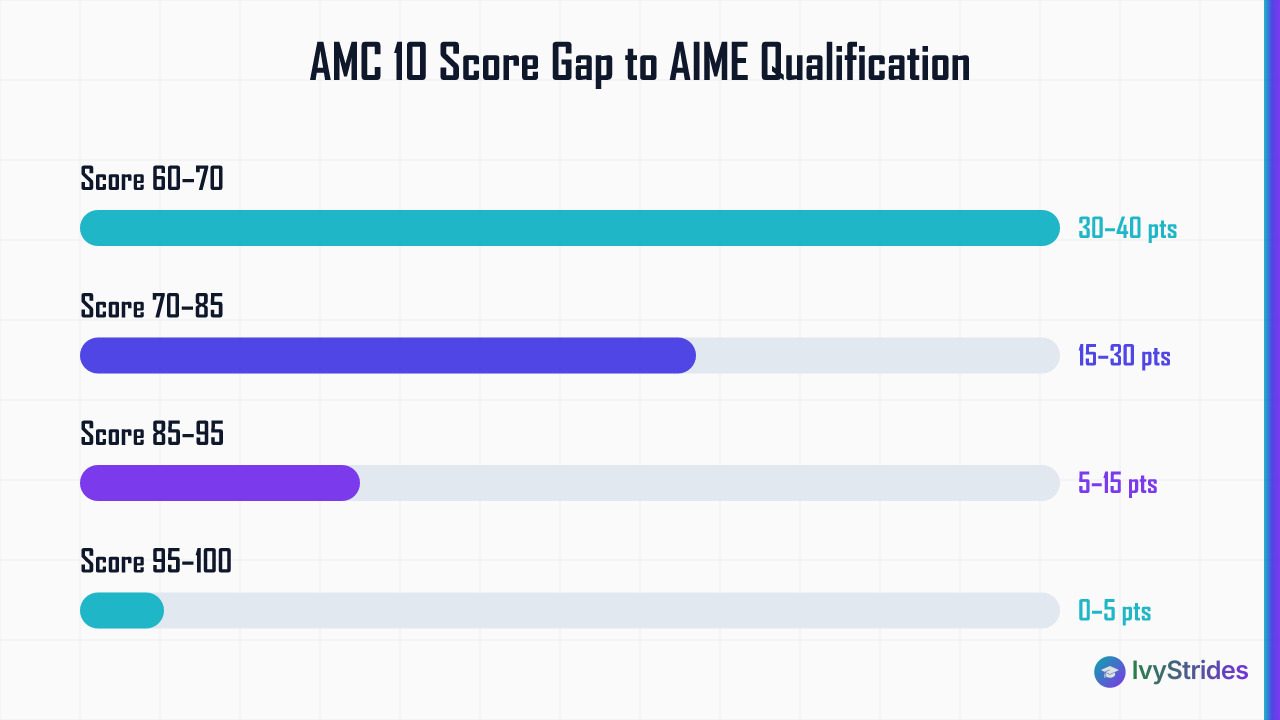
Now the math on your own gap. The AMC scores 6 points per correct answer, per the MAA. A student sitting at 70 on the AMC 10 needs 30 more points to reach 100, which means converting 5 more questions from blank-or-wrong to correct. IvyStrides calculates that gap from the MAA's published scale and threshold. Five questions sounds small. Those five are usually the hardest on the paper.
In our coaching with students in the 70-85 AMC 10 range, closing the gap to 100 typically takes 3 to 5 months of focused problem-set work across algebra, combinatorics, and number theory, with geometry close behind. Students working toward AIME qualification with a coach who specializes in competition mathematics close the gap faster than those drilling problems without a structured error-analysis process.
| Current AMC 10 Score | Points Needed | Typical Prep Timeline | Priority Topic Areas |
| 60-70 | 30-40 | Roughly 5-6 months | Number theory, combinatorics |
| 70-85 | 15-30 | Roughly 3-5 months | Combinatorics, algebra |
| 85-95 | 5-15 | Roughly 2-3 months | Geometry, speed and accuracy |
| 95-100 | 0-5 | Roughly 1-2 months | Careless-error control |
Students earlier in the ladder still building AMC 10 readiness will get more from the foundational topic framework in our guide on how to study for the AMC 8. For a structured plan tied to a specific contest date, our competition mathematics coaching is built around this exact gap-closing work.
AMC 10 or AMC 12: Which Path to AIME Qualification Is Right for You
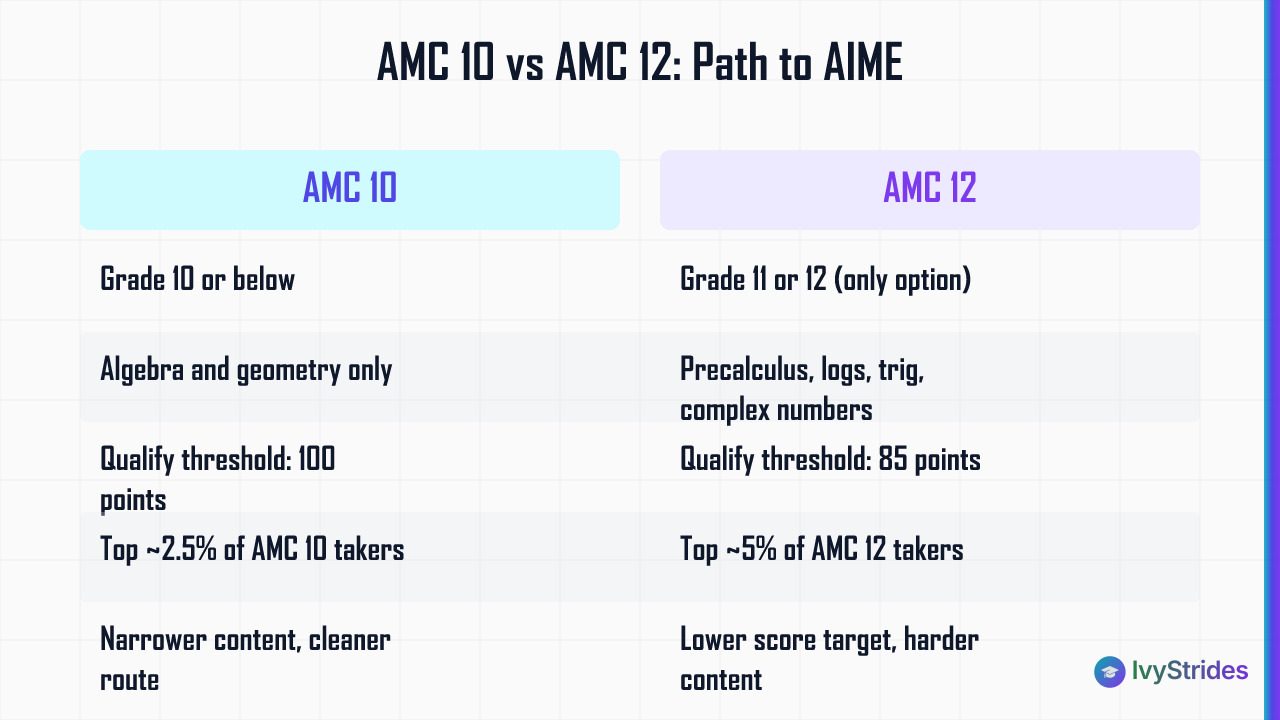
Choose the AMC 10 path if you are in grade 10 or below and haven't yet covered precalculus; choose the AMC 12 if you are in grade 11 or 12. Both exams qualify for the AIME, but the thresholds differ, 100 versus 85, and so does the content. That 85 on the AMC 12 looks lower than 100 on the AMC 10. For most students it is not the easier road.
Here is why. The AMC 12 draws on precalculus, logarithms, complex numbers, and trigonometry, per the MAA. The AMC 10 stops at algebra and geometry, with no precalculus. So the AMC 12's harder content offsets its lower point target. A student scoring 85 on the AMC 12 lands in approximately the top 5% of that field; a student scoring 100 on the AMC 10 lands in approximately the top 2.5% of AMC 10 takers.
The grade rules decide most cases for you. A grade 11 or 12 student can only sit the AMC 12, so there is no choice to make. The real decision belongs to grade 9 and 10 students eligible for both.
| Condition | Recommended Path |
| Grade 11 or 12 | AMC 12 (only option) |
| Grade 9-10, no precalculus yet | AMC 10 |
| Grade 10, strong in precalc and trig | AMC 12 for USAMO reach |
| Grade 9, building toward a multi-year plan | AMC 10 this year |
| Aiming at the fixed score threshold fastest | AMC 10 (narrower content) |
For most grade 9 and 10 students, the AMC 10 path is the cleaner route to an AIME qualifier: fewer topics to master, and the score cutoff sits on content you have already seen in school.
What AIME Qualification Actually Signals for College Admissions
AIME qualification signals top-2.5-to-5% math performance among a self-selected competitive pool, and selective STEM programs recognize it as a verifiable credential. AIME qualifiers represent roughly 2.5 to 5% of an already self-selected AMC test-taking population, per the MAA. That is what gives the credential its weight: it is nationally benchmarked and hard to fake.
Because the credential is verifiable, it carries in a way a self-reported activity does not. In our coaching with students applying to selective STEM programs, AIME qualification consistently appears on the activities list as a concrete, comparable math credential that admissions readers weigh against other applicants. It functions as a quantifiable academic spike for STEM applicants, a credential a reader can verify and compare directly.
A few honest caveats. AIME qualification helps most for STEM-focused applicants at highly selective schools; for a humanities-leaning profile it is less differentiated. And no single credential admits anyone. Admissions outcomes depend on the full application, not test scores or competition results alone.
| AMC Result | Approx. Percentile of Takers | What It Signals for Admission |
| AMC 10, 100+ | Top 2.5% | AIME qualifier, STEM spike |
| AMC 12, 85+ | Top 5% | AIME qualifier, STEM spike |
| High AIME + AMC index | National elite tier | USAMO/USAJMO eligibility |
| Below threshold | Participation only | Foundation, not yet a spike |
One rung higher, the AMC index score combined with your AIME result determines USAMO/USAJMO eligibility, the invitation-only stage above the AIME. If AIME qualification is the credential you want on a STEM application, our guidance on what is a spike in college admissions shows how a single strong signal anchors a profile. Families weighing course rigor alongside competitions can also read how many AP classes for Ivy League.
FAQ: AIME Qualifying Scores and What They Mean
What is the qualifying score for AIME?
Score 100 or higher on the AMC 10, or 85 or higher on the AMC 12. Both exams use a 0-150 scale. These are fixed thresholds the MAA set for the 2026-27 school year, replacing the older system of floating percentage cutoffs.
What percentage of people qualify for AIME?
Roughly 2.5% of AMC 10 takers and roughly 5% of AMC 12 takers reach the qualifying threshold in a typical year, per the MAA. Because AMC participants already self-select as strong math students, those percentages represent a genuinely selective cut rather than a broad one.
How difficult is it to qualify for AIME?
Qualifying is selective: the threshold sits in roughly the top 2.5 to 5% of an already competitive pool. In our coaching with students in the 70-85 AMC 10 range, closing the gap to 100 typically takes 3 to 5 months of focused work on algebra, combinatorics, and number theory.
Is AIME qualifier impressive?
Yes, for a high school student applying to selective colleges. AIME qualification is a verifiable, nationally benchmarked math credential signaling top-2.5-to-5% performance, and STEM-focused admissions readers recognize it. Admissions outcomes still depend on the full application, so treat it as one strong signal, not a decision by itself.
Your Next Step Toward an AIME Qualifier
You now have the two numbers that matter: 100 on the AMC 10, 85 on the AMC 12, both on a 0-150 scale, both verifiable at maa.org before each cycle. The gap between your current score and that threshold is measurable in whole questions, which makes it a plannable target rather than a vague ambition.
Here is what to do next:
- Pull your most recent AMC score and subtract it from your threshold to find your exact point gap.
- Divide that gap by 6 to see how many additional correct answers you need.
- Pick your exam path by grade and content readiness, AMC 10 for grade 9-10 without precalculus.
- Map roughly 3 to 5 months of topic-focused practice before your next sitting, weighting algebra, combinatorics, and number theory.

Two decades teaching quantitative and verbal aptitude on standardized tests. Rare dual expertise across Math and Verbal — particularly effective for students with gaps on both sides. Senior AP Mentor for our Calculus and English tracks.