
How to Study for the AMC 8: The Four Topic Areas and What to Practise First

On this page
- What the AMC 8 Actually Tests: Format, Difficulty, and the Four Topic Areas
- The Four AMC 8 Topic Areas Ranked: Where to Start and Why
- How to Build a Realistic AMC 8 Study Plan in 6 to 8 Weeks
- The Best AMC 8 Practice Resources and How to Use Them
- FAQ: AMC 8 Difficulty and Score Benchmarks
- Is the AMC 8 difficult?
- Is 17 a good AMC 8 score?
- What is a good AMC 8 score for a 7th grader?
- What level of math is the AMC 8 level?
- Your Next Step on the AMC 8
The AMC 8 is a 25-question, 40-minute math competition for students in grade 8 and below. Study it by working four topic areas in order: Algebra and Arithmetic first, then Geometry, Number Theory, and Counting and Probability. Practise past papers timed, and log every miss by topic.
That order comes from question volume, not habit. Algebra and Arithmetic carry the most points and overlap most with school math, so early wins there build both score and confidence. The Mathematical Association of America (MAA) sets the format and the no-penalty rule, and the harder questions are where your six weeks of prep actually go.
What the AMC 8 Actually Tests: Format, Difficulty, and the Four Topic Areas
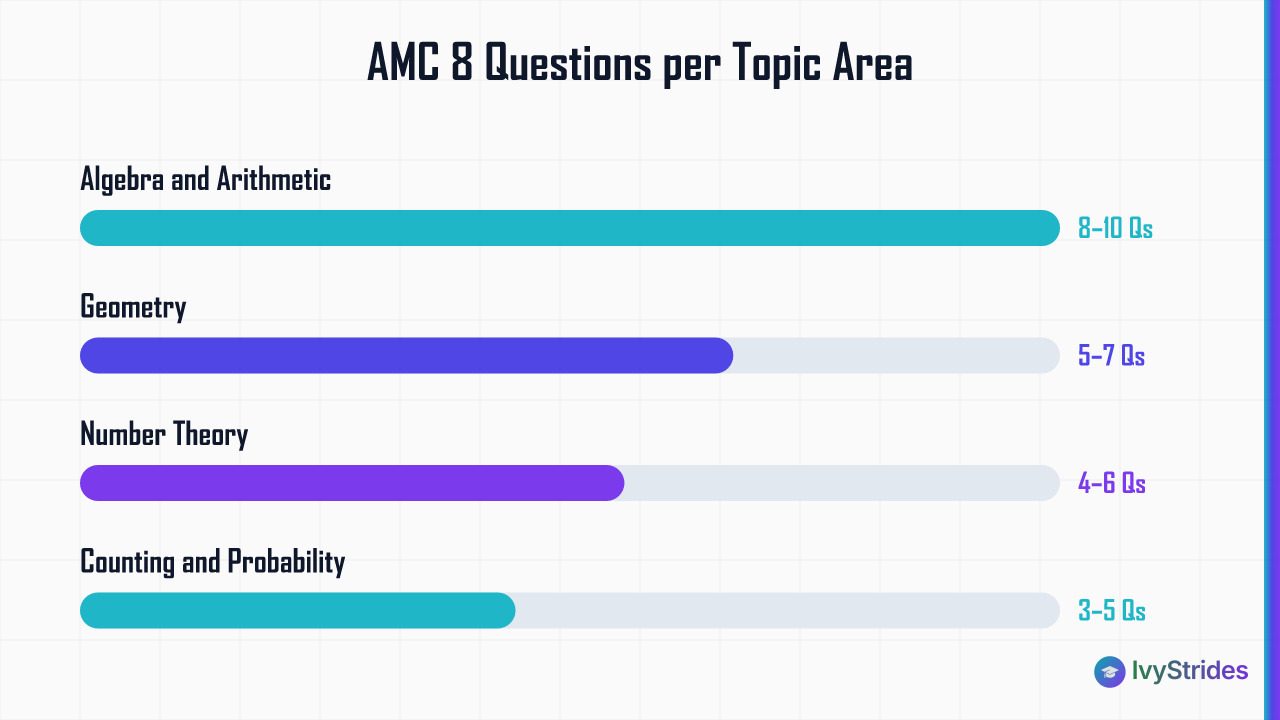
The AMC 8 is a multiple-choice competition of 25 questions in 40 minutes, open to students in grade 8 and below, with five answer choices per question and no penalty for wrong answers. That last rule matters more than it looks. Because a blank and a wrong answer both score zero, you should never leave a question empty. Guessing is always correct strategy.
Four topic areas make up the whole exam. Before building a study plan, confirm your child meets the grade eligibility requirements and has the baseline math skills the AMC 8 assumes; our full breakdown of what grade the AMC 8 is for covers readiness in detail.
Difficulty climbs across the 25 questions. Problems 1 through 10 are accessible to most students who know the underlying concept. Problems 11 through 19 reward technique and speed. Problems 20 through 25 need competition-specific ideas that a standard middle-school class rarely teaches. That gradient is why a topic-first plan beats grinding random papers.
| Topic Area | Approx. Questions per Exam | Key Concepts Tested | Difficulty to Learn Quickly |
| Algebra and Arithmetic | 8 to 10 | Ratios, percentages, word problems, linear equations, sequences | Easiest |
| Geometry | 5 to 7 | Area, perimeter, angles, similar triangles, coordinates | Moderate |
| Number Theory | 4 to 6 | Divisibility, prime factorisation, GCD, LCM | Moderate |
| Counting and Probability | 3 to 5 | Permutations, combinations, basic probability | Hardest |
The per-topic counts above are approximate. The MAA's public archive publishes every past AMC 8 problem by year; IvyStrides derived these ranges by sorting recent exams by topic, and the mix shifts slightly year to year.
The Four AMC 8 Topic Areas Ranked: Where to Start and Why
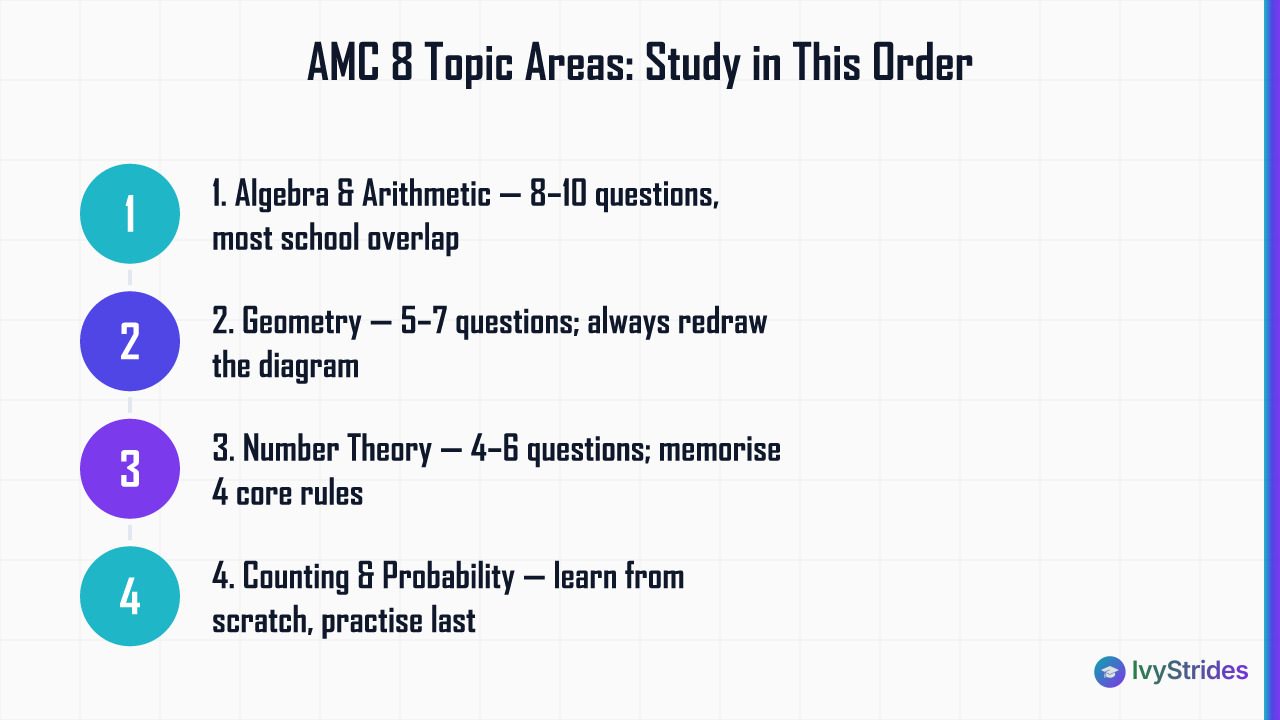
Algebra and Arithmetic is where most students should start, because it carries roughly 8 to 10 of the 25 questions and overlaps most with school math. IvyStrides derives this figure from the inputs cited above. That difficulty gradient from the format section means your early study time should land on the topic area with the most accessible points. In our coaching with students preparing for the AMC 8, those who begin with algebra and arithmetic drills from past papers consistently make faster early progress than those who open with Number Theory or Counting and Probability.
Geometry comes second. It covers about 5 to 7 questions per exam, spanning area, perimeter, angle relationships, and similar triangles. The single highest-return tactic here is drawing the diagram yourself, even when one is given. A redrawn figure with the given lengths labelled turns a stuck problem into a countable one.
Number Theory is third, and it is deceptively efficient. It appears on roughly 4 to 6 questions, but it runs on a small rule set: divisibility rules, prime factorisation, greatest common divisor, and least common multiple. Memorise those four ideas and you unlock a whole cluster of questions with little conceptual load.
Counting and Probability comes last, not because it is unimportant but because it is the most distinct from school math. It leans on permutations and combinations most students have not seen before grade 8, so it needs targeted, from-scratch practice rather than review. Students who chase it first often stall.
-
Algebra and Arithmetic (highest volume, most school overlap)
-
Geometry (draw the diagram)
-
Number Theory (memorise the small rule set)
-
Counting and Probability (learn from scratch, practise last)
Students who score well on the AMC 8 often move on to AMC 10 and AIME, and you can see the full ladder in our roundup of math competitions for high schoolers.
How to Build a Realistic AMC 8 Study Plan in 6 to 8 Weeks
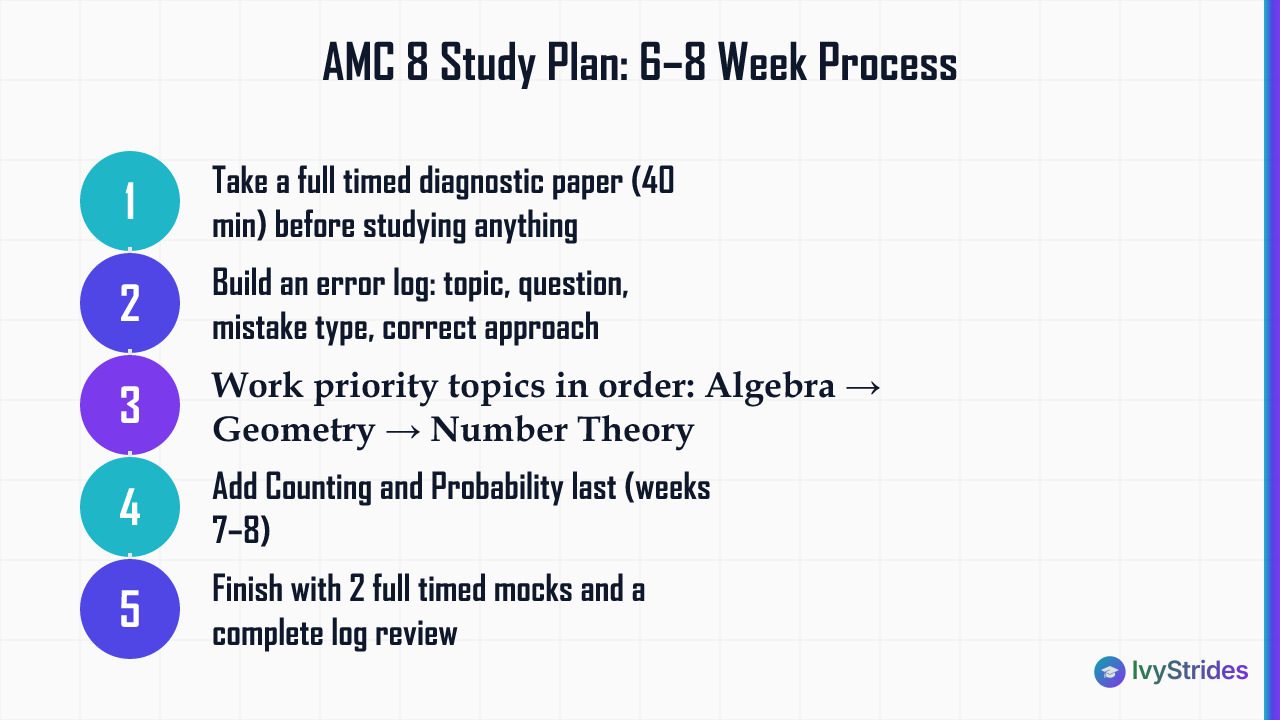
A realistic AMC 8 plan runs roughly 6 to 8 weeks and starts with a diagnostic, not a topic. Building on that Counting-and-Probability-last order, take one full past AMC 8 paper under timed 40-minute conditions before you study anything. Your baseline score, and more importantly your missed questions sorted by topic area, tell you exactly where the plan needs to lean.
Build an error log from that first paper. For every miss, record the topic area, the question number, the mistake type (concept, arithmetic slip, or ran out of time), and the correct approach. In our coaching, students who build an error log from their first timed paper typically find that one or two topic areas account for more than half their missed questions, which makes prioritising the plan straightforward.
| Week | Focus Topic Area | Session Type | Time per Week |
| 1 | Diagnostic + Algebra/Arithmetic | 1 timed paper, then drills | 5 to 6 hrs |
| 2 | Algebra and Arithmetic | Past-paper drills + log review | 5 to 6 hrs |
| 3 | Geometry | Diagram-drawing drills | 5 to 6 hrs |
| 4 | Geometry | Mixed drills + log review | 5 to 6 hrs |
| 5 | Number Theory | Rule memorisation + application | 5 to 6 hrs |
| 6 | Number Theory | Drills + log review | 5 to 6 hrs |
| 7 | Counting and Probability | Concept build + drills | 6 to 7 hrs |
| 8 | Full timed mocks | 2 timed papers + full log review | 6 to 7 hrs |
Five to six hours a week over eight weeks adds up to roughly 45 to 55 total hours, enough to work the priority areas and sit two or three full mocks. The problem-solving habits built through AMC 8 prep, particularly in Number Theory and Algebra, transfer directly to SAT Math and AP Calculus work later. Our overview of SAT math topics shows where that overlap surfaces in high school. If you want a coach to run this plan session by session, our 1-on-1 SAT and math prep covers competition-math work alongside standardised-test coaching.
The Best AMC 8 Practice Resources and How to Use Them
The single most efficient AMC 8 resource is the MAA's public archive of past problems and solutions, which is free and covers every past exam. Because the study plan above runs on past papers, this is the resource that powers it. The MAA site handles registration and confirms the current format and rules; use it to check dates, not to practise.
Use past papers two ways. Untimed first, when you are learning a topic: work slowly, read the solution for every problem, and add each miss to the log. Timed later, in full 40-minute sittings, once you want to test pacing and stamina. Doing everything timed from day one just rehearses your gaps at speed.
The error log is the engine, not the paper stack. Our full error-log method for test improvement gives a template that works across competition and standardised-test prep alike. If your student needs a specialist to sit alongside them for the harder Number Theory and Counting problems, our AMC and math olympiad programme pairs students with competition specialists.
Run each practice session against this checklist:
- Sit the paper (timed or untimed as the plan says)
- Mark it against the official solutions
- Log every miss: topic, question number, mistake type, correct approach
- Fill in an answer for every one of the 25 questions, since blanks score zero
- Tag each miss as concept, slip, or timing
- Redo missed problems from scratch two days later
- Review the log before the next session and pick the weakest topic
Remember that score benchmarks shift by year and cohort, so treat any threshold as approximate rather than a fixed cutoff. A math competition on the activities list signals academic strength, but it is one signal among many and does not determine admissions on its own.
FAQ: AMC 8 Difficulty and Score Benchmarks
Is the AMC 8 difficult?
The AMC 8 is harder than standard middle-school math but very manageable with targeted prep. Problems 1 to 10 are straightforward for a prepared student, while problems 20 to 25 use competition techniques most students have not seen in class. In our coaching, most students who prepare for roughly 6 to 8 weeks reach a score around 15 or above.
Is 17 a good AMC 8 score?
Yes, 17 out of 25 is a strong result. Historically a score near 15 places a student in roughly the top quarter of participants, and around 19 or above in roughly the top few percent, though these thresholds move year to year. A 17 signals solid preparation and a good foundation for AMC 10 work in high school.
What is a good AMC 8 score for a 7th grader?
For a 7th grader, a score in the low-to-mid teens is competitive and anything above 18 is excellent. Because most participants sit in grades 7 and 8, a 7th grader scoring around 15 or higher performs at or above the typical level for that cohort and is well-positioned to start AMC 10 prep in 9th or 10th grade.
What level of math is the AMC 8 level?
The AMC 8 draws on pre-algebra, basic algebra, introductory geometry, elementary number theory, and foundational counting and probability. It does not require calculus or advanced algebra. It does require competition problem-solving techniques that go beyond a standard middle-school curriculum, which is why targeted practice matters.
Your Next Step on the AMC 8
You now have the four topic areas ranked by point yield, a 6-to-8-week schedule anchored to that order, and a practice routine built on past papers and an error log. The work from here is execution, not more planning.
- Download one past AMC 8 paper from the MAA archive and sit it under timed 40-minute conditions
- Log every miss by topic area, question number, and mistake type
- Start targeted drills with Algebra and Arithmetic, your highest-volume topic
- Move through Geometry, Number Theory, then Counting and Probability
- Fit in two or three full timed mocks in the final two weeks

Two decades teaching quantitative and verbal aptitude on standardized tests. Rare dual expertise across Math and Verbal — particularly effective for students with gaps on both sides. Senior AP Mentor for our Calculus and English tracks.