
How Hard Is It to Get Into Caltech? Every Admit Gets a Professor's Yes
On this page
- Why Getting Into Caltech Is So Competitive: Class Size and Faculty Review
- What Caltech Actually Weighs: Five Very Important Factors for Fall 2027
- The Three Qualities Caltech Looks For and What Each One Demands
- What Caltech's Supplemental Essays Require and How to Approach Them
- FAQ: Caltech Admissions Difficulty
- How do I get into Caltech university?
- What is the average GPA in Caltech?
- Why isn't Caltech an Ivy League school?
- What is the acceptance rate for Caltech's Early Action program?
- Your Next Step Toward a Caltech Application
Getting into Caltech is exceptionally difficult. The California Institute of Technology is a test-required, STEM-focused university that rates course rigor and standardized test scores as Very Important, and every admitted student earns a positive faculty review. The three qualities it weighs: Capacity for Caltech Rigor, Scholarly Character, and Scientific Drive.
Those facts come from Caltech's own admissions pages and its 2025-2026 Common Data Set, cited below. The harder question is not the number on the acceptance letter. It is whether your course record, your scores, and your short essays can show a professor the three things Caltech is actually reading for.

Why Getting Into Caltech Is So Competitive: Class Size and Faculty Review
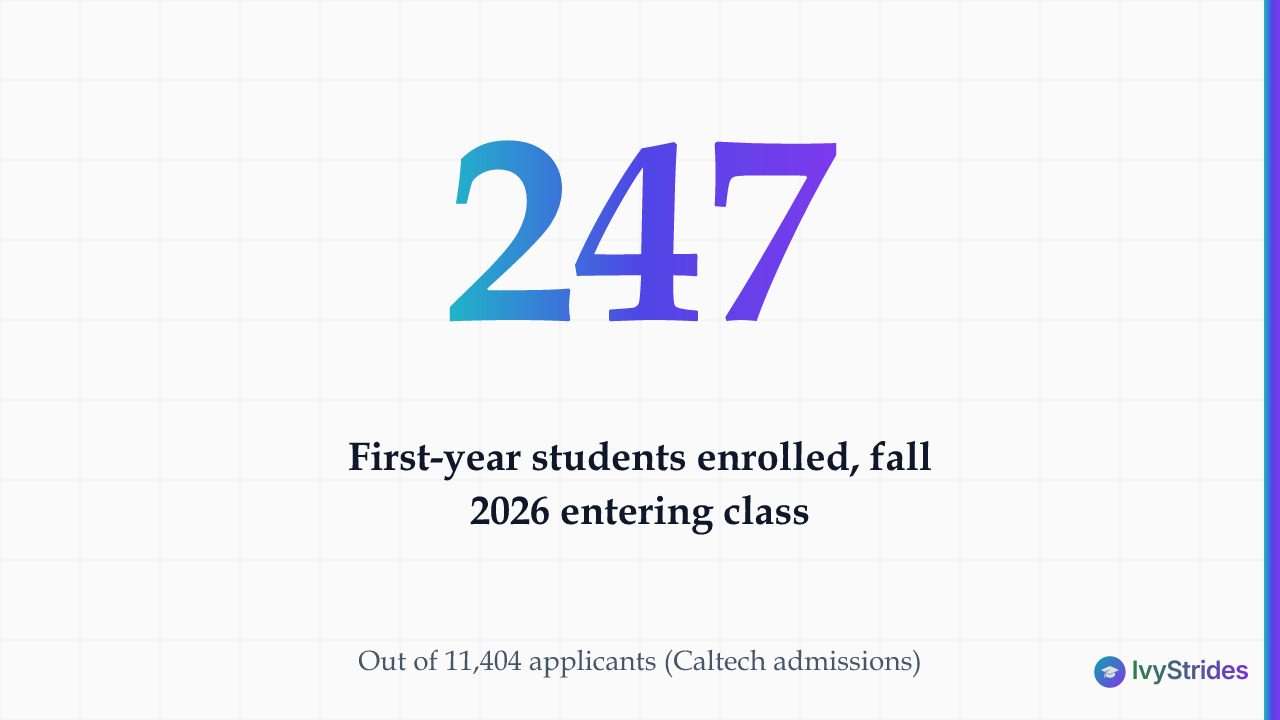
Caltech is competitive for two structural reasons: a very small undergraduate class and a review process that puts faculty inside the room. For the fall 2026 entering class, Caltech reported 247 enrolled first-year students against 11,404 applicants. A tiny class means every seat carries weight.
The faculty step sets Caltech apart. After staff review, more than 20 faculty do full reads of the most competitive files, and every admitted student receives a positive review from a professor. The chair of the first-year admissions committee writes, "Here at Caltech we instead look for ellipses." The committee reads for the student who keeps asking, not the student who has merely finished.
So what GPA gets you in? Caltech publishes no minimum GPA, its Common Data Set lists no average, and it states no minimum SAT or ACT score. Caltech faculty deliberately decided not to require a minimum score. Academic readiness is the gate, and a professor's yes is the lock.
Students apply through the Common App or QuestBridge. For those weighing Caltech against other elite STEM programs, whether Caltech is harder to get into than MIT is a fair question to ask early.
| Factor | Detail (2026-27 Cycle) |
| Testing policy | Test-required: SAT or ACT, neither preferred |
| Application platform | Common App or QuestBridge |
| Interviews | Not conducted (CDS C7: Not Considered) |
| Faculty review | 20+ faculty full reads; every admit gets a professor's yes |
| Restrictive Early Action | Closed November 1, 2026; decisions by mid-December |
| Regular Decision | Due January 4, 2027; decisions by mid-March |
| Admit rate (stated) | Under 5% for both REA and RD |
What Caltech Actually Weighs: Five Very Important Factors for Fall 2027
Caltech names five factors as Very Important in section C7 of its 2025-2026 Common Data Set: Rigor of secondary school record, Standardized test scores, Application Essay, Recommendation(s), and Character/personal qualities. The faculty-reviewed process from the section above rests on these five, and the same document lists what Caltech ignores: Interview, Alumni/ae relation, and State residency, all Not Considered.
Demonstrated interest does nothing at Caltech. Visiting campus or opening every email does not move a file; evidence does.
Test scores are required, and read by section. Caltech requires either the SAT or ACT for fall 2027 and sets aside the composite in favor of each section score. It considers each ACT subscore (Math, English, and Reading, plus Science and Writing, which are optional for fall 2027) rather than the composite. It superscores by section across all reported test dates.
Caltech also groups each section score into buckets. An SAT section of 780-800 or an ACT subscore of 35-36 shows the committee only as "Bucket A," with the exact score hidden. A 750-770 SAT or 33-34 ACT shows as "Bucket B."
Below 750 SAT or 33 ACT, the committee sees the exact score. This is why how Caltech groups section scores when reviewing the SAT changes how much time is worth spending on the last few points. Caltech says retaking for a perfect score is not a good use of time.
Two recommendation letters, by subject. Caltech requires one letter from a STEM teacher and one from a humanities or social science teacher, both from your last two years. The humanities teacher should be able to comment on your writing.
Academic readiness comes first at Caltech; the holistic factors follow once preparation is established.
Daily SAT and ACT prep on YouTube: short strategy videos from IvyStrides. Subscribe to IvyStrides on YouTube.
| Admission Factor | Caltech Rating |
| Rigor of secondary school record | Very Important |
| Standardized test scores | Very Important |
| Application Essay | Very Important |
| Recommendation(s) | Very Important |
| Character/personal qualities | Very Important |
| Class rank | Important |
| Academic GPA | Important |
| Extracurricular activities | Important |
| Interview | Not Considered |
The Three Qualities Caltech Looks For and What Each One Demands
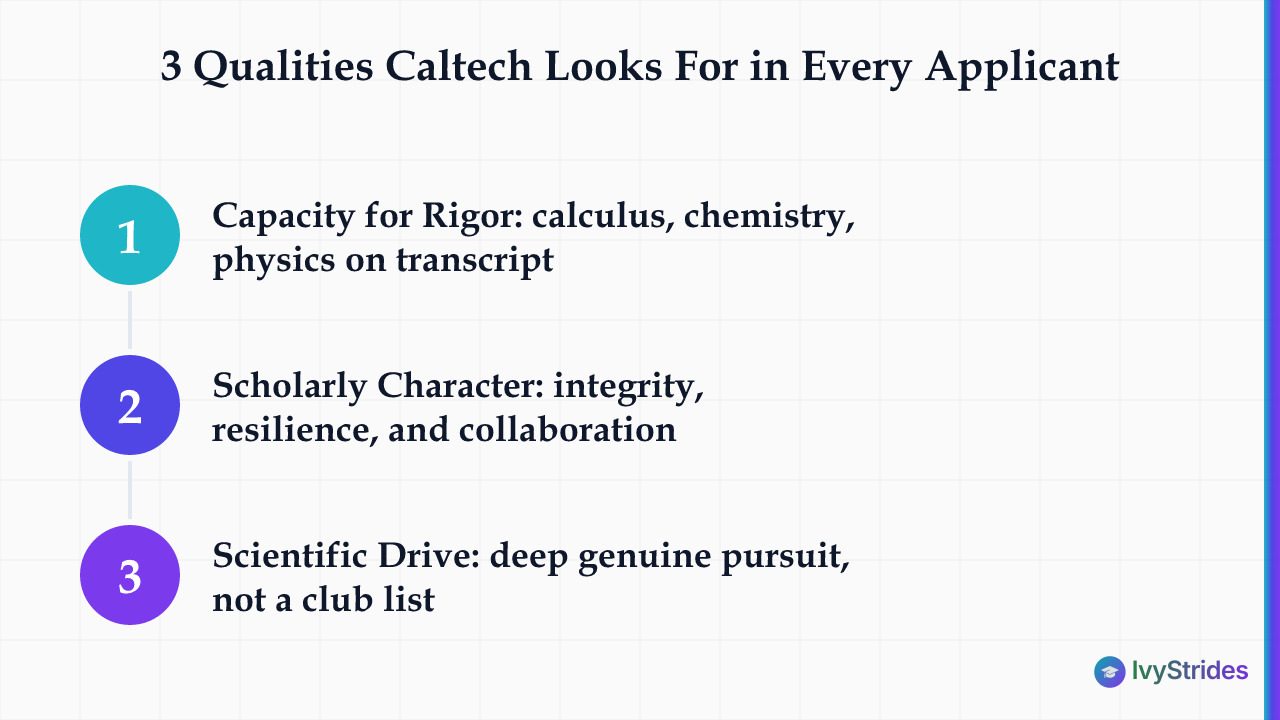
Caltech names three central qualities, and it calls them "not a checklist": Capacity for Caltech Rigor, Scholarly Character, and Scientific Drive. Those five Very Important factors are the evidence; these three qualities are what the evidence has to prove. Caltech is, in its own words, "an unapologetic STEM institution."
Capacity for Caltech Rigor means a strong math and science foundation, including demonstrated mastery of calculus, chemistry, and physics, judged in the context of the courses available to you. Caltech is explicit that "limited access to opportunities does not equate to limited capacity." The prerequisites set the floor: four years of math including calculus, one year of physics, one year of chemistry, four years of English, and two years of history or social science. Biology is recommended.
Students building that foundation need AP courses that signal STEM depth to selective colleges, not just the minimum. For families asking how hard it is to get into Caltech, IvyStrides offers college counseling with a month-by-month plan from the summer before 9th grade to the deposit deadline, including a written four-year course map for planning calculus, chemistry, and physics.
Scholarly Character is integrity, resilience, and generosity in learning. Caltech looks for the student who stays engaged when answers are not obvious, who knows when to ask for help, who collaborates, and who makes the learning environment stronger for others.
Scientific Drive is depth of engagement, not a count of activities. Caltech wants the student who returns to questions because they genuinely want to know how things work, and it says this is "more than participation in STEM extracurriculars for resume building." Its own examples include repairing devices and rebuilding a tractor on a farm.
Caltech offers two optional ways to add evidence. A STEM portfolio can hold coding projects, research posters, homemade inventions, robotics, schematics, notebooks, and AP Research papers. A research paper counts if you worked with a university or research-affiliated lab, reported to a senior researcher, and produced a paper that was published, submitted, or in preparation. Neither is required to prove scientific interest, and meeting the academic standard does not guarantee admission.
| Quality | What to Check in Your Application |
| Capacity for Caltech Rigor | Calculus, chemistry, physics on transcript; hardest track offered |
| Scholarly Character | Collaboration, resilience, asking good questions |
| Scientific Drive | One or two deep pursuits, not a long club list |
What Caltech's Supplemental Essays Require and How to Approach Them
Caltech's fall 2027 supplement is a set of short essays. The first asks you to choose a STEM area of academic interest and explain why, in 150-200 words. Scholarly Character asks for one prompt, Collaboration or Process, in a maximum of 200 words. Scientific Drive asks for two of three prompts (Learning, Pursuing, Making), each up to 200 words. A Fun Question on what you would contribute to the Caltech community runs 100-150 words, and an academic short answer is optional. The three qualities from the section above are exactly what these essays reveal.
Specificity wins at this length. The 150-200 word limit rewards a single area and a clear reason, not a survey of everything you like. Writing a response that shows genuine fit follows the same principle a strong "Why This College" essay does: concrete beats enthusiastic.
Your Common App personal essay and its current prompt set sit alongside these. One requirement families miss: Caltech asks you to self-report every AP and IB exam you have taken, regardless of score. Only enrolling students submit official scores.
Then the timing. For fall 2027, Restrictive Early Action applications were due November 1, 2026 (materials by November 6), and those applicants hear by mid-December. Regular Decision applications are due January 4, 2027, with materials accepted until January 10, and SAT or ACT testing must be completed before December 31, 2026. Caltech states its admit rate is under 5% in both rounds with a negligible difference, so applying in Regular Decision barely changes the odds. There are no interviews to prepare for.
If Caltech turns out to be a reach, getting into Carnegie Mellon starts with choosing one of seven colleges, a useful next target to map.
| Essay | Prompt Focus | Word Limit | Quality It Reveals |
| STEM academic interest | Pick an area, explain why | 150-200 | Scientific Drive |
| Scholarly Character | Collaboration or Process | Max 200 | Scholarly Character |
| Scientific Drive (two essays) | Two of Learning, Pursuing, Making | Max 200 each | Scientific Drive |
| Fun Question | What you would contribute to Caltech | 100-150 | Community fit |
FAQ: Caltech Admissions Difficulty
How do I get into Caltech university?
Start by meeting the course prerequisites: calculus, chemistry, physics, and four years of English. Submit either the SAT or ACT, since Caltech is test-required for fall 2027. Show all three qualities Caltech names, write every required supplemental essay with real specificity, and apply Regular Decision by January 4, 2027.
What is the average GPA in Caltech?
Caltech does not publish a median admitted GPA in its Common Data Set. It does state that Rigor of secondary school record is a Very Important factor, judged against the courses your school offered. Caltech also says "limited access to opportunities does not equate to limited capacity."
Why isn't Caltech an Ivy League school?
The Ivy League is an athletic conference of eight northeastern universities, and Caltech, a private institute in Pasadena, California, was never a member. The label is a conference membership, not a ranking of selectivity or research.
What is the acceptance rate for Caltech's Early Action program?
Caltech offers Restrictive Early Action, not standard Early Action, and publishes no separate REA acceptance rate. It states that the admit rate is under 5% in both rounds with a negligible difference. For fall 2027 the REA round closed on November 1, 2026, with decisions by mid-December; Regular Decision applications are due January 4, 2027.
Your Next Step Toward a Caltech Application
Caltech rewards depth that a professor can see on the page. Measure your profile against what the review weighs, then build from the gaps.
- Confirm your transcript includes calculus, chemistry, and physics, in the hardest track your school offers.
- Submit the SAT or ACT, and aim for each section into Bucket A or B rather than a perfect score.
- Draft each supplemental essay around one specific STEM interest, project, or honest moment of character.
- With the REA deadline passed, finish SAT or ACT testing before December 31, 2026 and submit Regular Decision by January 4, 2027.
College admissions insights on LinkedIn: follow IvyStrides for application guidance and counseling updates.

Rajesh is a technology leader, entrepreneur, and angel investor with 28+ years in Business & Technology Leadership and Product & Solution Engineering. He is passionate about education, mentoring, and driving digital transformation.