
How to Study for AP Chemistry and Score a 5: Your 2026 Game Plan
On this page
- What the 2026 AP Chemistry Exam Actually Looks Like
- Which AP Chemistry Units to Prioritize (and Why)
- The Part Most Students Get Wrong: FRQ Strategy for 2026
- How to Build Your AP Chemistry Study Schedule
- The Best AP Chemistry Prep Resources for 2026
- Is AP Chemistry Worth Taking? Difficulty, Score Rates, and Admissions Value
- Should You Self-Study AP Chemistry or Work With a Coach?
- FAQ
- What is the 5 percent rule in AP Chemistry?
- How rare is a 5 on AP Chemistry?
- Is AP Chemistry the hardest AP exam?
- What is the best prep book for AP Chemistry in 2026?
- How should I prepare for AP Chemistry if I only took regular chemistry before?
- Where can I find free AP Chemistry practice tests and past FRQs?
To score a 5 on the 2026 AP Chemistry exam, start with a diagnostic pass through all 9 units to find your weakest areas, then prioritize Units 3 (Intermolecular Forces), 6 (Thermodynamics), 7 (Equilibrium), and 8 (Acids and Bases), which together account for roughly half the exam. Practice free-response questions using official College Board rubrics every week. The 2026 exam includes 3 long and 4 short FRQs, with a stronger emphasis on particulate diagrams. Plan for roughly 8 to 12 weeks of structured prep, averaging about 6 to 8 hours per week.
Those format figures come from the College Board AP Program page for AP Chemistry, which you should verify before your exam cycle since the AP Program refreshes its documentation each year. The rest of this article breaks down the exact unit weightings, walks through the FRQ section where most students lose their 4 or 5, and gives you a week-by-week schedule you can actually follow.
What the 2026 AP Chemistry Exam Actually Looks Like
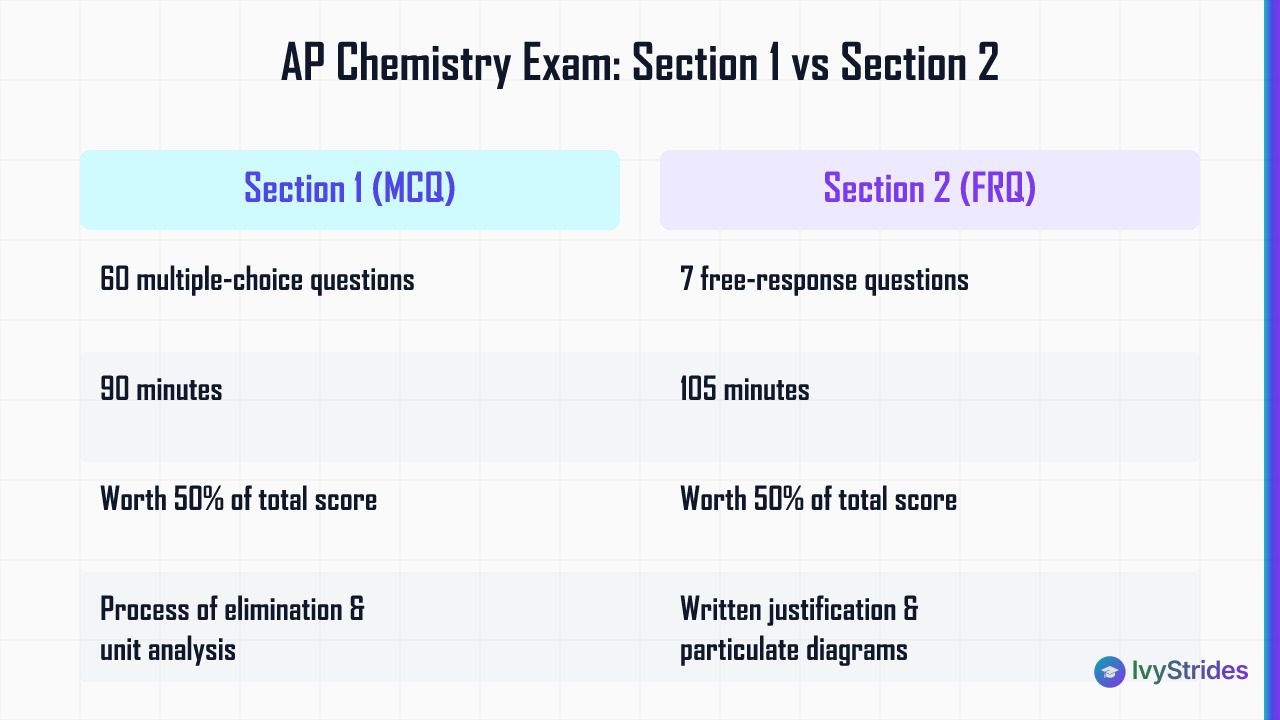
The AP Chemistry exam runs 3 hours and 15 minutes, split evenly into two sections. Section 1 is 60 multiple-choice questions (MCQs) in 90 minutes, worth 50 percent of your score. Section 2 is 7 free-response questions (FRQs) in 105 minutes, also worth 50 percent, per the College Board AP Program. That 50/50 weighting matters more than most students realize: you can't coast through the FRQs and expect a 5 on the strength of your MCQ score alone.
Here's what changed for 2026. The free-response section now consists of 3 long free-response questions and 4 short free-response questions. According to the College Board, the current format also carries a heavier emphasis on particulate-level diagrams and lab-based reasoning, meaning you'll be asked to draw or interpret molecular representations and explain what's happening at the level of individual particles. This isn't a cosmetic tweak. It shifts real point value toward conceptual reasoning and away from plug-and-chug calculation.
The full curriculum spans 9 units, from Atomic Structure and Properties all the way through Electrochemistry and Redox. On the multiple-choice side, you'll see questions that reward process of elimination and unit analysis. The free-response side demands something different: written scientific justification, correctly labeled particulate diagrams, and multi-step problem-solving under time pressure.
One caveat before you build anything on top of this. Exam format details do change, so confirm the current structure against the official College Board AP Chemistry course page before your specific exam date. Students who want structured instruction across the whole school year, not just an exam-season sprint, can look at IvyStrides' AP classes online, where each subject is taught by a per-subject specialist.
Which AP Chemistry Units to Prioritize (and Why)
Not every unit deserves equal study time. The College Board AP curriculum framework assigns each unit a weighting range, and if you spread your hours evenly across all 9 units, you're overspending on low-yield content and underspending where the points actually live.
Here's how the 9 units stack up. The four high-weight units are Unit 3 (Intermolecular Forces and Properties), Unit 6 (Thermodynamics), Unit 7 (Equilibrium), and Unit 8 (Acids and Bases). Per the College Board AP curriculum framework, these four together represent roughly 45 to 55 percent of the exam. If your prep window is short, this is where the majority of your hours go.
The supporting tier includes Unit 5 (Kinetics), which shows up in both multiple-choice questions and short free-response, and Unit 9 (Electrochemistry and Redox). Electrochemistry is worth flagging: it's a common source of lost points precisely because students treat it as skippable and run out of time before covering it. Don't.
The foundation tier, Units 1, 2, and 4 (Atomic Structure, Molecular and Ionic Compound Structure, and Chemical Reactions), carries less standalone weight but underpins everything above it. You can't reason about intermolecular forces without understanding molecular structure. You can't handle equilibrium without a firm grasp of chemical reactions.
Two patterns worth naming. Unit 7 (Equilibrium) and Unit 8 (Acids and Bases) are the most FRQ-heavy units in recent exam cycles, which is one reason they reward focused practice so heavily. And in our coaching, IvyStrides AP Chemistry specialists consistently find these same two units are where students recover the most points with targeted work, because equilibrium and acid-base chemistry tend to be shallowly understood after a typical high school course. If you want a diagnostic-based look at your own unit-level gaps, that's exactly what AP Chemistry specialist coaching starts with.
The Part Most Students Get Wrong: FRQ Strategy for 2026
The free-response section is where a 4 slips to a 3 and a 5 slips to a 4. Not because students can't do the chemistry, but because they don't write like the scoring rubric wants them to write. Let me be direct about this.
The 2026 format gives you 3 long FRQs and 4 short FRQs. The long questions are multi-part and carry roughly 10 or more points each, testing several connected concepts in sequence. The short questions are tighter, usually worth around 4 points, and they zero in on a single skill or calculation. Both formats now include particulate diagrams, so you need to sketch molecular-level representations that are correctly labeled and consistent with the question's data.
Here's the part most students miss. The "justify" and "explain" tasks want written scientific reasoning, not just a correct number. If a question asks you to explain why one substance has a higher boiling point than another, "London dispersion forces" isn't a full answer. You need to state which intermolecular forces are present, compare their relative strength, and connect that to the observed property. In our coaching with AP Chemistry students, the single most common point-loss pattern is incomplete written justification on explain tasks, not calculation errors. Students get the chemistry right in their heads and leave points on the table because they didn't write the reasoning down.
So how do you fix it? Practice with the official rubrics. The College Board publishes past AP Chemistry FRQs with scoring rubrics going back to 2013, and they're the closest thing to the real exam you'll ever touch. Take a full FRQ set under timed conditions, then score yourself against the actual rubric point by point. You'll quickly see the gap between "I knew that" and "I earned the point."
The other common mistakes: skipping units entirely (any of the 9 can appear), drawing particulate diagrams without labels, and abandoning a question because one part stumped you when the later parts were answerable independently. Students who complete at least 8 to 10 full FRQ sets with rubric self-scoring before exam day show measurably stronger Section 2 performance in our coaching cohorts.
If you're weighing whether a specialist coach is worth the investment for AP Chemistry, our honest breakdown of when AP tutoring pays off walks through the decision by score band and timeline. And students pairing AP Chemistry with AP Calculus in the same year should read our guide on AP Calculus AB/BC prep to coordinate study schedules across both exams.
How to Build Your AP Chemistry Study Schedule
A plan beats intensity. In our coaching, students who begin prep 10 or more weeks before the exam date are significantly more likely to reach a 4 or 5 than those who start in the final 3 weeks. So the schedule you build depends heavily on how much runway you have.
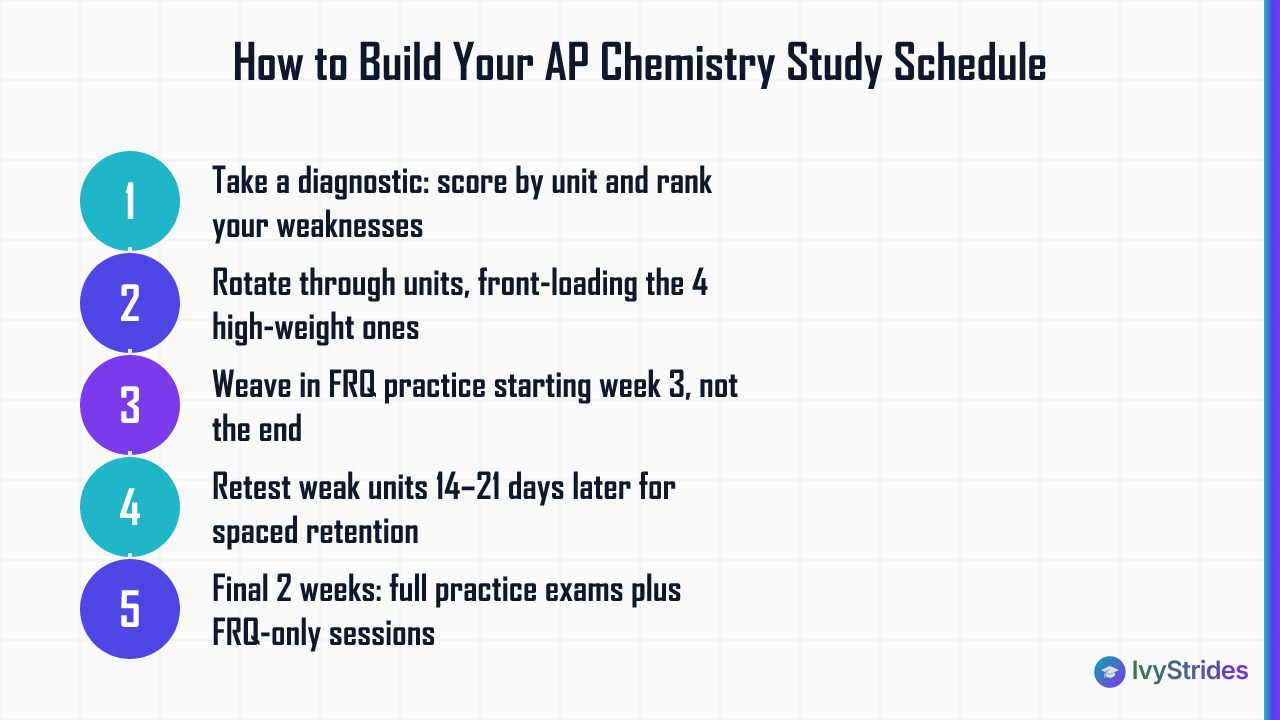
The 10-week plan. This is the strong version. A consistent 6 to 8 hours per week across 10 weeks adds up to roughly 60 to 80 total prep hours. Week 1 is a diagnostic pass: take one full multiple-choice set and one full FRQ set, score them by unit, and rank your weaknesses. Do not skip this. It tells you where to spend the next nine weeks. Weeks 2 through 8 rotate through the units, front-loading the high-weight four (Units 3, 6, 7, 8) while touching every unit at least once. Start weaving FRQ practice in from week 3, not the end. Build in spaced retesting: revisit a weak unit about 14 to 21 days after you first studied it, because retention decays and the recheck is where it sticks. The final 2 weeks shift to full practice exams plus FRQ-only sessions.
The 4-week plan. This is triage, roughly 25 to 35 total hours. You don't have time to cover everything well, so concentrate on the four high-weight units and do FRQ practice daily. Take a fast diagnostic on day 1, then spend the bulk of your hours on your two weakest high-weight units. Accept that you're optimizing for a 4; a 5 is possible but less likely from a cold 4-week start.
Students coming from regular chemistry rather than honors or pre-AP typically need 2 to 3 additional weeks of foundation work before the high-weight unit prep is effective, so bump the 10-week plan to 12 or 13 weeks if that's you. Spend those extra weeks solidifying Units 1 and 2 first.
For a parallel example of week-by-week AP scheduling, our AP Calculus AB/BC prep guide shows how to structure a study calendar around unit weightings.
The Best AP Chemistry Prep Resources for 2026
Start with the source: the College Board AP Program publishes official past FRQs with scoring rubrics going back to 2013, plus AP Daily video lessons aligned to each unit. These are the highest-quality materials available, and they're free. If you use nothing else, use the official past FRQs.
For content review, some free online prep platforms cover all 9 units with practice questions aligned to the College Board curriculum framework, and they make a solid starting point, especially for shoring up foundation units. Full-length multiple-choice practice is available through AP Classroom, which your teacher can open up through your school's account.
On prep books, the well-regarded 2026 editions have been updated to reflect the revised FRQ format, and the stronger options include 6 full-length practice tests plus thorough content review. A quick honesty note: AP Chemistry textbooks in PDF form circulate online, but IvyStrides doesn't distribute textbooks and we won't point you toward pirated files. Buy the book or borrow it from your school.
Here's where free resources fall short. They're strong for content review, but they rarely give you rubric-based FRQ feedback, and that feedback is what separates a 3 from a 5. A video can teach you Le Chatelier's principle. It can't read your written justification and tell you which point you failed to earn. That's the gap personalized AP Chemistry coaching is built to close. Students studying multiple sciences at once often lean on our AP Physics 1 coaching for the same rubric-driven feedback loop.
Is AP Chemistry Worth Taking? Difficulty, Score Rates, and Admissions Value
A 5 on AP Chemistry is genuinely difficult to earn. According to College Board AP score distribution data, approximately 10 to 13 percent of test-takers score a 5 in a typical year, and the combined 4-and-5 rate sits around 20 to 25 percent. Rates vary year to year, so treat these as ranges, not fixed numbers. AP Chemistry consistently lands among the AP exams with the lowest 5-rates.
Is it the hardest AP exam? Not definitively. AP Physics 1 has historically had an even lower 5-rate. What makes AP Chemistry demanding is the combination: quantitative problem-solving with kinetics and thermodynamics, conceptual reasoning, and written scientific justification, all tested in one sitting. Students deciding between AP Chemistry and AP Physics should know both exams demand strong quantitative reasoning; our AP Physics 2 coaching page outlines what that course covers if you're comparing.
On admissions value, a strong AP Chemistry score signals course rigor, which matters for students applying to STEM programs. But keep the caveat front and center: a single AP score doesn't decide admission. It's one component of a full application that includes grades, essays, and the rest of your record. If you're curious how test scores fit the broader picture, our piece on how much the SAT matters for college admission frames the same logic.
Then there's credit. AP Chemistry scores can translate into college credit at many universities, though credit policies vary significantly by institution, so check each school's AP credit chart before assuming placement. Some schools require a 4, some require a 5, and some highly selective universities grant no AP Chemistry credit regardless of score. These policies also change year to year, so verify at each institution's registrar page rather than trusting a number you saw online. Test-optional admissions, which varies by school and by year, doesn't erase the value of a strong AP score; the two operate on different parts of your application.
Should You Self-Study AP Chemistry or Work With a Coach?

Self-study genuinely works for some students. If you have a strong chemistry foundation, 10 or more weeks of lead time, and the discipline to run weekly FRQ practice with honest self-scoring, you can reach a 4 or 5 on your own. As a rough threshold: in our coaching, self-study tends to be viable for students scoring 70 percent or above on their initial multiple-choice diagnostic. Above that line, you mostly need structure and reps, not intervention.
Below that line, self-study tends to break down, and it usually breaks in three predictable places. First, the FRQ feedback gap: you can't reliably score your own explain tasks when you don't yet know what full-credit reasoning looks like. Second, unit-weighting blind spots: students self-studying often spread hours evenly and underweight Units 3, 6, 7, and 8. Third, accountability: a study plan that lives only in your head has a way of slipping in the final weeks.
A specialist coach adds what a video and a book can't. IvyStrides AP Chemistry coaches run a unit-level diagnostic in session one to pinpoint the 2 to 3 units with the highest score-recovery potential, then build the plan from there. They give rubric-based FRQ feedback, so you learn exactly which points you're leaving on the table. And they hold the pacing. In our coaching with AP Chemistry students, those who receive rubric-based FRQ feedback from a specialist in the final 6 weeks show stronger Section 2 improvement than those who self-score alone. One more distinction worth knowing: IvyStrides pairs you with a per-subject AP Chemistry specialist, not a generalist tutor juggling five subjects. You can read more about our approach on the IvyStrides About page. To meet the people who'd actually work with you, see the tutors page.
If you're still deciding, our breakdown of when AP tutoring pays off walks through the math by score band. Students who want year-round structure rather than an exam sprint can also explore AP classes online. The lowest-risk first step, whichever way you lean, is a free strategy call with a specialist who can look at your diagnostic and tell you honestly which path fits.
FAQ
What is the 5 percent rule in AP Chemistry?
The 5 percent rule is an approximation used in equilibrium calculations. When the change in concentration (x) is less than 5 percent of the initial concentration, you can simplify the ICE table math by ignoring x in the denominator. If x exceeds 5 percent of the initial value, the approximation is invalid and you must use the quadratic formula. This shows up constantly in Unit 7 (Equilibrium) FRQs, and knowing when to apply it versus when to abandon it is a frequent point of difference between a 3 and a 5.
How rare is a 5 on AP Chemistry?
Per College Board AP score distribution data, roughly 10 to 13 percent of AP Chemistry test-takers score a 5 in a typical exam year, and combined 4-and-5 rates run around 20 to 25 percent. Rates shift year to year. That makes it one of the lower 5-rate AP exams, but the difficulty is manageable with the right unit prioritization and consistent FRQ practice. A student who completes 8 to 10 full FRQ sets with rubric review and concentrates on Units 3, 6, 7, and 8 is in a strong position to reach a 4 or 5.
Is AP Chemistry the hardest AP exam?
It's consistently ranked among the more difficult AP exams, but it isn't definitively the hardest. AP Physics 1 has historically posted a lower 5-rate. What makes AP Chemistry challenging is that it tests quantitative problem-solving, conceptual reasoning, and written scientific justification all in one exam. The students who struggle most are those who memorize procedures without understanding the concepts underneath, and the FRQ section exposes that gap directly.
What is the best prep book for AP Chemistry in 2026?
Look for a 2026 edition that has been updated for the revised FRQ format, and favor one that includes multiple full-length practice tests plus thorough content review. That said, no prep book replaces the official College Board past FRQs with scoring rubrics, which are free at apstudents.collegeboard.org and remain the closest simulation of the actual exam. Use a book for structured content review and the official FRQs for realistic practice.
How should I prepare for AP Chemistry if I only took regular chemistry before?
Give yourself a longer runway, ideally 12 or more weeks. Spend the first 3 weeks solidifying Unit 1 (Atomic Structure) and Unit 2 (Molecular Structure) before moving into the higher-weight units. A free unit-aligned content-review course is a strong starting point for filling foundation gaps. The biggest adjustment is the level of written justification the FRQs demand, which goes well beyond what most regular chemistry courses require, so build in FRQ practice early.
Where can I find free AP Chemistry practice tests and past FRQs?
The College Board publishes official AP Chemistry past free-response questions with scoring rubrics going back to 2013 at apstudents.collegeboard.org. These are the highest-quality free materials available because they're the actual exam questions. Free online prep platforms also offer practice aligned to the College Board curriculum framework, and for full-length multiple-choice practice, AP Classroom (accessed through your school) includes additional question banks.
Score reporting, format details, and credit policies all shift over time, so treat this plan as a 2026 framework and verify the current specifics against the official College Board AP Chemistry course page before your exam. The chemistry doesn't change. The most efficient path to a 4 or 5 is always the same: diagnose your weak units, spend your hours on the high-weight four, and practice FRQs against the real rubrics until the reasoning is automatic.

Two decades teaching quantitative and verbal aptitude on standardized tests. Rare dual expertise across Math and Verbal — particularly effective for students with gaps on both sides. Senior AP Mentor for our Calculus and English tracks.