
How to Study for AP Biology and Score a 5: Your 2026 Game Plan
On this page
- What the 2026 AP Biology Exam Actually Looks Like
- Which AP Biology Units Deserve the Most Study Time
- How Rare Is a 5 on AP Biology and Why It Matters for Admissions
- The Part Most Students Get Wrong: AP Biology FRQ Strategy
- Building Your AP Biology Study Timeline: 8 Weeks vs. 16 Weeks
- How to Use AP Biology Practice Tests Effectively
- Free AP Biology Prep Resources vs. Coached Preparation: An Honest Comparison
- Is AP Biology the Hardest AP Science? Setting Realistic Expectations
- FAQ
- What is the best AP Biology prep book for 2026?
- How do I find full-length AP Biology practice tests?
- Is a 75% on AP Biology enough for a 5?
- How rare is a 5 on AP Biology?
- When should I start studying for AP Biology?
- What changed in the 2026 AP Biology exam?
To score a 5 on the 2026 AP Biology exam, concentrate your prep on the three highest-weighted units: Cellular Energetics (Unit 3), Cell Communication and Cell Cycle (Unit 4), and Gene Expression and Regulation (Unit 6). The exam is 60 multiple-choice questions and 6 free-response questions, each worth 50% of your composite score. A composite of roughly 72 out of 100 points is the typical threshold for a 5, based on College Board score conversion data, and only about 14 to 16 percent of test-takers hit that mark in a given year. Start with a full-length diagnostic practice test, log your weakest units, and build your schedule from that baseline.
Those unit weights, format details, and score distributions all trace back to the official College Board AP Biology course page, which is the source to treat as authoritative when other blogs disagree. The harder questions, what changed for 2026, how to write FRQs that actually earn rubric points, and how to time an 8-week or 16-week plan around your diagnostic score, are where the next sections go.

What the 2026 AP Biology Exam Actually Looks Like
The exam runs three hours total. Section I is 60 multiple-choice questions in 90 minutes, worth 50% of your score. Section II is 6 free-response questions in 90 minutes, also worth 50%. The FRQ section splits into 2 long-form questions and 4 short-form questions, each scored against an official rubric published by the College Board.
The curriculum still covers 8 units, from Chemistry of Life through Ecology, but the 2025-26 framework introduced meaningful shifts. Unit 1 was reorganized to present macromolecules in a more logical sequence, so if you're studying from an older prep book, the ordering will feel off. Photosynthesis and cellular respiration content was updated across Units 2 and 3. And across every unit, the exam now places enhanced emphasis on data analysis and science practices, meaning more questions ask you to interpret graphs, design experiments, or evaluate experimental controls rather than simply recall a definition.
Verify current details against the College Board AP Biology course page before your exam. AP curriculum frameworks get refined more often than most prep books get reprinted.
For coached prep aligned to the current framework, our AP courses online run by per-subject specialists.
Which AP Biology Units Deserve the Most Study Time
Not every unit carries equal weight, and this is where most self-studiers lose points. College Board's 2025-26 curriculum framework identifies Units 3, 4, and 6 as the heaviest-weighted content on the exam. If your hours are limited, those three units should get the majority of your review time.
Here's the practical breakdown.
Unit 3, Cellular Energetics. Photosynthesis, cellular respiration, enzymes, and the regulation of metabolic pathways. This unit's content was refined in the 2025-26 update, so make sure your study materials reflect the current sequence. Expect FRQs that ask you to interpret experimental data on enzyme kinetics or predict how a mutation affects electron transport chain output.
Unit 4, Cell Communication and Cell Cycle. Signal transduction pathways, feedback mechanisms, mitosis, and cell cycle checkpoints. FRQs in this unit love to give you a mutated protein and ask you to predict downstream consequences. Knowing "signal transduction" is not enough. You need to name receptors, second messengers, and specific checkpoint proteins like p53 or cyclin-CDK complexes.
Unit 6, Gene Expression and Regulation. DNA replication, transcription, translation, operons, epigenetics, and biotechnology. This unit rewards precise vocabulary. "Transcription factor" is a broader answer than "activator that binds the enhancer region," and rubrics reward the more specific version.
The remaining units still matter. Unit 1 covers macromolecules, carbohydrates, lipids, proteins, and nucleic acids, and shows up as foundational vocabulary across the exam. Unit 5 covers Mendelian genetics, non-Mendelian inheritance, and chi-square analysis, which appears reliably as a short-form FRQ. Unit 7 covers natural selection, phylogeny, and Hardy-Weinberg. Unit 8 covers ecology, from population dynamics to biogeochemical cycles.
If you're also enrolled in AP Chemistry, note that both exams test overlapping content in thermodynamics and molecular structure, so coordinating your review schedule across both subjects can save meaningful study hours. Our ap chemistry coaching maps this overlap explicitly for students taking both.
How Rare Is a 5 on AP Biology and Why It Matters for Admissions
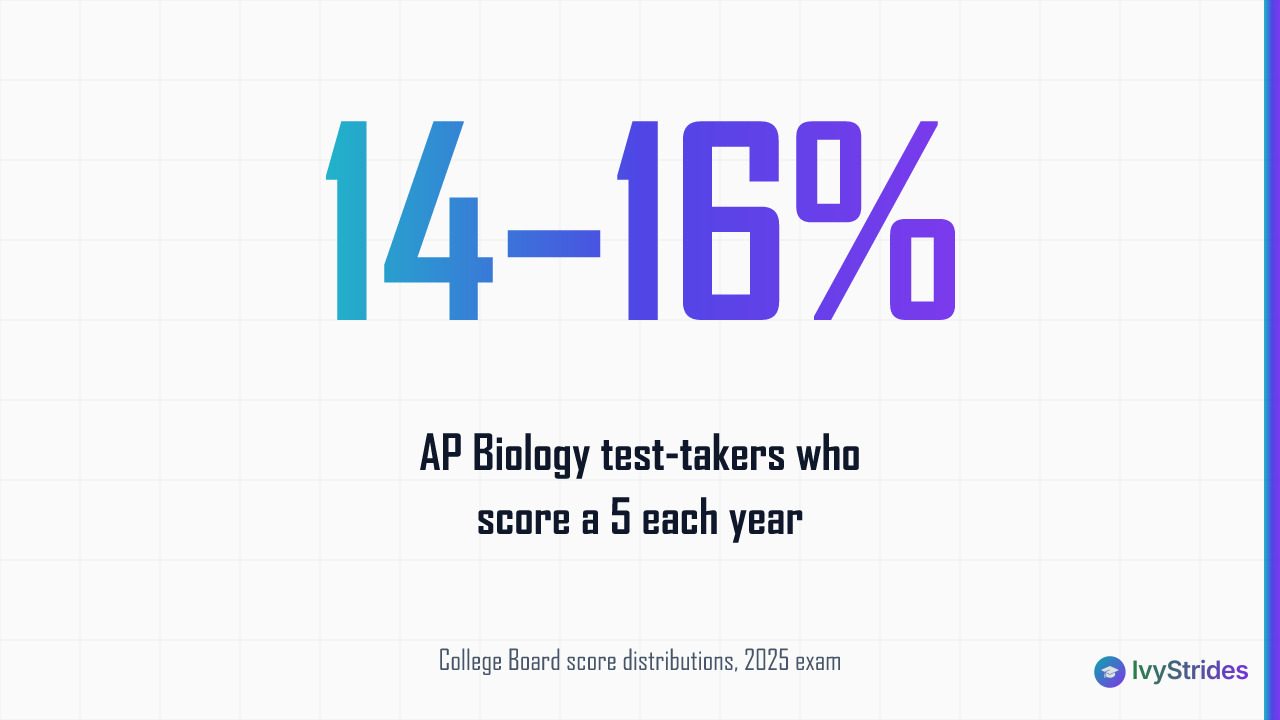
Roughly 14 to 16 percent of AP Biology test-takers score a 5 in a given year, according to College Board score distributions. About 70 percent of students scored a 3 or higher on the 2025 exam. So the exam is passable for prepared students, but the 5 sits in a narrower band that requires deliberate work on both content and FRQ execution.
The composite scoring works like this. The MCQ section contributes up to about 50 scaled points. The FRQ section contributes up to about 50 scaled points, with long-form questions carrying more weight per question than short-form. Add them together for a composite out of roughly 100. The threshold for a 5 typically lands around 72 points, though the exact cutoff shifts each year based on how difficult that year's exam turned out to be. A 75% composite on a released practice test generally projects at or just above the 5 threshold, which is why we tell students to target 75% or higher on practice exams to build a buffer.
Now, the admissions context. A strong AP Biology score signals academic rigor to admissions readers, but it works alongside your GPA, test scores, and essays rather than replacing any of them. AP credit policies vary widely by college. Some selective schools accept a 4 or 5 for course credit or placement, others accept only a 5, and some (particularly a handful of Ivies) grant no credit at all. Always verify the specific policy on the admissions or registrar's page of each college on your list.
Whether coached prep is worth the investment for AP Biology depends on your starting diagnostic score, your target score, and how many weeks remain before exam day. For a longer read on that decision, see Is AP tutoring worth it.
The Part Most Students Get Wrong: AP Biology FRQ Strategy
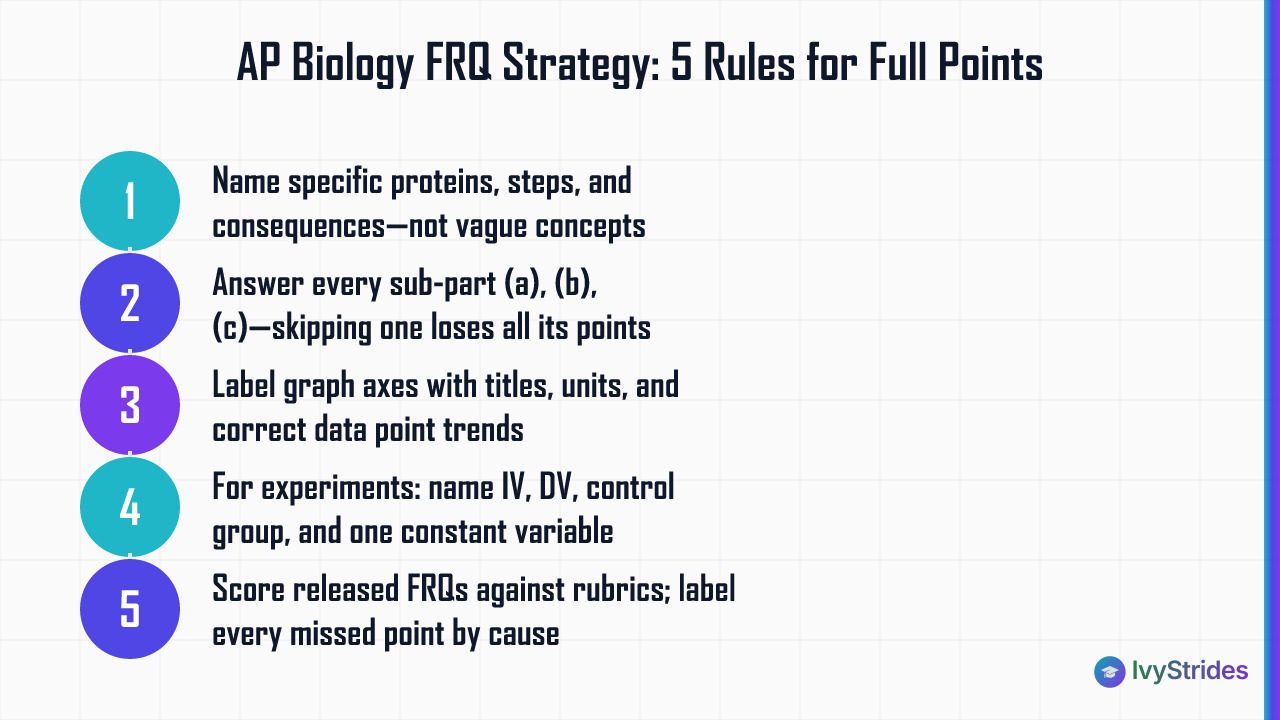
Look, this is where the 3s and the 5s separate. Students who know the content but lose FRQ points aren't lacking biology knowledge, they're lacking rubric discipline. FRQs are worth 50% of your score, and each rubric point is earned independently. Miss the language the rubric wants and you earn zero on that point, even if your answer is scientifically correct.
The single most common FRQ error we observe in our coaching is writing a correct biological concept without connecting it explicitly to the question's scenario. Example: a question describes a mutation in a specific G-protein-coupled receptor and asks you to predict the effect on the downstream cellular response. A student who writes "signal transduction would be disrupted" gets nothing. A student who writes "the mutated receptor cannot activate its associated G-protein, which prevents second messenger production and therefore blocks the downstream kinase cascade" earns full points because the answer names the specific proteins, the specific step, and the specific consequence.
A few concrete FRQ rules that work.
Answer every part. Long-form FRQs have multiple sub-parts labeled (a), (b), (c), and so on. Skipping (b) because you didn't know it costs you every point in (b), which can be 3 or 4 points on a single question.
Label your graphs completely. Axes need titles and units. Data points need to match the trend the question describes. In our coaching, unlabeled axes are the single most common source of point loss on graphing FRQs.
When asked to design an experiment, name the independent variable, dependent variable, control group, and one variable held constant. Rubrics almost always give one point for each of these four elements. Miss the control group and you drop a point that requires no additional biology knowledge to earn.
Use bullets when the question invites them. Some FRQ parts allow bulleted responses. A clean bullet list is faster to write and easier for the reader to score than a rambling paragraph.
The 2026 exam's enhanced emphasis on data analysis means more FRQs will hand you a table or graph and ask you to interpret it. Practice reading experimental results before writing anything. What is the independent variable? What is the trend? What does the control tell you? Answer those three questions in your head first, then write.
Released FRQs and their scoring guidelines live on AP Central. Score your own responses against the rubric. Circle every point you missed and label it: "missed because I was vague," "missed because I didn't answer that sub-part," "missed because I didn't cite specific data." Patterns emerge within three or four scored FRQs, and those patterns tell you exactly what to fix.
For students who want structured FRQ coaching with rubric-based feedback, our ap prep courses include weekly FRQ sessions with per-subject specialists.
Building Your AP Biology Study Timeline: 8 Weeks vs. 16 Weeks

Photo by RDNE Stock project on Pexels
The right timeline depends on your diagnostic score. Take a full-length released College Board practice test under timed conditions before you plan anything. That score is your baseline. Then match it to one of these two tracks.
16-week plan. For students scoring below 60% on their diagnostic or with limited course exposure. Budget roughly 6 to 8 hours per week, totaling around 96 to 128 hours of focused prep across the 16 weeks. Weeks 1 to 6 cover content review for the eight units, front-loading Units 3, 4, and 6. Weeks 7 to 10 shift to mixed MCQ practice and short-form FRQs. Weeks 11 to 14 add a second full-length practice test with error analysis by unit. The final 2 weeks run roughly 70% FRQ practice with rubric self-scoring and 30% timed MCQ sets on remaining weak areas.
8-week plan. For students with solid course exposure scoring roughly 60 to 70% on their diagnostic. Budget about 8 to 10 hours per week, totaling around 64 to 80 hours. Weeks 1 to 3 review the three heavy-weight units plus your two weakest units from the diagnostic. Weeks 4 to 5 add MCQ practice and short-form FRQs. Week 6 is a second full-length practice test with a full unit-by-unit error analysis. Weeks 7 to 8 shift to FRQ-dominant review with at least one long-form FRQ per day, self-scored against the official rubric.
In our coaching with AP Biology students, those who take at least two full-length timed practice tests before exam day typically score about one full point higher on the 1-5 scale than students who only review content. Timed practice isn't optional. It's the single highest-yield activity in the final month.
Students balancing AP Biology with a math-heavy course load, such as AP Calculus BC, often benefit from mapping both exam dates early and protecting the final four weeks before each exam for intensive review. For a parallel game plan, see How to Study for AP Calculus AB/BC and Score a 5.
How to Use AP Biology Practice Tests Effectively
Practice tests are only useful if you treat them like real exams and analyze them ruthlessly. Here's the protocol we use.
Source: use released College Board exams. AP Central publishes released FRQs with scoring guidelines going back multiple years, and the full released MCQ sets are the most representative of actual exam difficulty. Free supplementary practice aligned to the current curriculum framework is available on several official and third-party platforms, but College Board's own released material is the gold standard.
Conditions: simulate the real exam. Full 90 minutes for MCQ, full 90 minutes for FRQ, no phone, no notes, one 10-minute break between sections. If you can't recreate exam conditions at home, use a library or empty classroom.
Scoring: convert honestly. After you finish, score the MCQ section (count correct out of 60) and the FRQ section (score each response against the official rubric, not against your own generosity). Sum the scaled points and check against the composite thresholds. A composite of roughly 72 or higher typically projects to a 5, around 58 to 71 projects to a 4, and about 42 to 57 projects to a 3, though these bands shift year to year.
Analysis: build an error log. For every wrong MCQ answer, record three things: which unit the question tested, whether you missed it on content knowledge or on question interpretation, and what specific fact or skill would have gotten it right. In our coaching, students who categorize every wrong MCQ answer by unit before their next study session typically close unit-specific gaps noticeably faster than students who simply re-read content chapters.
For downloadable practice materials and study aids, check our free downloads library.
Free AP Biology Prep Resources vs. Coached Preparation: An Honest Comparison
Here's the honest answer: free resources are enough for some students and insufficient for others. It depends on your diagnostic score, your timeline, and your discipline.
When free resources are enough. You have 12 or more weeks until the exam. You scored 65% or higher on your diagnostic. You have the discipline to self-schedule roughly 6 to 8 hours per week, take timed practice tests without shortcuts, and score your own FRQs against official rubrics honestly. In that case, work through the AP Biology course page content review, use unit-aligned free video content and practice question banks, and take at least two full released practice exams. Free resources plus disciplined execution genuinely produces 5s.
When coached prep adds meaningful value. You scored below 60% on your diagnostic. You have 8 weeks or fewer until the exam. You've tried self-studying and your FRQ scores are stuck. You know the biology but keep losing rubric points. You want structured accountability rather than a growing pile of unfinished practice PDFs. In these cases, self-study alone rarely closes the gap in the time available.
In our coaching with AP Biology students, those who arrive with a diagnostic score below 55% and fewer than 10 weeks until the exam consistently benefit more from targeted 1-on-1 coaching than from self-directed book review alone. The reason isn't that the coaching contains secret content. It's that a per-AP-subject specialist can identify the two or three specific weaknesses that are costing you the most points, and can give rubric-based FRQ feedback in real time rather than after you've already reinforced bad habits over 40 practice questions.
Students preparing for AP Biology in junior year are often simultaneously managing SAT or ACT prep, and the same diagnostic-first approach that works for standardized tests applies directly to AP exam preparation. If you're juggling both, our ap biology specialist coaching coordinates with your standardized test timeline.
For a deeper breakdown on the coaching decision, read Is AP tutoring worth it for your situation.
You can also learn more about our approach. To see who you'd work with, meet the tutors supporting AP students across subjects.
Is AP Biology the Hardest AP Science? Setting Realistic Expectations
Short answer: no, but it's harder than students expect on the FRQ side.
About 70 percent of AP Biology students scored a 3 or higher in 2025, according to College Board data. That's a healthy pass rate. Compared to other AP sciences, AP Biology sits in the middle. AP Environmental Science is generally considered easier in content depth. AP Chemistry is comparable in content breadth but heavier on quantitative problem-solving. AP Physics 1 is less content-heavy but more mathematically demanding.
What makes AP Biology challenging isn't any single hard topic, it's the breadth. Eight units span molecular biology through ecology, and the exam expects you to move fluidly between scales, from a single enzyme's active site to a population's genetic drift, sometimes within the same FRQ. Then layer on the science practices requirement, which asks you to interpret unfamiliar experimental data in real time.
Is a 5 achievable? Yes, with structured preparation. In our coaching, students who score a 3 on their first diagnostic and complete a structured 12-week plan typically reach a 4 or 5 by exam day, for students completing the program. That's "typical," not guaranteed, and it depends on the student actually completing the practice tests and FRQ work.
One honest caveat. AP scores are one input into your college application, not the whole application. GPA, standardized test scores, essays, extracurriculars, and recommendations all matter. A 5 on AP Biology strengthens a rigor signal to admissions readers. It doesn't guarantee an admissions decision at any specific school.
For students weighing which AP sciences to take alongside Biology, our ap physics 1 prep page walks through the parallel game plan for Physics.
FAQ
What is the best AP Biology prep book for 2026?
The most useful prep books are ones aligned to the current 2025-26 curriculum framework, which reflects the Unit 1 reorganization and the updated photosynthesis and cellular respiration content. Any book published before mid-2025 will be partially outdated. For most students, one current prep book plus the College Board released exams is enough. A second book adds diminishing returns. More MCQ practice from released exams is a better use of the same hours.
How do I find full-length AP Biology practice tests?
The most reliable source is AP Central, which publishes released AP Biology exams including MCQ sets and FRQ prompts with official scoring guidelines. Some free platforms also offer unit-aligned practice questions mapped to the current curriculum framework. Avoid unofficial practice tests that predate the 2025-26 framework, since they may test outdated content sequences or omit the current science practices emphasis.
Is a 75% on AP Biology enough for a 5?
Usually, yes. A composite score of approximately 72 out of 100 points is the typical threshold for a 5, based on College Board score conversion data. A 75% composite generally places a student at or above that threshold. The exact cutoff shifts slightly each year based on the difficulty of that year's exam, so the safe target on practice tests is 75% or higher to build a buffer.
How rare is a 5 on AP Biology?
Roughly 14 to 16 percent of AP Biology test-takers score a 5 in a given year, according to College Board score distributions. It's one of the less common AP scores but far from impossible with targeted preparation. About 70 percent of students score a 3 or higher, meaning the exam is passable for most prepared students. The 5 requires consistent work on both content and FRQ strategy.
When should I start studying for AP Biology?
Depends on your diagnostic. Students scoring 60% or higher on a diagnostic practice test can prepare effectively in roughly 8 weeks with about 8 to 10 hours of focused study per week. Students starting from a lower baseline should plan for around 16 weeks at 6 to 8 hours per week. In either case, taking a full-length diagnostic in the first week is the most important first step, since it tells you which units need the most time.
What changed in the 2026 AP Biology exam?
The 2025-26 AP Biology curriculum framework includes several updates. Unit 1 was reorganized to present macromolecules in a more logical sequence. Photosynthesis and cellular respiration content in Units 2 and 3 was updated. And the exam places enhanced emphasis on data analysis and science practices across all units, with more FRQs requiring students to interpret experimental data and design investigations. Verify current details against the official AP Biology course page before your exam.
A 5 on AP Biology is a realistic target if you diagnose your starting point honestly, prioritize the heavy-weight units, and practice FRQs against real rubrics. Skip the diagnostic and you're guessing. Skip the FRQ rubric work and you'll cap out at a 4.

Two decades teaching quantitative and verbal aptitude on standardized tests. Rare dual expertise across Math and Verbal — particularly effective for students with gaps on both sides. Senior AP Mentor for our Calculus and English tracks.