
Writing Duke's Supplemental Essays? Show Knowledge, Not Just Interest
On this page
- What Duke's Supplemental Essays Require in 2026-27
- How to Write the Duke Why Duke Essay With Specific Knowledge
- How to Write Duke's Communities Essay in 250 Words
- Should You Write Duke's Optional Essay?
- FAQ: Duke Supplemental Essays for 2026-27
- Does Duke require supplemental essays?
- What are the prompts for the Duke supplemental essay in 2026-27?
- Are Duke optional essays really optional?
- How many supplemental essays does Duke require?
- Your Next Step on the Duke Supplements
Duke requires two supplemental essays for the 2026-27 cycle, both capped at 250 words: a Why Duke essay asking how the university matches your goals, values, and interests, and a Communities essay about a community that shaped you and what you learned from it to bring to Duke. You may also answer one of three optional prompts, or none.
Those prompts, limits, and the test-optional policy all come from Duke's official Apply page. The harder part is not reciting the prompts. It is writing a Why Duke response that shows you researched Duke rather than its reputation, the "demonstrated knowledge" Duke says it looks for.

What Duke's Supplemental Essays Require in 2026-27
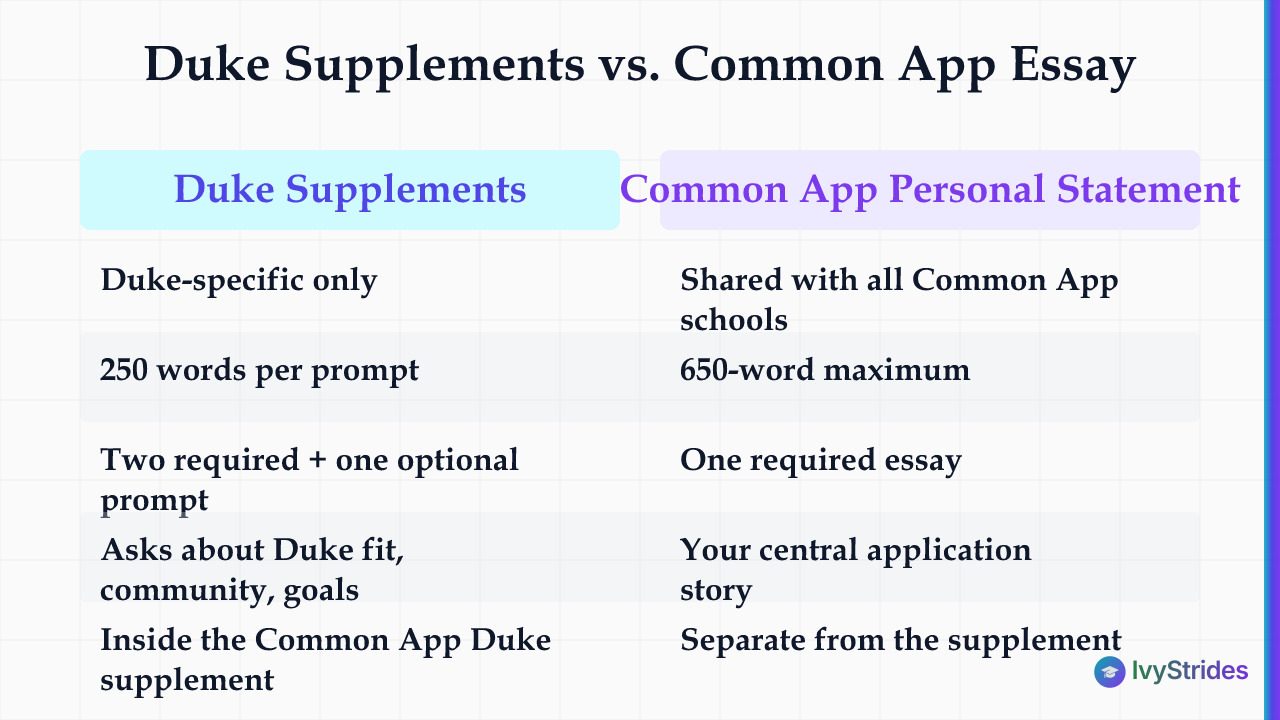
Duke's 2026-27 supplemental essays are two required 250-word responses plus an optional 250-word answer to one of three prompts, all inside the Common App Duke supplement. The Why Duke prompt asks for your impression of Duke and how it fits your goals, values, and interests, and invites you to name specific Trinity or Pratt offerings. The Communities prompt asks about a community that has shaped who you are, any way it has set you apart, and what you have learned from it that you hope to bring to Duke, per the Apply page. Applicants interested in the Duke Embark program also write a 150-word response.
Separate from the supplement. Your personal statement for the Common App has a 650-word maximum and does different work. The supplements are Duke-specific; the personal statement goes to every Common App college requiring it.
| Prompt | Required or Optional | Word Limit | What It Asks |
| Why Duke | Required | 250 | Your impression of Duke and why it matches your goals, values, interests |
| Communities | Required | 250 | A community that shaped who you are and what you learned from it that you hope to bring to Duke |
| Optional prompts | Optional (up to one of three) | 250 | Viewpoints and experiences, a difference of opinion, or something you are excited about |
| Common App personal statement | Required (separate) | 650 | Your central application essay, shared across your Common App schools |
Two required responses may look like a light load as you tally how many supplemental essays your selective schools require, but the 250-word ceiling makes every sentence carry weight.
Mind the deadline split. Duke's binding Early Decision deadline is November 2 and Regular Decision closes January 4, per Duke's Apply page; its admissions FAQ describes ED as a binding agreement. If you are applying ED by November 2, your supplement drafts need to be finished before your Common App personal statement is polished, so map them against the college application timeline for fall 2027. Every applicant also picks Trinity College of Arts and Sciences or the Pratt School of Engineering, and Duke says neither is easier to get into.
How to Write the Duke Why Duke Essay With Specific Knowledge
The Why Duke essay rewards demonstrated knowledge of the university, not admiration of its reputation. Duke states plainly that demonstrated interest "as most people use the term" is not a plus factor, and that emailing or meeting your regional officer brings no benefit. What Duke asks for instead is "demonstrated knowledge," shown through a well-researched Why Duke answer, per its Resources page.
That distinction changes how you draft. Duke says students don't need to visit campus, though its 2025-26 Common Data Set rates "level of applicant's interest" as Considered. Its FAQ recommends researching Duke well enough to write a thoughtful, detailed answer; a specific course, professor, lab, or center tied to your goals can show that research.
What Duke weighs alongside the essay. Duke names five primary factors: rigor of your academic program, grades, recommendations, extracurriculars, and the quality of thought and expression in the essay. The essay is a named factor, not an afterthought, per Duke's What We Look For page.
The same page says Duke likes "ambition and curiosity, talent and persistence, energy and humanity." A strong Why Duke answer shows ambition and curiosity about a real program, not a rehearsal of what you think Duke wants to hear.
A Why Duke draft that opens with Duke's ranking or campus beauty, rather than a named course, professor, or research center, spends words any applicant could write. The fix is to replace the reputation claim with a specific program connection. The same principle that makes a strong Why This College essay work applies here, that specific program names and genuine intellectual fit beat vague admiration.
If your draft reads generic and you cannot see why, IvyStrides' essay coaches review Why Duke drafts, find the specific Trinity or Pratt connection a draft is missing, and map the revision that builds the essay around it.
Why Duke Essay Self-Check Before You Submit
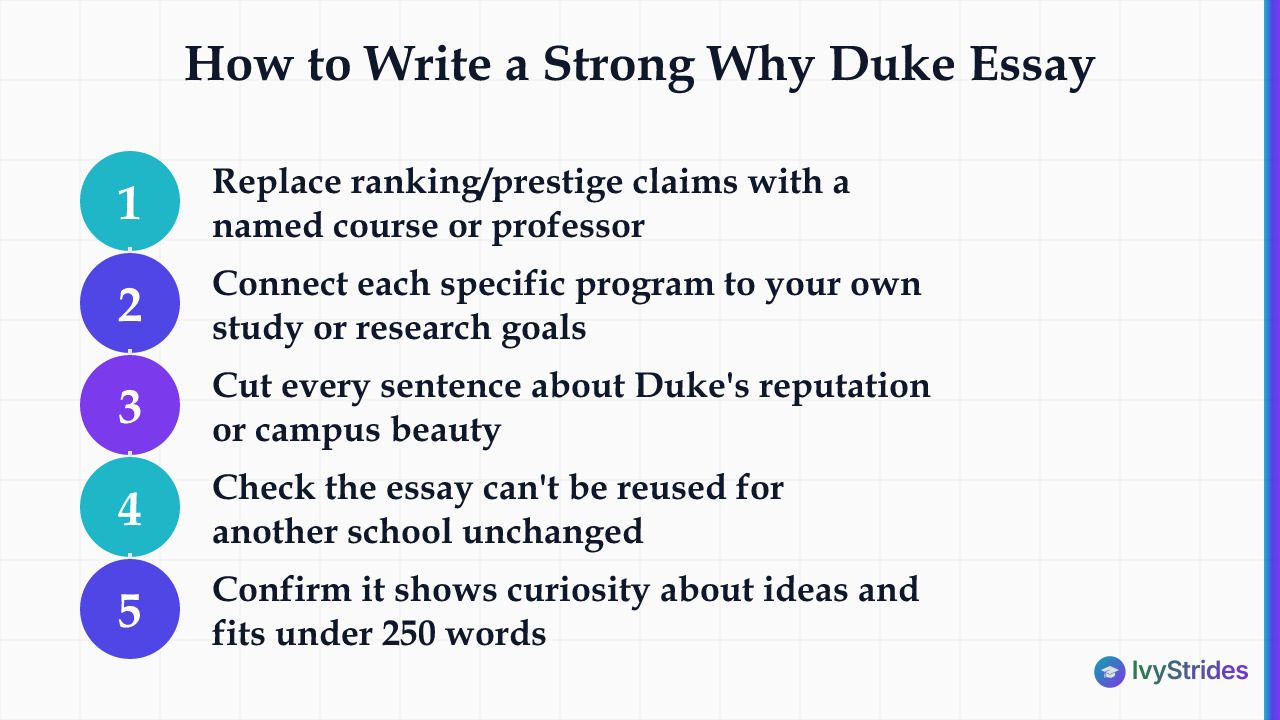
- Does the essay name at least one specific Trinity or Pratt course, professor, lab, or center?
- Does each named program connect to something you want to study or build?
- Have you cut every sentence about Duke's ranking, prestige, or campus beauty?
- Could this essay be pasted into another school's application unchanged? If yes, rewrite it.
- Does it stay under the 250-word limit without feeling rushed?
- Does it show curiosity about ideas, not just enthusiasm for the brand?
How to Write Duke's Communities Essay in 250 Words
Duke's Communities essay is the second required prompt for every 2026-27 first-year applicant, per the Apply page, and it asks how a community shaped you and what you learned there that you hope to bring to Duke. The specific connection you just built for the Why Duke prompt has a sibling here: name one community, one concrete contribution, one thread.
Duke's prompt describes communities "defined by place, faith, family, culture, interests or shared experience." A community can be a robotics team, a kitchen at a family restaurant, a church choir, or a neighborhood tutoring circle. Whichever you choose, a draft that describes the group in the abstract says less than one that shows you inside it, in a specific moment.
Context matters to Duke's readers. Duke reads accomplishments in the context of each applicant's opportunities and challenges, and it appreciates both "well-rounded and well-lopsided students," per its admissions overview of what it looks for. Duke rates character and personal qualities as Very Important in its 2025-26 Common Data Set, section C7.
A Communities essay that tells Duke you are a leader is weaker than one that uses the show-don't-tell technique to render a specific moment that shows how the community shaped you. Show the moment; let the reader draw the conclusion.
Building the Communities Essay in Four Moves
-
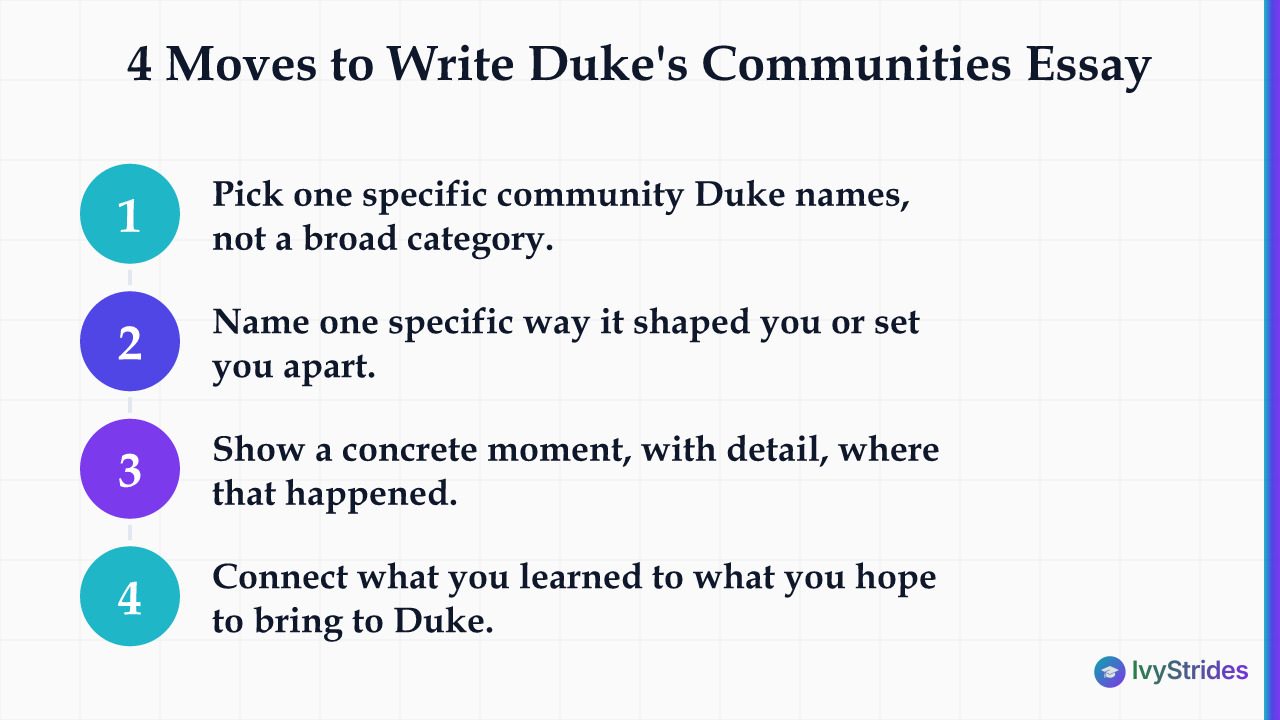
Pick one specific community of any kind Duke names, not a broad category.
-
Name one specific way it shaped you or set you apart.
-
Show a concrete moment, with detail, where that happened.
-
Connect what you learned to what you hope to bring to Duke.
The one-thread structure that works for a Why This Major essay applies to all four moves: one community, one contribution, one link to Duke. In 250 words you do not have room for two.
Should You Write Duke's Optional Essay?
Duke's optional essay is genuinely optional: you may answer one of three 250-word prompts, on viewpoints and experiences, a difference of opinion, or something you are excited about, and the Apply page invites an answer only if it "will add something meaningful that is not already addressed elsewhere in your application."
A weak optional essay is worse than none. It spends a reader's attention without earning it. If the optional prompt would only repeat an activity already in your Common App, skip it.
The test-optional angle. Duke is test-optional for the 2026-27 cycle, and it states that applicants without SAT or ACT scores are not at a disadvantage. If you are applying test-optional and deciding whether to submit scores, the optional essay is not a stand-in for scores; Duke bases decisions on the full application, with or without them. Test-optional policies vary by school and by year, so confirm Duke's policy on its site before you submit.
| Situation | Write It | Skip It |
| You have context nothing else in the file shows | Yes | |
| The prompt would repeat a listed activity | Yes | |
| You are applying without scores and have nothing new to add | Yes | |
| You are short on time before the deadline | Yes, finish the required two first | |
| You cannot connect it to a real part of your story | Yes |
Deciding what the optional slot should fill is a whole-file judgment. A counselor reviewing your full application can spot the gap the optional essay should close, which is hard to see from inside your own draft.
For Duke's binding ED round, finishing all your essays before November 2 matters more than agonizing over the optional one, and Duke's ED and RD acceptance rates sit behind that deadline decision. IvyStrides' counselors check Why Duke and Communities drafts against Duke's five primary factors and advise whether the optional slot adds context or repeats the file.
IvyStrides' analysis of Duke's published FAQ figures from the 2025-2026 cycle, when 12.6% of Early Decision applicants were admitted against 4.2% of Regular Decision applicants, puts the ED-to-RD ratio at roughly 3:1. Duke says ED "has an advantage in the admissions process," but the ratio describes applicant pools, not a prediction for any individual applicant.
FAQ: Duke Supplemental Essays for 2026-27
Does Duke require supplemental essays?
Yes. Duke requires two supplemental essays for all 2026-27 first-year applicants: a Why Duke essay and a Communities essay, both capped at 250 words. Duke invites an answer to one of three optional prompts only if it adds something meaningful to your application.
What are the prompts for the Duke supplemental essay in 2026-27?
For 2026-27, Duke's two required prompts are Why Duke, asking for your impression of Duke and how it matches your goals, values, and interests while inviting specific Trinity or Pratt offerings, and Communities, asking about a community that shaped who you are and what you learned from it to bring to Duke. Both run 250 words.
Are Duke optional essays really optional?
Yes, genuinely optional. Duke invites you to answer one of three optional prompts only "if you believe that doing so will add something meaningful that is not already addressed elsewhere in your application." A thin optional essay does more harm than no optional essay at all.
How many supplemental essays does Duke require?
Duke requires two supplemental essays for 2026-27, both 250 words: the Why Duke essay and the Communities essay. You may also answer one of three optional prompts, but none is required. All of this is separate from the Common App personal statement, which runs a 650-word maximum.
Your Next Step on the Duke Supplements
The whole game with Duke's supplements is specificity over enthusiasm. Duke tells you directly that it wants demonstrated knowledge, not demonstrated interest, and the 250-word ceiling leaves no room to hide behind reputation.
- Open the live Common App Duke supplement and confirm the current prompt wording before you draft.
- Research one or two real Trinity or Pratt courses, professors, or centers tied to your interests.
- Rebuild the Why Duke essay around that connection, not around Duke's name.
- Pick one community and one concrete contribution for the Communities essay.
- Decide on the optional essay only after both required drafts are done.

Rajesh is a technology leader, entrepreneur, and angel investor with 28+ years in Business & Technology Leadership and Product & Solution Engineering. He is passionate about education, mentoring, and driving digital transformation.