
College Interviews: How Much They Count and How to Walk In Ready
On this page
- What College Interviews Are and the Two Types You Will Encounter
- How Much College Interviews Actually Matter in Admissions
- When College Interviews Happen and What Getting One Means
- How to Prepare for a College Interview: A Practical Framework
- Practiced Alone and Still Not Sure Your Answers Land?
- Interview Date Set. Walk In With Answers That Actually Fit the School.
- FAQ: College Interview Questions and Preparation
- What does it mean if you get a college interview?
- What is the best way to prepare for a college interview?
- What are some good things to say in a college interview?
- How do you introduce yourself in a college interview?
- Your Next Step on College Interview Prep
A college interview is a conversation between an applicant and an admissions officer or alumni representative. Most are evaluative or informational. Evaluative interviews are scored and added to your application file; informational ones exist mainly to help you learn about the school.
That distinction shapes how you prepare, so it is where this guide starts. At most selective colleges the interview sits inside a holistic review, one voice among grades, test scores, essays, and recommendations, and a strong showing rarely rewrites a weak transcript on its own.
What College Interviews Are and the Two Types You Will Encounter
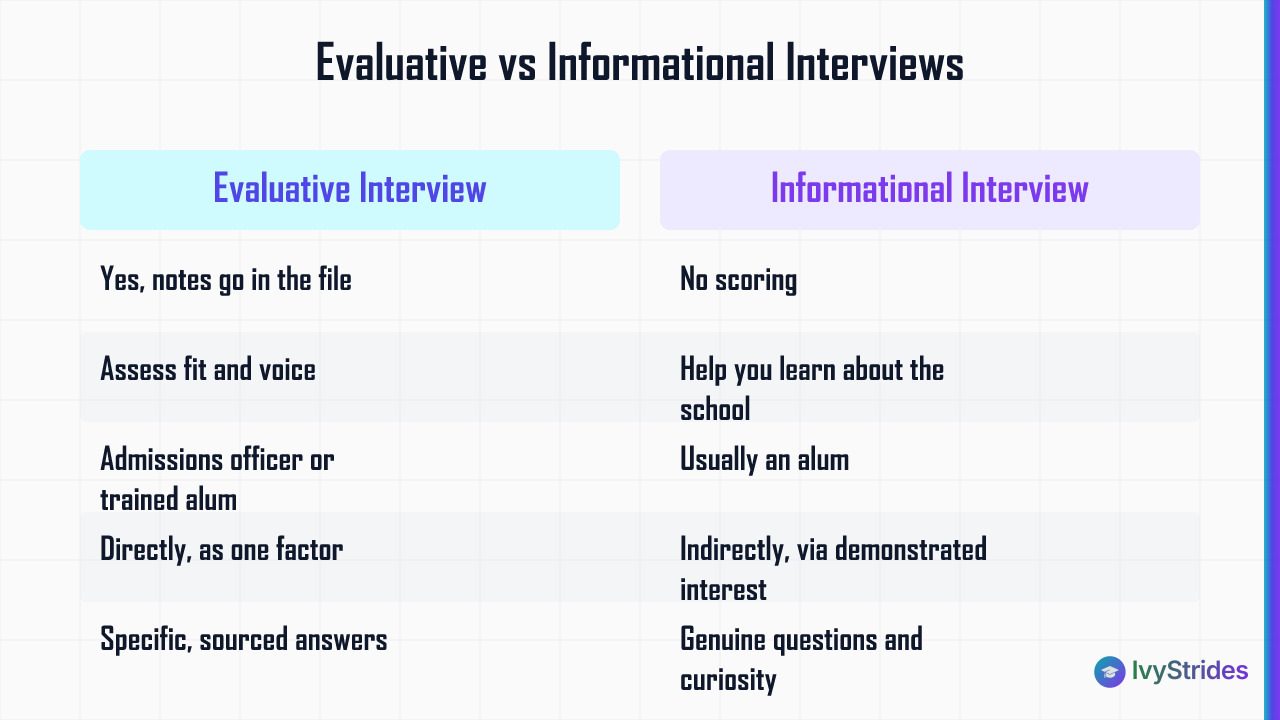
A college interview is a 30-to-60-minute conversation, and it comes in two forms: evaluative and informational. IvyStrides derives this figure from the inputs cited above. Knowing which one you have been offered tells you exactly how much of your file it touches.
Evaluative interviews are scored. The interviewer writes up notes against a rubric, and those notes go into your application file where a reader sees them alongside your essays and grades. Informational interviews are not scored. They give you a relaxed conversation to learn about the school, and completing one signals demonstrated interest rather than adding a graded data point.
Who runs the conversation varies too. An alumni interview is conducted by a graduate near where you live, often at a coffee shop or a small conference room, per the University of Rochester Admissions Blog. An admissions-officer interview happens on campus or over video with a staff member who reads applications. Format follows: in-person, virtual, or occasionally phone.
Accepting and completing an interview is one of the clearest demonstrated-interest signals a student can send, and some colleges track it explicitly in their review. For the fuller picture of how schools weigh that engagement, our page on demonstrated interest breaks it down.
| Feature | Evaluative Interview | Informational Interview |
| Scored? | Yes, notes go in the file | No |
| Purpose | Assess fit and voice | Help you learn about the school |
| Conducted by | Admissions officer or trained alum | Usually an alum |
| Affects the decision | Directly, as one factor | Indirectly, via demonstrated interest |
| Your prep goal | Specific, sourced answers | Genuine questions and curiosity |
How Much College Interviews Actually Matter in Admissions
College interviews are typically one of several factors in a holistic review, rarely the sole deciding factor. At highly selective schools a strong interview can tip a borderline decision, but it will not override weak grades or low test scores.
That leaves the interview one specific job: adding a human voice to the file. Like a strong recommendation letter, a strong interview supplies something numbers alone cannot. The reader hears how you think, not just what you scored.
What interviewers actually look for. In our coaching with students preparing for selective interviews, the qualities that move an evaluator's notes are consistent: intellectual curiosity, self-awareness, clear communication, and genuine fit with the school. A student who can explain why one specific program pulls at them reads very differently from one who recites a ranking.
Context can raise the stakes. When a student applies test-optional and submits no scores, the rest of the file, including the interview, may carry slightly more of the load. But test-optional policies vary by school and year, per FairTest, so treat that as a tendency, not a rule.
Timing shifts the picture too, since interviews land during deadline season. Our guide to college application deadlines maps how Early Decision and Regular Decision windows stack up. And if you are still deciding who writes your recommendations, how many recommendation letters do you need covers the parallel human-voice component.
| Scenario | Interview Weight | Why |
| Strong file, borderline decision | Higher | Can tip a close call at selective schools |
| Test-optional applicant | Slightly higher | Fewer data points, varies by school |
| Weak grades or scores | Lower | Interview rarely overrides the core file |
| Informational interview | Indirect | Counts as demonstrated interest, not a score |
When College Interviews Happen and What Getting One Means
Most US college interviews happen between October and February, overlapping the same stretch when Early Decision and Regular Decision applications come due. Invitations arrive by email, either from the admissions office or from a regional alumni network once your application is on file.
Because that window is tight and it collides with deadline season, responding fast matters. Getting an invitation is not always the strong signal students hope for. Some schools interview every applicant who requests one; others invite selectively, and only at the second kind does an invitation carry candidacy weight, per Harvard College. Check the school's admissions page before you read anything into the offer.
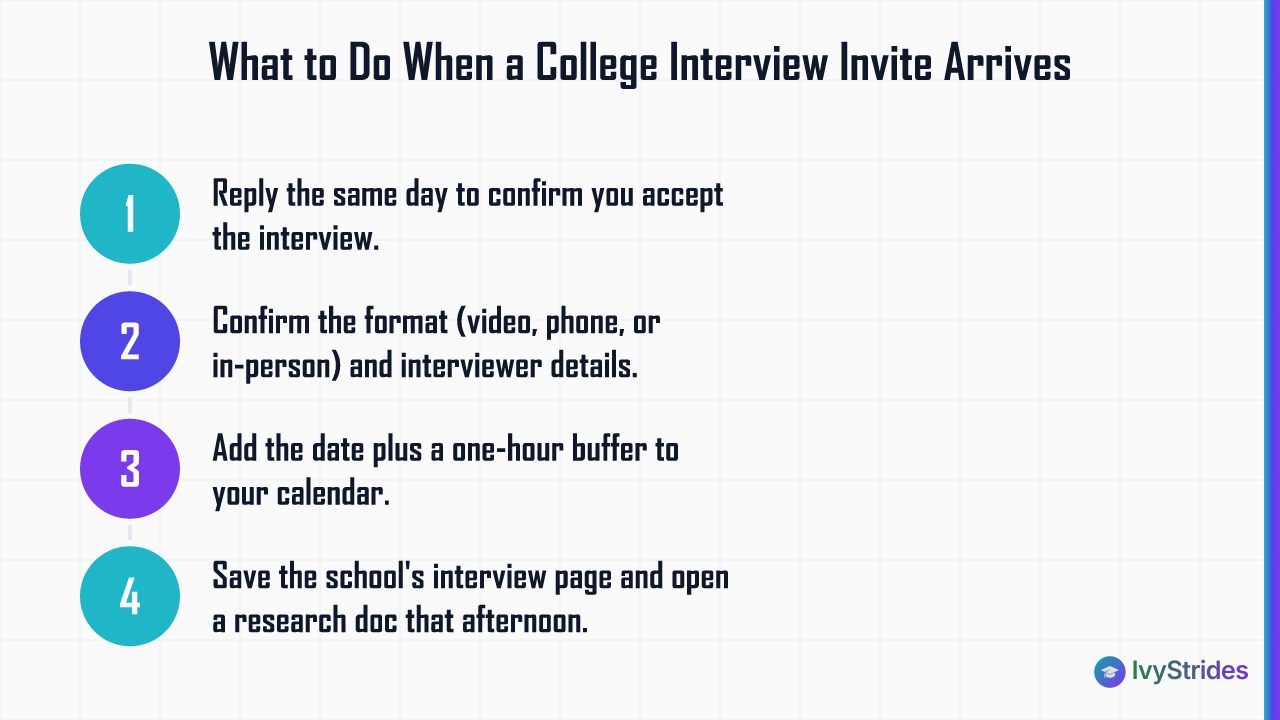
What to do the day the invitation lands. Interviews route through several channels, and some schools coordinate scheduling through the Common App portal or an alumni platform. Move on it the same day.
-
Respond to confirm you accept the interview.
-
Confirm the format: video, phone, or in-person.
-
Note the interviewer's name and role.
-
Add the date and a one-hour buffer to your calendar.
-
Save the school's official interview page for prep.
-
Start a research doc on the school that afternoon.
Because an interview is a demonstrated-interest signal, declining an optional one skips a chance to send it, though the impact varies and is not documented at schools where interviews are truly optional. If you are weighing this against other engagement signals, do campus visits help your admission chances covers what colleges actually record.
How to Prepare for a College Interview: A Practical Framework
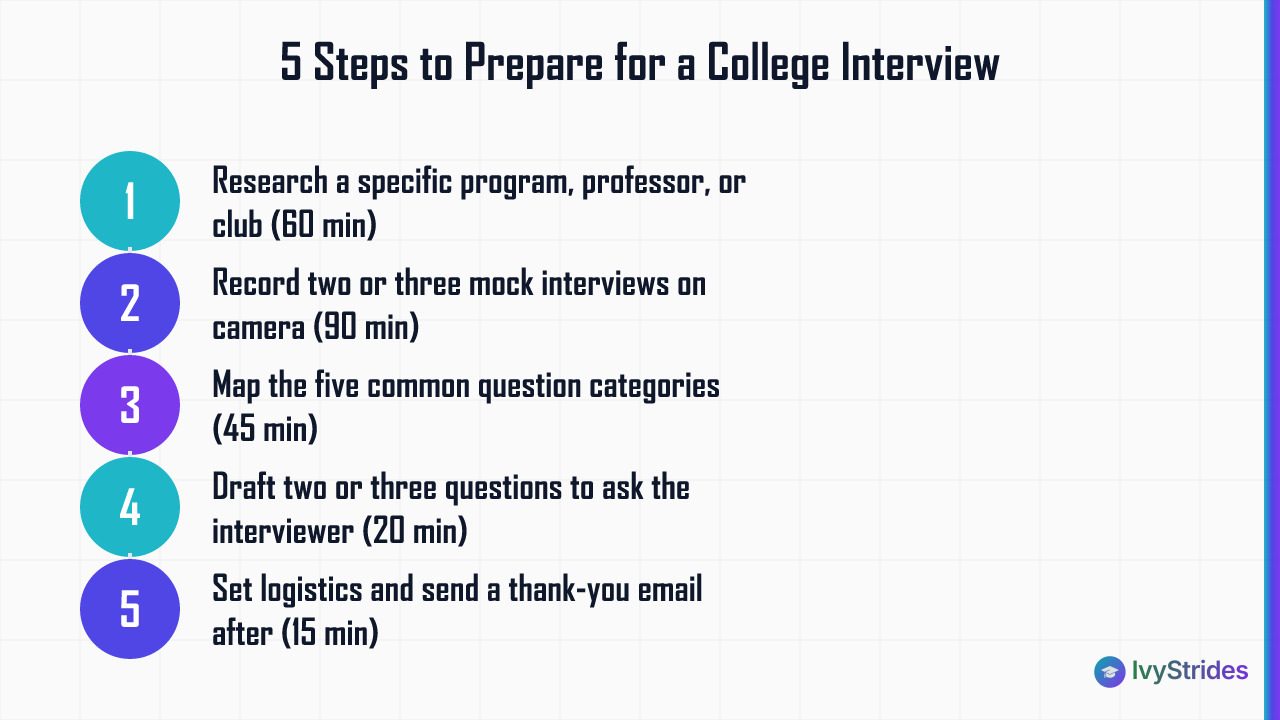
Preparing for a college interview comes down to five moves: research the school, practice out loud, map the common questions, prepare your own questions, and follow up. Preparation is the single most controllable variable in a process full of things you cannot control.
| Step | Action | Time to Spend |
| 1 | Research a program, professor, or club | 60 min |
| 2 | Record two or three mock interviews | 90 min |
| 3 | Map the five common question categories | 45 min |
| 4 | Draft two or three questions to ask | 20 min |
| 5 | Set logistics, then send thank-you email | 15 min |
Research the school specifically. Name a program you would enroll in, a professor whose work interests you, a club you would join, or a piece of recent campus news. In our coaching, the single most common gap is a generic answer to "why this college" that names the school's ranking instead of any of those specifics. The same specificity that makes a college essay memorable, concrete details over vague claims, is exactly what separates a strong interview answer from a forgettable one.
Practice out loud, ideally on camera. Students who complete two or three recorded mock interviews before the real one consistently report feeling more in control of pacing and less likely to ramble. A parent, counselor, or coach playing interviewer surfaces the vague answers you cannot hear yourself giving.
Map the five common question categories. Per the University of Illinois sample-questions guide, most questions fall into a handful of buckets. Prepare a specific story for each, not a script.
| Question category | What they are testing | Your answer anchor |
| Tell me about yourself | Self-awareness | One interest, one activity |
| Why this college | Fit and research | A named program or professor |
| A strength and a challenge | Honesty, growth | A real story with a turn |
| Extracurricular involvement | Depth over breadth | One activity that matters |
| Future goals | Direction | A question you want to chase |
Prepare two or three questions to ask. Bring questions the homepage cannot answer, per Rochester's guidance. A question about how a specific program handles undergraduate research shows you did the reading; a question about the acceptance rate does not.
Handle logistics and follow up. Dress business casual and arrive 10 to 15 minutes early, per the Rochester blog. Aim for roughly an 80/20 listening-to-speaking balance so the conversation breathes; a 30-to-60-minute window leaves you about 18 to 36 minutes of speaking time (IvyStrides calculation) to fill with specific answers. Then send a short thank-you email within 24 hours.
Honestly, the part most students underestimate is this: the skill that makes an interview answer land is the same skill that makes an essay land. For coached feedback on both, our college essay coaching builds the specificity and voice that interviewers reward. common college essay mistakes to avoid shows what vague writing looks like so you can hear it in your speech too.
Practiced Alone and Still Not Sure Your Answers Land?
You have the framework: school research done, common questions mapped, questions to ask ready. The gap most students cannot close on their own is knowing whether their answers sound specific and genuine or rehearsed and generic. A free 15-minute call walks through your prep, flags the answers that need sharper detail, and gives you a concrete revision before your interview date.
No interview guarantees admission, and outcomes depend on the full application, not one conversation. But of everything on this list, preparation is the piece entirely in your hands.
Interview Date Set. Walk In With Answers That Actually Fit the School.
You have a date, a school, and a list of questions to prepare. Turning that into answers specific enough to hold an interviewer's attention, and questions sharp enough to show real research, needs a focused push. A free 15-minute call maps the two or three answers worth sharpening most before you walk in.
FAQ: College Interview Questions and Preparation
What does it mean if you get a college interview?
It means the school wants to learn more about you beyond the paper application. At schools that interview selectively, an invitation is a mild positive signal. At schools that offer interviews to every applicant, it is simply an opportunity to demonstrate interest and add context. Either way, accepting and preparing is the right move.
What is the best way to prepare for a college interview?
Research the school specifically, practice answers to the five common question types out loud, prepare two or three questions to ask, dress business casual, and send a thank-you email within 24 hours. One or two mock interviews with a parent, counselor, or coach makes a real difference in how natural your answers sound.
What are some good things to say in a college interview?
Name specific programs, professors, clubs, or research opportunities that connect to your actual interests. Share a concrete story that shows intellectual curiosity or growth rather than listing achievements. Ask a question that proves you did real research, not one whose answer sits on the homepage.
How do you introduce yourself in a college interview?
Keep the introduction to two or three minutes. Name one or two academic interests, one extracurricular that genuinely matters to you, and one specific reason you want this school. Skip the resume recital. The goal is to hand the interviewer a thread to pull on, not a full biography.
Your Next Step on College Interview Prep
You now know what a college interview is, how much it typically counts, when it happens, and how to prepare. The interview is one voice in a holistic file, and preparation is the part you control.
- Respond to the invitation the day it arrives and confirm the format.
- Build a research doc naming a specific program, professor, or club.
- Record two mock interviews across the five common question types.
- Draft two or three questions that cannot be googled.
- Send a thank-you email within 24 hours of the conversation.

Award-winning author (South Asian Book Award) and graduate of BITS Pilani and UCLA Luskin School of Public Affairs. Brings a published writer's eye to Common App essays and grammatical precision to SAT and ACT R&W instruction.